-
R语言参数自抽样法Bootstrap:估计MSE、经验功效、杰克刀Jackknife、非参数自抽样法可视化
全文链接:http://tecdat.cn/?p=27695
原文出处:拓端数据部落公众号
参数引导:估计 MSE
统计学问题:级别(k\)修剪后的平均值的MSE是多少?
我们如何回答它:估计从标准柯西分布(t 分布 w/df = 1)生成的大小为 20 的随机样本的水平
k " role="presentation" style="position: relative;"> 修剪均值的 MSE。目标参数θ " role="presentation" style="position: relative;"> 是中心或中位数。柯西分布不存在均值。在表中总结 MSE 的估计值k = 1 , 2 , . . . 9 " role="presentation" style="position: relative;">。- result=rep(0,9)
- for(j in 1:9){
- n<-20
- for(i in 1:m){
- x<-sort(rcauchy(n))

参数自抽样法:经验功效计算
统计问题:随着零假设与现实之间的差异发生变化,功效如何变化?
我们如何回答:绘制 t 检验的经验功效曲线。
t 检验的原假设是
 。另一种选择是
 。
。您将从具有
 的正态分布总体中抽取大小为 20 的样本。您将使用 0.05 的显着性水平。
显示当总体的实际平均值从 350 变为 650(增量为 10)时,功效如何变化。
y 轴是经验功效(通过 bootstrap 估计),x 轴是
μ " role="presentation" style="position: relative;"> 的不同值(350、360、370 … 650)。- x <- rnorm(n, mean = muA, sd = sigma) #抽取平均值=450的样本
- ts <- t.test(x, mu = mu0) #对无效的mu=500进行t检验
- ts$p.value

参数自抽样法:经验功效计算
统计问题:样本量如何影响功效?
我们如何回答:创建更多的功效曲线,因为实际均值在 350 到 650 之间变化,但使用大小为 n = 10、n = 20、n = 30、n = 40 和 n = 50 的样本生成它们。同一图上的所有 5 条功效曲线。
- pvals <- replicate(m, pvalue())
- power <- mean(pvals <= 0.05)
- points(sequence,final2[2,],col="red",pch=1)
- points(sequence,final2[3,],col="blue",pch=2)

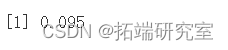
参数自抽样法:经验置信水平
统计问题:在制作 95% CI 时,如果我们的样本很小并且不是来自正态分布,我们是否仍有 95% 的置信度?
我们如何回答它:根据样本为总体的平均值创建一堆置信区间 (95%)。

您的样本大小应为 16,取自具有 2 个自由度的卡方分布。
找出未能捕捉总体真实均值的置信区间的比例。(提醒:自由度为
k " role="presentation" style="position: relative;"> 的卡方分布的平均值为k " role="presentation" style="position: relative;">。)- for(i in 1:m){
- samp=rchisq(n,df=2)
- mean=mean(samp)
- sd=sd(samp)
- upper=mean+qt(0.975,df=15)*sd/4
非参数自抽样法置信区间
统计问题:基于一个样本,我们可以为总体相关性创建一个置信区间吗?
我们如何回答:为相关统计量创建一个 bootstrap t 置信区间估计。
- boot.ti <-
- function(x, B = 500, R = 100, level = .95, stattic){
- x <- as.matrix(x)
- library(boot) #for boot and boot.ci
- data(law, package = "bootstrap")
- dat <- law
- ci <- boot.t.ci(dat, statistic = stat, B=2000, R=200)
- ci

自抽样法后的Jackknife
统计问题:R 的标准误差的 bootstrap 估计的标准误差是多少?
我们如何回答它:
data(law)像上一个问题一样使用。在 bootstrap 后执行 Jackknife 以获得标准误差估计的标准误差估计。(bootstrap 用于获得总体中 R 的 SE 的估计值。然后使用折刀法获得该 SE 估计值的 SE。)- indices <- matrix(0, nrow = B, ncol = n)
- # 进行自举
- for(b in 1:B){
- i <- sample(1:n, size = n, replace = TRUE)
- LSAT <- law$LSAT[i]
- # jackknife
- for(i in 1:n){
- keepers <- function(k){
- !any(k == i)
- }

自测题
Submit the rendered HTML file. Make sure all requested output (tables, graphs, etc.) appear in your document when you submit.
Parametric Bootstrap: Estimate MSE
Statistical question: What is the MSE of a level
k " role="presentation" style="position: relative;"> trimmed mean?How we can answer it: Estimate the MSE of the level
k " role="presentation" style="position: relative;"> trimmed mean for random samples of size 20 generated from a standard Cauchy distribution (t-distribution w/df = 1). The target parameterθ " role="presentation" style="position: relative;"> is the center or median. The mean does not exist for a Cauchy distribution. Summarize the estimates of MSE in a table fork = 1 , 2 , . . . 9 " role="presentation" style="position: relative;">.Parametric Bootstrap: Empirical Power Calculations
Statistical question: How does power change as the difference between the null hypothes and the reality changes?
How we can answer it: Plot an empirical power curve for a t-test.
The null hypothesis of the t-test is
μ = 500 " role="presentation" style="position: relative;">. The alternative isμ ≠ 500 " role="presentation" style="position: relative;">.You will draw samples of size 20, from a normally distributed population with
σ = 100 " role="presentation" style="position: relative;">. You will use a significance level of 0.05.Show how the power changes as the actual mean of the population changes from 350 to 650 (increments of 10).
On the y-axis will be the empirical power (estimated via bootstrap) and the x-axis will be the different values of
μ " role="presentation" style="position: relative;"> (350, 360, 370 … 650).Parametric Bootstrap: Empirical Power Calculations
Statistical question: How does sample size affect power?
How we can answer it: Create more power curves as the actual mean varies from 350 to 650, but produce them for using samples of size n = 10, n = 20, n = 30, n = 40, and n = 50. Put all 5 power curves on the same plot.
Parametric Bootstrap: Empirical Confidence Level
Statistical question: When making a 95% CI, are we still 95% confident if our samples are small and do not come from a normal distribution?
How we can answer it: Create a bunch of Confidence Intervals (95%) for the mean of a population based on a sample.
x ¯ ± t ∗ × s n Your samples should be of size 16, drawn from a chi-squared distribution with 2 degrees of freedom.
Find the proportion of Confidence Intervals that fail to capture the true mean of the population. (Reminder: a chi-squared distribution with
k " role="presentation" style="position: relative;"> degrees of freedom has a mean ofk " role="presentation" style="position: relative;">.)Non Parametric Bootstrap Confidence Interval
Statistical question: Based on one sample, can we create a confidence interval for the correlation of the population?
How we can answer it: Create a bootstrap t confidence interval estimate for the correlation statistic.
Jackknife after bootstrap
Statistical question: What is the standard error of the bootstrap estimate of the standard error of R?
How we can answer it: Use
data(law)like the previous problem. Perform Jackknife after bootstrap to get a standard error estimate of the standard error estimate. (The bootstrap is used to get an estimate of the SE of R in the population. The jackknife is then used to get an SE of that SE estimate.)

最受欢迎的见解
1.使用R语言进行METROPLIS-IN-GIBBS采样和MCMC运行
3.R语言实现MCMC中的Metropolis–Hastings算法与吉布斯采样
4.R语言BUGS JAGS贝叶斯分析 马尔科夫链蒙特卡洛方法(MCMC)采样
5.R语言中的block Gibbs吉布斯采样贝叶斯多元线性回归
7.R语言用Rcpp加速Metropolis-Hastings抽样估计贝叶斯逻辑回归模型的参数
8.R语言使用Metropolis- Hasting抽样算法进行逻辑回归
9.R语言中基于混合数据抽样(MIDAS)回归的HAR-RV模型预测GDP增长
-
相关阅读:
1000道最新高频Java面试题,覆盖25个技术栈,从底层原理到架构
Flink 重启策略和故障恢复策略
CTR特征建模:ContextNet & MaskNet(Twitter在用的排序模型)
贪吃蛇(C语言版)
在T3开发板上实现SylixOS最小系统(六)
小程序如何设置配送方式
SwiftUI 如何保证 Text 中字符数量相等的字符串显示宽度一定相同?
Java版企业电子招标采购系统源码—企业战略布局下的采购寻源
静态时序分析简明教程(六)]时钟组与其他时钟特性
FFplay文档解读-8-格式选项
- 原文地址:https://blog.csdn.net/qq_19600291/article/details/125887666