-
Java基础 --- 集合 Collection
Collection Interface
- the Java collection library separates interfaces and implementations

Concrete Implementations

LinkedList
Add
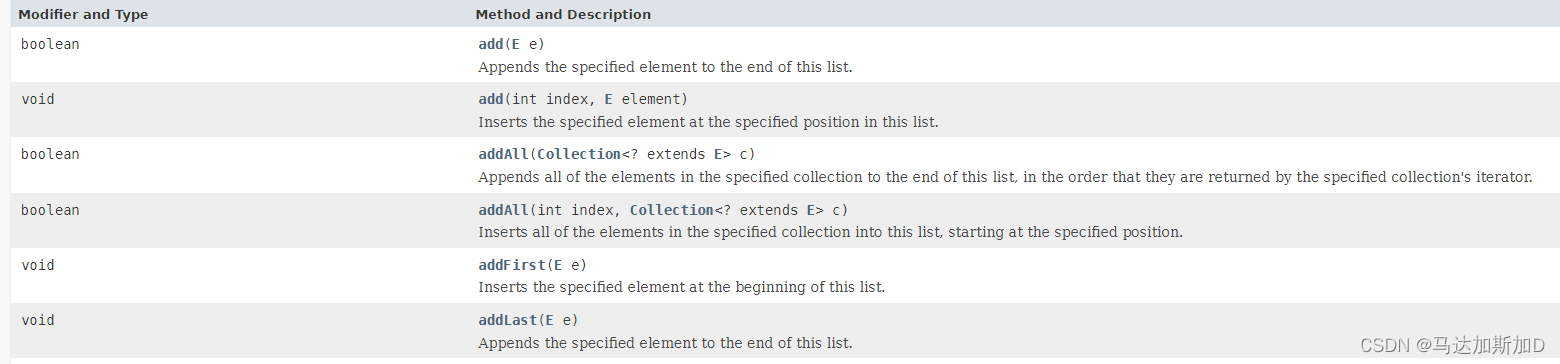
Get and Set


Offer, Peek, Poll

Pop, Push

Remove
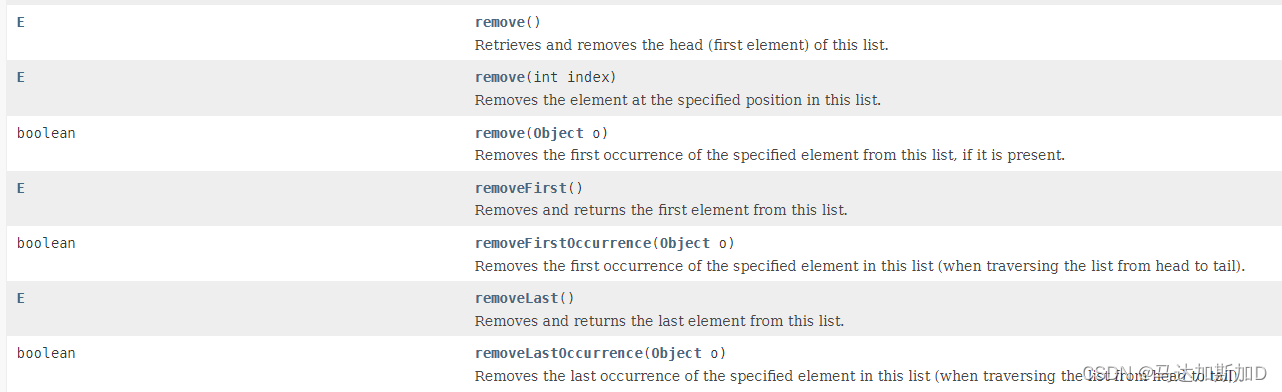
Utilitiesvoid clear(): Removes all of the elements from this list.- 1
Object clone(): Returns a shallow copy of this LinkedList.- 1
boolean contains(Object o): Returns true if this list contains the specified element.- 1
int indexOf(Object o): Returns the index of the first occurrence of the specified element in this list, or -1 if this list does not contain the element.- 1
int size(): Returns the number of elements in this list.- 1
Object[] toArray(): Returns an array containing all of the elements in this list in proper sequence (from first to last element).- 1
ArrayList
Add

delete

set, get, replaceE get(int index): Returns the element at the specified position in this list.- 1
E set(int index, E element): Replaces the element at the specified position in this list with the specified element.- 1
void replaceAll(UnaryOperator<E> operator): Replaces each element of this list with the result of applying the operator to that element.## Sets- 1
Utilities
void clear(): Removes all of the elements from this list.- 1
Object clone(): Returns a shallow copy of this ArrayList instance.- 1
boolean contains(Object o): Returns true if this list contains the specified element.- 1
void forEach(Consumer<? super E> action): Performs the given action for each element of the Iterable until all elements have been processed or the action throws an exception.- 1
int indexOf(Object o): Returns the index of the first occurrence of the specified element in this list, or -1 if this list does not contain the element.- 1
Object[] toArray(): Returns an array containing all of the elements in this list in proper sequence (from first to last element).- 1
“only arrayList”
boolean isEmpty(): Returns true if this list contains no elements.- 1
int size(): Returns the number of elements in this list.- 1
void sort(Comparator<? super E> c): Sorts this list according to the order induced by the specified Comparator.- 1
void trimToSize(): Trims the capacity of this ArrayList instance to be the list's current size.- 1
void ensureCapacity(int minCapacity): Increases the capacity of this ArrayList instance, if necessary, to ensure that it can hold at least the number of elements specified by the minimum capacity argument.- 1
ArrayList 和 LinkedList的区别
insert and delete
- ArrayList: O(n), 因为要将目标位置之后的元素向前移位(delete)或者向后移位(insert),
如果超出capacity则需要扩容会增加时间复杂度 - LinkedList: O(n), 需要遍历linkedlist找到node, 然后进行操作: O(1)
set and get
- ArrayList: O(1), 通过下标直接操作
- LinkedList: O(n) 需要遍历linkedlist找到node, 然后进行操作
“space”
- ArrayList: 只需数组的空间
- LinkedList: 有overhead, 比如next,pre指针
Summary
- 很多场景下ArrayList更受欢迎
Queues and Deques
- Queue: 在尾部加入元素, 从头部删除元素
- Deque (double-ended queue): 可以从头部或者尾部加入删除元素
- 可以用LinkedList替代(LinkedList提供了Queue和Deque功能)


Priority Queues

package priorityQueue; import java.util.*; import java.time.*; /** * This program demonstrates the use of a priority queue. * @version 1.02 2015-06-20 * @author Cay Horstmann */ public class PriorityQueueTest { public static void main(String[] args) { PriorityQueue<LocalDate> pq = new PriorityQueue<>(); pq.add(LocalDate.of(1906, 12, 9)); // G. Hopper pq.add(LocalDate.of(1815, 12, 10)); // A. Lovelace pq.add(LocalDate.of(1903, 12, 3)); // J. von Neumann pq.add(LocalDate.of(1910, 6, 22)); // K. Zuse System.out.println("Iterating over elements..."); for (LocalDate date : pq) System.out.println(date); System.out.println("Removing elements..."); while (!pq.isEmpty()) System.out.println(pq.remove()); } }- 1
- 2
- 3
- 4
- 5
- 6
- 7
- 8
- 9
- 10
- 11
- 12
- 13
- 14
- 15
- 16
- 17
- 18
- 19
- 20
- 21
- 22
- 23
- 24
HashSets
- 无序的set
- 使用HashTable实现 bucket hashing (Array + LinkedList)
- 默认bucket大小是 2^16, load factor是0.75

public class SetTest { public static void main(String[] args) { Set<String> words = new HashSet<>(); // HashSet implements Set long totalTime = 0; try (Scanner in = new Scanner(System.in)) { while (in.hasNext()) { String word = in.next(); long callTime = System.currentTimeMillis(); words.add(word); callTime = System.currentTimeMillis() - callTime; totalTime += callTime; } } Iterator<String> iter = words.iterator(); for (int i = 1; i <= 20 && iter.hasNext(); i++) System.out.println(iter.next()); System.out.println(". . ."); System.out.println(words.size() + " distinct words. " + totalTime + " milliseconds."); } }- 1
- 2
- 3
- 4
- 5
- 6
- 7
- 8
- 9
- 10
- 11
- 12
- 13
- 14
- 15
- 16
- 17
- 18
- 19
- 20
- 21
- 22
- 23
LinkedHashSet
是HashSet的一个子类, 元素按照加入顺序排序
TreeSets
- 有序的Set
- 使用红黑树实现
- TreeSet的插入复杂度要比HashSet快, 但是检查重复要比HashSet快(LogN)
- 因为是有序的所以必须重新
compareTo否则会报错, String等非自定义类型已经重写了compareTo方法 - 如果数据不要求排序最好使用HashSet


public class TreeSetTest { public static void main(String[] args) { SortedSet<Item> parts = new TreeSet<>(); parts.add(new Item("Toaster", 1234)); parts.add(new Item("Widget", 4562)); parts.add(new Item("Modem", 9912)); System.out.println(parts); NavigableSet<Item> sortByDescription = new TreeSet<>( Comparator.comparing(Item::getDescription)); sortByDescription.addAll(parts); System.out.println(sortByDescription); } }- 1
- 2
- 3
- 4
- 5
- 6
- 7
- 8
- 9
- 10
- 11
- 12
- 13
EnumSet
- element是enum类型
- Since an enumerated type has a finite number of instances, the EnumSet is internally implemented simply as a sequence of bits.
- A bit is turned on if the corresponding value is present in the set.
enum Weekday { MONDAY, TUESDAY, WEDNESDAY, THURSDAY, FRIDAY, SATURDAY, SUNDAY }; EnumSet<Weekday> always = EnumSet.allOf(Weekday.class); EnumSet<Weekday> never = EnumSet.noneOf(Weekday.class); EnumSet<Weekday> workday = EnumSet.range(Weekday.MONDAY, Weekday.FRIDAY); EnumSet<Weekday> mwf = EnumSet.of(Weekday.MONDAY, Weekday.WEDNESDAY, Weekday.FRIDAY);- 1
- 2
- 3
- 4
- 5
Map
- Map没有继承Collection接口
- AbstractMap和AbstractCollection是平级关系

Map的基本操作
package map; import java.util.*; /** * This program demonstrates the use of a map with key type String and value type Employee. * @version 1.12 2015-06-21 * @author Cay Horstmann */ public class MapTest { public static void main(String[] args) { Map<String, Employee> staff = new HashMap<>(); staff.put("144-25-5464", new Employee("Amy Lee")); staff.put("567-24-2546", new Employee("Harry Hacker")); staff.put("157-62-7935", new Employee("Gary Cooper")); staff.put("456-62-5527", new Employee("Francesca Cruz")); // print all entries System.out.println(staff); // remove an entry staff.remove("567-24-2546"); // replace an entry staff.put("456-62-5527", new Employee("Francesca Miller")); // look up a value System.out.println(staff.get("157-62-7935")); // iterate through all entries staff.forEach((k, v) -> System.out.println("key=" + k + ", value=" + v)); } }- 1
- 2
- 3
- 4
- 5
- 6
- 7
- 8
- 9
- 10
- 11
- 12
- 13
- 14
- 15
- 16
- 17
- 18
- 19
- 20
- 21
- 22
- 23
- 24
- 25
- 26
- 27
如何查看Map
the set of keys: 将所有的key作为一个set返回
Set<K> keySet()- 1
Set<String> keys = map.keySet(); for (String key : keys) { do something with key }- 1
- 2
- 3
- 4
the collection of values (which is not a set): 将所有的value作为一个collection返回
Collection<V> values()- 1
Map<String,String> map=new HashMap<>(); map.put("abc","123"); map.put("efg","456"); // 使用增强型for遍历循环Map集合 Collection<String> values = map.values(); for (String value : values) { System.out.println(value); }- 1
- 2
- 3
- 4
- 5
- 6
- 7
- 8
the set of key/value pairs: 得到每一对key value pair
Set<Map.Entry<K, V>> entrySet()- 1
for (Map.Entry<String, Employee> entry : staff.entrySet()) { String k = entry.getKey(); Employee v = entry.getValue(); do something with k, v }- 1
- 2
- 3
- 4
- 5
Type of HashMap
HashMap
- Hash table based implementation of the Map interface
- the default load factor (.75)
- 有一个子类为LinkedHashMap, 元素按照加入顺序排序
TreeMap
- A Red-Black tree based NavigableMap implementation.
- 需要根据compareTo排序
EumerateHashMap
- A specialized Map implementation for use with enum type keys.
- All of the keys in an enum map must come from a single enum type that is specified
WeakHashMap
- Hash table based implementation of the Map interface, with weak keys.
- An entry in a WeakHashMap will automatically be removed when its key is no longer in ordinary use
Collection和Array互相转换
Collection To Array
Object[] values = staff.toArray();- 1
- 但是values的类型是Object并且不能转换类型
String[] values = (String[]) staff.toArray(); // Error! - 可以用如下写法:
String[] values = staff.toArray(new String[staff.size()]);
Array To Collection
Arrays.asList()- 1
String[] values = . . .; HashSet<String> staff = new HashSet<>(Arrays.asList(values)); //所有的collection都可以通过另外一个collection初始化- 1
- 2
- 3
- the Java collection library separates interfaces and implementations
-
相关阅读:
项目管理之组织级项目管理
软考135-上午题-【软件工程】-软件配置管理
Mac用NTFS文件夹读写NTFS硬盘 NTFS能复制多大的文件
MMDeploy部署实战系列【第三章】:MMdeploy pytorch模型转换onnx,tensorrt
Java基础抽象类详解
Vue_Bug error0308010Cdigital envelope routinesunsupported
下半年重要的10大美国写作比赛不要错过
IDEA控制台取消悬浮&全局配置&SpringBoot配置https
Webshell检测初识
JavaScript:理解时间戳 / 常用时间戳 日期 转换
- 原文地址:https://blog.csdn.net/weixin_38803409/article/details/125357882
- 最新文章
-
沪漂五周年了:我越来越迷茫了
Agentic Skill Routing 实战:别再把所有 Skill 塞进 AI Agent 上下文
MySQL-Seconds_behind_master的精度误差
[MAF预定义ChatClient中间件-03]CachingChatClient——利用缓存省钱省时间
AI的至暗历史:从万众期待到被政府撤资,AI的两次死亡徘徊
Agent OS :五种驯服不确定性的范式
PortSwigger SQL注入LAB11
数据库即时编译JIT
[Begin]AI Learn Data Day 0
深度学习进阶(二十七)现代 LLM 的核心架构设计其二:SwiGLU