k8s client-go源码分析 informer源码分析(2)-初始化与启动分析
前面一篇文章对k8s informer做了概要分析,本篇文章将对informer的初始化与启动进行分析。
informer架构
先来回忆一下informer的架构。
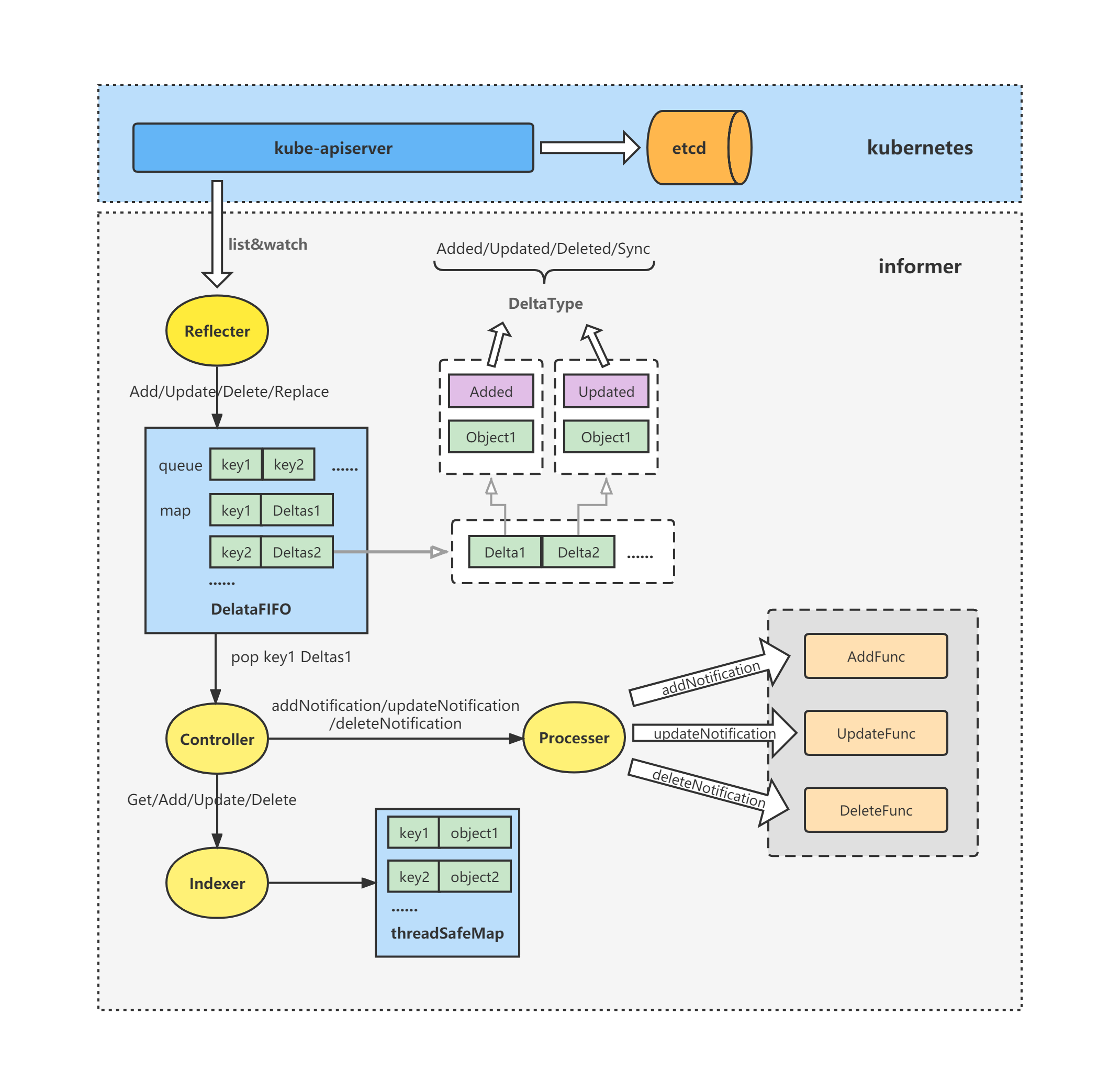
k8s client-go informer主要包括以下部件:
(1)Reflector:Reflector从kube-apiserver中list&watch资源对象,然后调用DeltaFIFO的Add/Update/Delete/Replace方法将资源对象及其变化包装成Delta并将其丢到DeltaFIFO中;
(2)DeltaFIFO:DeltaFIFO中存储着一个map和一个queue,即map[object key]Deltas以及object key的queue,Deltas为Delta的切片类型,Delta装有对象及对象的变化类型(Added/Updated/Deleted/Sync) ,Reflector负责DeltaFIFO的输入,Controller负责处理DeltaFIFO的输出;
(3)Controller:Controller从DeltaFIFO的queue中pop一个object key出来,并获取其关联的 Deltas出来进行处理,遍历Deltas,根据对象的变化更新Indexer中的本地内存缓存,并通知Processor,相关对象有变化事件发生;
(4)Processor:Processor根据对象的变化事件类型,调用相应的ResourceEventHandler来处理对象的变化;
(5)Indexer:Indexer中有informer维护的指定资源对象的相对于etcd数据的一份本地内存缓存,可通过该缓存获取资源对象,以减少对apiserver、对etcd的请求压力;
(6)ResourceEventHandler:用户根据自身处理逻辑需要,注册自定义的的ResourceEventHandler,当对象发生变化时,将触发调用对应类型的ResourceEventHandler来做处理。
概述
    ...
	factory := informers.NewSharedInformerFactory(client, 30*time.Second)
	podInformer := factory.Core().V1().Pods()
	informer := podInformer.Informer()
	...
	go factory.Start(stopper)
	...
	if !cache.WaitForCacheSync(stopper, informer.HasSynced) {
		runtime.HandleError(fmt.Errorf("Timed out waiting for caches to sync"))
		return
	}
	...
上一节有列举了informer的使用代码,注意看到示例代码中的下面这段代码,做了informer初始化与启动,其中包括:
(1)informers.NewSharedInformerFactory:初始化informer factory;
(2)podInformer.Informer:初始化pod informer;
(3)factory.Start:启动informer factory;
(4)cache.WaitForCacheSync:等待list操作获取到的对象都同步到informer本地缓存Indexer中;
下面也将根据这四部分进行informer的初始化与启动分析。
基于k8s v1.17.4版本依赖的client-go
1.SharedInformerFactory的初始化
1.1 sharedInformerFactory结构体
先来看下sharedInformerFactory结构体,看下里面有哪些属性。
看到几个比较重要的属性:
(1)client:连接k8s的clientSet;
(2)informers:是个map,可以装各个对象的informer;
(3)startedInformers:记录已经启动的informer;
// staging/src/k8s.io/client-go/informers/factory.go
type sharedInformerFactory struct {
	client           kubernetes.Interface
	namespace        string
	tweakListOptions internalinterfaces.TweakListOptionsFunc
	lock             sync.Mutex
	defaultResync    time.Duration
	customResync     map[reflect.Type]time.Duration

	informers map[reflect.Type]cache.SharedIndexInformer
	// startedInformers is used for tracking which informers have been started.
	// This allows Start() to be called multiple times safely.
	startedInformers map[reflect.Type]bool
}
1.2 NewSharedInformerFactory
NewSharedInformerFactory方法用于初始化informer factory,主要是初始化并返回sharedInformerFactory结构体。
// staging/src/k8s.io/client-go/informers/factory.go
func NewSharedInformerFactory(client kubernetes.Interface, defaultResync time.Duration) SharedInformerFactory {
	return NewSharedInformerFactoryWithOptions(client, defaultResync)
}

func NewFilteredSharedInformerFactory(client kubernetes.Interface, defaultResync time.Duration, namespace string, tweakListOptions internalinterfaces.TweakListOptionsFunc) SharedInformerFactory {
	return NewSharedInformerFactoryWithOptions(client, defaultResync, WithNamespace(namespace), WithTweakListOptions(tweakListOptions))
}

func NewSharedInformerFactoryWithOptions(client kubernetes.Interface, defaultResync time.Duration, options ...SharedInformerOption) SharedInformerFactory {
	factory := &sharedInformerFactory{
		client:           client,
		namespace:        v1.NamespaceAll,
		defaultResync:    defaultResync,
		informers:        make(map[reflect.Type]cache.SharedIndexInformer),
		startedInformers: make(map[reflect.Type]bool),
		customResync:     make(map[reflect.Type]time.Duration),
	}

	// Apply all options
	for _, opt := range options {
		factory = opt(factory)
	}

	return factory
}
2.对象informer的初始化
上一节有列举了informer的使用代码,注意看到示例代码中的下面这段代码,这里利用了工厂方法设计模式,podInformer.Informer()即初始化了sharedInformerFactory中的pod的informer,具体调用关系可自行看如下代码,比较简单,这里不再展开分析。
    // 初始化informer factory以及pod informer
	factory := informers.NewSharedInformerFactory(client, 30*time.Second)
	podInformer := factory.Core().V1().Pods()
	informer := podInformer.Informer()
2.1 podInformer.Informer
Informer方法中调用了f.factory.InformerFor方法来做pod informer的初始化。
// k8s.io/client-go/informers/core/v1/pod.go
func (f *podInformer) Informer() cache.SharedIndexInformer {
	return f.factory.InformerFor(&corev1.Pod{}, f.defaultInformer)
}
2.2 f.factory.InformerFor
Informer方法中调用了f.factory.InformerFor方法来做pod informer的初始化,并传入f.defaultInformer作为newFunc,而在f.factory.InformerFor方法中,调用newFunc来初始化informer。
这里也可以看到,其实informer初始化后会存储进map f.informers[informerType]中,即存储进sharedInformerFactory结构体的informers属性中,方便共享使用。
// staging/src/k8s.io/client-go/informers/factory.go
func (f *sharedInformerFactory) InformerFor(obj runtime.Object, newFunc internalinterfaces.NewInformerFunc) cache.SharedIndexInformer {
	f.lock.Lock()
	defer f.lock.Unlock()

	informerType := reflect.TypeOf(obj)
	informer, exists := f.informers[informerType]
	if exists {
		return informer
	}

	resyncPeriod, exists := f.customResync[informerType]
	if !exists {
		resyncPeriod = f.defaultResync
	}

	informer = newFunc(f.client, resyncPeriod)
	f.informers[informerType] = informer

	return informer
}
2.3 newFunc/f.defaultInformer
defaultInformer方法中,调用了NewFilteredPodInformer方法来初始化pod informer,最终初始化并返回sharedIndexInformer结构体。
// k8s.io/client-go/informers/core/v1/pod.go
func (f *podInformer) defaultInformer(client kubernetes.Interface, resyncPeriod time.Duration) cache.SharedIndexInformer {
	return NewFilteredPodInformer(client, f.namespace, resyncPeriod, cache.Indexers{cache.NamespaceIndex: cache.MetaNamespaceIndexFunc}, f.tweakListOptions)
}

func NewFilteredPodInformer(client kubernetes.Interface, namespace string, resyncPeriod time.Duration, indexers cache.Indexers, tweakListOptions internalinterfaces.TweakListOptionsFunc) cache.SharedIndexInformer {
	return cache.NewSharedIndexInformer(
		&cache.ListWatch{
			ListFunc: func(options metav1.ListOptions) (runtime.Object, error) {
				if tweakListOptions != nil {
					tweakListOptions(&options)
				}
				return client.CoreV1().Pods(namespace).List(options)
			},
			WatchFunc: func(options metav1.ListOptions) (watch.Interface, error) {
				if tweakListOptions != nil {
					tweakListOptions(&options)
				}
				return client.CoreV1().Pods(namespace).Watch(options)
			},
		},
		&corev1.Pod{},
		resyncPeriod,
		indexers,
	)
}

func NewSharedIndexInformer(lw ListerWatcher, objType runtime.Object, defaultEventHandlerResyncPeriod time.Duration, indexers Indexers) SharedIndexInformer {
	realClock := &clock.RealClock{}
	sharedIndexInformer := &sharedIndexInformer{
		processor:                       &sharedProcessor{clock: realClock},
		indexer:                         NewIndexer(DeletionHandlingMetaNamespaceKeyFunc, indexers),
		listerWatcher:                   lw,
		objectType:                      objType,
		resyncCheckPeriod:               defaultEventHandlerResyncPeriod,
		defaultEventHandlerResyncPeriod: defaultEventHandlerResyncPeriod,
		cacheMutationDetector:           NewCacheMutationDetector(fmt.Sprintf("%T", objType)),
		clock: realClock,
	}
	return sharedIndexInformer
}
2.4 sharedIndexInformer结构体
sharedIndexInformer结构体中重点看到以下几个属性:
(1)indexer:对应着informer中的部件Indexer,Indexer中有informer维护的指定资源对象的相对于etcd数据的一份本地内存缓存,可通过该缓存获取资源对象,以减少对apiserver、对etcd的请求压力;
(2)controller:对应着informer中的部件Controller,Controller从DeltaFIFO中pop Deltas出来处理,根据对象的变化更新Indexer中的本地内存缓存,并通知Processor,相关对象有变化事件发生;
(3)processor:对应着informer中的部件Processor,Processor根据对象的变化事件类型,调用相应的ResourceEventHandler来处理对象的变化;
// staging/src/k8s.io/client-go/tools/cache/shared_informer.go
type sharedIndexInformer struct {
	indexer    Indexer
	controller Controller

	processor             *sharedProcessor
	cacheMutationDetector CacheMutationDetector

	// This block is tracked to handle late initialization of the controller
	listerWatcher ListerWatcher
	objectType    runtime.Object

	// resyncCheckPeriod is how often we want the reflector's resync timer to fire so it can call
	// shouldResync to check if any of our listeners need a resync.
	resyncCheckPeriod time.Duration
	// defaultEventHandlerResyncPeriod is the default resync period for any handlers added via
	// AddEventHandler (i.e. they don't specify one and just want to use the shared informer's default
	// value).
	defaultEventHandlerResyncPeriod time.Duration
	// clock allows for testability
	clock clock.Clock

	started, stopped bool
	startedLock      sync.Mutex

	// blockDeltas gives a way to stop all event distribution so that a late event handler
	// can safely join the shared informer.
	blockDeltas sync.Mutex
}
Indexer接口与cache结构体
cache结构体为Indexer接口的实现;
// staging/src/k8s.io/client-go/tools/cache/store.go
type cache struct {
	cacheStorage ThreadSafeStore
	keyFunc KeyFunc
}
threadSafeMap struct是ThreadSafeStore接口的一个实现,其最重要的一个属性便是items了,items是用map构建的键值对,资源对象都存在items这个map中,key根据资源对象来算出,value为资源对象本身,这里的items即为informer的本地缓存了,而indexers与indices属性则与索引功能有关。
// staging/src/k8s.io/client-go/tools/cache/thread_safe_store.go
type threadSafeMap struct {
	lock  sync.RWMutex
	items map[string]interface{}

	// indexers maps a name to an IndexFunc
	indexers Indexers
	// indices maps a name to an Index
	indices Indices
}
关于Indexer的详细分析会在后续有专门的文章做分析,这里不展开分析;
controller结构体
而controller结构体则包含了informer中的主要部件Reflector以及DeltaFIFO;
(1)Reflector:Reflector从kube-apiserver中list&watch资源对象,然后将对象的变化包装成Delta并将其丢到DeltaFIFO中;
(2)DeltaFIFO:DeltaFIFO存储着map[object key]Deltas以及object key的queue,Delta装有对象及对象的变化类型 ,Reflector负责DeltaFIFO的输入,Controller负责处理DeltaFIFO的输出;
// staging/src/k8s.io/client-go/tools/cache/controller.go
type controller struct {
	config         Config
	reflector      *Reflector
	reflectorMutex sync.RWMutex
	clock          clock.Clock
}

type Config struct {
	// The queue for your objects; either a FIFO or
	// a DeltaFIFO. Your Process() function should accept
	// the output of this Queue's Pop() method.
	Queue
	...
}
3.启动sharedInformerFactory
sharedInformerFactory.Start为informer factory的启动方法,其主要逻辑为循环遍历informers,然后跑goroutine调用informer.Run来启动sharedInformerFactory中存储的各个informer。
// staging/src/k8s.io/client-go/informers/factory.go
func (f *sharedInformerFactory) Start(stopCh <-chan struct{}) {
	f.lock.Lock()
	defer f.lock.Unlock()

	for informerType, informer := range f.informers {
		if !f.startedInformers[informerType] {
			go informer.Run(stopCh)
			f.startedInformers[informerType] = true
		}
	}
}
sharedIndexInformer.Run
sharedIndexInformer.Run用于启动informer,主要逻辑为:
(1)调用NewDeltaFIFO,初始化DeltaFIFO;
(2)构建Config结构体,这里留意下Process属性,赋值了s.HandleDeltas,后面会分析到该方法;
(3)调用New,利用Config结构体来初始化controller;
(4)调用s.processor.run,启动processor;
(5)调用s.controller.Run,启动controller;
// staging/src/k8s.io/client-go/tools/cache/shared_informer.go
func (s *sharedIndexInformer) Run(stopCh <-chan struct{}) {
	defer utilruntime.HandleCrash()

    // 初始化DeltaFIFO
	fifo := NewDeltaFIFO(MetaNamespaceKeyFunc, s.indexer)

    // 构建Config结构体
	cfg := &Config{
		Queue:            fifo,
		ListerWatcher:    s.listerWatcher,
		ObjectType:       s.objectType,
		FullResyncPeriod: s.resyncCheckPeriod,
		RetryOnError:     false,
		ShouldResync:     s.processor.shouldResync,

		Process: s.HandleDeltas,
	}

	func() {
		s.startedLock.Lock()
		defer s.startedLock.Unlock()
        // 初始化controller
		s.controller = New(cfg)
		s.controller.(*controller).clock = s.clock
		s.started = true
	}()

	// Separate stop channel because Processor should be stopped strictly after controller
	processorStopCh := make(chan struct{})
	var wg wait.Group
	defer wg.Wait()              // Wait for Processor to stop
	defer close(processorStopCh) // Tell Processor to stop
	wg.StartWithChannel(processorStopCh, s.cacheMutationDetector.Run)
	// 启动processor
	wg.StartWithChannel(processorStopCh, s.processor.run)

	defer func() {
		s.startedLock.Lock()
		defer s.startedLock.Unlock()
		s.stopped = true // Don't want any new listeners
	}()
	// 启动controller
	s.controller.Run(stopCh)
}
3.1 New
New函数初始化了controller并return。
// staging/src/k8s.io/client-go/tools/cache/controller.go
func New(c *Config) Controller {
	ctlr := &controller{
		config: *c,
		clock:  &clock.RealClock{},
	}
	return ctlr
}
3.2 s.processor.run
s.processor.run启动了processor,其中注意到listener.run与listener.pop两个核心方法即可,暂时没有用到,等下面用到他们的时候再做分析。
// staging/src/k8s.io/client-go/tools/cache/shared_informer.go
func (p *sharedProcessor) run(stopCh <-chan struct{}) {
	func() {
		p.listenersLock.RLock()
		defer p.listenersLock.RUnlock()
		for _, listener := range p.listeners {
			p.wg.Start(listener.run)
			p.wg.Start(listener.pop)
		}
		p.listenersStarted = true
	}()
	<-stopCh
	p.listenersLock.RLock()
	defer p.listenersLock.RUnlock()
	for _, listener := range p.listeners {
		close(listener.addCh) // Tell .pop() to stop. .pop() will tell .run() to stop
	}
	p.wg.Wait() // Wait for all .pop() and .run() to stop
}
3.3 controller.Run
controller.Run为controller的启动方法,这里主要看到几个点:
(1)调用NewReflector,初始化Reflector;
(2)调用r.Run,实际上是调用了Reflector的启动方法来启动Reflector;
(3)调用c.processLoop,开始controller的核心处理;
// k8s.io/client-go/tools/cache/controller.go
func (c *controller) Run(stopCh <-chan struct{}) {
	defer utilruntime.HandleCrash()
	go func() {
		<-stopCh
		c.config.Queue.Close()
	}()
	r := NewReflector(
		c.config.ListerWatcher,
		c.config.ObjectType,
		c.config.Queue,
		c.config.FullResyncPeriod,
	)
	r.ShouldResync = c.config.ShouldResync
	r.clock = c.clock

	c.reflectorMutex.Lock()
	c.reflector = r
	c.reflectorMutex.Unlock()

	var wg wait.Group
	defer wg.Wait()

	wg.StartWithChannel(stopCh, r.Run)

	wait.Until(c.processLoop, time.Second, stopCh)
}
3.3.1 Reflector结构体
先来看到Reflector结构体,这里重点看到以下属性:
(1)expectedType:放到Store中(即DeltaFIFO中)的对象类型;
(2)store:store会赋值为DeltaFIFO,具体可以看之前的informer初始化与启动分析即可得知,这里不再展开分析;
(3)listerWatcher:存放list方法和watch方法的ListerWatcher interface实现;
// k8s.io/client-go/tools/cache/reflector.go
type Reflector struct {
    ...
    expectedType reflect.Type
    store Store
    listerWatcher ListerWatcher
    ...
}
3.3.2 r.Run/Reflector.Run
Reflector.Run方法中启动了Reflector,而Reflector的核心处理逻辑为从kube-apiserver处做list&watch操作,然后将得到的对象封装存储进DeltaFIFO中。
// staging/src/k8s.io/client-go/tools/cache/reflector.go
func (r *Reflector) Run(stopCh <-chan struct{}) {
	klog.V(3).Infof("Starting reflector %v (%s) from %s", r.expectedTypeName, r.resyncPeriod, r.name)
	wait.Until(func() {
		if err := r.ListAndWatch(stopCh); err != nil {
			utilruntime.HandleError(err)
		}
	}, r.period, stopCh)
}
3.3.3 controller.processLoop
controller的核心处理方法processLoop中,最重要的逻辑是循环调用c.config.Queue.Pop将DeltaFIFO中的队头元素给pop出来,然后调用c.config.Process方法来做处理,当处理出错时,再调用c.config.Queue.AddIfNotPresent将对象重新加入到DeltaFIFO中去。
// k8s.io/client-go/tools/cache/controller.go
func (c *controller) processLoop() {
	for {
		obj, err := c.config.Queue.Pop(PopProcessFunc(c.config.Process))
		if err != nil {
			if err == ErrFIFOClosed {
				return
			}
			if c.config.RetryOnError {
				// This is the safe way to re-enqueue.
				c.config.Queue.AddIfNotPresent(obj)
			}
		}
	}
}
3.3.4 c.config.Process/sharedIndexInformer.HandleDeltas
根据前面sharedIndexInformer.Run方法的分析中可以得知,c.config.Process其实就是sharedIndexInformer.HandleDeltas。
HandleDeltas方法中,将从DeltaFIFO中pop出来的对象以及类型,相应的在indexer中做添加、更新、删除操作,并调用s.processor.distribute通知自定义的ResourceEventHandler。
// staging/src/k8s.io/client-go/tools/cache/shared_informer.go
func (s *sharedIndexInformer) HandleDeltas(obj interface{}) error {
	s.blockDeltas.Lock()
	defer s.blockDeltas.Unlock()

	// from oldest to newest
	for _, d := range obj.(Deltas) {
		switch d.Type {
		case Sync, Added, Updated:
			isSync := d.Type == Sync
			s.cacheMutationDetector.AddObject(d.Object)
			if old, exists, err := s.indexer.Get(d.Object); err == nil && exists {
				if err := s.indexer.Update(d.Object); err != nil {
					return err
				}
				s.processor.distribute(updateNotification{oldObj: old, newObj: d.Object}, isSync)
			} else {
				if err := s.indexer.Add(d.Object); err != nil {
					return err
				}
				s.processor.distribute(addNotification{newObj: d.Object}, isSync)
			}
		case Deleted:
			if err := s.indexer.Delete(d.Object); err != nil {
				return err
			}
			s.processor.distribute(deleteNotification{oldObj: d.Object}, false)
		}
	}
	return nil
}
怎么通知到自定义的ResourceEventHandler呢?继续往下看。
3.3.5 sharedIndexInformer.processor.distribute
可以看到distribute方法最终是将构造好的addNotification、updateNotification、deleteNotification对象写入到p.addCh中。
// staging/src/k8s.io/client-go/tools/cache/shared_informer.go
func (p *sharedProcessor) distribute(obj interface{}, sync bool) {
	p.listenersLock.RLock()
	defer p.listenersLock.RUnlock()

	if sync {
		for _, listener := range p.syncingListeners {
			listener.add(obj)
		}
	} else {
		for _, listener := range p.listeners {
			listener.add(obj)
		}
	}
}

func (p *processorListener) add(notification interface{}) {
	p.addCh <- notification
}
到这里,processor中的listener.pop以及listener.run方法终于派上了用场,继续往下看。
3.3.6 listener.pop
分析processorListener的pop方法可以得知,其逻辑实际上就是将p.addCh中的对象给拿出来,然后丢进了p.nextCh中。那么谁来处理p.nextCh呢?继续往下看。
// staging/src/k8s.io/client-go/tools/cache/shared_informer.go
func (p *processorListener) pop() {
	defer utilruntime.HandleCrash()
	defer close(p.nextCh) // Tell .run() to stop

	var nextCh chan<- interface{}
	var notification interface{}
	for {
		select {
		case nextCh <- notification:
			// Notification dispatched
			var ok bool
			notification, ok = p.pendingNotifications.ReadOne()
			if !ok { // Nothing to pop
				nextCh = nil // Disable this select case
			}
		case notificationToAdd, ok := <-p.addCh:
			if !ok {
				return
			}
			if notification == nil { // No notification to pop (and pendingNotifications is empty)
				// Optimize the case - skip adding to pendingNotifications
				notification = notificationToAdd
				nextCh = p.nextCh
			} else { // There is already a notification waiting to be dispatched
				p.pendingNotifications.WriteOne(notificationToAdd)
			}
		}
	}
}
3.3.7 listener.run
在processorListener的run方法中,将循环读取p.nextCh,判断对象类型,是updateNotification则调用p.handler.OnUpdate方法,是addNotification则调用p.handler.OnAdd方法,是deleteNotification则调用p.handler.OnDelete方法做处理。
// staging/src/k8s.io/client-go/tools/cache/shared_informer.go
func (p *processorListener) run() {
	// this call blocks until the channel is closed.  When a panic happens during the notification
	// we will catch it, **the offending item will be skipped!**, and after a short delay (one second)
	// the next notification will be attempted.  This is usually better than the alternative of never
	// delivering again.
	stopCh := make(chan struct{})
	wait.Until(func() {
		// this gives us a few quick retries before a long pause and then a few more quick retries
		err := wait.ExponentialBackoff(retry.DefaultRetry, func() (bool, error) {
			for next := range p.nextCh {
				switch notification := next.(type) {
				case updateNotification:
					p.handler.OnUpdate(notification.oldObj, notification.newObj)
				case addNotification:
					p.handler.OnAdd(notification.newObj)
				case deleteNotification:
					p.handler.OnDelete(notification.oldObj)
				default:
					utilruntime.HandleError(fmt.Errorf("unrecognized notification: %T", next))
				}
			}
			// the only way to get here is if the p.nextCh is empty and closed
			return true, nil
		})

		// the only way to get here is if the p.nextCh is empty and closed
		if err == nil {
			close(stopCh)
		}
	}, 1*time.Minute, stopCh)
}
而p.handler.OnUpdate、p.handler.OnAdd、p.handler.OnDelete方法实际上就是自定义的的ResourceEventHandlerFuncs了。
informer.AddEventHandler(cache.ResourceEventHandlerFuncs{
    AddFunc:    onAdd,
    UpdateFunc: onUpdate,
    DeleteFunc: onDelete,
  })
// staging/src/k8s.io/client-go/tools/cache/controller.go
type ResourceEventHandlerFuncs struct {
	AddFunc    func(obj interface{})
	UpdateFunc func(oldObj, newObj interface{})
	DeleteFunc func(obj interface{})
}

func (r ResourceEventHandlerFuncs) OnAdd(obj interface{}) {
	if r.AddFunc != nil {
		r.AddFunc(obj)
	}
}

func (r ResourceEventHandlerFuncs) OnUpdate(oldObj, newObj interface{}) {
	if r.UpdateFunc != nil {
		r.UpdateFunc(oldObj, newObj)
	}
}

func (r ResourceEventHandlerFuncs) OnDelete(obj interface{}) {
	if r.DeleteFunc != nil {
		r.DeleteFunc(obj)
	}
}
4.cache.WaitForCacheSync(stopper, informer.HasSynced)
可以看出在cache.WaitForCacheSync方法中,实际上是调用方法入参cacheSyncs ...InformerSynced来判断cache是否同步完成(即调用informer.HasSynced方法),而这里说的cache同步完成,意思是等待informer从kube-apiserver同步资源完成,即informer的list操作获取的对象都存入到informer中的indexer本地缓存中;
// staging/src/k8s.io/client-go/tools/cache/shared_informer.go
func WaitForCacheSync(stopCh <-chan struct{}, cacheSyncs ...InformerSynced) bool {
	err := wait.PollImmediateUntil(syncedPollPeriod,
		func() (bool, error) {
			for _, syncFunc := range cacheSyncs {
				if !syncFunc() {
					return false, nil
				}
			}
			return true, nil
		},
		stopCh)
	if err != nil {
		klog.V(2).Infof("stop requested")
		return false
	}

	klog.V(4).Infof("caches populated")
	return true
}
4.1 informer.HasSynced
HasSynced方法实际上是调用了sharedIndexInformer.controller.HasSynced方法;
// staging/src/k8s.io/client-go/tools/cache/shared_informer.go
func (s *sharedIndexInformer) HasSynced() bool {
	s.startedLock.Lock()
	defer s.startedLock.Unlock()

	if s.controller == nil {
		return false
	}
	return s.controller.HasSynced()
}
s.controller.HasSynced
这里的c.config.Queue.HasSynced()方法,实际上是指DeltaFIFO的HasSynced方法,会在DeltaFIFO的分析中再详细分析,这里只需要知道当informer的list操作获取的对象都存入到informer中的indexer本地缓存中则返回true即可;
// staging/src/k8s.io/client-go/tools/cache/controller.go
func (c *controller) HasSynced() bool {
	return c.config.Queue.HasSynced()
}
4.2 sharedInformerFactory.WaitForCacheSync
可以顺带看下sharedInformerFactory.WaitForCacheSync方法,其实际上是遍历factory中的所有informer,调用cache.WaitForCacheSync,然后传入每个informer的HasSynced方法作为入参;
// staging/src/k8s.io/client-go/informers/factory.go
func (f *sharedInformerFactory) WaitForCacheSync(stopCh <-chan struct{}) map[reflect.Type]bool {
	informers := func() map[reflect.Type]cache.SharedIndexInformer {
		f.lock.Lock()
		defer f.lock.Unlock()

		informers := map[reflect.Type]cache.SharedIndexInformer{}
		for informerType, informer := range f.informers {
			if f.startedInformers[informerType] {
				informers[informerType] = informer
			}
		}
		return informers
	}()

	res := map[reflect.Type]bool{}
	for informType, informer := range informers {
		res[informType] = cache.WaitForCacheSync(stopCh, informer.HasSynced)
	}
	return res
}
至此,整个informer的初始化与启动的分析就结束了,后面会对informer中的各个核心部件进行详细分析,敬请期待。
总结
下面用两张图片总结一下informer的初始化与启动;
informer初始化

informer启动
