-
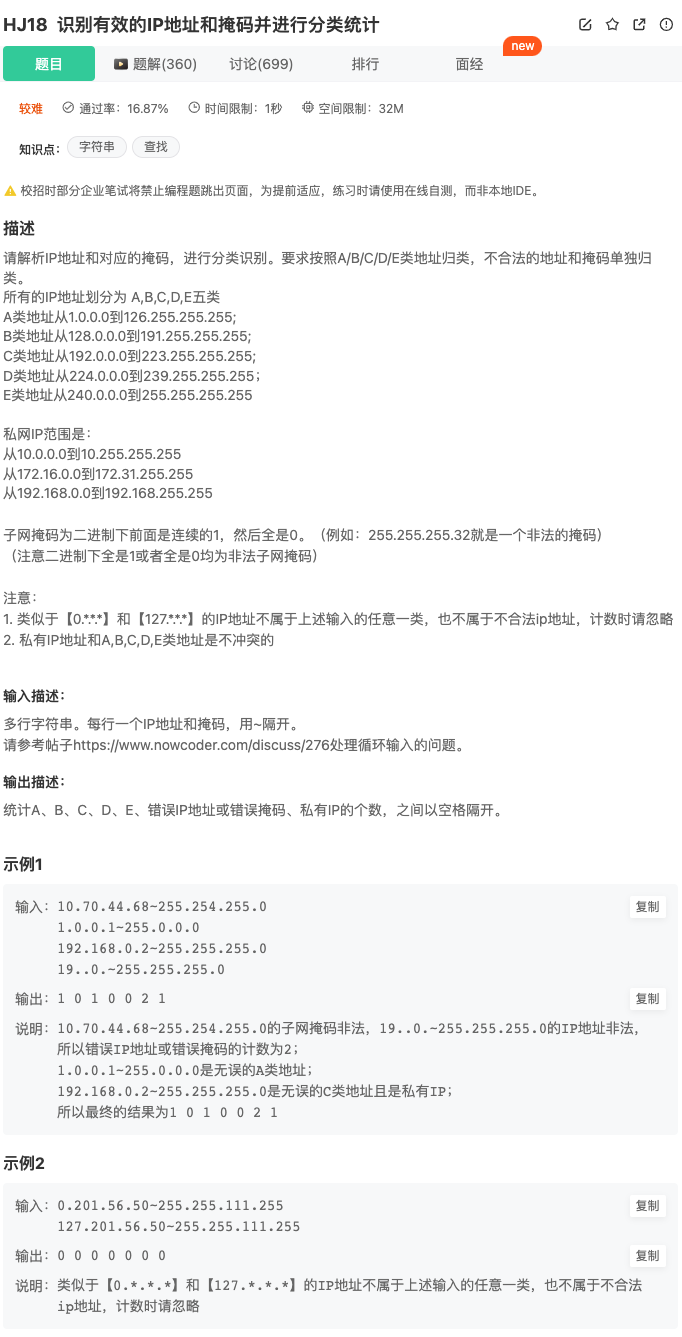
华为机考入门python3--(18)牛客18- 识别有效的IP地址和掩码并进行分类统计
分类:字符串
知识点:
-
字符串是否由数字组成 my_str.isdigit()
-
字符串填充 不足8位左侧填充0 my_str.zfill(8)
题目来自【牛客】
- import sys
- def classify_ip(ip_mask):
- ip_class, is_private_ip, mask_class = 'ignore_ip', 0, 'valid_mask'
- # 解析IP地址和子网掩码
- ip, mask = ip_mask.split('~')
- ip_parts = ip.split('.')
- mask_parts = mask.split('.')
- # 验证IP地址是否合法
- if len(ip_parts) != 4:
- ip_class = 'error_ip'
- for part in ip_parts:
- if not part.isdigit() or int(part) < 0 or int(part) > 255:
- ip_class = 'error_ip'
- # 验证子网掩码是否合法
- if len(mask_parts) != 4:
- mask_class = 'error_mask'
- for part in mask_parts:
- if not part.isdigit() or int(part) < 0 or int(part) > 255:
- mask_class = 'error_mask'
- # zfill() 是字符串(str)对象的一个方法,用于在字符串的左侧填充零zero,直到字符串达到指定的长度。
- mask_binary = ''.join([bin(int(part))[2:].zfill(8) for part in mask_parts])
- # rfind() 是 Python 中字符串(str)对象的一个方法,用于在字符串中从右向左查找子字符串,
- # 并返回子字符串的最后一个匹配的索引。如果找不到子字符串,则返回 -1。
- # print(mask_binary)
- if '01' in mask_binary or mask_binary.count('1') == 0 or mask_binary.count('0') == 0:
- mask_class = 'error_mask'
- # IP地址分类
- if ip_class != 'error_ip':
- # 判断是否为私有IP
- if int(ip_parts[0]) == 10 or (int(ip_parts[0]) == 172 and 16 <= int(ip_parts[1]) <= 31):
- is_private_ip = 1
- # 判断IP地址所属的类别
- if 1 <= int(ip_parts[0]) <= 126:
- ip_class = 'A'
- elif 128 <= int(ip_parts[0]) <= 191:
- ip_class= 'B'
- elif 192 <= int(ip_parts[0]) <= 223:
- ip_class = 'C'
- elif 224 <= int(ip_parts[0]) <= 239:
- ip_class = 'D'
- elif 240 <= int(ip_parts[0]) <= 255:
- ip_class = 'E'
- else:
- ip_class = 'ignore_ip'
- return ip_class, is_private_ip, mask_class
- count = {'A': 0, 'B': 0, 'C': 0, 'D': 0, 'E': 0, 'error_ip': 0, 'error_mask': 0, 'private': 0, 'ignore_ip': 0}
- for line in sys.stdin:
- ip_mask = line.strip()
- # print(ip_mask)
- ip_class, is_private_ip, mask_class = classify_ip(ip_mask)
- # print(ip_class, is_private_ip, mask_class)
- if ip_class == 'ignore_ip':
- count['ignore_ip'] += 1
- elif ip_class == 'error_ip':
- count['error_ip'] += 1
- elif mask_class == 'error_mask':
- count['error_mask'] += 1
- else:
- count[ip_class] += 1
- if is_private_ip == 1:
- count['private'] += 1
- print(count['A'], count['B'], count['C'], count['D'], count['E'], count['error_ip'] + count['error_mask'], count['private'])
-
-
相关阅读:
自动升级Notes客户机AUT功能实战
redhat8下载配置jdk1.8和jdk11
C++行为型模式-职责链模式
Pyhon中利用GM(1,1)和ARIMA模型对卫星DCB值进行预测
58%数据泄漏由内部引起,防泄密系统助力企业数据安全管理防泄露
leetcode两数之和使用JavaScript解题
MySQL:库操作 | 表操作
全面解析HTTPS协议
【机器学习】李宏毅——自监督式学习
深入协议栈了解TCP的三次握手、四次挥手、CLOSE-WAIT、TIME-WAIT。
- 原文地址:https://blog.csdn.net/u013288190/article/details/138001236
