-
【智能家居】7、主程序编写+实现语音、网络和串口功能
需要毕业论文私信有偿获取
截止目前mainPro.c代码
- #include
- #include
- #include "controlDevices.h"
- #include "inputCmd.h"
- struct Devices *findDevicesName(char *name,struct Devices *phead){
- struct Devices *tmp=phead;
- if(phead==NULL){
- return NULL;
- }else{
- while(tmp!=NULL){
- if(strcmp(tmp->devicesName,name)==0){
- return tmp;
- }
- tmp=tmp->next;
- }
- return NULL;
- }
- }
- int main(){
- if(wiringPiSetup()==-1){
- return -1;
- }
- struct Devices *pdevicesHead=NULL;
- struct InputCmd *pinputCmdHead=NULL;
- pdevicesHead=addbathroomLightToDevicesLink(pdevicesHead);
- pdevicesHead=addupstairLightToDevicesLink(pdevicesHead);
- pdevicesHead=addlivingroomLightToDevicesLink(pdevicesHead);
- pdevicesHead=addrestaurantLightToDevicesLink(pdevicesHead);
- pdevicesHead=addFireToDevicesLink(pdevicesHead);
- pinputCmdHead=addVoiceToInputCmdLink(pinputCmdHead);
- pinputCmdHead=addSocketToInputCmdLink(pinputCmdHead);
- char name[128]={'\0'};
- struct Devices *tmp=NULL;
- while(1){
- printf("INPUT:\n");
- scanf("%s",name);
- tmp=findDevicesName(name,pdevicesHead);
- if(tmp!=NULL){
- tmp->devicesInit(tmp->pinNum);
- tmp->open(tmp->pinNum);
- tmp->readStatus(tmp->pinNum);
- }
- }
- return 0;
- }
一、编写流程
1、工厂初始化
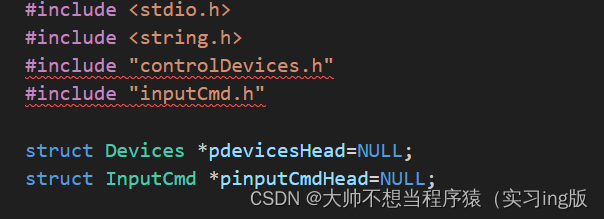
将指令和设备结构体指针定义为全局变量
(1)指令工厂初始化
- /*指令工厂初始化*/
- pinputCmdHead=addVoiceToInputCmdLink(pinputCmdHead);
- pinputCmdHead=addSocketToInputCmdLink(pinputCmdHead);
(2)设备控制工厂初始化
- /*设备工厂初始化*/
- pdevicesHead=addbathroomLightToDevicesLink(pdevicesHead);
- pdevicesHead=addupstairLightToDevicesLink(pdevicesHead);
- pdevicesHead=addlivingroomLightToDevicesLink(pdevicesHead);
- pdevicesHead=addrestaurantLightToDevicesLink(pdevicesHead);
- pdevicesHead=addFireToDevicesLink(pdevicesHead);
2、查找指令名称函数
- struct InputCmd *findCmdName(char *name,struct InputCmd *phead){
- struct InputCmd *tmp=phead;
- if(phead==NULL){
- return NULL;
- }else{
- while(tmp!=NULL){
- if(strcmp(tmp->cmdName,name)==0){
- return tmp;
- }
- tmp=tmp->next;
- }
- return NULL;
- }
- }
3、线程池

pthread_t *thread:类型为指向pthread_t类型的指针,用于存储新创建线程的标识符。当线程成功创建后,函数会将新线程的 ID 值填入这个地址所指向的位置。const pthread_attr_t *attr:类型为指向pthread_attr_t结构体的常量指针,用来指定线程属性,如线程的调度策略、优先级、栈大小等。如果不需要设置特定属性,可以传入NULL,使用默认属性。void *(*start_routine)(void *):类型为指向函数的指针,该函数接收一个void *类型的参数,并返回void *类型的值。这是新线程开始执行时调用的函数,通常被称为线程入口函数或线程启动例程。void *arg:类型为void *,这是一个通用指针,作为传递给start_routine函数的唯一参数。程序员可以通过这个参数向线程传递任意类型的数据。函数返回值:
- 如果成功创建线程,返回0。
- 如果失败,则返回一个非零错误码,可以通过宏
pthread_getspecific()来获取错误信息。
pthread_create()创建了一个新的线程,并安排它从指定的start_routine函数开始执行,同时可以传递一个自定义参数给这个线程函数(1)语音线程
- /*语音线程*/
- pthread_create(&voice_thread,NULL,voice_thread,NULL);
1)线程标识符(线程ID存储位置)
pthread_creat参数一

2)线程入口函数
pthread_creat参数三
- void *voice_thread(void *data){
- struct InputCmd *voiceHandler;
- int nread;
- voiceHandler=findCmdName("voice",pinputCmdHead);
- if(voiceHandler==NULL){
- printf("voiceHandler unfound!\n");
- pthread_exit(NULL);
- }else{
- if(voiceHandler->Init(voiceHandler,NULL,NULL)<0){
- printf("voice init error!\n");
- pthread_exit(NULL);
- }
- while(1){
- voiceHandler->getCmd(voiceHandler);
- if(nread==0){
- printf("voice no data was received!\n");
- }else{
- printf("voice received data:%s\n",voiceHandler->cmd);
- }
- }
- }
- }
(2)Socket线程
- /*Socket线程*/
- pthread_create(&socket_thread,NULL,socket_thread,NULL);
1)线程标识符(线程ID存储位置)
pthread_creat参数一

2)线程入口函数
pthread_creat参数三
- void *socket_thread(void *data){
- int nread=0;
- pthread_t readThread;
- struct sockaddr_in c_addr;
- memset(&c_addr,0,sizeof(struct sockaddr_in));
- int len=sizeof(struct sockaddr_in);
- socketHandler=findCmdName("socket",pinputCmdHead);
- if(socketHandler==NULL){
- printf("socketHandler unfound!\n");
- pthread_exit(NULL);
- }
- socketHandler->Init(socketHandler,NULL,NULL);
- while (1){
- c_fd=accept(socketHandler->s_fd,(struct sockaddr *)&c_addr,&len);
- pthread_create(&readThread,NULL,read_thread,NULL);
- }
- }
read线程参数三
- void *read_thread(void *data){
- int n_read;
- n_read=read(c_fd,socketHandler->cmd,sizeof(socketHandler->cmd));
- if(n_read==-1){
- perror("read");
- }else if(n_read>0){
- printf("\nget:%d %s\n",n_read,socketHandler->cmd);
- }else{
- printf("client quit!\n");
- }
- }
4、mainPro.c
- #include
- #include
- #include "controlDevices.h"
- #include "inputCmd.h"
- #include
- int c_fd;
- struct Devices *pdevicesHead=NULL;
- struct InputCmd *pinputCmdHead=NULL;
- struct InputCmd *socketHandler=NULL;
- struct Devices *findDevicesName(char *name,struct Devices *phead){
- struct Devices *tmp=phead;
- if(phead==NULL){
- return NULL;
- }else{
- while(tmp!=NULL){
- if(strcmp(tmp->devicesName,name)==0){
- return tmp;
- }
- tmp=tmp->next;
- }
- return NULL;
- }
- }
- struct InputCmd *findCmdName(char *name,struct InputCmd *phead){
- struct InputCmd *tmp=phead;
- if(phead==NULL){
- return NULL;
- }else{
- while(tmp!=NULL){
- if(strcmp(tmp->cmdName,name)==0){
- return tmp;
- }
- tmp=tmp->next;
- }
- return NULL;
- }
- }
- void *voice_thread(void *data){
- struct InputCmd *voiceHandler;
- printf("voice_thread\n");
- int nread;//接收串口字节数
- voiceHandler=findCmdName("voice",pinputCmdHead);
- if(voiceHandler==NULL){
- printf("voiceHandler unfound!\n");
- pthread_exit(NULL);
- }else{
- if(voiceHandler->Init(voiceHandler,NULL,NULL)<0){
- printf("voice init error!\n");
- pthread_exit(NULL);
- }else{
- /*初始化语音*/
- printf("%s init success\n",voiceHandler->cmdName);
- }
- while(1){
- nread=voiceHandler->getCmd(voiceHandler);
- if(nread==0){
- printf("voice no data was received!\n");
- }else{
- printf("voice received data:%s\n",voiceHandler->cmd);
- }
- }
- }
- }
- void *read_thread(void *data){
- printf("read_thread\n");
- int n_read;
- /*清空命令接收区,方便下次检测*/
- memset(socketHandler->cmd,'\0',sizeof(socketHandler->cmd));
- n_read=read(c_fd,socketHandler->cmd,sizeof(socketHandler->cmd));
- if(n_read==-1){
- perror("read");
- }else if(n_read>0){
- printf("\nget:%d %s\n",n_read,socketHandler->cmd);
- }else{
- printf("client quit!\n");
- }
- }
- void *socket_thread(void *data){
- printf("socket_thread\n");
- int nread=0;
- pthread_t readThread;
- struct sockaddr_in c_addr;
- memset(&c_addr,0,sizeof(struct sockaddr_in));
- int len=sizeof(struct sockaddr_in);
- /*从命令工厂找到网络设备*/
- socketHandler=findCmdName("socket",pinputCmdHead);
- if(socketHandler==NULL){
- printf("socketHandler unfound!\n");
- pthread_exit(NULL);
- }else{
- printf("%s init success\n",socketHandler->cmdName);
- }
- /*初始化网络*/
- socketHandler->Init(socketHandler,NULL,NULL);
- /*不断监听客户端发送的数据,并创建线程处理*/
- while (1){
- c_fd=accept(socketHandler->s_fd,(struct sockaddr *)&c_addr,&len);
- pthread_create(&readThread,NULL,read_thread,NULL);
- }
- }
- int main(){
- char name[128]={'\0'};
- struct Devices *tmp=NULL;
- pthread_t voiceThread;
- pthread_t socketThread;
- if(wiringPiSetup()==-1){
- return -1;
- }
- printf("main\n");
- /*指令工厂初始化*/
- pinputCmdHead=addVoiceToInputCmdLink(pinputCmdHead);
- pinputCmdHead=addSocketToInputCmdLink(pinputCmdHead);
- /*设备工厂初始化*/
- pdevicesHead=addbathroomLightToDevicesLink(pdevicesHead);
- pdevicesHead=addupstairLightToDevicesLink(pdevicesHead);
- pdevicesHead=addlivingroomLightToDevicesLink(pdevicesHead);
- pdevicesHead=addrestaurantLightToDevicesLink(pdevicesHead);
- pdevicesHead=addFireToDevicesLink(pdevicesHead);
- /*线程池*/
- //pthread_create(pthread_t *thread,const pthread_attr_t *attr,void *(start_routine)(void *),void *arg);
- /*语音线程*/
- pthread_create(&voiceThread,NULL,voice_thread,NULL);
- /*Socket线程*/
- pthread_create(&socketThread,NULL,socket_thread,NULL);
- pthread_join(voiceThread,NULL);
- pthread_join(socketThread,NULL);
- // while(1){
- // printf("INPUT:\n");
- // scanf("%s",name);
- // tmp=findDevicesName(name,pdevicesHead);
- // if(tmp!=NULL){
- // tmp->devicesInit(tmp->pinNum);
- // tmp->open(tmp->pinNum);
- // tmp->readStatus(tmp->pinNum);
- // }
- // }
- return 0;
- }
二、测试
1、在树莓派上编译成功

2、打印一些信息查看程序运行情况
(1)mainPro.c(语音和网络线程是否创建成功)


(2)Socket.c(网络线程是否进入监听)

(3)编译测试
gcc mainPro.c controlDevices.c bathroomLight.c livingroomLight.c restaurantLight.c upstairLight.c monitor.c socket.c voice.c -L ./ -lwiringPi -lpthread -o sh在语音初始化中开启串口报错Permission denied,权限不足


解决办法
- sudo chmod 666 /dev/ttyAMA0 (修改权限)
- sudo ./sh (管理员方式运行,sh是编译后生成的可执行文件)
运行成功


网络调试助手网络功能测试

串口功能测试

-
相关阅读:
云栖大会开源重磅升级!PolarDB-X v2.2: 企业级和国产化适配
Kubernetes - Ingress暴露应用(四)
计算机网络---第四章网络层---ipv4---应用题
Elasticsearch:使用 Amazon Bedrock 的 semantic_text
R语言聚类分析可视化
矩阵的相似性度量的常用方法
web网站开发人员有哪些必学的基础?
java-net-php-python-java亚奥跆拳道网站的设计与实现计算机毕业设计程序
离散数学_第8章 图__平面图
Vue | Vue.js 组件化 知识拓展
- 原文地址:https://blog.csdn.net/weixin_53062144/article/details/135889213
- 最新文章
-
沪漂五周年了:我越来越迷茫了
Agentic Skill Routing 实战:别再把所有 Skill 塞进 AI Agent 上下文
MySQL-Seconds_behind_master的精度误差
[MAF预定义ChatClient中间件-03]CachingChatClient——利用缓存省钱省时间
AI的至暗历史:从万众期待到被政府撤资,AI的两次死亡徘徊
Agent OS :五种驯服不确定性的范式
PortSwigger SQL注入LAB11
数据库即时编译JIT
[Begin]AI Learn Data Day 0
深度学习进阶(二十七)现代 LLM 的核心架构设计其二:SwiGLU