-
leetcode:20. 有效的括号
一、题目:
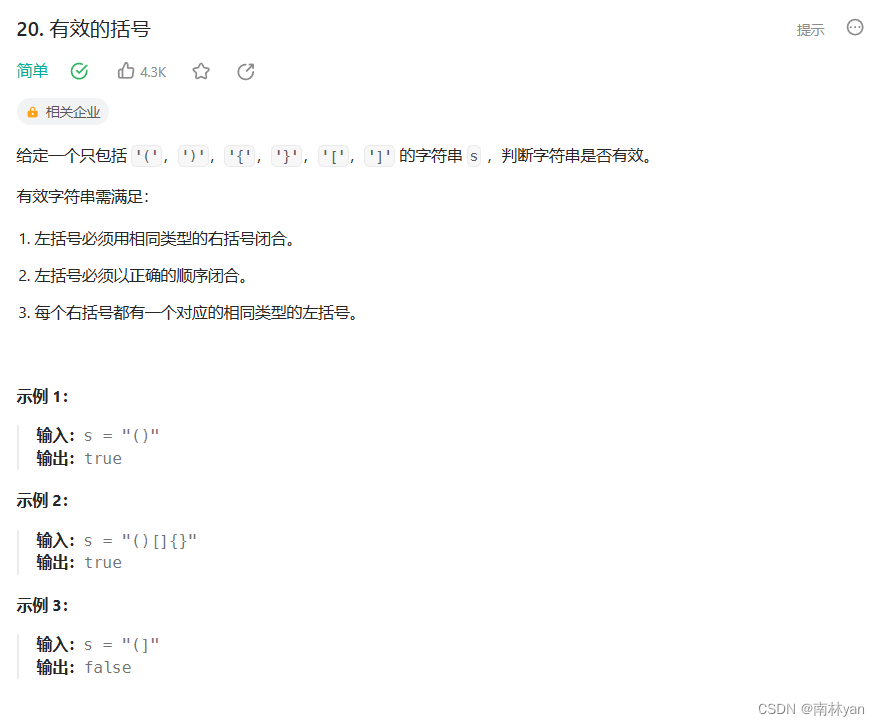
函数原型:bool isValid(char* s)
二、思路:
利用栈来解这道题会方便许多:
遍历字符串s,当遇到左括号就将其压入栈中;遇到右括号首先判断栈是否为空,如果为空说明左右括号数量不匹配返回false,再判断它与左括号是否匹配,如果不匹配返回false,如果匹配则将栈顶元素出栈。全部遍历完成后,如果栈不为空,说明左右括号数量不匹配,返回false,如果栈为空则返回true。
三、代码:
- //顺序栈的结构定义
- typedef char STDataType;
- typedef struct Stack {
- STDataType* a;
- int top;
- int capacity;
- }ST;
- //顺序栈的初始化
- void STInit(ST* pst)
- {
- assert(pst);
- pst->a = NULL;
- pst->top = 0;//top指针指向栈顶元素的下一位
- pst->capacity = 0;//顺序栈的容量
- }
- //顺序栈的打印
- void STPrint(ST pst)
- {
- for (int i = 0; i < pst.top; i++)
- {
- printf("%d ", pst.a[i]);
- }
- printf("\n");
- }
- //顺序栈的入栈
- void STPush(ST* pst, STDataType x)
- {
- assert(pst);
- //检查扩容
- if (pst->top == pst->capacity)
- {
- int newcapacity = pst->capacity == 0 ? 4 : 2 * pst->capacity;
- STDataType* p = (STDataType*)realloc(pst->a, newcapacity * sizeof(STDataType));
- if (p == NULL)
- {
- perror("realloc fail");
- exit(-1);
- }
- else
- {
- pst->a = p;
- pst->capacity = newcapacity;
- }
- }
- pst->a[pst->top++] = x;
- }
- //顺序栈出栈
- void STPop(ST* pst)
- {
- assert(pst);
- assert(pst->top > 0);
- pst->top--;
- }
- //求顺序栈栈顶元素
- STDataType STTop(ST* pst)
- {
- assert(pst);
- assert(pst->top > 0);
- return pst->a[pst->top - 1];
- }
- //顺序栈判空
- bool STEmpty(ST* pst)
- {
- assert(pst);
- return pst->top == 0;
- }
- //顺序栈销毁
- void STDestroy(ST* pst)
- {
- assert(pst);
- if (pst->a != NULL)
- {
- free(pst->a);
- pst->a = NULL;
- pst->top = 0;
- pst->capacity = 0;
- }
- }
- bool isValid(char* s) {
- //定义顺序栈
- ST st;
- //初始化顺序栈
- STInit(&st);
- int len=strlen(s);
- for(int i=0;i{if(s[i]=='('||s[i]=='{'||s[i]=='['){STPush(&st,s[i]);}else if(s[i]==')'||s[i]=='}'||s[i]==']'){if(STEmpty(&st))return false;else{if((STTop(&st)=='('&&s[i]!=')')||(STTop(&st)=='{'&&s[i]!='}')||(STTop(&st)=='['&&s[i]!=']'))return false;STPop(&st);}}}if(!STEmpty(&st))return false;elsereturn true;}
- 相关阅读:
2023国赛数学建模C题思路模型代码 高教社杯
学习git博客
进制转换【二进制、八进制、十进制、十六进制】
spark相关网站
每日学习笔记:C++ STL 的forward_list
Linux Debian12使用podman安装pikachu靶场环境
Kube-OVN v1.10.0:新增Windows节点支持,用户自定义子网ACL等10+硬核功能
STM32F103VET6基于STM32CubeMX创建EXTI外部中断工程
网页元素解析a标签
PYTHON中的字符编码
- 原文地址:https://blog.csdn.net/2301_76197086/article/details/134543113
- 最新文章
-
沪漂五周年了:我越来越迷茫了
Agentic Skill Routing 实战:别再把所有 Skill 塞进 AI Agent 上下文
MySQL-Seconds_behind_master的精度误差
[MAF预定义ChatClient中间件-03]CachingChatClient——利用缓存省钱省时间
AI的至暗历史:从万众期待到被政府撤资,AI的两次死亡徘徊
Agent OS :五种驯服不确定性的范式
PortSwigger SQL注入LAB11
数据库即时编译JIT
[Begin]AI Learn Data Day 0
深度学习进阶(二十七)现代 LLM 的核心架构设计其二:SwiGLU
