-
C/C++轻量级并发TCP服务器框架Zinx-游戏服务器开发002:框架学习-按照三层结构模式重构测试代码+Tcp数据适配+时间轮定时器
1 Zinx框架总览

2 三层模式的分析

3 三层重构原有的功能 - 头文件
三层结构重构原有功能
- 自定义消息类,继承UserData,添加一个成员变量szUserData
- 定义多个Role类继承Irole,重写ProcMsg函数,进行不同处理
- 定义protocol类,继承Iprotocol,重写四个函数,两个函数时原始
数据和用户数据之间的转换;另两个用来找消息处理对象和消息发
送对象。 - 定义channel类,继承Ichannel,在getnextinputstage函数中返回协
议对象
3.1 通道层Stdin和Stdout类
通道类,派生自基础处理者类,提供基于系统调用的数据收发功能
一般地,用户应该根据处理的文件(信息源)不同而创建通道类的子类或选用合适的实用类(已经提供的通道类子类)来完成系统级文件IO

class StdInChannel : public Ichannel { public: StdInChannel(); virtual ~StdInChannel(); // 通过 Ichannel 继承 virtual bool Init() override; virtual bool ReadFd(std::string& _input) override; virtual bool WriteFd(std::string& _output) override; virtual void Fini() override; virtual int GetFd() override; virtual std::string GetChannelInfo() override; virtual AZinxHandler* GetInputNextStage(BytesMsg& _oInput) override; }; class StdOutChannel :public Ichannel { // 通过 Ichannel 继承 virtual bool Init() override; virtual bool ReadFd(std::string& _input) override; virtual bool WriteFd(std::string& _output) override; virtual void Fini() override; virtual int GetFd() override; virtual std::string GetChannelInfo() override; virtual AZinxHandler* GetInputNextStage(BytesMsg& _oInput) override; };- 1
- 2
- 3
- 4
- 5
- 6
- 7
- 8
- 9
- 10
- 11
- 12
- 13
- 14
- 15
- 16
- 17
- 18
- 19
- 20
- 21
- 22
- 23
- 24
- 25
- 26
- 27
- 28
3.1.2 StdInChannel
bool StdInChannel::ReadFd(std::string& _input) { cin >> _input; return true; } bool StdInChannel::WriteFd(std::string& _output) { return false; } int StdInChannel::GetFd() { return 0; } std::string StdInChannel::GetChannelInfo() { return "stdin"; } AZinxHandler* StdInChannel::GetInputNextStage(BytesMsg& _oInput) { /*返回协议对象*/ return CmdCheck::GetInstance(); }- 1
- 2
- 3
- 4
- 5
- 6
- 7
- 8
- 9
- 10
- 11
- 12
- 13
- 14
- 15
- 16
- 17
- 18
- 19
- 20
- 21
- 22
- 23
- 24
- 25
- 26
3.1.2 StdOutChannel
bool StdOutChannel::ReadFd(std::string& _input) { return false; } bool StdOutChannel::WriteFd(std::string& _output) { cout << _output << endl; return true; } int StdOutChannel::GetFd() { return 1; } std::string StdOutChannel::GetChannelInfo() { return "stdout"; } AZinxHandler* StdOutChannel::GetInputNextStage(BytesMsg& _oInput) { return nullptr; }- 1
- 2
- 3
- 4
- 5
- 6
- 7
- 8
- 9
- 10
- 11
- 12
- 13
- 14
- 15
- 16
- 17
- 18
- 19
- 20
- 21
- 22
- 23
- 24
- 25
- 26
3.2 协议层CmdCheck和CmdMsg类
3.2.1 CmdCheck单例模式
- 原始数据和业务数据相互函数,开发者重写该函数,实现协议
- 获取处理角色对象函数,开发者应该重写该函数,用来指定当前产生的用户数据消
- 获取发送通道函数,开发者应该重写该函数,用来指定当前字节流应该由哪个通道对象发出
class CmdCheck : public Iprotocol { CmdCheck(); virtual ~CmdCheck(); static CmdCheck *poSingle; public: // 通过 Iprotocol 继承 /*原始数据和业务数据相互函数,开发者重写该函数,实现协议*/ virtual UserData * raw2request(std::string _szInput) override; virtual std::string * response2raw(UserData & _oUserData) override; /*获取处理角色对象函数,开发者应该重写该函数,用来指定当前产生的用户数据消息应该传递给哪个角色处理*/ virtual Irole * GetMsgProcessor(UserDataMsg & _oUserDataMsg) override; /*获取发送通道函数,开发者应该重写该函数,用来指定当前字节流应该由哪个通道对象发出*/ virtual Ichannel * GetMsgSender(BytesMsg & _oBytes) override; static CmdCheck *GetInstance() { return poSingle; } std::string szOutChannel; };- 1
- 2
- 3
- 4
- 5
- 6
- 7
- 8
- 9
- 10
- 11
- 12
- 13
- 14
- 15
- 16
- 17
- 18
- 19
- 20
3.2.1.1 单例模式
构造全局唯一的协议对象
#include "CmdCheck.h" #include "CmdMsg.h" #include "EchoRole.h" using namespace std; CmdCheck *CmdCheck::poSingle = new CmdCheck();- 1
- 2
- 3
- 4
- 5
- 6
- 7
3.2.1.2 * 命令识别类向业务层不同类别做分发
通过是不是命令来进行区分:
if (isCmd)Irole * CmdCheck::GetMsgProcessor(UserDataMsg & _oUserDataMsg) { szOutChannel = _oUserDataMsg.szInfo; if ("stdin" == szOutChannel) { szOutChannel = "stdout"; } /*根据命令不同,交给不同的处理role对象*/ auto rolelist = ZinxKernel::Zinx_GetAllRole(); auto pCmdMsg = dynamic_cast<CmdMsg *>(_oUserDataMsg.poUserData); /*读取当前消息是否是命令*/ bool isCmd = pCmdMsg->isCmd; Irole *pRetRole = NULL; for (Irole *prole : rolelist) { if (isCmd) { auto pOutCtrl = dynamic_cast<OutputCtrl *>(prole); if (NULL != pOutCtrl) { pRetRole = pOutCtrl; break; } } else { auto pDate = dynamic_cast<DatePreRole *>(prole); if (NULL != pDate) { pRetRole = pDate; break; } } } return pRetRole; }- 1
- 2
- 3
- 4
- 5
- 6
- 7
- 8
- 9
- 10
- 11
- 12
- 13
- 14
- 15
- 16
- 17
- 18
- 19
- 20
- 21
- 22
- 23
- 24
- 25
- 26
- 27
- 28
- 29
- 30
- 31
- 32
- 33
- 34
- 35
- 36
- 37
- 38
- 39
- 40
- 41
- 42
3.2.2 CmdMsg自定义用户信息类,继承UserData
class CmdMsg : public UserData { public: /*成员变量表示要回显的字符串*/ std::string szUserData; /*开启输出标志*/ bool isOpen = true; /*该消息是命令*/ bool isCmd = false; /*要加前缀*/ bool needDatePre = false; CmdMsg(); virtual ~CmdMsg(); };- 1
- 2
- 3
- 4
- 5
- 6
- 7
- 8
- 9
- 10
- 11
- 12
- 13
- 14
- 15
- 16
- 17
3.3 业务层:回显类, 输出通道控制类, 日期前缀管理类
3.3.1 回显对象EchoRole
主要有init, procmsg,fini三个函数
#pragma once #includeclass EchoRole : public Irole { public: EchoRole(); virtual ~EchoRole(); // 通过 Irole 继承 virtual bool Init() override; virtual UserData * ProcMsg(UserData & _poUserData) override; virtual void Fini() override; }; - 1
- 2
- 3
- 4
- 5
- 6
- 7
- 8
- 9
- 10
- 11
- 12
- 13
- 14
- 15
- 容易出错的点:参数一必须是一个堆对象
UserData * EchoRole::ProcMsg(UserData & _poUserData) { /*写出去*/ GET_REF2DATA(CmdMsg, input, _poUserData); CmdMsg *pout = new CmdMsg(input); ZinxKernel::Zinx_SendOut(*pout, *(CmdCheck::GetInstance())); return nullptr; }- 1
- 2
- 3
- 4
- 5
- 6
- 7
- 8
- 9
3.3.2 控制输入输出
- 写一个关闭输出的角色类,摘除输出通道或添加输出通道
- 在CmdMsg用户数据类中添加开关标志,是否是命令标志
- 在协议类中,根据输入字符串,设置开关标志和是否是命令的标志
- 在协议类分发消息时,判断是否是命令,是命令则发给关闭输出角 色类,否则发给回显角色类
class OutputCtrl :public Irole { // 通过 Irole 继承 virtual bool Init() override; virtual UserData * ProcMsg(UserData & _poUserData) override; virtual void Fini() override; Ichannel *pOut = NULL; };- 1
- 2
- 3
- 4
- 5
- 6
- 7
3.3.3 日期管理类
class DatePreRole :public Irole { // 通过 Irole 继承 virtual bool Init() override; virtual UserData * ProcMsg(UserData & _poUserData) override; virtual void Fini() override; bool needAdd = false; };- 1
- 2
- 3
- 4
- 5
- 6
- 7
4 Tcp数据适配
4.1 工厂类 - 框架头文件分析
- 产生tcp数据套接字通道类的抽象工厂类。
- 开发者需要重写CreateTcpDataChannel函数,来返回一个tcp通道对象。
- 般地,开发者应该同时创建一对tcp通道类和工厂类
class IZinxTcpConnFact { public: virtual ZinxTcpData *CreateTcpDataChannel(int _fd) = 0; };- 1
- 2
- 3
- 4
- tcp监听通道类,这是一个实体类(不建议继承该类)。
- 开发者可以直接创建tcp监听通道对象,
- 一般地,开发者应该在该类的构造函数中,指定一个tcp套接字通道类的工厂类,当有连接到来后,该工厂类的成员方法会被调用
class ZinxTCPListen : public Ichannel { private: unsigned short m_usPort = 0; int m_fd = -1; IZinxTcpConnFact *m_ConnFac = NULL; public: ZinxTCPListen(unsigned short _usPort, IZinxTcpConnFact *_pConnFac) :m_usPort(_usPort), m_ConnFac(_pConnFac){} virtual ~ZinxTCPListen(); virtual bool Init() override; virtual bool ReadFd(std::string & _input) override; virtual bool WriteFd(std::string & _output) override; virtual void Fini() override; virtual int GetFd() override; virtual std::string GetChannelInfo() override; virtual AZinxHandler * GetInputNextStage(BytesMsg & _oInput); };- 1
- 2
- 3
- 4
- 5
- 6
- 7
- 8
- 9
- 10
- 11
- 12
- 13
- 14
- 15
- 16
- 17
- 18
- 19
- 20
4.2 tcp通道实现
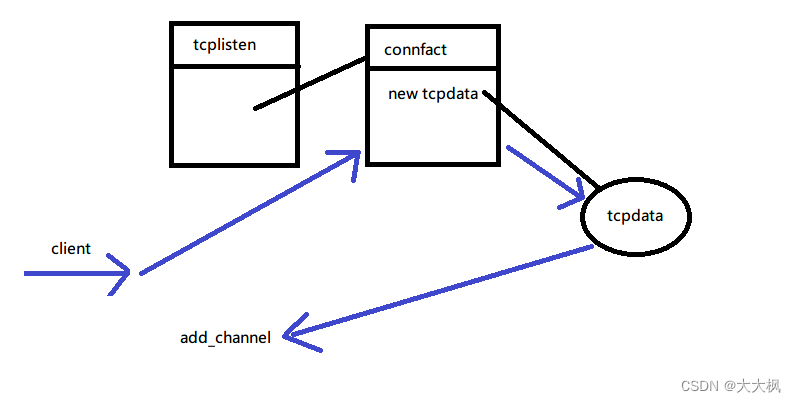
4.2.1 Tcp套接字通道通信类
- tcp数据套接字通道类,继承通道类,该类也是一个抽象类,需要开发者继承该类,重写GetInputNextStage函数以指定读取到的字节流的处理方式
// h class myTcpData :public ZinxTcpData { public: myTcpData(int _fd) :ZinxTcpData(_fd) {} // 通过 ZinxTcpData 继承 virtual AZinxHandler* GetInputNextStage(BytesMsg& _oInput) override; };- 1
- 2
- 3
- 4
- 5
- 6
- 7
- Q: Ichannel对象读取到的数据给谁了?
- 给该对象调用GetInputNextStage函数返回的对象
AZinxHandler* myTcpData::GetInputNextStage(BytesMsg& _oInput) { /*返回协议对象*/ return CmdCheck::GetInstance(); }- 1
- 2
- 3
- 4
- 5
- Q: Iprotocol对象转换出的用户请求给谁了?
- 给该对象调用GetMsgProcessor函数返回的对象
4.2.2 tcp数据套接字通道类的工厂类
- 产生tcp数据套接字通道类的抽象工厂类,开发者需要重写CreateTcpDataChannel函数,来返回一个tcp通道对象
一般地,开发者应该同时创建一对tcp通道类和工厂类
// h class myFact :public IZinxTcpConnFact { // 通过 IZinxTcpConnFact 继承 virtual ZinxTcpData* CreateTcpDataChannel(int _fd) override; };- 1
- 2
- 3
- 4
- 5
ZinxTcpData* myFact::CreateTcpDataChannel(int _fd) { return new myTcpData(_fd); }- 1
- 2
- 3
- 4
5 时间轮定时器
5.1 timerfd产生超时事件
timerfd_create()返回定时器文件描述符
timerfd_settime()设置定时周期,立刻开始计时
read,读取当当前定时器超时的次数,没超时会阻塞.
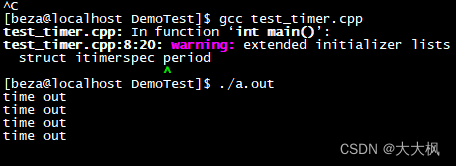
一般地,会将定时器文件描述符结合IO多路复用使用5.1.1 测试代码
#include#include #include #include int main() { int iTimerfd = timerfd_create(CLOCK_MONOTONIC, 0); struct itimerspec period {{5, 0},{5, 0} }; timerfd_settime(iTimerfd,0, &period,NULL); __uint64_t count = 0; while(1) { read(iTimerfd, &count, sizeof(count)); puts("time out"); } } - 1
- 2
- 3
- 4
- 5
- 6
- 7
- 8
- 9
- 10
- 11
- 12
- 13
- 14
- 15
- 16
- 17
5.2 时间轮设置
单例模式
AZinxHandler * ZinxTimerChannel::GetInputNextStage(BytesMsg & _oInput) { return &TimerOutMng::GetInstance(); } TimerOutMng TimerOutMng::single;- 1
- 2
- 3
- 4
- 5
- 6
5.2.1 时间轮的定义
// h class TimerOutProc { public: virtual void Proc() = 0; virtual int GetTimeSec() = 0; /*所剩圈数*/ int iCount = -1; };- 1
- 2
- 3
- 4
- 5
- 6
- 7
- 8
- 9
- vector存储轮的齿
- 每个齿里用list存每个定时任务
- 每个定时任务需要记录剩余圈数
- 时间轮类中要有一个刻度,每秒进一步
TimerOutMng::TimerOutMng() { /*创建10个齿*/ for (int i = 0; i < 10; i++) { list<TimerOutProc *> tmp; m_timer_wheel.push_back(tmp); } }- 1
- 2
- 3
- 4
- 5
- 6
- 7
- 8
- 9
5.2.2 时间轮的移动
// h class TimerOutMng :public AZinxHandler { std::vector<std::list<TimerOutProc *> > m_timer_wheel; int cur_index = 0; static TimerOutMng single; TimerOutMng(); public: /*处理超时事件,遍历所有超时任务*/ virtual IZinxMsg * InternelHandle(IZinxMsg & _oInput) override; virtual AZinxHandler * GetNextHandler(IZinxMsg & _oNextMsg) override; void AddTask(TimerOutProc *_ptask); void DelTask(TimerOutProc *_ptask); static TimerOutMng &GetInstance() { return single; } };- 1
- 2
- 3
- 4
- 5
- 6
- 7
- 8
- 9
- 10
- 11
- 12
- 13
- 14
- 15
- 16
- 17
- 移动当前刻度
- 遍历当前齿中的任务列表
- 若圈数为0,则执行处理函数,摘除本节点,重新添加
- 否则,圈数–
IZinxMsg * TimerOutMng::InternelHandle(IZinxMsg & _oInput) { unsigned long iTimeoutCount = 0; GET_REF2DATA(BytesMsg, obytes, _oInput); obytes.szData.copy((char *)&iTimeoutCount, sizeof(iTimeoutCount), 0); while (iTimeoutCount-- > 0) { /*移动刻度*/ cur_index++; cur_index %= 10; list<TimerOutProc *> m_cache; /*遍历当前刻度所有节点,指向处理函数或圈数-1,*/ for (auto itr = m_timer_wheel[cur_index].begin(); itr != m_timer_wheel[cur_index].end(); ) { if ((*itr)->iCount <= 0) { /*缓存待处理的超时节点*/ m_cache.push_back(*itr); auto ptmp = *itr; itr = m_timer_wheel[cur_index].erase(itr); AddTask(ptmp); } else { (*itr)->iCount--; ++itr; } } /*统一待处理超时任务*/ for (auto task : m_cache) { task->Proc(); } } return nullptr; }- 1
- 2
- 3
- 4
- 5
- 6
- 7
- 8
- 9
- 10
- 11
- 12
- 13
- 14
- 15
- 16
- 17
- 18
- 19
- 20
- 21
- 22
- 23
- 24
- 25
- 26
- 27
- 28
- 29
- 30
- 31
- 32
- 33
- 34
- 35
- 36
- 37
- 38
- 39
- 40
5.2.3 添加和删除任务
5.2.3.1 添加任务
- 计算当前任务在哪个齿上
- 添加该任务到该齿对应的list里
- 计算所需圈数记录到任务中
void TimerOutMng::AddTask(TimerOutProc * _ptask) { /*计算当前任务需要放到哪个齿上*/ int index = (_ptask->GetTimeSec() + cur_index) % 10; /*把任务存到该齿上*/ m_timer_wheel[index].push_back(_ptask); /*计算所需圈数*/ _ptask->iCount = _ptask->GetTimeSec() / 10; }- 1
- 2
- 3
- 4
- 5
- 6
- 7
- 8
- 9
5.2.3.2 删除任务
- 遍历所有齿
- 在每个齿中遍历所有节点
- 若找到则删除并返回
void TimerOutMng::DelTask(TimerOutProc * _ptask) { /*遍历时间轮所有齿,删掉任务*/ for (list<TimerOutProc *> &chi : m_timer_wheel) { for (auto task : chi) { if (task == _ptask) { chi.remove(_ptask); return; } } } }- 1
- 2
- 3
- 4
- 5
- 6
- 7
- 8
- 9
- 10
- 11
- 12
- 13
- 14
- 15
5.3 定时器设置
5.3.1 定时器定义
class ZinxTimerChannel : public Ichannel { int m_TimerFd = -1; public: ZinxTimerChannel(); virtual ~ZinxTimerChannel(); // 通过 Ichannel 继承 virtual bool Init() override; virtual bool ReadFd(std::string & _input) override; virtual bool WriteFd(std::string & _output) override; virtual void Fini() override; virtual int GetFd() override; virtual std::string GetChannelInfo() override; virtual AZinxHandler * GetInputNextStage(BytesMsg & _oInput) override; };- 1
- 2
- 3
- 4
- 5
- 6
- 7
- 8
- 9
- 10
- 11
- 12
- 13
- 14
- 15
- 16
- 17
- 18
5.3.2 定时器初始化
/*创建定时器文件描述符*/ bool ZinxTimerChannel::Init() { bool bRet = false; //判断成功或者失败 /*创建文件描述符*/ int iFd = timerfd_create(CLOCK_MONOTONIC, 0); if (0 <= iFd) { /*设置定时周期*/ struct itimerspec period = { {1,0}, {1,0} }; if (0 == timerfd_settime(iFd, 0, &period, NULL)) { bRet = true; m_TimerFd = iFd; } } return bRet; } /*读取超时次数*/ bool ZinxTimerChannel::ReadFd(std::string & _input) { bool bRet = false; char buff[8] = { 0 }; if (sizeof(buff) == read(m_TimerFd, buff, sizeof(buff))) { bRet = true; _input.assign(buff, sizeof(buff)); } return bRet; } bool ZinxTimerChannel::WriteFd(std::string & _output) { return false; } /*关闭文件描述符*/ void ZinxTimerChannel::Fini() { close(m_TimerFd); m_TimerFd = -1; } /*返回当前的定时器文件描述符*/ int ZinxTimerChannel::GetFd() { return m_TimerFd; } std::string ZinxTimerChannel::GetChannelInfo() { return "TimerFd"; // 名字随便起的 }- 1
- 2
- 3
- 4
- 5
- 6
- 7
- 8
- 9
- 10
- 11
- 12
- 13
- 14
- 15
- 16
- 17
- 18
- 19
- 20
- 21
- 22
- 23
- 24
- 25
- 26
- 27
- 28
- 29
- 30
- 31
- 32
- 33
- 34
- 35
- 36
- 37
- 38
- 39
- 40
- 41
- 42
- 43
- 44
- 45
- 46
- 47
- 48
- 49
- 50
- 51
- 52
- 53
- 54
- 55
- 56
- 57
5.3.3 输出hello world
class output_hello :public AZinxHandler { // 通过 AZinxHandler 继承 virtual IZinxMsg * InternelHandle(IZinxMsg & _oInput) override { auto pchannel = ZinxKernel::Zinx_GetChannel_ByInfo("stdout"); std::string output = "hello world"; ZinxKernel::Zinx_SendOut(output, *pchannel); return nullptr; } virtual AZinxHandler * GetNextHandler(IZinxMsg & _oNextMsg) override { return nullptr; } } *pout_hello = new output_hello();- 1
- 2
- 3
- 4
- 5
- 6
- 7
- 8
- 9
- 10
- 11
- 12
- 13
- 14
- 15
-
相关阅读:
视觉与机器人的九点标定(二)
前端体验优化(3)——后端
一文整理深度学习【深度学习linux的docker+pytorch+cuda+nvidia-docker+vscode配置】
Java并发编程图册
Java-JDBC
达梦数据库启动与停止
C语言环境变量和错误处理
通讯网关软件003——利用CommGate X2Mbt实现Modbus TCP访问OPC Server
iOS中的3种定时器
复杂逻辑的开发利器—Mendix快速实现AQL质量抽检
- 原文地址:https://blog.csdn.net/jiangchufeng123/article/details/134194908

- 最新文章
-
沪漂五周年了:我越来越迷茫了
Agentic Skill Routing 实战:别再把所有 Skill 塞进 AI Agent 上下文
MySQL-Seconds_behind_master的精度误差
[MAF预定义ChatClient中间件-03]CachingChatClient——利用缓存省钱省时间
AI的至暗历史:从万众期待到被政府撤资,AI的两次死亡徘徊
Agent OS :五种驯服不确定性的范式
PortSwigger SQL注入LAB11
数据库即时编译JIT
[Begin]AI Learn Data Day 0
深度学习进阶(二十七)现代 LLM 的核心架构设计其二:SwiGLU