-
LeetCode //C - 98. Validate Binary Search Tree
98. Validate Binary Search Tree
Given the root of a binary tree, determine if it is a valid binary search tree (BST).
A valid BST is defined as follows:
- The left subtree of a node contains only nodes with keys less than the node’s key.
- The right subtree of a node contains only nodes with keys greater than the node’s key.
- Both the left and right subtrees must also be binary search trees.
Example 1:
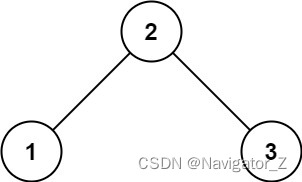
Input: root = [2,1,3]
Output: trueExample 2:

Input: root = [5,1,4,null,null,3,6]
Output: false
Explanation: The root node’s value is 5 but its right child’s value is 4.Constraints:
- The number of nodes in the tree is in the range [ 1 , 1 0 4 1, 10^4 1,104].
- − 2 31 < = N o d e . v a l < = 2 31 − 1 -2^{31} <= Node.val <= 2^{31} - 1 −231<=Node.val<=231−1
From: LeetCode
Link: 98. Validate Binary Search Tree
Solution:
Ideas:
1. Initialization: The function isValidBST initializes the validation process by calling the helper function with the entire valid integer range.
2. Base Case: If the current node is nullptr, it means we’ve reached a leaf node, and we return true since a leaf node is trivially a BST.
3. Value Check: For any other node, we check if its value lies within the permissible range (lower and upper).
- If the value lies outside this range, the BST property is violated, and we return false.
4. Recursive Calls:
- For the left child, we update the upper boundary to the current node’s value because all values in the left subtree should be less than the current node’s value.
- For the right child, we update the lower boundary to the current node’s value because all values in the right subtree should be greater than the current node’s value.
5. Combining Results: The final result for the current node is a logical AND (&&) of the results from the left and right subtrees. This ensures that both subtrees must be valid BSTs for the current tree to be a BST.
Code:
/** * Definition for a binary tree node. * struct TreeNode { * int val; * TreeNode *left; * TreeNode *right; * TreeNode() : val(0), left(nullptr), right(nullptr) {} * TreeNode(int x) : val(x), left(nullptr), right(nullptr) {} * TreeNode(int x, TreeNode *left, TreeNode *right) : val(x), left(left), right(right) {} * }; */ class Solution { public: bool isValidBST(TreeNode* root) { return helper(root, LONG_MIN, LONG_MAX); } bool helper(TreeNode* node, long long lower, long long upper) { if (!node) return true; if (node->val <= lower || node->val >= upper) { return false; } return helper(node->left, lower, node->val) && helper(node->right, node->val, upper); } };- 1
- 2
- 3
- 4
- 5
- 6
- 7
- 8
- 9
- 10
- 11
- 12
- 13
- 14
- 15
- 16
- 17
- 18
- 19
- 20
- 21
- 22
- 23
- 24
- 25
- 26
- 27
- 28
-
相关阅读:
PyQt5学习一(环境搭建)
wifi码系统贴牌源码定制开发搭建oem
C++ 命名空间-----namespace(超详细解析,小白必看系列)
【论文笔记】(FGSM)Explaining and Harnessing Adversarial Examples
LINUX
基于springboot+vue的家政服务预约管理系统 elementui
GPU服务器环境搭建
unity il2cpp打包安卓打包崩溃原因Unity2020.3 il2cpp.so丢失
【Vue简介+搭建Vue开发环境+Hello小案例】
第十二章·装饰模式
- 原文地址:https://blog.csdn.net/navicheung/article/details/133062430
