-
【python零基础入门学习】python进阶篇之时间表示方法和异常处理以及linux系统的os模块执行shell命令以及记账程序编写教学(一)
本站以分享各种运维经验和运维所需要的技能为主
《python零基础入门》:python零基础入门学习
《python运维脚本》: python运维脚本实践
《terraform》持续更新中:terraform_Aws学习零基础入门到最佳实战
《k8》暂未更新
《docker学习》暂未更新
《ceph学习》ceph日常问题解决分享
《日志收集》ELK+各种中间件
《运维日常》运维日常
《linux》运维面试100问
时间表示方法和异常处理
时间表示方法:

time模块:
时间表示方法:
-
时间戳:自1970-1-1 0:0:0到某一时间之间的秒数
-
UTC时间,世界协调时.
-
struct_time元组:9个元素组成:(年月日时分秒,一周中第几天,一年中的第几天,是否是夏季节约时间--原来时间-1)

闰秒---- 61
- >>> import time
- #获取当时的时间戳
- >>> time.time()
- 1575854726.0655887 -----1970--至今
- #获取UTC的字符串形式时间
- >>> time.ctime()
- 'Mon Dec 9 09:26:30 2019'
- #获取当前时间的9元组
- >>> time.localtime()
- time.struct_time(tm_year=2019, tm_mon=12, tm_mday=9, tm_hour=9, tm_min=27, tm_sec=2, tm_wday=0, tm_yday=343, tm_isdst=0)
- >>> t = time.localtime()
- >>> t.tm_year
- 2019
- >>> t.tm_yday
- 343
- #算数计时器:
- import time
- result = 0
- start = time.time()
- for i in range(1,10000001):
- result += i
- end = time.time()
- print(result)
- print(end - start)
- #睡眠3秒
- >>> import time
- >>> time.sleep(3)
- #返回特定的时间格式
- >>> time.strftime('%Y-%m-%d %H:%M:%S')
- '2019-12-09 09:48:38'
- >>> time.strftime('%a %A')
- 'Mon Monday'
- #把时间字符串转化为9元素组格式
- >>> t = time.strptime('2019-12-09 09:48:38', '%Y-%m-%d %H:%M:%S')
- >>> t.tm_year
- 2019
- >>> time.strptime('2019-12-09 09:48:38', '%Y-%m-%d %H:%M:%S')
- time.struct_time(tm_year=2019, tm_mon=12, tm_mday=9, tm_hour=9, tm_min=48, tm_sec=38, tm_wday=0, tm_yday=343, tm_isdst=-1)
- #应用
- import time
- t9 = time.strptime('2019-12-09 09:00:00', '%Y-%m-%d %H:%M:%S')
- t12 = time.strptime('2019-12-09 12:00:00', '%Y-%m-%d %H:%M:%S')
- with open('mylog.txt') as fobj:
- for line in fobj:
- t = time.strptime(line[:19],'%Y-%m-%d %H:%M:%S')
- if t > t12 :
- break
- if t >=t9:
- print(line,end='')
- # with open('mylog.txt') as fobj:
- # for line in fobj:
- # t = time.strptime(line[:19],'%Y-%m-%d %H:%M:%S')
- # if t9 <= t <= t12 :
- # print(line,end='')
datetime模块:
- 简单应用:
- >>> from datetime import datetime
- >>> datetime.now()
- datetime.datetime(2019, 12, 9, 10, 48, 9, 388722)
- >>> t.year
- 2019
- >>> t.month
- 12
- >>> t.day
- 9
- >>> t.min
- t.min t.minute
- >>> t.minute
- 48
- >>> t.hour
- 10
- >>> t.second
- 52
- >>> t.microsecond
- 887151
- >>> t9 = datetime.strptime('2019-12-9 10:55:29' , '%Y-%m-%d %H:%M:%S') #指定字符串转成datetime对象
- >>> t9
- datetime.datetime(2019, 12, 9, 10, 55, 29)
- >>> t = datetime.now()
- >>> t
- datetime.datetime(2019, 12, 9, 10, 55, 29, 493483)
- >>> t.strftime('%Y/%m/%d %H:%M:%S') #datetime对象转成指定字符串
- '2019/12/09 10:55:29'
- 案例一:
- from datetime import datetime
- t9 = datetime.strptime('2019-12-09 09:00:00', '%Y-%m-%d %H:%M:%S')
- t12 = datetime.strptime('2019-12-09 12:00:00', '%Y-%m-%d %H:%M:%S')
- with open('mylog.txt') as fobj:
- for line in fobj:
- t = datetime.strptime(line[:19],'%Y-%m-%d %H:%M:%S')
- if t > t12 :
- break
- if t >=t9:
- print(line,end='')
- 案例二:
- # 计算时间差,获取从现在开始前100天,后100天
- >>> from datetime import datetime,timedelta
- >>> t = datetime.now()
- >>> dats = timedelta(days=100,hours=1)
- >>> t
- datetime.datetime(2019, 12, 9, 11, 22, 46, 973981)
- >>> t - dats
- datetime.datetime(2019, 8, 31, 10, 22, 46, 973981)
- >>> t + dats
- datetime.datetime(2020, 3, 18, 12, 22, 46, 973981)
异常处理:
-
- 没有异常处理的代码,当程序遇到错误时,程序将会崩溃,终止执行,在屏幕上打印报错信息
-
- 异常处理是,提前考虑到程序运行过程中将会出现的错误,给出这些错误的解决方案,使得程序不要崩溃,还可以继续执行下去


- try:
- num = int(input('number: '))
- result = 100 / num
- print(result)
- print('Done')
- except (ValueError, ZeroDivisionError) as e:
- print('无效输入',e)
- except (EOFError, KeyboardInterrupt) :
- print('\nBye-Bye')
- #0 报错不能作为除数: ZeroDivisionError: division by zero
- # asdasd 值不对类型 : ValueError: invalid literal for int() with base 10: 'asdasdasd'
- # Ctrl D 直接结束: EOFError: EOF when reading a line
- # >>> asdasdasd 直接Ctrl C----->结果:KeyboardInterrupt
- #>>> a = [1 , 2 ]
- #>>> a[3] 下标没有这个索引,只有0 1 --->IndexError: list index out of range
- #>>> b 还没有定义变量b: ----->NameError: name 'b' is not defined
- try:
- num = int(input('number: '))
- result = 100 / num
- except (ValueError, ZeroDivisionError) as e:
- print('无效输入',e)
- except (EOFError, KeyboardInterrupt) :
- print('\nBye-Bye')
- exit(1) #程序遇到exit将会彻底结束,并且返回1,正确输出
- else:
- print(result) #前面的代码正确执行的时候,才执行
- finally:
- print('一定要执行的语句')
- print('Done')
触发异常:

- def set_age(name,age):
- if not 0 < age < 120:
- raise ValueError('年龄超出正常范围')
- print('%s is %s years old' % (name,age))
- if __name__ == '__main__':
- set_age('牛老师',200)
- import myerror
- #调用上面的函数:
- try:
- name = input('名字: ')
- age = int(input('年龄: '))
- myerror.set_age(name,age)
- except ValueError :
- print('请输入0~120的年龄')
- except (EOFError, KeyboardInterrupt) :
- print('\nBye-Bye')
断言:
• 断言是一句必须等价于布尔值为真的判定
• 此外,发生异常也意味着表达式为假
- def set_age(name,age):
- assert 0 < age < 120,'年龄超出正常范围'
- print('%s is %s years old' % (name,age))
- if __name__ == '__main__':
- try:
- age = int(input('年龄: '))
- set_age('牛牛',age)
- except (ValueError,AssertionError) as e:
- print('错误:',e)
- except (KeyboardInterrupt,EOFError):
- print('\nBye-Bye')
OS模块:
- import os
- os.getcwd() #pwd
- os.listdir() #ls
- os.mkdir('/root/dd') #mkdir
- os.makedirs('/root/dd/ss/ss/ss') #mkdir -p
- os.chdir() #cd
- os.remove() #rm -rf
- os.symlink('/etc/passwd','mimo') # ln -s
- os.chmod('zhuji',0o755) # chmod 755 zhuji
- #注意:linux命令chmod使用的进制为 8进制
- >>> 0o755
- 493
- os.chmod('zhuji',493) #十进制
- os.stat('zhuji') #文件的详细信息,什么时候被改动或者被访问
- #访问时间
- #更改change时间:指定内容更改
- #更改modify时间:内容以及权限都算在内
- >>> os.stat('sss.py')
- os.stat_result(st_mode=33188, st_ino=6426766, st_dev=2050, st_nlink=1, st_uid=0, st_gid=0, st_size=4, st_atime=1575875055, st_mtime=1575875055, st_ctime=1575875055)
- >>> import time
- >>> time.ctime(1575875055)
- 'Mon Dec 9 15:04:15 2019'
- >>> sss = os.stat('sss.py')
- >>> sss.st_atime
- 1575875055.8465357
- >>> sss.st_size
- 4
- 判断:
- os.path.isabs('/etc') #是绝对路径吗?
- os.path.isdir('/asdf') #/asdf不存在也返回Ture
- ---修改一下os.path.isabs('/asdf')
- os.path.isfile() #存在并且是文件吗? [ -f fname ]
- os.path.ismount() #存在并且是挂载点吗?
- os.path.isdir() #存在并且是目录吗? [ -d dname ]
- os.path.islink() #存在并且是软链接吗?
- os.path.exists() #存在吗? [ -e d/fname ]
- >>> path = '/root/nsd1907/py02/day01/sss.txt'
- >>> os.path.split(path)
- ('/root/nsd1907/py02/day01', 'sss.txt')
- >>> os.path.basename(path)
- 'sss.txt'
- >>> os.path.dirname(path)
- '/root/nsd1907/py02/day01'
- >>> os.path.join('/root/nsd1907/py02/day01','sss.txt')
- '/root/nsd1907/py02/day01/sss.txt'
- import shutil
- shutil.copy('/etc/hosts','zhuji')#拷贝到当前
- shutil.copytree() #拷贝目录
案例之遍历linux系统的目录:
- # 递归列出目录中所有内容
- >>> list(os.walk('anquan'))
- [('anquan', ['console.apps', 'console.perms.d', 'limits.d', 'namespace.d'], ['access.conf', 'chroot.conf', 'console.handlers', 'console.perms', 'group.conf', 'limits.conf', 'namespace.conf', 'namespace.init', 'opasswd', 'pam_env.conf', 'sepermit.conf', 'time.conf', 'pwquality.conf']), ('anquan/console.apps', [], ['config-util', 'xserver', 'liveinst', 'setup']), ('anquan/console.perms.d', [], []), ('anquan/limits.d', [], ['20-nproc.conf']), ('anquan/namespace.d', [], [])]
- >>> data = list(os.walk('anquan')) # 列表由5个元组构成
- >>> len(data)
- 5
- # 构成列表的元组有统一的结构:(字符串,列表,列表)
- # 进一步观察元组结构:(路径字符串,该路径下目录列表,该路径下文件列表)
- >>> data[0]
- ('anquan', ['console.apps', 'console.perms.d', 'limits.d', 'namespace.d'], ['access.conf', 'chroot.conf', 'console.handlers', 'console.perms', 'group.conf', 'limits.conf', 'namespace.conf', 'namespace.init', 'opasswd', 'pam_env.conf', 'sepermit.conf', 'time.conf', 'pwquality.conf'])
- >>> data[1]
- ('anquan/console.apps', [], ['config-util', 'xserver', 'liveinst', 'setup'])
- >>> data[2]
- ('anquan/console.perms.d', [], [])
- # 遍历,打印5行元组
- >>> for item in os.walk('anquan'):
- ... print(item)
- # 遍历,将元组中的三项分别赋值给3个变量
- >>> for path, folders, files in os.walk('anquan'):
- ... print(path, folders, files)
- # 遍历,将目录列表和文件列表也逐一遍历出来
- >>> for path, folders, files in os.walk('anquan'):
- ... print('%s:' % path)
- ... for mulu in folders:
- ... print(mulu, end='\t')
- print('')
- ... for file in files:
- ... print(file, end='\t')
- ... print('\n')
pickle模块:
-
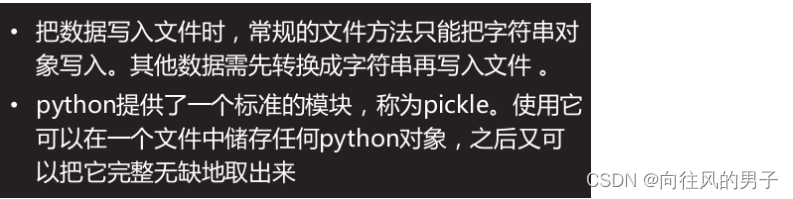
可以将任意的数据类型写到文件,还可以无损地取出
- >>> import pickle
- >>> shopping_list = ['apple','banana','egg','orange']
- #将列表写入文件
- >>> with open('/tmp/shopping.data' , 'wb') as fobj :
- ... pickle.dump(shopping_list,fobj)
- ...
- #在文件中将列表取出
- >>> with open('/tmp/shopping.data' , 'rb') as fobj :
- ... alist = pickle.load(fobj)
- ...
- >>> type(alist)
- <class 'list'>
- >>> alist
- ['apple', 'banana', 'egg', 'orange']
- >>>
案例练习:
记账程序:
- import pickle
- import os
- from time import strftime
- def save(fname):
- '记录收入'
- date = strftime('%Y-%m-%d')
- try:
- amount = int(input('金额: '))
- comment = input('备注: ')
- except ValueError:
- print('输入的金额无效')
- return
- except (KeyboardInterrupt,EOFError):
- print('\nbye')
- exit(1)
- # 在fname文件中取出最新余额,加上当前收入金额,即为最新余额
- with open(fname,'rb') as fobj:
- records = pickle.load(fobj)
- balance = records[-1][-2] + amount
- #将最新记录添加到文件中
- record = [date, amount, 0, balance, comment]
- records.append(record)
- with open(fname,'wb') as fobj:
- pickle.dump(records, fobj)
- def cost(fname):
- '记录支出'
- date = strftime('%Y-%m-%d')
- try:
- amount = int(input('金额: '))
- comment = input('备注: ')
- except ValueError:
- print('输入的金额无效')
- return
- except (KeyboardInterrupt,EOFError):
- print('\nbye')
- exit(1)
- # 在fname文件中取出最新余额,减去当前支出金额,即为最新余额
- with open(fname,'rb') as fobj:
- records = pickle.load(fobj)
- balance = records[-1][-2] - amount
- #将最新记录添加到文件中
- record = [date, 0, amount, balance, comment]
- records.append(record)
- with open(fname,'wb') as fobj:
- pickle.dump(records, fobj)
- def query(fname):
- '查询'
- #打印表头
- print('%-12s%-8s%-8s%-12s%-20s' % ('date','save','cost','balance','comment'))
- #取出全部记录:
- with open(fname , 'rb') as fobj:
- records = pickle.load(fobj)
- #打印记录
- for record in records:
- print('%-12s%-8s%-8s%-12s%-20s' % tuple(record))
- def show_menu():
- cmds = {'0':save,'1':cost,'2':query}
- menu = """(0) 收入
- (1) 支出
- (2) 查询
- (3) 退出
- 请选择(0/1/2/3): """
- fname = 'account.data'
- init_data = [
- ['2019-12-10',0,0,10000,'init data']
- ]
- #如果文件不存在,则创建并且写入初始化数据
- if not os.path.exists(fname):
- with open(fname,'wb') as fobj:
- pickle.dump(init_data,fobj)
- while 1:
- try:
- choice = input(menu).strip()
- except (EOFError, KeyboardInterrupt):
- choice = '3'
- # except KeyError:
- # print('无效输入:')
- # continue
- # except ValueError:
- # print('请按照提示数字输入,谢谢')
- if choice not in ['0','1','2','3']:
- print('无效输入,请根据提示数字输入,谢谢')
- continue
- if choice == '3' :
- print('bye-bye')
- break
- cmds[choice](fname)
- if __name__ == '__main__':
- show_menu()
-
-
相关阅读:
RHCSA认证考试---12.查找字符串
OpenSceneGraph3.5.1编译
[硬件基础]-555定时器-非稳态多谐振荡器配置
BGP边界网关路由实验(华为)
怎么做 Redis 容灾
LeetCode——1455.检查单词是否为句中其他单词的前缀
konva 系列教程 1:konva 是什么?
【单调队列】
开源媒体浏览器Kyoo
梦想编织者——Adobe Dreamweaver
- 原文地址:https://blog.csdn.net/zerotoall/article/details/133131493