-
动态规划-货币问题
动态规划-货币问题
题目一
arr是货币数组,其中的值都是正数。再给定一个正数aim。每个值都认为是一张货币,即便是值相同的货币也认为每一张都是不同的,返回组成aim的方法数。例如 : arr = { 1,1,1 },aim = 2,第0个和第1个能组成2,第1个和第2个能组成2,第0个和第2个能组成2,一共3种方法,所以返回3
从递归入手,对于每一个货币,要么选,要么不选,那么递归代码如下:
int MethodCount1(vector<int>& arr, int aim) { return process1(arr, aim, 0, 0);//从0位置开始的总方法数 } int process1(vector<int>& arr, int aim, int curIndex, int total) { if (total == aim) { return 1; } if (total > aim || curIndex == arr.size()) { return 0; } //1.选择当前位置 int p1 = process1(arr, aim, curIndex + 1, total + arr[curIndex]); //2.不选 int p2 = process1(arr, aim, curIndex + 1, total); return p1 + p2; }- 1
- 2
- 3
- 4
- 5
- 6
- 7
- 8
- 9
- 10
- 11
- 12
- 13
- 14
- 15
- 16
其中process1的参数含义如下:
- curIndex:表示当前正在arr的curIndex位置做决策(是否选择curIndex位置的货币)
- total:表示在curIndex之前做的决策已经积累了多少货币
递归终止条件:
- total==aim,表示当前来到curIndex位置是,前面做的决策组成的总货币数量正好等于title,可以直接返回1,表示前面做的决策是正确的,同时后面不应该继续决策(否则total会大于aim)
- total>aim,表示前面做的决策是错误的,返回0种方法
- total
当来到某一个位置时,可以选择使用当前位置的货币,对应p1,也可以选择不使用当前位置的货币,对应p2,然后在到下一个为止去做选择,这是2种不同的选择,所以总的方法数为p1+p2
递归过程中是否存在重复子过程?
具有重复子过程的递归才有改动态规划的意义,上面的递归过程是可能存在重复子过程的,以[1,1,1,2,5,3],aim=7为例,可以选择下标为0和下标为1位置的1,不选择下标为2位置的1,于是就来到了下标为3的位置,此时total=2;也可以选择下标为1和下标为2位置的1,不选择下标为0位置的1,也来到了下标为3的位置,total=2,来到下标为3的位置,total=2出现了重复,因此上述递归过程存在重复子过程,改动态规划有利可图
动态规划
-
分析可变参数的变化范围,在递归过程中,可变参数只有2个,curIndex和total,curIndex的变化范围是[0,arr.size()],total的变化范围是[0,aim],在递归过程中,虽然可能存在total>aim的情况,但是此时的返回值是确定的,为0,可以在改动态规划时进行边界判断,因此dp表的大小为
arr.size()*aim -
分析位置依赖,从递归过程可以看出,
process1(curIndex,total)依赖于process1(curIndex + 1, total)和process1(curIndex + 1, total + arr[curIndex]),反应到dp表中就是当前行只依赖于下一行的数据,因此在填表时从最后一行开始填即可 -
状态转移方程,递归的过程就是状态转移方程,
process1(curIndex,total)依赖于process1(curIndex + 1, total)和process1(curIndex + 1, total + arr[curIndex]),所以状态转移方程就是dp[i][j]=dp[i+1][j]+dp[i+1][j+arr[i]] -
初始化,dp表的初始化就是递归过程的临界条件,当total==aim的时候,无论curIndex为和值,结果都是1,当total!=aim,total > aim || curIndex == arr.size()时,结果是0
-
动态规划代码:
int MethodCount1dp(vector<int>& arr, int aim) { //可变参数为curIndex和total //curIndex->[0,arr.size()] //total->[0,aim],因为当total>aim时返回0 vector<vector<int>> dp(arr.size() + 1, vector<int>(aim + 1)); for (int curIndex = 0; curIndex <= arr.size(); curIndex++) { dp[curIndex][aim] = 1;//total==aim时 } for (int curIndex = arr.size() - 1; curIndex >= 0; curIndex--) {//从最后一行开始填表 for (int total = 0; total < aim; total++) { //total从左往后或从右往左填无所谓 //循环条件为total- 1
- 2
- 3
- 4
- 5
- 6
- 7
- 8
- 9
- 10
- 11
- 12
- 13
- 14
- 15
- 16
- 17
- 18
- 19
题目二
arr是面值数组,其中的值都是正数且没有重复。再给定一个正数aim。每个值都认为是一种面值,且认为张数是无限的。返回组成aim的方法数例如︰arr = {1,2}, aim = 4。方法如下∶1 + 1 + 1 + 1、1 + 1 + 2、2 + 2一共3种方法,所以返回3。
递归过程与题目1类似,均为从左往右的尝试模型,只是每一种面值都可以选择无限多张,在递归时需要注意选择的总面额要<=aim,递归过程:
int MethodCount2(vector<int>& arr, int aim) { //暴力递归:每一个位置可以选择多次 return process2(arr, 0, aim);//当前在0位置,还需要凑齐aim元的方法 } int process2(vector<int>& arr, int Index, int rest) { if (rest == 0) { return 1; } if (Index == arr.size()) {//不会出现aim<0的情况,因为在for循环中已经避免 return 0; } int ans = 0; //当前位置可以选很多次 for (int cnt = 0; cnt * arr[Index] <= rest; cnt++) { ans += process2(arr, Index + 1, rest - (cnt * arr[Index])); } return ans; }- 1
- 2
- 3
- 4
- 5
- 6
- 7
- 8
- 9
- 10
- 11
- 12
- 13
- 14
- 15
- 16
- 17
- 18
参数含义:
- Index,表示当前正在Index位置做决策
- rest,还需要凑总计rest价值的面额,当rest==0时表示不需要凑面额了,也就是找到了一种方法。第二个参数也可以定义为目前已经凑到的面额数,这样就与题目1一样,只要逻辑上合理即可
递归过程:
- 当rest==0时,表示还需要凑0价值的面额,表示前面所做的决策是正确的,找到了1种方法
- rest>0&&Index == arr.size(),表示已经达到结尾,但是还有rest面额需要去凑,此时返回0
- rest>0&&Index < arr.size(),此时可以选择自由选择Index位置的面额,可以选1次、2次、……,不过需要注意的是,选择n次之后rest应该保证大于0,例如需要凑5元的面值,不能选6张1块的,通过
cnt * arr[Index] <= rest可以保证这一点 - 递归过程中不可能出现rest<0的情况,因为主函数在调用process2时传入的rest一定大于0,在process2中,for循环内调用process2也保证了rest>=0,因此整个过程rest>=0
动态规划
在process2过程中,process2(Index,rest)依赖于process2(Index+1,……),当前行只依赖于下一行的数据,因此在填dp表时,从最后一行开始填
int MethodCount2dp(vector<int>& arr, int aim) { //Index->[0,arr.size()] //rest->[0,aim] vector<vector<int>> dp(arr.size() + 1, vector<int>(aim + 1)); for (int i = 0; i <= arr.size(); i++) { dp[i][0] = 1;//rest==0,return 1 } for (int Index = arr.size() - 1; Index >= 0; Index--) { for (int rest = 1; rest <= aim; rest++) {//rest==0已经填过了 int ans = 0; for (int cnt = 0; cnt * arr[Index] <= rest; cnt++) { ans += dp[Index + 1][rest - (cnt * arr[Index])]; } dp[Index][rest] = ans; } } return dp[0][aim]; }- 1
- 2
- 3
- 4
- 5
- 6
- 7
- 8
- 9
- 10
- 11
- 12
- 13
- 14
- 15
- 16
- 17
- 18
分析位置依赖
在动态规划方法的填表过程中,确定一个位置需要通过for循环完成,我们可以画出位置依赖图

假设rest=7,当前来到2号下标做选择,arr[2]=3,那么根据for循环代码,(rest,Index)位置依赖于下一行的图示位置A、B和C,同时还可以观察出(rest-arr[Index],Index)依赖于下一行的A和B,所以一个位置实际上依赖于它左边的位置和它下方的位置,因此动态规划的状态转移方程可以简化为
dp[Index][rest]=dp[Index+1][rest]+dp[Index][rest-arr[Index]](需要处理边界),这是通过分析位置依赖得出的结论。所以上面的代码可以改写为:int MethodCount2dp(vector<int>& arr, int aim) { vector<vector<int>> dp(arr.size() + 1, vector<int>(aim + 1)); for (int i = 0; i <= arr.size(); i++) { dp[i][0] = 1; } for (int Index = arr.size() - 1; Index >= 0; Index--) { for (int rest = 1; rest <= aim; rest++) {//rest==0已经填过了 dp[Index][rest]=dp[Index+1][rest]; if(rest-arr[Index]>=0){ dp[Index][rest]+=dp[Index][rest-arr[Index]]; } } } return dp[0][aim]; }- 1
- 2
- 3
- 4
- 5
- 6
- 7
- 8
- 9
- 10
- 11
- 12
- 13
- 14
- 15
题目三
arr是货币数组,其中的值都是正数。再给定一个正数aim。每个值都认为是一张货币,认为值相同的货币没有任何不同,返回组成aim的方法数。例如 : arr = {1,2,1,1,2,1,2}, aim = 4,方法∶1 + 1 + 1 + 1、1 + 1 + 2、2 + 2一共就3种方法,所以返回3
题目3中需要统计出每种面值出现的次数,递归过程也是采用从左往右进行尝试
int MethodCount3(vector<int>& arr, int aim) { vector<int> counts;//统计张数 vector<int> money; unordered_map<int, int> hashMap; for (int m : arr) { hashMap[m]++; } for (auto [m, c] : hashMap) { money.push_back(m); counts.push_back(c); } return process3(money, counts, 0, aim); } int process3(vector<int>& money, vector<int>& counts, int Index, int rest) { if (rest == 0) { return 1; } if (Index == money.size()) { return 0;//rest>0 } int ans = 0; for (int cnt = 0; cnt <= counts[Index] && rest - cnt * money[Index] >= 0; cnt++) { ans += process3(money, counts, Index + 1, rest - cnt * money[Index]); } return ans; }- 1
- 2
- 3
- 4
- 5
- 6
- 7
- 8
- 9
- 10
- 11
- 12
- 13
- 14
- 15
- 16
- 17
- 18
- 19
- 20
- 21
- 22
- 23
- 24
- 25
- 26
与题目2不同的是,题目3中的for循环除了保证rest减完之后大于0,还要保证在Index位置使用的货币数量不能超过原数组中对应的面值数量。
动态规划
由递归过程可以比较容易的改出动态规划版本
int MethodCount3dp(vector<int>& arr, int aim) { vector<int> counts; vector<int> money; unordered_map<int, int> hashMap; for (int m : arr) { hashMap[m]++; } for (auto [m, c] : hashMap) { money.push_back(m); counts.push_back(c); } vector<vector<int>> dp(money.size() + 1, vector<int>(aim + 1)); for (int i = 0; i <= money.size(); i++) { dp[i][0] = 1; } for (int Index = money.size() - 1; Index >= 0; Index--) { for (int rest = 0; rest <= aim; rest++) { int ans = 0; for (int cnt = 0; cnt <= counts[Index] && rest - cnt * money[Index] >= 0; cnt++) { ans += dp[Index + 1][rest - cnt * money[Index]]; } dp[Index][rest] = ans; } } return dp[0][aim]; }- 1
- 2
- 3
- 4
- 5
- 6
- 7
- 8
- 9
- 10
- 11
- 12
- 13
- 14
- 15
- 16
- 17
- 18
- 19
- 20
- 21
- 22
- 23
- 24
- 25
- 26
分析位置依赖
假设来到Index=2位置做决策,并假设此时rest=11,money[2]=3,counts[2]=2,则位置依赖如图:
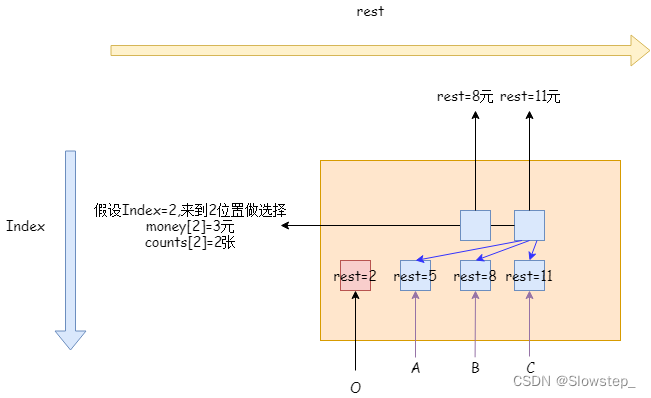
通过观察可以发现:
dp[Index][rest]=dp[Index+1][rest]+dp[Index][rest-money[Index]]-O点(需要对边界进行额外处理),O点的坐标为(Index+1,rest-(counts[Index]+1)*money[Index])。优化代码:int MethodCount3dp2(vector<int>& arr, int aim) { vector<int> counts; vector<int> money; unordered_map<int, int> hashMap; for (int m : arr) { hashMap[m]++; } for (auto [m, c] : hashMap) { money.push_back(m); counts.push_back(c); } vector<vector<int>> dp(money.size() + 1, vector<int>(aim + 1)); for (int i = 0; i <= money.size(); i++) { dp[i][0] = 1; } for (int Index = money.size() - 1; Index >= 0; Index--) { for (int rest = 0; rest <= aim; rest++) { dp[Index][rest] = dp[Index + 1][rest]; if (rest - money[Index] >= 0) { dp[Index][rest] += dp[Index][rest - money[Index]]; } if (rest - (counts[Index] + 1) * money[Index] > 0) { dp[Index][rest] -= dp[Index + 1][rest - (counts[Index] + 1) * money[Index]]; } } } return dp[0][aim]; }- 1
- 2
- 3
- 4
- 5
- 6
- 7
- 8
- 9
- 10
- 11
- 12
- 13
- 14
- 15
- 16
- 17
- 18
- 19
- 20
- 21
- 22
- 23
- 24
- 25
- 26
- 27
- 28
- 29
总结
有重复子过程的递归可以尝试将其改写为动态规划,这样会使得解决问题的时间复杂度大大减小,动态规划的状态转移方程其实就是递归的尝试过程,dp表的初始化就是递归的出口,dp表的填表顺序取决于尝试策略,在填表时,若确定dp表的一个位置需要使用for循环,应该尝试分析递归过程和位置依赖,以确定是否可以做进一步的优化。
-
相关阅读:
代码随想录算法训练营20期|第三十一天|● 理论基础 ● 455.分发饼干 ● 376. 摆动序列 ● 53. 最大子序和
kindle自定义屏保之自定义字帖
软件架构设计(八) 基于架构的软件开发方法
Linux Ubuntu20.04深度学习环境快速配置命令记录
NSSCTF做题第9页(3)
EF Core:基于关系的复杂查询 区分IEnumerable和IQueryable
【前端】JavaScript变量
milvus和相似度检索
使用RNN联合注意力机制实现机器翻译
easyui disabled 属性设置
- 原文地址:https://blog.csdn.net/Slowstep_/article/details/132948676

- 最新文章
-
沪漂五周年了:我越来越迷茫了
Agentic Skill Routing 实战:别再把所有 Skill 塞进 AI Agent 上下文
MySQL-Seconds_behind_master的精度误差
[MAF预定义ChatClient中间件-03]CachingChatClient——利用缓存省钱省时间
AI的至暗历史:从万众期待到被政府撤资,AI的两次死亡徘徊
Agent OS :五种驯服不确定性的范式
PortSwigger SQL注入LAB11
数据库即时编译JIT
[Begin]AI Learn Data Day 0
深度学习进阶(二十七)现代 LLM 的核心架构设计其二:SwiGLU