-
驱动开发,IO多路复用实现过程,epoll方式
1.框架图
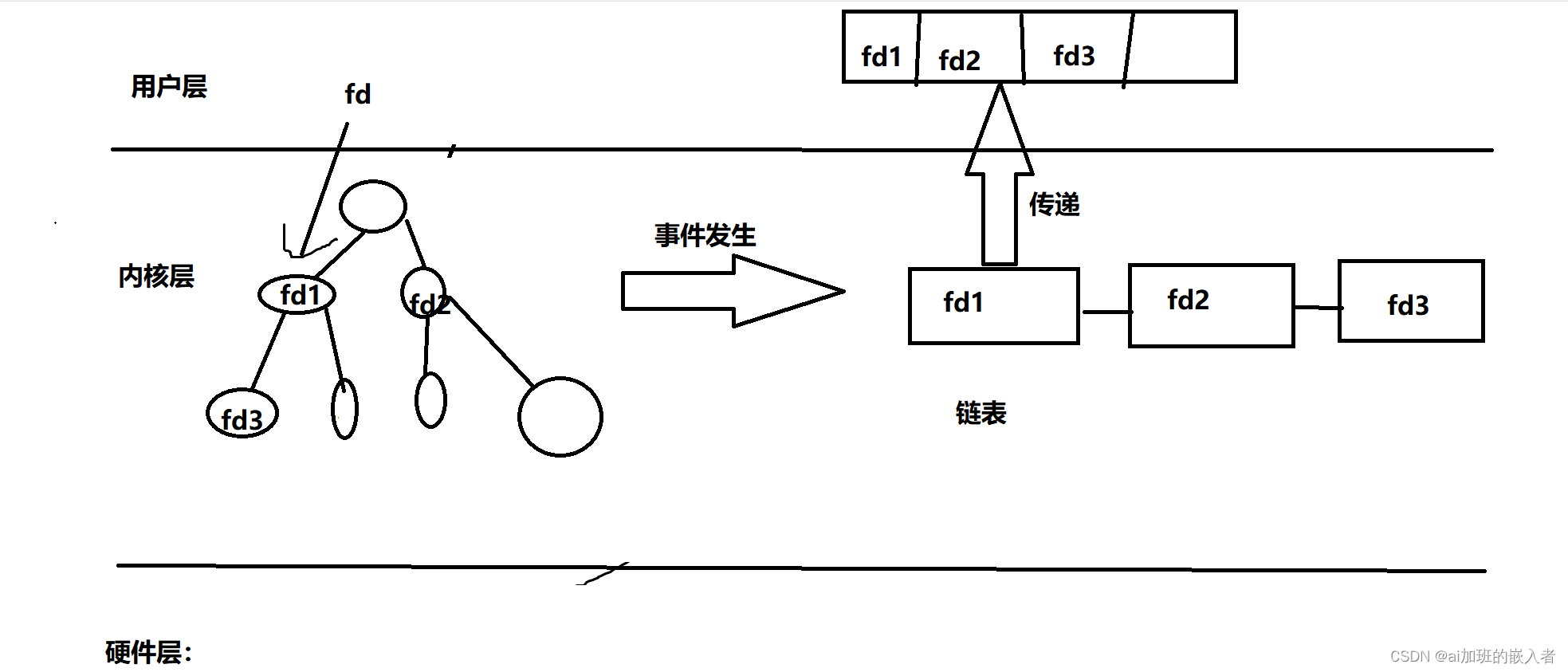
被称为当前时代最好用的io多路复用方式;
核心操作:一棵树(红黑树)、一张表(内核链表)以及三个接口;
思想:(fd代表文件描述符)
epoll要把检测的事件fd挂载到内核空间红黑树上,遍历红黑树,调用每个fd对应的操作方法,找到发生事件的fd,如果没有发生事件的fd,进程休眠,如果事件发生,将发生事件的fd拷贝一份放到内核链表,每个节点对应一个fd,最后把链表的节点信息传递到用户空间的数组中,用户空间无需判断事件的发生,需要判断事件类型(读写等);
2.代码
---pro1.c---应用程序(epoll方式)
- #include <sys/types.h>
- #include <sys/stat.h>
- #include <fcntl.h>
- #include <stdio.h>
- #include <string.h>
- #include <unistd.h>
- #include <stdlib.h>
- #include <sys/ioctl.h>
- #include <sys/select.h>
- #include <sys/time.h>
- #include <sys/epoll.h>
- int main(int argc, const char *argv[])
- {
- int fd1,fd2,epfd;
- char buf[128] = {0};
- struct epoll_event event; //用于操作epoll
- struct epoll_event events[10]; //用户空间存放发生事件的数组
- //创建epoll句柄,红黑树根节点
- epfd = epoll_create(1);
- if(epfd < 0)
- {
- printf("epoll_create fail\n");
- exit(-1);
- }
- //打开设备文件
- fd1 = open("/dev/input/mouse0", O_RDWR);
- if (fd1 < 0)
- {
- printf("鼠标事件文件失败\n");
- exit(-1);
- }
- fd2 = open("/dev/myled0", O_RDWR);
- if (fd2 < 0)
- {
- printf("自定义事件文件失败\n");
- exit(-1);
- }
- //添加准备就绪事件到epoll
- event.events = EPOLLIN; //读事件
- event.data.fd = fd1;
- if((epoll_ctl(epfd,EPOLL_CTL_ADD,fd1,&event)) < 0)
- {
- printf("epoll_ctl fd1 fail\n");
- }
- event.events = EPOLLIN; //读事件
- event.data.fd = fd2;
- if((epoll_ctl(epfd,EPOLL_CTL_ADD,fd2,&event)) < 0)
- {
- printf("epoll_ctl fd2 fail\n");
- }
- //监听时间是否发生
- while(1)
- {
- //成功接收返回时间的个数,放入events数组中
- int ret = epoll_wait(epfd,events,10,-1);
- if(ret < 0)
- {
- printf("epoll_wait fail\n");
- exit(-1);
- }
- int i;
- //循环遍历数组,做事件的处理
- for(i=0; i<ret; i++)
- {
- if(events[i].events & EPOLLIN) //发生事件是读事件
- {
- read(events[i].data.fd,buf,sizeof(buf));
- printf("buf:%s\n",buf);
- memset(buf,0,sizeof(buf));
- }
- }
- }
- close(fd1);
- close(fd2);
- return 0;
- }
---pro2.c---应用程序(模拟自定义设备数据就绪)
- #include <sys/types.h>
- #include <sys/stat.h>
- #include <fcntl.h>
- #include <stdio.h>
- #include <string.h>
- #include <unistd.h>
- #include <stdlib.h>
- int main(int argc, const char *argv[])
- {
- char buf[128] = "hello world";
- int fd = open("/dev/myled0", O_RDWR);
- if (fd < 0)
- {
- printf("打开设备文件失败\n");
- exit(-1);
- }
- write(fd, buf, sizeof(buf));
- close(fd);
- return 0;
- }
---epoll.c---驱动程序
- #include <linux/init.h>
- #include <linux/module.h>
- #include <linux/fs.h>
- #include <linux/io.h>
- #include <linux/device.h>
- #include <linux/uaccess.h>
- #include <linux/wait.h>
- #include<linux/poll.h>
- char kbuf[128] = {0};
- unsigned int major;
- struct class *cls;
- struct device *dev;
- unsigned int condition = 0;
- // 定义一个等待队列头
- wait_queue_head_t wq_head;
- // 封装操作方法
- int mycdev_open(struct inode *inode, struct file *file)
- {
- printk("%s:%s:%d\n", __FILE__, __func__, __LINE__);
- return 0;
- }
- ssize_t mycdev_read(struct file *file, char *ubuf, size_t size, loff_t *lof)
- {
- int ret;
- ret = copy_to_user(ubuf, kbuf, size);
- if (ret)
- {
- printk("copy_to_ user err\n");
- return -EIO;
- }
- condition = 0; // 下一次硬件数据没有就绪
- return 0;
- }
- ssize_t mycdev_write(struct file *file, const char *ubuf, size_t size, loff_t *lof)
- {
- int ret;
- // 从用户拷贝数据,模拟硬件数据
- ret = copy_from_user(kbuf, ubuf, size);
- if (ret)
- {
- printk("copy_from_user err\n");
- return -EIO;
- }
- condition = 1;
- wake_up_interruptible(&wq_head);
- return 0;
- }
- //封装POLL方法
- __poll_t mycdev_poll(struct file *file, struct poll_table_struct *wait)
- {
- __poll_t mask = 0;
- //向上提交等待队列头
- poll_wait(file,&wq_head,wait);
- //根据事件是否发生给一个合适的返回值
- if(condition)
- {
- mask = POLLIN;
- }
- return mask;
- }
- int mycdev_close(struct inode *inode, struct file *file)
- {
- printk("%s:%s:%d\n", __FILE__, __func__, __LINE__);
- return 0;
- }
- struct file_operations fops = {
- .open = mycdev_open,
- .read = mycdev_read,
- .poll = mycdev_poll,
- .write = mycdev_write,
- .release = mycdev_close,
- };
- // 入口函数
- static int __init mycdev_init(void)
- {
- //初始化等待队列
- init_waitqueue_head(&wq_head);
- major = register_chrdev(0, "myled", &fops);
- if (major < 0)
- {
- printk("字符设备驱动注册失败\n");
- return major;
- }
- printk("字符设备驱动注册成功:major=%d\n", major);
- // 向上提交目录
- cls = class_create(THIS_MODULE, "MYLED");
- if (IS_ERR(cls))
- {
- printk("向上提交目录失败\n");
- return -PTR_ERR(cls);
- }
- printk("向上提交目录成功\n");
- // 向上提交设备节点信息
- int i;
- for (i = 0; i < 3; i++)
- {
- dev = device_create(cls, NULL, MKDEV(major, i), NULL, "myled%d", i);
- if (IS_ERR(dev))
- {
- printk("向上提交设备节点信息失败\n");
- return -PTR_ERR(dev);
- }
- }
- printk("向上提交设备节点信息成功\n");
- return 0;
- }
- // 出口函数
- static void __exit mycdev_exit(void)
- {
- // 销毁设备节点信息
- int i;
- for (i = 0; i < 3; i++)
- {
- device_destroy(cls, MKDEV(major, i));
- }
- // 销毁目录信息
- class_destroy(cls);
- // 字符设备驱动注销
- unregister_chrdev(major, "myled");
- }
- // 声明
- // 入口函数地址
- module_init(mycdev_init);
- // 出口函数地址
- module_exit(mycdev_exit);
- // 遵循的GPL协议
- MODULE_LICENSE("GPL");
3.测试结果
执行pro2.c,自定义事件被监听到;
在ubuntu上动鼠标,鼠标事件被监听;

-
相关阅读:
os_cfg.h、os_cpu.h和ucos_ii.h
在centos7下docker 制作 java8镜像,上传到阿里云镜像仓库
第11章 AOF持久化
qt中qstring合并字符串
安装和应用anaconda过程中的一些问题
为什么说网络安全是风口行业?是it行业最后的红利?
2023.10.17
CMakeLists编译前拷贝文件或目录
虚拟机使用 WinSCP & Putty
前端入门学习笔记四十六
- 原文地址:https://blog.csdn.net/weixin_46260677/article/details/132911473
