-
2-2 自动微分机制
神经网络是如何更新网络参数的呢?
为什么需要自动微分机制?
以及什么是自动微分机制?
神经网络通常依赖反向传播求梯度来更新网络参数,求梯度过程通常是一件非常复杂而容易出错的事情。而深度学习框架可以帮助我们自动地完成这种求梯度运算。
Pytorch一般通过反向传播 backward 方法 实现这种求梯度计算。该方法求得的梯度将存在对应自变量张量的grad属性下。
除此之外,也能够调用torch.autograd.grad 函数来实现求梯度计算。
这就是Pytorch的自动微分机制。一、利用backward方法求导数
backward 方法通常在一个标量张量上调用,该方法求得的梯度将存在对应自变量张量的grad属性下。
如果调用的张量非标量,则要传入一个和它同形状的gradient参数张量。
相当于用该gradient参数张量与调用张量作向量点乘,得到的标量结果再反向传播。1.标量的反向传播
import numpy as np import torch # f(x) = a*x**2 + b*x + c的导数 x = torch.tensor(0.0,requires_grad = True) # x需要被求导 a = torch.tensor(1.0) b = torch.tensor(-2.0) c = torch.tensor(1.0) y = a*torch.pow(x,2) + b*x + c y.backward() # 利用backward() 注意是y调用这个方法 而前面已经说明 x 需要被求导 dy_dx = x.grad # print(dy_dx)- 1
- 2
- 3
- 4
- 5
- 6
- 7
- 8
- 9
- 10
- 11
- 12
- 13
- 14
- 15

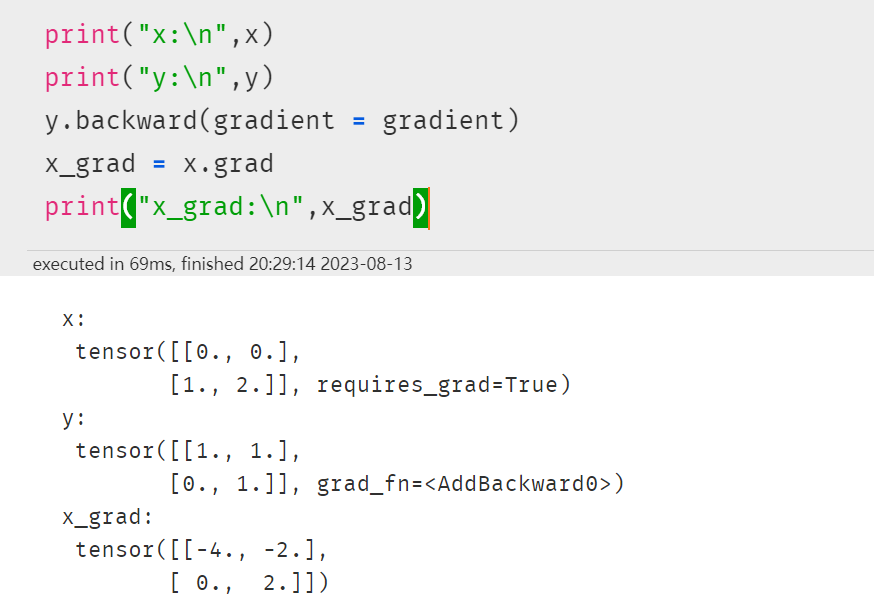
2.非标量的反向传播
如果调用的张量非标量,则要传入一个和它同形状 的gradient参数张量。
import numpy as np import torch # f(x) = a*x**2 + b*x + c x = torch.tensor([[0.0,0.0],[1.0,2.0]],requires_grad = True) # x需要被求导 a = torch.tensor(1.0) b = torch.tensor(-2.0) c = torch.tensor(1.0) y = a*torch.pow(x,2) + b*x + c gradient = torch.tensor([[1.0,1.0],[1.0,1.0]]) print("x:\n",x) print("y:\n",y) y.backward(gradient = gradient) x_grad = x.grad print("x_grad:\n",x_grad)- 1
- 2
- 3
- 4
- 5
- 6
- 7
- 8
- 9
- 10
- 11
- 12
- 13
- 14
- 15
- 16
- 17
- 18
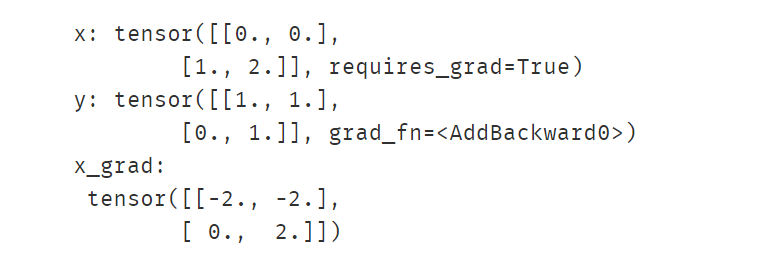
3.非标量的反向传播可以用标量的反向传播实现
接2 2就相当于用该gradient参数张量与调用张量作向量点乘,得到的标量结果再反向传播。
import numpy as np import torch # f(x) = a*x**2 + b*x + c x = torch.tensor([[0.0,0.0],[1.0,2.0]],requires_grad = True) # x需要被求导 a = torch.tensor(1.0) b = torch.tensor(-2.0) c = torch.tensor(1.0) y = a*torch.pow(x,2) + b*x + c gradient = torch.tensor([[1.0,1.0],[1.0,1.0]]) z = torch.sum(y*gradient) # torch.sum计算标量相乘获取标量之后再反向传播 print("x:",x) print("y:",y) z.backward() x_grad = x.grad print("x_grad:\n",x_grad)- 1
- 2
- 3
- 4
- 5
- 6
- 7
- 8
- 9
- 10
- 11
- 12
- 13
- 14
- 15
- 16
- 17
- 18
- 19
- 20
二、利用autograd.grad方法求导数
import numpy as np import torch # f(x) = a*x**2 + b*x + c的导数 x = torch.tensor(0.0,requires_grad = True) # x需要被求导 a = torch.tensor(1.0) b = torch.tensor(-2.0) c = torch.tensor(1.0) y = a*torch.pow(x,2) + b*x + c # create_graph 设置为 True 将允许创建更高阶的导数 dy_dx = torch.autograd.grad(y,x,create_graph=True)[0] # 去除[0]报错 AttributeError: 'tuple' object has no attribute 'data' print(dy_dx.data) # 一阶导 # 求二阶导数 dy2_dx2 = torch.autograd.grad(dy_dx,x)[0] print(dy2_dx2.data) # 二阶导- 1
- 2
- 3
- 4
- 5
- 6
- 7
- 8
- 9
- 10
- 11
- 12
- 13
- 14
- 15
- 16
- 17
- 18
- 19
- 20
- 21
- 22

import numpy as np import torch x1 = torch.tensor(1.0,requires_grad = True) # x需要被求导 x2 = torch.tensor(2.0,requires_grad = True) y1 = x1*x2 y2 = x1+x2 # 允许同时对多个自变量求导数 (dy1_dx1,dy1_dx2) = torch.autograd.grad(outputs=y1,inputs = [x1,x2],retain_graph = True) print(dy1_dx1,dy1_dx2) # 如果有多个因变量,相当于把多个因变量的梯度结果求和 (dy12_dx1,dy12_dx2) = torch.autograd.grad(outputs=[y1,y2],inputs = [x1,x2]) print(dy12_dx1,dy12_dx2)- 1
- 2
- 3
- 4
- 5
- 6
- 7
- 8
- 9
- 10
- 11
- 12
- 13
- 14
- 15
- 16
- 17
- 18
- 19

三、利用自动微分和优化器求最小值
import numpy as np import torch # f(x) = a*x**2 + b*x + c的最小值 x = torch.tensor(0.0,requires_grad = True) # x需要被求导 a = torch.tensor(1.0) b = torch.tensor(-2.0) c = torch.tensor(1.0) optimizer = torch.optim.SGD(params=[x],lr = 0.01) def f(x): result = a*torch.pow(x,2) + b*x + c return(result) for i in range(500): optimizer.zero_grad() y = f(x) y.backward() optimizer.step() print("y=",f(x).data,";","x=",x.data) # 当 x=0 时 y取得最小值0- 1
- 2
- 3
- 4
- 5
- 6
- 7
- 8
- 9
- 10
- 11
- 12
- 13
- 14
- 15
- 16
- 17
- 18
- 19
- 20
- 21
- 22
- 23
- 24
- 25
-
相关阅读:
【Express连接MySQL数据库】
如何获取淘宝商品评论 API接口
HNU工训中心STC-B学习板大作业-基于OLED模块的多功能MP4
Spring(四)- Spring配置非自定义Bean
Flume的简介
归并排序算法(思路分析) [数据结构][Java]
【Network】网络基础@应用层 —— 协议 | http | https
vscode调教配置:快捷修复和格式化代码
Java集合面试题(总结最全面的面试题)
TypeError: copytree() got an unexpected keyword argument ‘dirs_exist_ok‘
- 原文地址:https://blog.csdn.net/hxhabcd123/article/details/132863950

