-
ROS2中如何从欧拉角转换成四元素
ROS1中使用from tf.transformations import quaternion_from_euler导入quaternion_from_euler()即可调用。而ROS2中默认没有安装,需要单独安装一下ros-galactic-tf-transformations(我使用的ROS2是galactic,根据版本名不同做相应修改即可):
- sudo apt-get update
- sudo apt-get install ros-galactic-tf-transformations
然后导入包,不过包名改成了tf_transformations
- import tf_transformations
- # 将欧拉角转换为四元数(roll, pitch, yaw)
- q = tf_transformations.quaternion_from_euler(roll, pitch, yaw)
- # 将四元素转换成欧拉角
- euler = tf_transformations.euler_from_quaternion([x, y, z, w])
不安装tf_transformations的话,还可以安装其它工具包来替代,例如python的第三方quaternions包:
pip install quaternions -i http://mirrors.aliyun.com/pypi/simple/ --trusted-host mirrors.aliyun.com- from quaternions import Quaternion as Quaternion
- euler = [0.98012,0.5232,0.2105] # ROLL PITCH HEADING
- q = Quaternion.from_euler(euler, axes = ['y', 'y', 'x']) # a= (w, x, y, z)
- e = Quaternion.get_euler(q) # e = (Heading, Pitch, Roll)
需要注意的是ROS在gemetry_msgs包里已定义有Quaternion类,另外ROS1里tf2里也定义有Quaternion,同时使用时注意用别名或包名区分。
另外,也可以安装trimesh工具包后使用里面的quaternion_from_euler
pip3.8 install trimesh -i http://mirrors.aliyun.com/pypi/simple/ --trusted-host mirrors.aliyun.com- from trimesh.transformations import quaternion_from_euler
- from geometry_msgs.msg import Quaternion as GeoQuaternion
- def createQuaternionFromYaw(yaw):
- q = quaternion_from_euler(0, 0, yaw)
- return GeoQuaternion(x=q[0],y=q[1],z=q[2],w=q[3])
看一下trimesh里/usr/local/lib/python3.8/dist-packages/trimesh/transformations.py里的quaternion_from_euler()的源码和/opt/ros/galactic/lib/python3.8/site-packages/tf_transformations/__init__.py里的quaternion_from_euler()代码,发现功能实现基本一致:
- # axis sequences for Euler angles
- _NEXT_AXIS = [1, 2, 0, 1]
- # map axes strings to/from tuples of inner axis, parity, repetition, frame
- _AXES2TUPLE = {
- 'sxyz': (0, 0, 0, 0), 'sxyx': (0, 0, 1, 0), 'sxzy': (0, 1, 0, 0),
- 'sxzx': (0, 1, 1, 0), 'syzx': (1, 0, 0, 0), 'syzy': (1, 0, 1, 0),
- 'syxz': (1, 1, 0, 0), 'syxy': (1, 1, 1, 0), 'szxy': (2, 0, 0, 0),
- 'szxz': (2, 0, 1, 0), 'szyx': (2, 1, 0, 0), 'szyz': (2, 1, 1, 0),
- 'rzyx': (0, 0, 0, 1), 'rxyx': (0, 0, 1, 1), 'ryzx': (0, 1, 0, 1),
- 'rxzx': (0, 1, 1, 1), 'rxzy': (1, 0, 0, 1), 'ryzy': (1, 0, 1, 1),
- 'rzxy': (1, 1, 0, 1), 'ryxy': (1, 1, 1, 1), 'ryxz': (2, 0, 0, 1),
- 'rzxz': (2, 0, 1, 1), 'rxyz': (2, 1, 0, 1), 'rzyz': (2, 1, 1, 1)}
- _TUPLE2AXES = dict((v, k) for k, v in _AXES2TUPLE.items())
- ...
- def quaternion_from_euler(ai, aj, ak, axes='sxyz'):
- """Return quaternion from Euler angles and axis sequence.
- ai, aj, ak : Euler's roll, pitch and yaw angles
- axes : One of 24 axis sequences as string or encoded tuple
- >>> q = quaternion_from_euler(1, 2, 3, 'ryxz')
- >>> np.allclose(q, [0.435953, 0.310622, -0.718287, 0.444435])
- True
- """
- try:
- firstaxis, parity, repetition, frame = _AXES2TUPLE[axes.lower()]
- except (AttributeError, KeyError):
- _TUPLE2AXES[axes] # validation
- firstaxis, parity, repetition, frame = axes
- i = firstaxis + 1
- j = _NEXT_AXIS[i + parity - 1] + 1
- k = _NEXT_AXIS[i - parity] + 1
- if frame:
- ai, ak = ak, ai
- if parity:
- aj = -aj
- ai /= 2.0
- aj /= 2.0
- ak /= 2.0
- ci = math.cos(ai)
- si = math.sin(ai)
- cj = math.cos(aj)
- sj = math.sin(aj)
- ck = math.cos(ak)
- sk = math.sin(ak)
- cc = ci * ck
- cs = ci * sk
- sc = si * ck
- ss = si * sk
- q = np.empty((4, ))
- if repetition:
- q[0] = cj * (cc - ss)
- q[i] = cj * (cs + sc)
- q[j] = sj * (cc + ss)
- q[k] = sj * (cs - sc)
- else:
- q[0] = cj * cc + sj * ss
- q[i] = cj * sc - sj * cs
- q[j] = cj * ss + sj * cc
- q[k] = cj * cs - sj * sc
- if parity:
- q[j] *= -1.0
- return q
- def euler_from_quaternion(quaternion, axes='sxyz'):
- """Return Euler angles from quaternion for specified axis sequence.
- >>> angles = euler_from_quaternion([0.99810947, 0.06146124, 0, 0])
- >>> np.allclose(angles, [0.123, 0, 0])
- True
- """
- return euler_from_matrix(quaternion_matrix(quaternion), axes)
- def quaternion_from_euler(ai, aj, ak, axes='sxyz'):
- """
- Return quaternion from Euler angles and axis sequence.
- ai, aj, ak : Euler's roll, pitch and yaw angles
- axes : One of 24 axis sequences as string or encoded tuple
- >>> q = quaternion_from_euler(1, 2, 3, 'ryxz')
- >>> numpy.allclose(q, [0.310622, -0.718287, 0.444435, 0.435953])
- True
- """
- return _reorder_output_quaternion(
- transforms3d.euler.euler2quat(ai, aj, ak, axes=axes)
- )
- ...
- def euler_from_quaternion(quaternion, axes='sxyz'):
- """
- Return Euler angles from quaternion for specified axis sequence.
- >>> angles = euler_from_quaternion([0.06146124, 0, 0, 0.99810947])
- >>> numpy.allclose(angles, [0.123, 0, 0])
- True
- """
- return euler_from_matrix(quaternion_matrix(quaternion), axes)
另外,ros2默认安装的spawn_entity代码/opt/ros/galactic/lib/python3.8/site-packages/scripts/spawn_entity.py里的提供了一个简单实现:
- def quaternion_from_euler(roll, pitch, yaw):
- cy = math.cos(yaw * 0.5)
- sy = math.sin(yaw * 0.5)
- cp = math.cos(pitch * 0.5)
- sp = math.sin(pitch * 0.5)
- cr = math.cos(roll * 0.5)
- sr = math.sin(roll * 0.5)
- q = [0] * 4
- q[0] = cy * cp * cr + sy * sp * sr #w
- q[1] = cy * cp * sr - sy * sp * cr #x
- q[2] = sy * cp * sr + cy * sp * cr #y
- q[3] = sy * cp * cr - cy * sp * sr #z
- return q
可以看到这个实现没有提供坐标轴顺序参数axes,按默认的sxyz来的。
pyquaternion包里的Quaternion只提供了使用q[w,x,y,z]创建实例以及使用matrix创建实例或使用由3维向量指定的旋转轴和旋转角度(弧度)创建实例,当使用nuScenes数据集时,里面涉及的3Dbox的roation都是pyquaternion.Quaternion类型的(标注文件sample_annotations.json的rotation的值就是[w,x,y,z]形式),需要把3D检测模型输出的yaw角的弧度值转换成Quaternion后计算nuScenes指标时就需要使用上面的转换获得q[w,x,y,z]后,再直接使用Quaternion(q)创建实例即可。
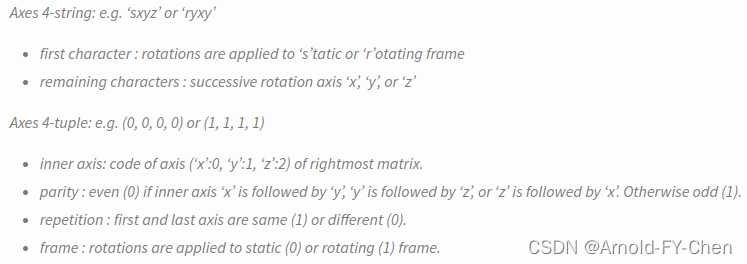
那么axes参数值都有哪些呢?意思是什么,查了一下资料这里汇总一下:
根据三次基本转动选取的坐标轴的不同,欧拉角共有12种组合,再考虑到可选取原始坐标系的坐标轴,也可选取“新”坐标系的坐标轴,则共有24种欧拉角表示。一般规定原始坐标系为静坐标系(static),每个基本转动后形成的新坐标系为动坐标系(rotating)。
24 种欧拉角表示列举如下:
- 静轴(即转轴选静坐标系的坐标轴):
sXYZ,sXZY,sXYX,sXYZ,sXZY,sXYX,sXYZ,sXZY,sXYX,
sXZX,sYXZ,sYZX,sXZX,sYXZ,sYZX,sXZX,sYXZ,sYZX,
sYXY,sYZY,sZXY,sYXY,sYZY,sZXY,sYXY,sYZY,sZXY,
sZYX,sZXZ,sZYZsZYX,sZXZ,sZYZsZYX,sZXZ,sZYZ- 动轴(即转轴选动坐标系的坐标轴):
rZYX,rYZX,rXYX,rZYX,rYZX,rXYX,rZYX,rYZX,rXYX,
rXZX,rZXY,rXZY,rXZX,rZXY,rXZY,rXZX,rZXY,rXZY,
rYXY,rYZY,rYXZ,rYXY,rYZY,rYXZ,rYXY,rYZY,rYXZ,
rXYZ,rZXZ,rZYZrXYZ,rZXZ,rZYZrXYZ,rZXZ,rZYZ静轴欧拉角和动轴欧拉角有如下规律:
绕静轴 XYZXYZXYZ 分别 转 α,β,γα,β,γα,β,γ 角度的转动与绕动轴 ZYXZYXZYX分别转 γ,β,αγ,β,αγ,β,α 角度的转动等价,其他形式的欧拉角亦有此类似规律。axes的值和firstaxis, parity, repetition, frame的含义解释:
-
相关阅读:
《代码大全2》第7章 高质量的子程序
Python 操作redisearch
计算机毕业设计之java+springboot基于vue的校园台球厅人员与设备管理系统
渗透测试-应急响应思路分享
SAP PO接口日志 集成引擎的归档对象
6.10.多段线图层(Polyline)
【国庆头像】来一波美女国庆头像 超好看
OpenHarmony网络协议通信—kcp
C# HTML
最新AI智能创作系统ChatGPT商业源码+详细图文搭建部署教程+AI绘画系统
- 原文地址:https://blog.csdn.net/XCCCCZ/article/details/132657227
