-
强化学习Q-learning实践
1. 引言
前篇文章介绍了强化学习系统红的基本概念和重要组成部分,并解释了
Q-learning算法相关的理论知识。本文的目标是在Python3中实现该算法,并将其应用于实际的实验中。
闲话少说,我们直接开始吧!2. Taxi-v3 Env
为了使本文具有实际具体的意义,特意选择了一个简单而基本的环境,可以让大家充分欣赏
Q-learning算法的优雅。我们选择的环境是OpenAI Gym的Taxi-v3,该环境简单明了,是强化学习RL领域的优秀入门样例。实际上Taxi-v3由一个grid map组成,如下图示:

其中,该环境下的
agent是一名出租车司机,他必须接客户(红色小人)并将其送到目的地(图中的小房子)。3. States
一版来说,
States的作用如下 (1) 确定action(2)计算执行action的奖励reward(3)计算到下一状态的转换所需的信息。观察上图,我们的网格
grid map的大小为5x5,所以出租车所有可能的选择有25个。除此之外,等待接车的乘客可以在四个可能的接车点(标记为Y、R、G、B)处等待当然也可以在出租车里,所以乘客所有可能的选择有(4+1)个;最后,乘客的目的地在(Y、R、G、B)四个中的一个,所以乘客的目的地共有4个选择,图示如下:
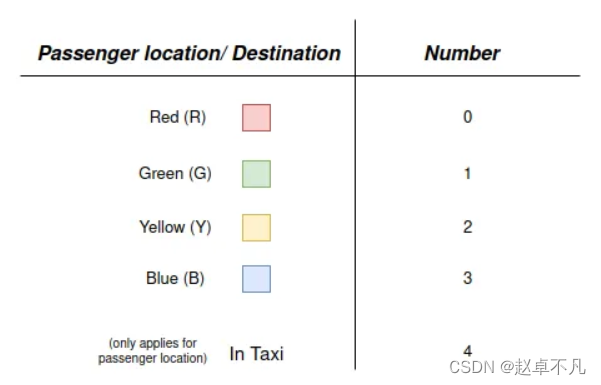
综上,我们用以下向量表示
States:State = [x_pos_taxi, y_pos_taxi, pos_passenger, dest_passenger]进而,我们
agent的States一共有5X5X5X4=500个,可以被编码为0到499之间的整数。其实,实际可用的状态的数量略小于500,例如,乘客将永远不会有相同的乘车点和目的地。由于建模的复杂性,我们通常关注完整的状态空间。4. 举个栗子
上述文字讲完后,有些同学还是有很多不理解的东东,那我们来找个中间过程来看看,如下:

上图中,STATE:(2,1,0,1)表示,当前出租车在grid map中的第二行第一列,同时乘客的状态选择为0表示位于乘客位于红色格子里等待乘车,同时乘客的目的地状态选择为1表示乘客的目的地为绿色格子。
进而,下图中的STATE:(3,4,4,0)表示,当前出租车在grid map中的第三行第四列,同时乘客的状态选择为4表示此时乘客位于出租车里,同时乘客的目的地状态选择为0,表示乘客的目的地为红色格子。看到这里的童鞋,请仔细理解上述两个例子。
5. Action space
至于该环境
Env下agent的动作空间Action space,我们可以想象,代理agent可以使用以下离散动作来与环境交互:向前、向后、向右、向左、接乘客和送乘客。这使得总共有6个可能的动作,这些动作依次以0到5的数字编码,以便于编程。动作和数字之间的对应关系如图1所示。

6. Rewards
至于
agent执行的每一步action所获得的奖励reward,做如下约定:移动:-1, 表示每一步都会受到一点惩罚,以鼓励从出发地到目的地走最短的路。错误运送:-10, 表示当乘客被送到到错误的位置时,乘客自然会不高兴,所以惩罚大一些是合适的。成功送达:20,表示出租车司机成功完成了任务,鼓励相应的行为,因此产生了正向的reward。
7. Initialization
在数学上定义了这个问题之后,我们接着将着手用代码实现。首先,我们安装必要的库,然后导入它们。显然,我们需要安装
gym环境。除此之外,我们只需要一些可视化的东西和常见的数据处理库。"""install libraries""" !pip install cmake 'gym[atari]' scipy pygame """Import libraries""" import gym import numpy as np import matplotlib.pyplot as plt import random from IPython.display import clear_output from time import sleep from matplotlib import animation- 1
- 2
- 3
- 4
- 5
- 6
- 7
- 8
- 9
- 10
- 11
接着,我们使用以下代码来创建和渲染Taxi-v3环境。
"""Initialize and validate the environment""" env = gym.make("Taxi-v3", render_mode="rgb_array").env state, _ = env.reset() # Print dimensions of state and action space print("State space: {}".format(env.observation_space)) print("Action space: {}".format(env.action_space)) # Sample random action action = env.action_space.sample(env.action_mask(state)) next_state, reward, done, _, _ = env.step(action) # Print output print("State: {}".format(state)) print("Action: {}".format(action)) print("Action mask: {}".format(env.action_mask(state))) print("Reward: {}".format(reward)) # Render and plot an environment frame frame = env.render() plt.imshow(frame) plt.axis("off") plt.show()- 1
- 2
- 3
- 4
- 5
- 6
- 7
- 8
- 9
- 10
- 11
- 12
- 13
- 14
- 15
- 16
- 17
- 18
- 19
- 20
- 21
- 22
- 23
结果如下:

8. 测试随机
agent在上述环境
Env按照预期开始工作后,此时我们可以随机让代理疯狂运行了。我们不妨让我们的agent在任何时刻都会采取随机行动,来看看会产生怎样的效果。"""Simulation with random agent""" epoch = 0 num_failed_dropoffs = 0 experience_buffer = [] cum_reward = 0 done = False state, _ = env.reset() while not done: # Sample random action "Action selection without action mask" action = env.action_space.sample() "Action selection with action mask" #action = env.action_space.sample(env.action_mask(state)) state, reward, done, _, _ = env.step(action) cum_reward += reward # Store experience in dictionary experience_buffer.append({ "frame": env.render(), "episode": 1, "epoch": epoch, "state": state, "action": action, "reward": cum_reward, } ) if reward == -10: num_failed_dropoffs += 1 epoch += 1 # Run animation and print console output run_animation(experience_buffer) print("# epochs: {}".format(epoch)) print("# failed drop-offs: {}".format(num_failed_dropoffs))- 1
- 2
- 3
- 4
- 5
- 6
- 7
- 8
- 9
- 10
- 11
- 12
- 13
- 14
- 15
- 16
- 17
- 18
- 19
- 20
- 21
- 22
- 23
- 24
- 25
- 26
- 27
- 28
- 29
- 30
- 31
- 32
- 33
- 34
- 35
- 36
- 37
- 38
- 39
- 40
- 41
- 42
运行上述代码后,得到结果如下:

为什么要看完上述冗长的动画?好吧,这确实给人一种印象,一个未经训练的RL模型下的agent是如何表现的,以及需要多长时间才能获得有意义的reward。9. 训练
agent接着,我们来尝试训练我们的
agent,我们知道Q值是在进行观测之后使用以下等式进行更新的。

请注意,对于500个状态和6个动作,我们必须填写一个大小为500*6=3000的Q表,每个状态-动作二元组需要多次观察才能学到有用的知识。相应的训练代码如下:
"""Training the agent""" q_table = np.zeros([env.observation_space.n, env.action_space.n]) # Hyperparameters alpha = 0.1 # Learning rate gamma = 1.0 # Discount rate epsilon = 0.1 # Exploration rate num_episodes = 10000 # Number of episodes # Output for plots cum_rewards = np.zeros([num_episodes]) total_epochs = np.zeros([num_episodes]) for episode in range(1, num_episodes+1): # Reset environment state, info = env.reset() epoch = 0 num_failed_dropoffs = 0 done = False cum_reward = 0 while not done: if random.uniform(0, 1) < epsilon: "Basic exploration [~0.47m]" action = env.action_space.sample() # Sample random action (exploration) "Exploration with action mask [~1.52m]" # action = env.action_space.sample(env.action_mask(state)) "Exploration with action mask" else: "Exploitation with action mask [~1m52s]" # action_mask = np.where(info["action_mask"]==1,0,1) # invert # masked_q_values = np.ma.array(q_table[state], mask=action_mask, dtype=np.float32) # action = np.ma.argmax(masked_q_values, axis=0) "Exploitation with random tie breaker [~1m19s]" # action = np.random.choice(np.flatnonzero(q_table[state] == q_table[state].max())) "Basic exploitation [~47s]" action = np.argmax(q_table[state]) # Select best known action (exploitation) next_state, reward, done, _ , info = env.step(action) cum_reward += reward old_q_value = q_table[state, action] next_max = np.max(q_table[next_state]) new_q_value = (1 - alpha) * old_q_value + alpha * (reward + gamma * next_max) q_table[state, action] = new_q_value if reward == -10: num_failed_dropoffs += 1 state = next_state epoch += 1 total_epochs[episode-1] = epoch cum_rewards[episode-1] = cum_reward if episode % 100 == 0: clear_output(wait=True) print(f"Episode #: {episode}") print("\n") print("===Training completed.===\n") # Plot reward convergence plt.title("Cumulative reward per episode") plt.xlabel("Episode") plt.ylabel("Cumulative reward") plt.plot(cum_rewards) plt.show() # Plot epoch convergence plt.title("# epochs per episode") plt.xlabel("Episode") plt.ylabel("# epochs") plt.plot(total_epochs) plt.show()- 1
- 2
- 3
- 4
- 5
- 6
- 7
- 8
- 9
- 10
- 11
- 12
- 13
- 14
- 15
- 16
- 17
- 18
- 19
- 20
- 21
- 22
- 23
- 24
- 25
- 26
- 27
- 28
- 29
- 30
- 31
- 32
- 33
- 34
- 35
- 36
- 37
- 38
- 39
- 40
- 41
- 42
- 43
- 44
- 45
- 46
- 47
- 48
- 49
- 50
- 51
- 52
- 53
- 54
- 55
- 56
- 57
- 58
- 59
- 60
- 61
- 62
- 63
- 64
- 65
- 66
- 67
- 68
- 69
- 70
- 71
- 72
- 73
- 74
- 75
- 76
- 77
- 78
- 79
- 80
- 81
在2000个
episode之后,我们似乎学到了一个相当好的模型,如下:

上图图像中,横坐标表示我们一共训练了10000个Episode,纵坐标表示每一个Episode下,出租车司机将乘客送达目的地所需要的移动步数epochs。10. 验证训练效果
最后,让我们看看我们的模型学到了什么。根据我们所处的状态,我们在Q表中查找相应的Q值(即,每个状态对应于动作的六个值),并选择具有最高相关Q值的动作。代码如下:
"""Test policy performance after training""" num_epochs = 0 total_failed_deliveries = 0 num_episodes = 1 experience_buffer = [] store_gif = True for episode in range(1, num_episodes+1): # Initialize experience buffer my_env = env.reset() state = my_env[0] epoch = 1 num_failed_deliveries =0 cum_reward = 0 done = False while not done: action = np.argmax(q_table[state]) state, reward, done, _, _ = env.step(action) cum_reward += reward if reward == -10: num_failed_deliveries += 1 # Store rendered frame in animation dictionary experience_buffer.append({ 'frame': env.render(), 'episode': episode, 'epoch': epoch, 'state': state, 'action': action, 'reward': cum_reward } ) epoch += 1 total_failed_deliveries += num_failed_deliveries num_epochs += epoch if store_gif: store_episode_as_gif(experience_buffer) # Run animation and print output run_animation(experience_buffer) # Print final results print("\n") print(f"Test results after {num_episodes} episodes:") print(f"Mean # epochs per episode: {num_epochs / num_episodes}") print(f"Mean # failed drop-offs per episode: {total_failed_deliveries / num_episodes}")- 1
- 2
- 3
- 4
- 5
- 6
- 7
- 8
- 9
- 10
- 11
- 12
- 13
- 14
- 15
- 16
- 17
- 18
- 19
- 20
- 21
- 22
- 23
- 24
- 25
- 26
- 27
- 28
- 29
- 30
- 31
- 32
- 33
- 34
- 35
- 36
- 37
- 38
- 39
- 40
- 41
- 42
- 43
- 44
- 45
- 46
- 47
- 48
- 49
- 50
- 51
- 52
- 53
结果如下:

可以看到,在执行了足够多的迭代之后,我们可以发现出租车总是直接驶向乘客,走最短的路到达目的地,并成功地将乘客放下。
11. 总结
本文通过具体的应用,来对前篇Q-learning的理论知识用代码进行了详细的说明,主要通过业内知名的
Taxi-v3环境进行了讲解,并给出了完整的代码示例。您学废了嘛?
-
相关阅读:
二、稀疏数组和队列
新手小白学JAVA 泛型 Collection List Set
这篇spring事务理解透了,工资直接涨10K
常见的排序算法(插入、希尔、选择、堆、冒泡、快排、归并)
【C++】类和对象核心总结
Microsoft Remote Desktop Mac
HarmonyOS 自定义页面请求与前端页面调试
(迪杰斯特拉)Dijkstra算法 单源最短路径算法 图解
微信小程序通过 movable-area 做一个与vuedraggable相似的上下拖动排序控件
centos pip失效
- 原文地址:https://blog.csdn.net/sgzqc/article/details/131143832

- 最新文章
-
沪漂五周年了:我越来越迷茫了
Agentic Skill Routing 实战:别再把所有 Skill 塞进 AI Agent 上下文
MySQL-Seconds_behind_master的精度误差
[MAF预定义ChatClient中间件-03]CachingChatClient——利用缓存省钱省时间
AI的至暗历史:从万众期待到被政府撤资,AI的两次死亡徘徊
Agent OS :五种驯服不确定性的范式
PortSwigger SQL注入LAB11
数据库即时编译JIT
[Begin]AI Learn Data Day 0
深度学习进阶(二十七)现代 LLM 的核心架构设计其二:SwiGLU