斐波那契散列和hashMap实践#
适合的场景:抽奖(游戏、轮盘、活动促销等等)
如果有不对的地方,欢迎指正!
HashMap实现数据散列:#
配置项目,引入pom.xml:
<dependency>
    <groupId>com.alibabagroupId>
    <artifactId>fastjsonartifactId>
    <version>1.2.58version>
dependency>
<dependency>
    <groupId>org.apache.commonsgroupId>
    <artifactId>commons-lang3artifactId>
    <version>3.8version>
dependency>
<dependency>
    <groupId>junitgroupId>
    <artifactId>junitartifactId>
    <scope>testscope>
dependency>
<dependency>
    <groupId>cn.hutoolgroupId>
    <artifactId>hutool-allartifactId>
    <version>5.8.5version>
dependency>
前置条件:
- 存放数组:128位
- 100个数据进行散列
- 若有hash冲突,使用拉链法
首先,初始化100个随机数,这里采用雪花算法snowFlake,采用灵活注解引用,声明为Component,
简单了解下SnowFlake工具类实现方式:
import com.example.containstest.containsTestDemo.mapper.FileNameAndType;
import com.example.containstest.containsTestDemo.mapper.FileNameInsertMapper;
import com.example.containstest.containsTestDemo.pojo.DatagenertionDao;
import com.example.containstest.containsTestDemo.pojo.FileNameType;
import com.example.containstest.containsTestDemo.utils.SnowFlake;
import lombok.extern.slf4j.Slf4j;
import org.junit.jupiter.api.Test;
import org.springframework.beans.factory.annotation.Autowired;
import org.springframework.boot.test.context.SpringBootTest;

import javax.annotation.Resource;
import java.util.List;
import java.util.concurrent.atomic.AtomicInteger;
@Component
public class SnowFlake implements IIdGenerator {

    private Snowflake snowflake;

    @PostConstruct
    public void init(){
        // 0 ~ 31 位,可以采用配置的方式使用
        long workerId;
        try {
            workerId = NetUtil.ipv4ToLong(NetUtil.getLocalhostStr());
        }catch (Exception e){
            workerId = NetUtil.getLocalhostStr().hashCode();
        }
        workerId = workerId >> 16 & 31;
        long dataCenterId = 1L;
        snowflake = IdUtil.createSnowflake(workerId,dataCenterId);
    }


    @Override
    public long nextId() {
        return snowflake.nextId();
    }
}
循环100,取其随机数保存列表中:
List list = new ArrayList<>();
//保存idx和重复的值
Map map = new HashMap<>();
for(int i = 0; i < 101; i++){
    list.add(String.valueOf(snowFlake.nextId()));
}
创建数据散列到的数组大小,这里取128
//定义要存放的数组 模拟初始化为128
String[] res = new String[128];
遍历保存的数组,计算出当前数值的hash值,然后到数组对应的下标处对应;
- 为空。当前
key赋值到该数组下标值 - 不为空,表示
hash冲突,这里采用字符串拼接模拟碰撞后使用的拉链法 map存储对应idx和key值- 对重复的散列的值进行排序输出
for(String key : list){
    //计算hash值,未使用扰动函数
    int idx = key.hashCode() & (res.length - 1);
    log.info("key的值{},idx的值{}",key,idx);
    if(null == res[idx]){
        res[idx] = key;
        continue;
    }
    res[idx] = res[idx] +"->" + key;
    map.put(idx,res[idx]);
}
//排序
mapSort(map);
map排序:
private void mapSort(Map map) {
    // 按照Map的键进行排序
    Map sortedMap = map.entrySet().stream()
            .sorted(Map.Entry.comparingByKey())
            .collect(
                    Collectors.toMap(
                            Map.Entry::getKey,
                            Map.Entry::getValue,
                            (oldVal, newVal) -> oldVal,
                            LinkedHashMap::new
                    )
            );
    log.info("====>HashMap散列算法碰撞数据:{}",JSON.toJSONString(sortedMap));
}
未使用扰动函数HashMap散列输出结果展示:
{
    28: "1596415617815183397->1596415617815183430",
    29: "1596415617815183398->1596415617815183431",
    30: "1596415617815183399->1596415617815183432",
    59: "1596415617815183363->1596415617815183440",
    60: "1596415617815183364->1596415617815183441",
    61: "1596415617815183365->1596415617815183442",
    62: "1596415617815183366->1596415617815183443",
    63: "1596415617815183367->1596415617815183400->1596415617815183444",
    64: "1596415617815183368->1596415617815183401->1596415617815183445",
    65: "1596415617815183369->1596415617815183402->1596415617815183446",
    66: "1596415617815183403->1596415617815183447",
    67: "1596415617815183404->1596415617815183448",
    68: "1596415617815183405->1596415617815183449",
    90: "1596415617815183373->1596415617815183450",
    91: "1596415617815183374->1596415617815183451",
    92: "1596415617815183375->1596415617815183452",
    93: "1596415617815183376->1596415617815183453",
    94: "1596415617815183377->1596415617815183410->1596415617815183454",
    95: "1596415617815183378->1596415617815183411->1596415617815183455",
    96: "1596415617815183379->1596415617815183412->1596415617815183456",
    97: "1596415617815183413->1596415617815183457",
    98: "1596415617815183414->1596415617815183458",
    99: "1596415617815183415->1596415617815183459",
    121: "1596415617815183383->1596415617815183460",
    125: "1596415617815183387->1596415617815183420",
    126: "1596415617815183388->1596415617815183421",
    127: "1596415617815183389->1596415617815183422"
}
针对上述代码,修改int idx = key.hashCode() & (res.length - 1);为下面:
int idx = (res.length - 1) & (key.hashCode() ^ (key.hashCode() >>> 16));
使用扰动函数HashMap散列输出结果展示:
{
    44: "1596518378456121344->1596518378456121388",
    67: "1596518378460315650->1596518378460315694",
    72: "1596518378456121351->1596518378456121395",
    73: "1596518378456121350->1596518378456121394",
    83: "1596518378456121345->1596518378456121389",
    92: "1596518378460315651->1596518378460315695",
    93: "1596518378460315652->1596518378460315696"
}
从对比结果可以看到,加入扰动函数后hash碰撞减少了很多。
斐波那契散列算法#
前置条件:
- 生成模拟数据:随机且不重复的100个数
- 声明散列数组:大小128
- 若有hash冲突,保存map,方便数据查看
静态变量声明:
//黄金分割点
private static final int HASH_INCREMENT = 0x61c88647;
private static int range = 100;
按照惯例,初始化数组,模拟数据;
List listThreadLocal = new ArrayList<>();

Map map = new HashMap<>();
//定义要存放的数组 模拟初始化为128
Integer[] result = new Integer[128];
result = getNumber(range);
//......

//-----方法
/**
 * 随机生成100以内不重复的数
 * @param total
 * @return
 */
public static Integer[] getNumber(int total){
    Integer[] NumberBox = new Integer[total];			//容器A
    Integer[] rtnNumber = new Integer[total];			//容器B

    for (int i = 0; i < total; i++){
        NumberBox[i] = i;		//先把N个数放入容器A中
    }
    Integer end = total - 1;

    for (int j = 0; j < total; j++){
        int num = new Random().nextInt(end + 1);	//取随机数
        rtnNumber[j] = NumberBox[num];			//把随机数放入容器B
        NumberBox[num] = NumberBox[end];			//把容器A中最后一个数覆盖所取的随机数
        end--;									//缩小随机数所取范围
    }
    return rtnNumber;							//返回int型数组
}
遍历模拟的数据,通过源码阅读,可以找到new ThreadLocal
注意点,threadLocal实现主要是在ThreadLoacalMap中
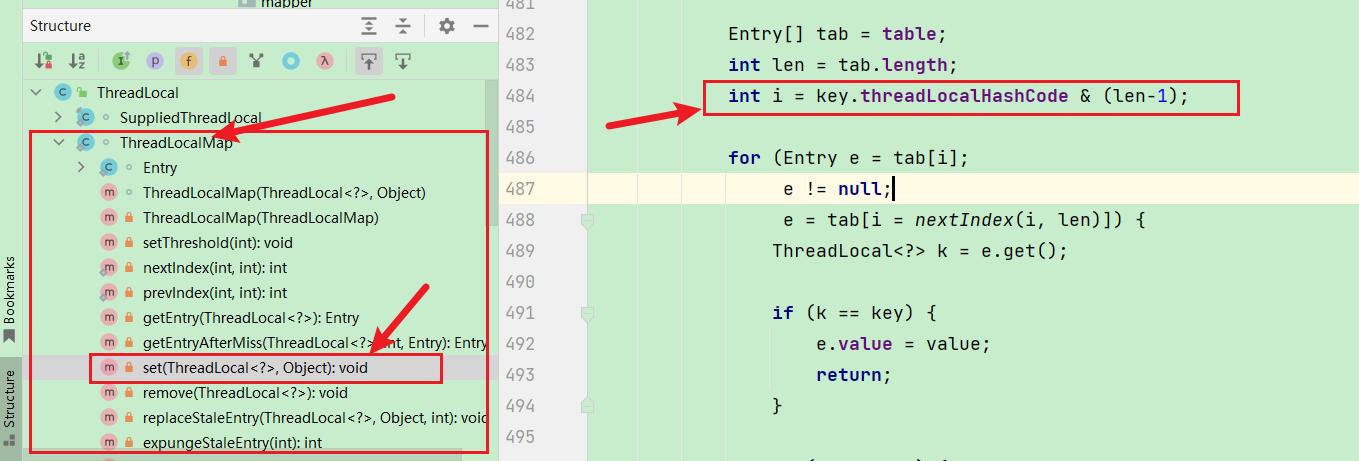
//2
private final int threadLocalHashCode = nextHashCode();
//4  默认值0
private static AtomicInteger nextHashCode = new AtomicInteger();
//3步骤使用
private static final int HASH_INCREMENT = 0x61c88647;

//3
private static int nextHashCode() {
    return nextHashCode.getAndAdd(HASH_INCREMENT);
}

//key和len是外部传入  1
int i = key.threadLocalHashCode & (len-1);
可以看到每次计算哈希值的时候,都会加一次HASH_INCREMENT黄金分割点,来更好的散列数据,然后模拟该操作:代码如下
for(int i = 0; i < listThreadLocal.size(); i++){
    hashCode = listThreadLocal.get(i) * HASH_INCREMENT + HASH_INCREMENT;
    Integer idx = (hashCode & 127);
    log.info("key的值{},idx的值{}",listThreadLocal.get(i),idx);
    if(null == result[idx]){
        result[idx] = listThreadLocal.get(i);
        continue;
    }
    String idxInRes = map.get(idx);
    String idxInRess = idxInRes + "->" + listThreadLocal.get(i);
    map.put(idx,idxInRess);
}
进行冲突后重复值排序
//map排序
if(CollectionUtil.isEmpty(map)){
    log.info("斐波那契额散列数据集:{}",JSON.toJSONString(result));
    System.out.println("===》无重复数据,不需要排序");
    return;
}
mapSort(map);
使用斐波那契散列算法输出结果展示:
斐波那契额散列数据集:38,15,29,22,55,86,70,64,47,32,67,7,60,85,97,95,58,46,14,83,12,72,18,96,36,20,76,59,6,33,50,30,23,42,81,31,66,71,82,61,53,84,41,45,74,63,89,77,90,16,8,37,1,62,65,99,51,78,91,39,5,57,27,56,44,13,92,25,0,24,80,3,94,26,40,34,73,35,88,2,87,11,93,54,69,68,10,17,43,48,19,9,79,21,98,52,4,28,75,49]
===》无重复数据,不需要排序
由上我们可以看到,没有重复的数据,全部比较完美的散列到不同的地方。
参考文章:#
https://blog.csdn.net/qq_26327971/article/details/104757316