-
神经网络分析中医药数据Excel数据||神经网络pytorch实现||五折交叉验证||pytorch神经网络框架||神经网络模型参数保存
注意参数位已用中文描述代替。
如果你想训练自己的数据集,大多情况修改他们就可以了。
如果数据格式不大相同 或者 你想要修改网络结构(本文是三层全连接BP神经网络)。
那么你可以试着修改其中的一些函数,试着符合你的要求。
五折交叉、模型保存等均在代码中解释,自行选择
如果你没有安装pytorch,你可以尝试安装这个包的cpu版
如果不想安装,可以去去郭大侠的github,哪里不需要pytorch
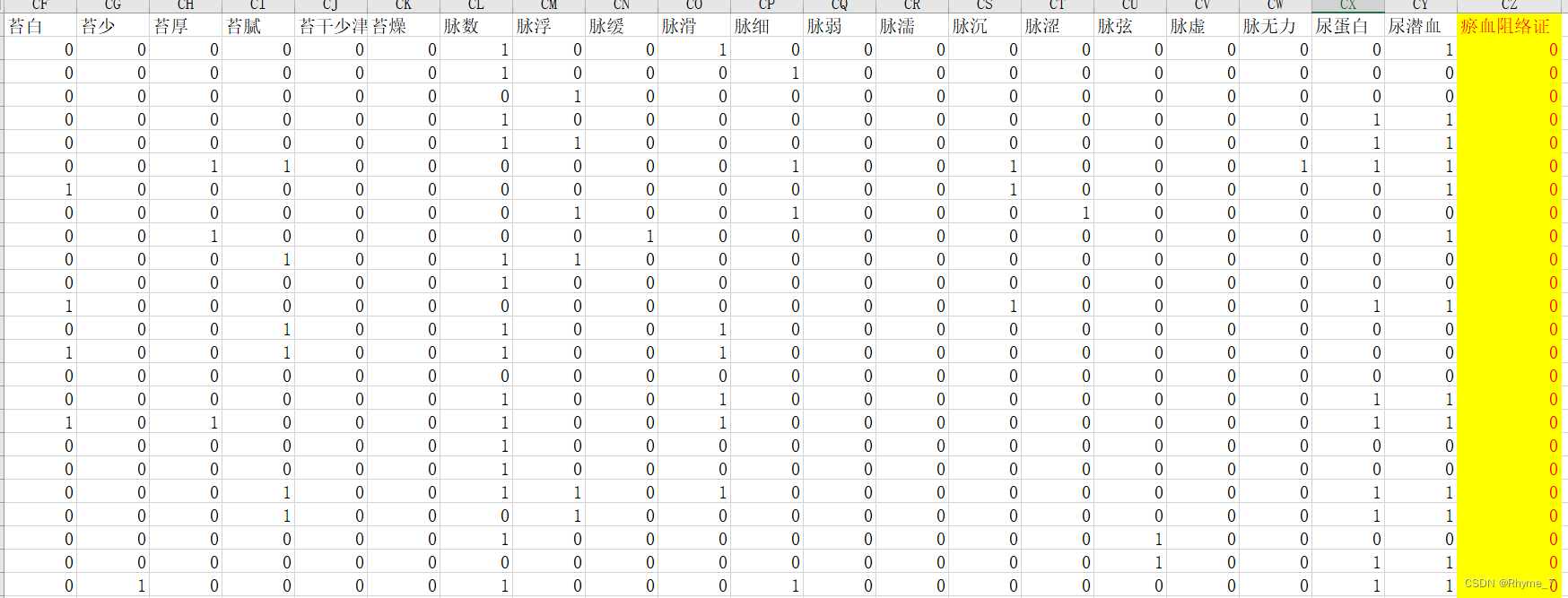
数据格式
664条样本 每条103个属性,最后一列为标签
结果
不使用五折交叉验证

使用五折交叉验证

代码
不使用五折交叉验证
- """
- BP神经网络二分类任务 瘀血阻络证 103特征
- """
- import pandas as pd
- import matplotlib.pyplot as plt
- import numpy as np
- import random
- import torch
- import torch.nn as nn
- from torch.utils.data import DataLoader, TensorDataset
- from sklearn.model_selection import train_test_split
- from sklearn.metrics import classification_report, roc_curve, auc
- def open_excel(file_url):
- """
- 打开数据集,进行数据处理
- :param file_url:文件路径
- :return:特征集数据、标签集数据
- """
- readbook = pd.read_excel(f'{file_url}', engine='openpyxl')
- nplist = readbook.T.to_numpy()
- data = nplist[0:-1].T
- data = np.float64(data)
- target = nplist[-1]
- return data, target
- def open_csv(file_url):
- """
- 打开数据集,进行数据处理
- :param file_url:文件名
- :return:特征集数据、标签集数据
- """
- readbook = pd.read_csv(f'{file_url}.csv')
- nplist = readbook.T.to_numpy()
- data = nplist[0:-1].T
- data = np.float64(data)
- target = nplist[-1]
- return data, target
- def random_number(data_size, key):
- """
- 使用shuffle()打乱
- """
- number_set = []
- for i in range(data_size):
- number_set.append(i)
- if key == 1:
- random.shuffle(number_set)
- return number_set
- def inputtotensor(inputtensor, labeltensor):
- """
- 将数据集的输入和标签转为tensor格式
- :param inputtensor: 数据集输入
- :param labeltensor: 数据集标签
- :return: 输入tensor,标签tensor
- """
- inputtensor = np.array(inputtensor)
- inputtensor = torch.FloatTensor(inputtensor)
- labeltensor = np.array(labeltensor)
- labeltensor = labeltensor.astype(float)
- labeltensor = torch.LongTensor(labeltensor)
- return inputtensor, labeltensor
- # 定义BP神经网络
- class NeuralNetwork(nn.Module):
- def __init__(self):
- super(NeuralNetwork, self).__init__()
- self.fc1 = nn.Linear(input_size, hidden_size) # 输入层->隐藏层1
- self.relu = nn.ReLU()
- self.fc2 = nn.Linear(hidden_size, hidden_size) # 隐藏层1->隐藏层2
- self.fc3 = nn.Linear(hidden_size, num_classes) # 隐藏层2->输出层
- self.dropout_i = nn.Dropout(p=0.2) # dropout训练
- self.dropout_h = nn.Dropout(p=0.5) # 隐藏层的dropout训练
- def forward(self, x):
- out = self.fc1(x)
- out = self.dropout_i(out)
- out = self.relu(out)
- out = self.fc2(out)
- out = self.dropout_h(out)
- out = self.relu(out)
- out = self.fc3(out)
- return out
- def addbatch(data_train, data_test, batchsize):
- """
- 设置batch
- :param data_train: 输入
- :param data_test: 标签
- :param batchsize: 一个batch大小
- :return: 设置好batch的数据集
- """
- data = TensorDataset(data_train, data_test)
- data_loader = DataLoader(data, batch_size=batchsize, shuffle=True)
- return data_loader
- def train_test(traininput, trainlabel, Epochs, batchsize): # ,testinput, testlabel
- """
- 函数输入为:训练输入,训练标签,测试输入,测试标签,一个batch大小
- 进行BP的训练,每训练一次就算一次准确率,同时记录loss
- :return:训练次数list,训练loss,测试loss,准确率
- """
- # 设置batch
- traindata = addbatch(traininput, trainlabel, batchsize) # shuffle打乱数据集
- total_step = len(traindata)
- for epoch in range(Epochs):
- for step, data in enumerate(traindata):
- net.train()
- inputs, labels = data
- # 前向传播
- out = net(inputs)
- # 计算损失函数
- loss = loss_func(out, labels)
- # 清空上一轮的梯度
- optimizer.zero_grad()
- # 反向传播
- loss.backward()
- # 参数更新
- optimizer.step()
- # 输出loss
- if (epoch + 1) % 100 == 0:
- print('Epoch [{}/{}], Step [{}/{}], Loss: {:.8f}'
- .format(epoch + 1, Epochs, step + 1, total_step, loss.item()))
- ''' # 测试准确率
- net.eval()
- testout = net(testinput)
- testloss = loss_func(testout, testlabel)
- prediction = torch.max(testout, 1)[1] # torch.max
- pred_y = prediction.numpy() # 事先放在了GPU,所以必须得从GPU取到CPU中!!!!!!
- target_y = testlabel.data.numpy()
- j = 0
- for i in range(pred_y.size):
- if pred_y[i] == target_y[i]:
- j += 1
- acc = j / pred_y.size
- if epoch % 10 == 0:
- print("训练次数为", epoch, "的准确率为:", acc)'''
- # 根据标签和预测概率结果画出ROC图,并计算AUC值
- def acu_curve(y, prob):
- fpr, tpr, threshold = roc_curve(y, prob) ###计算真正率和假正率
- roc_auc = auc(fpr, tpr) ###计算auc的值
- print("AUC:", roc_auc)
- plt.figure()
- lw = 2
- plt.figure(figsize=(6, 6))
- plt.plot(fpr, tpr, color='darkorange',
- lw=lw, label='ROC curve (area = %0.3f)' % roc_auc) ###假正率为横坐标,真正率为纵坐标做曲线
- plt.plot([0, 1], [0, 1], color='navy', lw=lw, linestyle='--')
- plt.xlim([0.0, 1.0])
- plt.ylim([0.0, 1.05])
- plt.xlabel('False Positive Rate')
- plt.ylabel('True Positive Rate')
- plt.title('Receiver operating characteristic')
- plt.legend(loc="lower right")
- plt.show()
- return roc_auc
- if __name__ == "__main__":
- # 利用open_excel读取数据
- feature, label = open_excel('症状_瘀血阻络证_data.xlsx')
- # 数据划分为训练集和测试集
- x_train, x_test, y_train, y_test = train_test_split(feature, label, test_size=你的比例, random_state=你的随机数)
- # 将数据转为tensor格式
- traininput, trainlabel = inputtotensor(x_train, y_train)
- testinput, testlabel = inputtotensor(x_test, y_test)
- # 归一化处理
- traininput = nn.functional.normalize(traininput)
- testinput = nn.functional.normalize(testinput)
- # 设置超参数
- Epochs = 你的迭代次数
- input_size = 103
- hidden_size = 你的隐层神经元个数
- num_classes = 2
- LR = 你的学习率
- batchsize =
- # 定义网络
- net = NeuralNetwork()
- # 优化器
- optimizer = torch.optim.Adam(net.parameters(), LR)
- # 设定损失函数
- loss_func = torch.nn.CrossEntropyLoss()
- # 训练并且记录每次loss 函数输入为:训练输入,训练标签,测试输入,测试标签,一个batch大小
- print(traininput)
- print(trainlabel)
- train_test(traininput, trainlabel, Epochs, batchsize)
- print('----------------------------------不使用五折交叉验证----------------------------------')
- # 不使用五折交叉验证的测试结果
- net.eval()
- test_predict1 = net(testinput).cpu().detach().numpy() # 将tensor转为概率数组
- test_predict2 = np.argmax(test_predict1, axis=1) # 将概率数组转为label
- # print(test_predict1)
- # print(test_predict2)
- print(classification_report(testlabel, test_predict2))
- auc = acu_curve(testlabel, test_predict1[:, 1:])
- #######是否保存模型参数#######
- save = True 或者 False
- if save:
- device = torch.device('cuda' if torch.cuda.is_available() else 'cpu')
- model = NeuralNetwork().to(device)
- str = 'hidden_size'+str(hidden_size)+'-batchsize'+str(batchsize)+'-Epochs'+str(Epochs)+'-auc'+str(auc)
- url = './'+ str + '.pth'
- torch.save(model.state_dict(), url)
- print('模型参数已保存到'+url)
- '''# 读取教师模型参数 并预测
- device = torch.device('cuda' if torch.cuda.is_available() else 'cpu')
- open_model = NeuralNetwork()
- open_model.load_state_dict(torch.load('./名字.pth'))
- open_model.to(device)
- test_predict1 = open_model(testinput.to(device)).cpu().detach().numpy()
- test_predict2 = np.argmax(test_predict1, axis=1) # 将概率数组转为label
- print(classification_report(testlabel, test_predict2))
- acu_curve(testlabel, test_predict1[:, 1:])
- '''
使用五折交叉验证(修改之处)
前155行与上述相同(多了几个import)
- import pandas as pd
- import matplotlib.pyplot as plt
- import numpy as np
- import random
- import torch
- import torch.nn as nn
- from torch.utils.data import DataLoader, TensorDataset
- from sklearn.model_selection import KFold
- from sklearn.metrics import roc_curve, precision_score, recall_score, f1_score, \
- roc_auc_score, accuracy_score, auc
- from itertools import chain
- def statistics(testlabel, test_predict1, test_predict2):
- """
- :testlabel 测试集label:
- :test_predict1 预测概率数组:
- :test_predict2 预测label:
- :return:
- """
- # 准确率
- print(f"Accuracy:", accuracy_score(testlabel, test_predict2))
- # 精确率
- print("Precision:", precision_score(testlabel, test_predict2, average='macro'))
- # 召回率
- print("Recall:", recall_score(testlabel, test_predict2, average='macro'))
- # F1值
- print("F1-Score:", f1_score(testlabel, test_predict2, average='macro'))
- # 画ROC曲线
- fpr, tpr, thresholds = roc_curve(testlabel, test_predict1[:, 1], pos_label=1) # pos_label=1表示正样本的标签为1
- roc_auc = auc(fpr, tpr) ###计算auc的值
- print("AUC:", roc_auc)
- plt.plot(fpr, tpr, linewidth=2, label="ROC(AUC=%0.3f)" % roc_auc_score(testlabel, test_predict1[:, 1]), color='darkorange')
- plt.xlabel('False Positive Rate')
- plt.ylabel('True Positive Rate')
- plt.plot([0, 1], [0, 1], color='navy', lw=2, linestyle='--')
- plt.ylim(0, 1.05)
- plt.xlim(0, 1.05)
- plt.legend(loc=4)
- plt.show()
- return roc_auc
- if __name__ == "__main__":
- # 加载数据
- df = pd.read_excel(r"症状_瘀血阻络证_data.xlsx")
- data = df.iloc[:, :-1]
- data['target'] = df.iloc[:, -1] # 添加标签
- data = data.to_numpy()
- # 5-fold cross-validation
- kf = KFold(n_splits=5, shuffle=True)
- for train_index, test_index in kf.split(data):
- x_train, x_test = data[train_index, :data.shape[1] - 1], data[test_index, :data.shape[1] - 1]
- y_train, y_test = data[train_index, data.shape[1] - 1:data.shape[1]], data[test_index,data.shape[1] - 1:data.shape[1]]
- '''这里把y_train、y_test降维 否则见221行 ps:目前是200行'''
- y_train = list(chain.from_iterable(y_train))
- y_test = list(chain.from_iterable(y_test))
- # 将数据转为tensor格式
- traininput, trainlabel = inputtotensor(x_train, y_train)
- testinput, testlabel = inputtotensor(x_test, y_test)
- # 归一化处理
- traininput = nn.functional.normalize(traininput)
- testinput = nn.functional.normalize(testinput)
- # 设置超参数
- Epochs = 你的迭代次数
- input_size = 103
- hidden_size = 你的隐层神经元个数
- num_classes = 2
- LR = 你的学习率
- batchsize = 你的batchsize
- # 定义网络
- net = NeuralNetwork()
- # 优化器
- optimizer = torch.optim.Adam(net.parameters(), LR)
- '''设定损失函数 KFold使trainlabel升维 需要更改为多标签损失函数MultiLabelSoftMarginLoss 当然我没这么做 我在200行把y_train、y_test降维了'''
- #loss_func = torch.nn.MultiLabelSoftMarginLoss()
- loss_func = torch.nn.CrossEntropyLoss()
- # 训练并且记录每次loss 函数输入为:训练输入,训练标签,测试输入,测试标签,一个batch大小
- train_test(traininput, trainlabel, Epochs, batchsize)
- print('----------------------------------使用五折交叉验证----------------------------------')
- # 使用五折交叉验证的测试结果
- net.eval()
- test_predict1 = net(testinput).cpu().detach().numpy() # 将tensor转为概率数组
- test_predict2 = np.argmax(test_predict1, axis=1) # 将概率数组转为label
- auc = statistics(testlabel, test_predict1, test_predict2)
- #######是否保存模型参数#######
- save = True 或者 False
- if save:
- device = torch.device('cuda' if torch.cuda.is_available() else 'cpu')
- model = NeuralNetwork().to(device)
- str = 'hidden_size'+str(hidden_size)+'-batchsize'+str(batchsize)+'-Epochs'+str(Epochs)+'-auc'+str(auc)
- url = './'+ str + '.pth'
- torch.save(model.state_dict(), url)
- print('模型参数已保存到'+url)
- '''# 读取教师模型参数 并预测
- device = torch.device('cuda' if torch.cuda.is_available() else 'cpu')
- open_model = NeuralNetwork()
- open_model.load_state_dict(torch.load('./名字.pth'))
- open_model.to(device)
- test_predict1 = open_model(testinput.to(device)).cpu().detach().numpy()
- test_predict2 = np.argmax(test_predict1, axis=1) # 将概率数组转为label
- statistics(testlabel, test_predict1, test_predict2)
- '''
注意点(参考)
2 、pytorch:批量数据分割(batch)_XYKenny的博客-CSDN博客
 https://blog.csdn.net/XYKenny/article/details/105935836
 -
相关阅读:
【MineCraft】-- 学习Mod制作烧炼配方
Linux基础IO【II】
【AI】行业消息精选和分析(11月21日 星期二)
SpringCloud进阶-消费者模块
shell 各种括号作用总结
模方新建工程时,显示空三与模型坐标系不一致怎么解决
ATJ2157内存篇【炬芯音频芯片】---sct语法
Android Studio.exe 下载 2023 最新更新,网盘下载
freesql自定义sql和参数查询
从固定管线到可编程管线:十段代码入门OpenGL
- 原文地址:https://blog.csdn.net/qq_54499870/article/details/127974826
- 最新文章
-
沪漂五周年了:我越来越迷茫了
Agentic Skill Routing 实战:别再把所有 Skill 塞进 AI Agent 上下文
MySQL-Seconds_behind_master的精度误差
[MAF预定义ChatClient中间件-03]CachingChatClient——利用缓存省钱省时间
AI的至暗历史:从万众期待到被政府撤资,AI的两次死亡徘徊
Agent OS :五种驯服不确定性的范式
PortSwigger SQL注入LAB11
数据库即时编译JIT
[Begin]AI Learn Data Day 0
深度学习进阶(二十七)现代 LLM 的核心架构设计其二:SwiGLU