-
Day 64 栈的顺序和链式存储 队列
1.栈的概念:
栈( stack )又名堆栈,它是一种运算受限的线性表。限定仅在表尾进行插入和删除操作的线性表。这一端被称为栈顶,相对地,把另一端称为栈底。向一个栈插入新元素又称作进栈、入栈或压栈,它是把新 元素放到栈顶元素的上面,使之成为新的栈顶元素;从一个栈删除元素又称作出栈或退栈,它是把栈顶 元素删除掉,使其相邻的元素成为新的栈顶元素。栈 ( Stack ):是只允许在一端进行插入或删除的线性表。首先栈是一 种线性表, 但限定这种线性表只能在某一端进行插入和删除操作。栈顶 ( Top ):线性表允许进行插入删除的那一端。栈底 ( Bottom ):固定的,不允许进行插入和删除的另一端。空栈 :不含任何元素的空表。栈又称为后进先出( Last In First Out )的线性表,简称 LIFO 结构特性:它的特殊之处在于限制了这个线性表的插入和删除的位置 , 它始终只在栈顶进行。这也就使得 : == 栈底是固定的 , 最先进栈的只能在栈底 == 。对栈的操作:示例如下:- #include
- #include
- #include
- #define MAX_SIZE 50
- typedef struct{
- void *data[MAX_SIZE];
- int size;
- }Stack;
- typedef struct{
- char name[15];
- int age;
- char breed[10];
- }Stu;
- Stack *initstack(void){
- Stack *stack=(Stack *)malloc(sizeof(Stack));
- if(stack==NULL){
- printf("malloc error.\n");
- return NULL;
- }
- for(int i=0;istack->data[i]=NULL;}stack->size=0;return stack;}void pushstack(Stack *stack,void *data){if(stack==NULL){return;}if(stack->size==MAX_SIZE){return;}if(data==NULL){return;}stack->data[stack->size]=data;stack->size++;}void popstack(Stack *stack){if(stack==NULL){return;}if(stack->size==0){return;}stack->data[stack->size-1]=NULL;stack->size--;}void *topelement(Stack *stack){if(stack==NULL){return NULL;}if(stack->size==0){return NULL;}return stack->data[stack->size-1];}int isempty(Stack *stack){if(stack==NULL){return 0;}if(stack->size==0){return 0;}return 1;}int sizestack(Stack *stack){if(stack==NULL){return -1;}return stack->size;}void clearstack(Stack *stack){if(stack==NULL){return;}for(int i=0;i
size;i++){ stack->data[i]=NULL;}stack->size=0;}void freestack(Stack *stack){if(stack==NULL){return;}free(stack);}int main(){Stack *stack=initstack();Stu p1={"洛羽晨",18,"人类"};Stu p2={"虚构康",20,"不详"};Stu p3={"丁真",23,"出生"};Stu p4={"谷爱凌",22,"剑冢"};pushstack(stack,&p1);pushstack(stack,&p2);pushstack(stack,&p3);pushstack(stack,&p4);while(sizestack(stack)>0){Stu *p=(Stu *)topelement(stack);printf("name:%s,age=%d,breed=%s\n",p->name,p->age,p->breed);popstack(stack);}freestack(stack);return 0;}2.栈的链式存储结构:
概念:上面讲的是栈的顺序存储结构,相当于一个线性表,只是操作位置有限制。链式存储结构也就是链表形式的栈。它和链表的结构是一样的,操作方式和上面的一样。
操作:
示例如下:
- #include "linkstack.h"
- typedef struct
- {
- char name[64];
- int age;
- int score;
- }Person;
- //打印函数
- void my_print(void *data)
- {
- Person *p=(Person *)data;
- printf("name:%s age:%d score:%d\n",p->name,p->age,p->score);
- }
- int main()
- {
- //创建链表
- LinkStack *stack=init_linkstack();
- //获取链表长度
- printf("stack 长度:%d\n",size_linkstack(stack));
- //创建数据
- //创建数据
- Person p1={"aaa",10,80};
- Person p2={"bbb",11,81};
- Person p3={"ccc",12,82};
- Person p4={"ddd",13,83};
- //入栈
- push_linkstack(stack, &p1);
- push_linkstack(stack, &p2);
- //打印
- print_linkstack(stack, my_print);
- printf("\n");
- //入栈
- push_linkstack(stack, &p3);
- push_linkstack(stack, &p4);
- //打印
- print_linkstack(stack, my_print);
- printf("\n");
- //出栈
- void *data=pop_linkstack(stack);
- my_print(data);
- printf("\n");
- //打印
- print_linkstack(stack, my_print);
- printf("\n");
- //获取链表长度
- printf("stack 长度:%d\n",size_linkstack(stack));
- //返回第一个结点
- Person *p=(Person *)top_element(stack);
- printf("top_element:name-%s,age-%d,score-%d\n",p->name,p->age,p->score);
- //销毁
- free_linkstack(stack);
- return 0;
- }
- #include "linkstack.h"
- //初始链表
- LinkStack *init_linkstack(void)
- {
- LinkStack *stack=(LinkStack *)malloc(sizeof(LinkStack));
- stack->size=0;
- //头结点
- stack->head=(LinkNode *)malloc(sizeof(LinkNode));
- stack->head->data=NULL;
- stack->head->next=NULL;
- return stack;
- }
- //指定位置插入
- void push_linkstack(LinkStack *stack, void *data)
- {
- if(stack == NULL)
- {
- return ;
- }
- if(data == NULL)
- {
- return ;
- }
- //创建新的结点
- LinkNode *newnode=(LinkNode *)malloc(sizeof(LinkNode));
- newnode->data=data;
- newnode->next=NULL;
- //找结点
- //辅助指针变量
- LinkNode *pcurrent=stack->head;
- //新结点插入链表
- newnode->next=pcurrent->next;
- pcurrent->next=newnode;
- stack->size++;
- }
- //删除指定位置的值
- void *pop_linkstack(LinkStack *stack)
- {
- if(stack == NULL)
- {
- return NULL;
- }
- //找结点
- //辅助指针变量
- LinkNode *pcurrent=stack->head;
- //删除结点
- LinkNode *delnode=pcurrent->next;
- pcurrent->next=delnode->next;
- void *data=delnode->data;
- free(delnode);
- stack->size--;
- return data;
- }
- //获取链表长度
- int size_linkstack(LinkStack *stack)
- {
- return stack->size;
- }
- //返回栈顶元素数据域
- void *top_element(LinkStack *stack)
- {
- return stack->head->next->data;
- }
- //打印栈内所有内容
- void print_linkstack(LinkStack *stack, printlinknode print)
- {
- if(stack == NULL)
- {
- return ;
- }
- //辅助指针变量
- LinkNode *pcurrent=stack->head->next;
- while(pcurrent!=NULL)
- {
- print(pcurrent->data);
- pcurrent=pcurrent->next;
- }
- }
- //释放链表内存
- void free_linkstack(LinkStack *stack)
- {
- if(stack == NULL)
- {
- return ;
- }
- //辅助指针变量
- LinkNode *pcurrent=stack->head;
- while(pcurrent!=NULL)
- {
- //缓存下一个结点
- LinkNode *pnext=pcurrent->next;
- free(pcurrent);
- pcurrent=pnext;
- }
- //释放链表内存
- stack->size=0;
- free(stack);
- }
- #ifndef LINKLIST_H
- #define LINKLIST_H
- #include
- #include
- #include
- #endif
- //结点结构体
- typedef struct NODE
- {
- void *data;
- struct NODE *next;
- }LinkNode;
- //栈表结构体
- typedef struct
- {
- LinkNode *head;
- int size;
- }LinkStack;
- //打印函数指针
- typedef void(*printlinknode)(void *);
- //初始栈表
- LinkStack *init_linkstack(void);
- //入栈
- void push_linkstack(LinkStack *stack, void *data);
- //出栈
- void *pop_linkstack(LinkStack *stack);
- //获取链表长度
- int size_linkstack(LinkStack *stack);
- //返回第一个结点
- void *top_element(LinkStack *stack);
- //打印栈内结点
- void print_linkstack(LinkStack *stack, printlinknode print);
- //释放栈内存
- void free_linkstack(LinkStack *stack);
2.队列的概念:
队列是一种特殊的 线性表 ,特殊之处在于它只允许在表的前端( front )进行删除操作,而在表的后端( rear )进行插入操作,和栈一样,队列是一种操作受限制的线性表。进行插入操作的端称为队尾,进 行删除操作的端称为队头。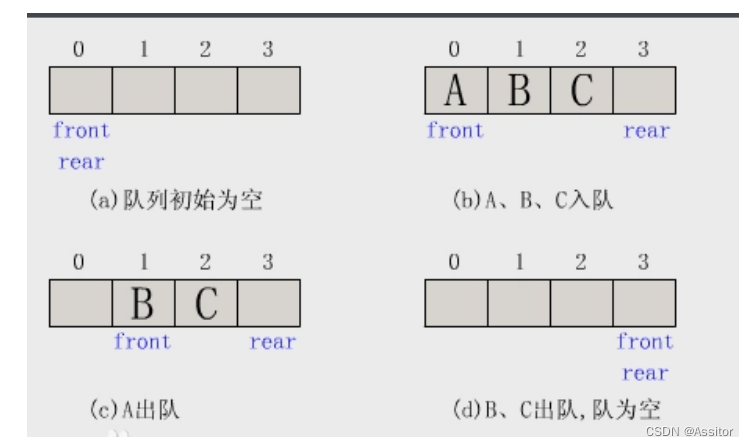 队列的数据元素又称为队列元素。在队列中插入一个队列元素称为入队,从队列中删除一个队列元素称为出队。因为队列只允许在一端插入,在另一端删除,所以只有最早进入队列的元素才能最先从队列中 删除, == 故队列又称为先进先出( FIFO—first in first out ) 线性表 。2.对队列的操作: 增删改查示例如下:
- #include
- #include
- #define MAX_SIZE 1024
- typedef struct
- {
- void *data[MAX_SIZE];
- int size;
- }Queue;
- //初始化
- Queue * init_queue(void)
- {
- Queue *queue=(Queue *)malloc(sizeof(Queue));
- for(int i=0;i{queue->data[i]=NULL;}queue->size=0;return queue;}//入队void push_queue(Queue *queue, void *data){//数组左边当做对头if(queue==NULL){return ;}if(data==NULL){return ;}queue->data[queue->size]=data;queue->size++;}//返回对头元素void *front_queue(Queue *queue){if(queue==NULL){return NULL;}if(queue->size==0){return NULL;}return queue->data[0];}//出队void pop_queue(Queue *queue){//需要移动元素if(queue==NULL){return ;}if(queue->size==0){return ;}for(int i=0;i
size-1;i++) {queue->data[i]=queue->data[i+1];}queue->size--;}//返回队尾元素void *back_queue(Queue *queue){if(queue==NULL){return NULL;}if(queue->size==0){return NULL;}return queue->data[queue->size-1];}//返回大小int size_queue(Queue *queue){if(queue==NULL){return -1;}return queue->size;}//清空队列void clear_queue(Queue *queue){if(queue==NULL){return ;}while(queue->size>0){queue->size--;queue->data[queue->size]=NULL;}}//销毁void free_queue(Queue *queue){if(queue==NULL){return ;}free(queue);}typedef struct{char name [64];int age;}Person;int main(){//创建队列Queue *queue=init_queue();//创建数据Person p1={"aaa",10};Person p2={"bbb",10};Person p3={"ccc",10};Person p4={"ddd",10};//入队push_queue(queue,&p1);push_queue(queue,&p2);push_queue(queue,&p3);push_queue(queue,&p4);//取出对尾元素Person *p=(Person *)back_queue(queue);printf("name:%s, age=%d\n",p->name,p->age);printf("\n");clear_queue(queue);printf("\n");//入队push_queue(queue,&p1);push_queue(queue,&p2);push_queue(queue,&p3);push_queue(queue,&p4);//输出while(size_queue(queue)>0){//取出对头元素Person *p=(Person *)front_queue(queue);printf("name:%s, age=%d\n",p->name,p->age);//出队pop_queue(queue);}//销毁队列free_queue(queue);return 0;}
- 相关阅读:
stm32之dma
标记蛋白用PEG衍生物Fmoc-PEG4-NHS ester,1314378-14-7
每日一博 - 图解进程(Process)和线程(Thread)区别联系
C++基础——第1章:C++初探
antv G6在vue项目中的实践总结
DataGridView 控件分页
Inno Setup 选择安装路径的问题
python的类属性和实例属性
【ETL工具】本地环境IDEA远程DEBUG调试Flume代码
【JavaSE】基础语法知识汇总
- 原文地址:https://blog.csdn.net/m0_60247706/article/details/127794234
