-
lambda表达式
1.
lambda表达式的形式lambda表达式的形式(可以省略参数列表和返回类型,但必须包含捕获列表和函数体):
[capture list](parameter list) -> return type {function body}
更详细点:
[捕获参数列表](函数参数列表) mutable throw(类型)->返回值类型 {函数语句};空捕获列表表明
lambda不使用它所在函数中的任何局部变量。lambda不能有默认参数,因此一个lambda调用的实参数目永远与形参数目相等。lambda的调用方式与普通函数的调用方式相同,都是使用调用运算符。#ifndef TEST_LAMBDA_H_ #define TEST_LAMBDA_H_ #include#include #include #include #include namespace test_lambda { auto main() -> int { std::cout << "Testing lambda......" << std::endl; auto f = [](){int a = 9; return 8;}; std::cout << f() << std::endl; // 8 std::cout << typeid(f()).name() << std::endl; // int std::vector<std::string> strs{"1234567890", "1", "123456", "123", "12345678"}; std::sort(strs.begin(), strs.end(), [](const std::string& a, const std::string& b){return a.size() < b.size();}); for(int i = 0; i < strs.size(); ++i){ std::cout << strs[i] << std::endl; } std::cout << "------------------------------" << std::endl; return 0; } } #endif - 1
- 2
- 3
- 4
- 5
- 6
- 7
- 8
- 9
- 10
- 11
- 12
- 13
- 14
- 15
- 16
- 17
- 18
- 19
- 20
- 21
- 22
- 23
- 24
- 25
- 26
- 27
- 28
- 29
- 30
- 31
- 32
- 33
输出:
Testing lambda...... 8 int 1 123 123456 12345678 1234567890 ------------------------------- 1
- 2
- 3
- 4
- 5
- 6
- 7
- 8
- 9
2.
lambda表达式的本质#include#include namespace test_lambda { auto main() -> int { std::cout << "Testing lambda......" << std::endl; /* 1. lambda expression只是一个表达式expression。 2. 一个闭包closure是一个被lambda创建的运行时对象object。 3. 一个闭包类closure class源自创建闭包实例的类,每个lambda都会让编译器产生一个独特的闭包类(即闭包类创建了lambda对象)。 闭包是可以被拷贝的,因此一个闭包类型closure type可能生成很多个闭包closures。 */ { int i = 9; auto c0 = [i]()mutable{ std::cout << "i=" << ++i; std::cout << ", lambda expression defined in: " << __func__ << ", " << __LINE__ << std::endl; // 在__func__的位置会输出"operator ()",证实了c0内心住着一个functor }; /* 可以拷贝闭包,但拷贝完成之后就"各自为政"了,谁也不影响谁, 比如进行值捕获的i,在c0、c1、c2、c3中是各自有一个副本,彼此互不影响;但对每个闭包调用多次会修改闭包内变量i的值, 总的来说,对闭包进行拷贝时,如果是值捕获则被捕获的变量在各个拷贝的闭包独自运行互不影响;如果是引用捕获则各个拷贝共同修改被捕获变量 */ auto c1 = c0; auto c2 = c1; auto c3 = c2; c0(); // 10 c2(); // 10,虽然执行过一次c0(),且c2是c1的拷贝,c1是c0的拷贝,但两次拷贝时都没有对c0进行调用过,因此调用完c2,c2内部的i都是拷贝时的10 c3(); // 10 c3(); // 11 c2(); // 11,第二次调用c2会修改c2内部的i,因此i此时变成11 c1(); // 10 c0(); // 11 auto c4 = c3; c4(); // 12,c4是c3的拷贝,拷贝时c3内i已经是11了,因此调用一次c4后c4内部的i会变成12 std::cout << "i=" << i << std::endl; // 9 std::cout << typeid(c0).name() << std::endl; // 输出class ,证实lambda其实是一个类对象 } /* 注意:有人可能觉得值捕获多次调用lambda表达式并不会不断修改捕获的变量的副本, 因为似乎看起来每调用一次都是在局部区域修改变量的值,调用结束之后就出了作用域了, 比如两次调用c0()输出的结果似乎都应该是10,而不应该每次调用都会加1。 但实际上应该将每个lambda表达式看成一个闭包closure、一个对象, 每次调用c0()其实都是对同一个对象的操作,因此捕获变量的值每次调用都会产生变化。*/ std::cout << "------------------------------" << std::endl; { /* 按引用捕获会导致闭包包含对局部变量的引用,一旦由lambda创建的闭包越过了该局部变量的生命期,那么闭包内部的引用就会悬空 */ int i = 9; auto c0 = [&i]()mutable{ std::cout << "i=" << ++i; std::cout << ", lambda expression defined in: " << __func__ << ", " << __LINE__ << std::endl; }; /* 引用捕获则各个拷贝共同修改被捕获变量 */ decltype(c0) c1 = c0; decltype(c1) c2 = c1; decltype(c2) c3 = c2; c0(); // 10 c2(); // 11 c3(); // 12 c3(); // 13 c2(); // 14 c1(); // 15 std::cout << "i=" << i << std::endl; // 15 std::cout << typeid(c0).name() << std::endl; } return 0; } }- 1
- 2
- 3
- 4
- 5
- 6
- 7
- 8
- 9
- 10
- 11
- 12
- 13
- 14
- 15
- 16
- 17
- 18
- 19
- 20
- 21
- 22
- 23
- 24
- 25
- 26
- 27
- 28
- 29
- 30
- 31
- 32
- 33
- 34
- 35
- 36
- 37
- 38
- 39
- 40
- 41
- 42
- 43
- 44
- 45
- 46
- 47
- 48
- 49
- 50
- 51
- 52
- 53
- 54
- 55
- 56
- 57
- 58
- 59
- 60
- 61
- 62
- 63
- 64
- 65
- 66
- 67
- 68
- 69
- 70
- 71
- 72
- 73
输出:
Testing lambda...... i=10, lambda expression defined in: operator (), 226 i=10, lambda expression defined in: operator (), 226 i=10, lambda expression defined in: operator (), 226 i=11, lambda expression defined in: operator (), 226 i=11, lambda expression defined in: operator (), 226 i=10, lambda expression defined in: operator (), 226 i=11, lambda expression defined in: operator (), 226 i=12, lambda expression defined in: operator (), 226 i=9 class <lambda_afcedac3f7c7146c1c21461d632c0c31> ------------------------------ i=10, lambda expression defined in: operator (), 255 i=11, lambda expression defined in: operator (), 255 i=12, lambda expression defined in: operator (), 255 i=13, lambda expression defined in: operator (), 255 i=14, lambda expression defined in: operator (), 255 i=15, lambda expression defined in: operator (), 255 i=15 class <lambda_c3fd70843e0a34e585cc39112e403eb6>- 1
- 2
- 3
- 4
- 5
- 6
- 7
- 8
- 9
- 10
- 11
- 12
- 13
- 14
- 15
- 16
- 17
- 18
- 19
- 20
3.
lambda表达式捕获的都是局部变量一个
lambda只有在其捕获列表中捕获一个它所在函数中的局部变量,才能在函数体中使用该变量。
捕获列表只用于局部非static变量。lambda可以直接使用局部static变量和它所在函数之外声明的名字。#pragma once #include#include #include #include namespace test_lambda { // str是函数局部非static变量,出现在捕获列表中,lambda表达式可以使用 // std::cout是函数外定义的变量,可以在lambda中使用 void printBigger(const std::string &str, const std::vector<std::string>& words){ std::for_each(words.begin(), words.end(), [str](const std::string& it){ if(it.size() > str.size()) std::cout << it << std::endl;}); } auto main()-> void{ std::cout << "test_lambda......." << std::endl; std::vector<std::string> strs{"1234567890", "1", "123456", "123", "12345678"}; printBigger("abcd", strs); std::cout << "test_lambda pass\n----------------------------" << std::endl; } } - 1
- 2
- 3
- 4
- 5
- 6
- 7
- 8
- 9
- 10
- 11
- 12
- 13
- 14
- 15
- 16
- 17
- 18
- 19
- 20
- 21
- 22
- 23
- 24
- 25
输出:
test_lambda....... 1234567890 123456 12345678 test_lambda pass ----------------------------- 1
- 2
- 3
- 4
- 5
- 6
3.1 企图使用未捕获的非静态局部变量会出错
示例:
#pragma once #include#include #include #include namespace test_lambda { void printBigger(const std::string &str, const std::vector<std::string>& words){ int i = 0; std::for_each(words.begin(), words.end(), [str](const std::string& it){ if(it.size() > str.size()) { std::cout << it << std::endl; std::cout << i++ << std::endl; // error: 'i' is not captured }}); } auto main()-> void{ std::cout << "test_lambda......." << std::endl; std::vector<std::string> strs{"1234567890", "1", "123456", "123", "12345678"}; printBigger("abcd", strs); std::cout << "test_lambda pass\n----------------------------" << std::endl; } } - 1
- 2
- 3
- 4
- 5
- 6
- 7
- 8
- 9
- 10
- 11
- 12
- 13
- 14
- 15
- 16
- 17
- 18
- 19
- 20
- 21
- 22
- 23
- 24
- 25
- 26
- 27
3.2 可以直接使用未捕获的静态局部变量
#pragma once #include#include #include #include namespace test_lambda { void printBigger(const std::string &str, const std::vector<std::string>& words){ static int i = 0; // 静态局部变量 std::for_each(words.begin(), words.end(), [str](const std::string& it){ // 并未捕获i if(it.size() > str.size()) { std::cout << it << std::endl; std::cout << i++ << std::endl; }}); } auto main()-> void{ std::cout << "test_lambda......." << std::endl; std::vector<std::string> strs{"1234567890", "1", "123456", "123", "12345678"}; printBigger("abcd", strs); std::cout << "test_lambda pass\n----------------------------" << std::endl; } } - 1
- 2
- 3
- 4
- 5
- 6
- 7
- 8
- 9
- 10
- 11
- 12
- 13
- 14
- 15
- 16
- 17
- 18
- 19
- 20
- 21
- 22
- 23
- 24
- 25
- 26
- 27
- 28
输出:
test_lambda....... 1234567890 0 123456 1 12345678 2 test_lambda pass ----------------------------- 1
- 2
- 3
- 4
- 5
- 6
- 7
- 8
- 9
3.3 可以主动捕获局部静态变量,但编译器会警告,因此不建议做多余的捕获
示例:
#pragma once #include#include #include #include namespace test_lambda { void printBigger(const std::string &str, const std::vector<std::string>& words){ static int i = 0; // 对于局部静态变量,如果主动捕获会有警告 std::for_each(words.begin(), words.end(), [str,i](const std::string& it){ // warning: capture of variable 'i' with non-automatic storage duration if(it.size() > str.size()) { std::cout << it << std::endl; std::cout << i++ << std::endl; }}); } auto main()-> void{ std::cout << "test_lambda......." << std::endl; std::vector<std::string> strs{"1234567890", "1", "123456", "123", "12345678"}; printBigger("abcd", strs); std::cout << "test_lambda pass\n----------------------------" << std::endl; } } - 1
- 2
- 3
- 4
- 5
- 6
- 7
- 8
- 9
- 10
- 11
- 12
- 13
- 14
- 15
- 16
- 17
- 18
- 19
- 20
- 21
- 22
- 23
- 24
- 25
- 26
- 27
- 28
输出:
test_lambda....... 1234567890 0 123456 1 12345678 2 test_lambda pass ----------------------------- 1
- 2
- 3
- 4
- 5
- 6
- 7
- 8
- 9
4.
lambda表达式定义了类型和对应的变量当向一个函数传递一个lambda时,同时定义了一个新类型和该类型的一个对象: 传递的参数就是此编译器生成的类类型的未命名对象; 类似的,当使用auto定义一个用lambda初始化的变量时,定义了一个从lambda生成的类型的对象。
#include#include namespace test_lambda { auto main() -> int { std::cout << "Testing lambda......" << std::endl; auto f = [](){int a = 9; return 8;}; std::cout << typeid(f).name() << std::endl; // [Visual Studio 15 2017] class std::cout << typeid(f()).name() << std::endl; // int std::cout << "------------------------------" << std::endl; return 0; } } - 1
- 2
- 3
- 4
- 5
- 6
- 7
- 8
- 9
- 10
- 11
- 12
- 13
- 14
- 15
- 16
- 17
- 18
- 19
输出:
Testing lambda...... class <lambda_d95bb8f939d4d5414300050c2be20dce> int ------------------------------- 1
- 2
- 3
- 4
5. 捕获
类似函数传递,变量的捕获方式可以是值捕获或引用捕获。
5.1 值捕获
与传值参数类似,采用值捕获的前提是变量可以拷贝。与参数不同,被捕获的变量的值是在
lambda创建时拷贝,而不是调用时拷贝。
示例:#includenamespace test_lambda { auto main() -> int { std::cout << "Testing lambda......" << std::endl; int i = 999; auto f = [i](){return i;}; // 被捕获的变量的值是在`lambda`创建时拷贝,而不是调用时拷贝。 i = 888; std::cout << f() << std::endl; // 999而不是888 std::cout << "------------------------------" << std::endl; return 0; } } - 1
- 2
- 3
- 4
- 5
- 6
- 7
- 8
- 9
- 10
- 11
- 12
- 13
- 14
- 15
- 16
- 17
- 18
- 19
输出:
Testing lambda...... 999 ------------------------------- 1
- 2
- 3
5.1.1 值捕获全局变量有点难以理解
值捕获函数内部局部变量时不会修改局部变量的值,但是值捕获全局变量的时候会修改全局变量的值,原因未知。
#pragma once #includeint gi = 2; namespace test_lambda { auto main()-> void{ std::cout << "test_lambda......." << std::endl; int i = 2; auto lambd = [=]()mutable{std::cout << "i = " << ++i << ", gi = " << ++gi << std::endl;}; lambd(); // 此时i仍然是2,但是gi已经变成了3 std::cout << "i = " << i << ", gi = " << gi << std::endl; std::cout << "test_lambda pass\n----------------------------" << std::endl; } } - 1
- 2
- 3
- 4
- 5
- 6
- 7
- 8
- 9
- 10
- 11
- 12
- 13
- 14
- 15
- 16
- 17
- 18
- 19
- 20
- 21
输出:
__cplusplus: 201703 test_lambda....... i = 3, gi = 3 i = 2, gi = 3 test_lambda pass ----------------------------- 1
- 2
- 3
- 4
- 5
- 6
5.1.2 值捕获会调用对象的拷贝构造函数
#include#include #include namespace test_lambda { using FuncVec = std::vector<std::function<int(void)>>; class Wiget { public: Wiget(int num):num_(num){std::cout << "Wiget ctor called." << std::endl;} Wiget(const Wiget& wg):num_(wg.num_){std::cout << "Wiget copy-ctor called." << std::endl;} ~Wiget(){num_ = -1; std::cout << "~Wiget dtor called." << std::endl;} std::function<int(void)> getfunc()const{ int copy_num = this->num_; // 使用num_的拷贝,防止Wiget对象析构后继续使用成员带来的未定义行为 auto lambda = [copy_num]() -> int{ return copy_num; }; return lambda; } void print()const{ std::cout << "num_ = " << num_ << std::endl; } private: int num_; }; auto main() -> int { std::cout << "Testing lambda......" << std::endl; #if 0 FuncVec fv; { Wiget wg(5); fv.emplace_back(wg.getfunc()); std::cout << "fv[0]() = " << fv[0]() << std::endl; } // 此时wg已经析构,但lambda中捕获的是局部变量copy_num,因此不会产生未定义行为 std::cout << "fv[0]() = " << fv[0]() << std::endl; #endif Wiget wg1(8); auto lambda = [wg1](){wg1.print();}; lambda(); return 0; } } - 1
- 2
- 3
- 4
- 5
- 6
- 7
- 8
- 9
- 10
- 11
- 12
- 13
- 14
- 15
- 16
- 17
- 18
- 19
- 20
- 21
- 22
- 23
- 24
- 25
- 26
- 27
- 28
- 29
- 30
- 31
- 32
- 33
- 34
- 35
- 36
- 37
- 38
- 39
- 40
- 41
- 42
- 43
- 44
- 45
- 46
- 47
- 48
- 49
- 50
输出:
Testing lambda...... Wiget ctor called. Wiget copy-ctor called. // 此处说明值捕获会对对象进行拷贝 num_ = 8 ~Wiget dtor called. ~Wiget dtor called.- 1
- 2
- 3
- 4
- 5
- 6
5.2 引用捕获
以引用方式捕获变量时,在
lambda函数体内使用的是引用所绑定的对象。
当以引用方式捕获一个变量时,必须保证在lambda执行时变量是存在的。例如,1.绑定前变量已经定义;2.绑定后在函数体结束之后不能再继续使用;3.从函数返回lambda时此lambda不能包含引用捕获。#includenamespace test_lambda { auto main() -> int { std::cout << "Testing lambda......" << std::endl; int i = 999; auto f = [&i](){return i;}; // 引用捕获 i = 888; std::cout << f() << std::endl; // 888 std::cout << "------------------------------" << std::endl; return 0; } } - 1
- 2
- 3
- 4
- 5
- 6
- 7
- 8
- 9
- 10
- 11
- 12
- 13
- 14
- 15
- 16
- 17
- 18
- 19
输出:
Testing lambda...... 888 ------------------------------- 1
- 2
- 3
5.3 隐式捕获
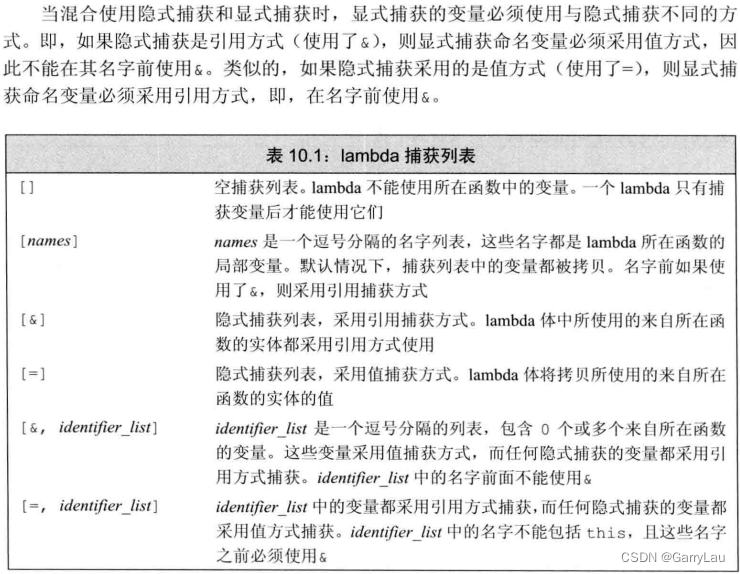 图1 lambda捕获列表
5.3.1 隐式引用捕获
#includenamespace test_lambda { auto main() -> int { std::cout << "Testing lambda......" << std::endl; int i = 9; float j = 3.14f; // auto foo = [=]{i += 1; j = j * j;}; // error C3491: “i”: 无法在非可变 lambda 中修改通过复制捕获 // error C3491: “j”: 无法在非可变 lambda 中修改通过复制捕获 auto bar = [&]{i += 1; j = j * j;}; bar(); std::cout << i << ", \t" << j << std::endl; std::cout << "------------------------------" << std::endl; return 0; } } - 1
- 2
- 3
- 4
- 5
- 6
- 7
- 8
- 9
- 10
- 11
- 12
- 13
- 14
- 15
- 16
- 17
- 18
- 19
- 20
- 21
- 22
- 23
输出:
Testing lambda...... 10, 9.8596 ------------------------------- 1
- 2
- 3
5.3.2 混合使用隐式捕获、显式捕获
#includenamespace test_lambda { auto main() -> int { std::cout << "Testing lambda......" << std::endl; int i = 9; float j = 3.14f; auto foo = [=, &j]()->int{ j = j * j; return i + 1; }; std::cout << foo() << std::endl; std::cout << i << ", \t" << j << std::endl; std::cout << "------------------------------" << std::endl; return 0; } } - 1
- 2
- 3
- 4
- 5
- 6
- 7
- 8
- 9
- 10
- 11
- 12
- 13
- 14
- 15
- 16
- 17
- 18
- 19
- 20
- 21
- 22
- 23
- 24
输出:
Testing lambda...... 10 9, 9.8596 ------------------------------- 1
- 2
- 3
- 4
5.3.3 混合使用隐式捕获、显式捕获时必须是真混合
#includenamespace test_lambda { auto main() -> int { std::cout << "Testing lambda......" << std::endl; int i = 9; float j = 3.14f; // =已经指定是值捕获了,j就不能再是值捕获,即第二位必须是引用捕获,前后必须不同 auto foo = [=, j]()->int{ // error C3489: 当默认捕获模式为按复制捕获时,需要“&j”(=) j = j * j; return i + 1; }; // &已经指定是引用捕获了,j就不能再是引用捕获,即第二位必须是值捕获,前后必须不同 auto bar = [&, &j]{}; // error C3488: 当默认捕获模式为按引用捕获时,无法显式捕获“&j”(&) std::cout << "------------------------------" << std::endl; return 0; } } - 1
- 2
- 3
- 4
- 5
- 6
- 7
- 8
- 9
- 10
- 11
- 12
- 13
- 14
- 15
- 16
- 17
- 18
- 19
- 20
- 21
- 22
- 23
- 24
- 25
5.4 值捕获时使用
mutable使用值捕获时
lambda不会改变变量的值。当想在lambda函数体内部修改该变量的值但是又不想改变该变量在lambda外部的值的时候可以使用mutable。#includenamespace test_lambda { auto main() -> int { std::cout << "Testing lambda......" << std::endl; int i = 9; auto foo = [i]()mutable->int {return ++i;}; std::cout << i << std::endl; // 9 std::cout << foo() << std::endl; // 10 std::cout << i << std::endl; // 9 std::cout << "------------------------------" << std::endl; return 0; } } - 1
- 2
- 3
- 4
- 5
- 6
- 7
- 8
- 9
- 10
- 11
- 12
- 13
- 14
- 15
- 16
- 17
- 18
- 19
- 20
- 21
输出:
Testing lambda...... 9 10 9 ------------------------------- 1
- 2
- 3
- 4
- 5
5.5 引用捕获时没必要使用
mutable吧?#includenamespace test_lambda { auto main() -> int { std::cout << "Testing lambda......" << std::endl; int i = 9; auto foo = [&i]()->int {return ++i;}; // auto foo = [&i]()mutable->int {return ++i;}; // 结果和上句一样 std::cout << i << std::endl; // 9 std::cout << foo() << std::endl; // 10 std::cout << i << std::endl; // 10 std::cout << "------------------------------" << std::endl; return 0; } } - 1
- 2
- 3
- 4
- 5
- 6
- 7
- 8
- 9
- 10
- 11
- 12
- 13
- 14
- 15
- 16
- 17
- 18
- 19
- 20
- 21
- 22
输出:
9 10 10 ------------------------------- 1
- 2
- 3
- 4
5.6 引用捕获时也不是说一定可以改变捕获变量的值
引用捕获时能不能改变捕获变量的值取决于捕获的对象是
const还是非const。
引用捕获非const示例:#includenamespace test_lambda { auto main() -> int { std::cout << "Testing lambda......" << std::endl; int i = 9; auto foo = [&i]()->int {return ++i;}; i = 0; std::cout << foo() << std::endl; // 1 std::cout << i << std::endl; // 1 std::cout << "------------------------------" << std::endl; return 0; } } - 1
- 2
- 3
- 4
- 5
- 6
- 7
- 8
- 9
- 10
- 11
- 12
- 13
- 14
- 15
- 16
- 17
- 18
- 19
- 20
- 21
输出:
Testing lambda...... 1 1 ------------------------------- 1
- 2
- 3
- 4
引用捕获
const示例:#includenamespace test_lambda { auto main() -> int { std::cout << "Testing lambda......" << std::endl; const int i = 9; auto foo = [&i]()->int {return ++i;}; // error C3491: “i”: 无法在非可变 lambda 中修改通过复制捕获 std::cout << "------------------------------" << std::endl; return 0; } } - 1
- 2
- 3
- 4
- 5
- 6
- 7
- 8
- 9
- 10
- 11
- 12
- 13
- 14
- 15
- 16
- 17
5.7 值捕获与引用捕获示例
示例1:
#pragma once #include#include namespace test_lambda { auto test0()-> void { int id = 0; auto lambda0 = [id]()mutable{ // 此处的id跟上句不是同一个,可以看作副本 std::cout << "id: " << id << std::endl; ++id; }; id = 42; // 此处修改id的值并不会修改上面lambda0中id的值,因为二者不是同一个变量 lambda0(); // 0,多次调用修改的是同一个变量id lambda0(); // 1,多次调用修改的是同一个变量id lambda0(); // 2,多次调用修改的是同一个变量id std::cout << "id: " << id << std::endl; // 42,lambda0中是值传递,修改lambda0内id的副本不会改变外部id的值 } auto test1()-> void { int id = 0; auto lambda1 = [&id](){ // 传引用,lambda1内外部会联动,因此修改lambda1内部的id即是修改外部的id,二者是同一个变量id std::cout << "id: " << id << std::endl; ++id; }; id = 42; lambda1(); // 42 lambda1(); // 43 lambda1(); // 44 std::cout << "id: " << id << std::endl; // 45 } auto main()-> void { std::cout << "test_lambda......." << std::endl; test0(); std::cout << std::string(20,'-') << std::endl; test1(); std::cout << "test_lambda pass" << std::endl; } } - 1
- 2
- 3
- 4
- 5
- 6
- 7
- 8
- 9
- 10
- 11
- 12
- 13
- 14
- 15
- 16
- 17
- 18
- 19
- 20
- 21
- 22
- 23
- 24
- 25
- 26
- 27
- 28
- 29
- 30
- 31
- 32
- 33
- 34
- 35
- 36
- 37
- 38
- 39
- 40
- 41
- 42
- 43
- 44
- 45
- 46
- 47
- 48
输出:
test_lambda....... id: 0 id: 1 id: 2 id: 42 -------------------- id: 42 id: 43 id: 44 id: 45 test_lambda pass- 1
- 2
- 3
- 4
- 5
- 6
- 7
- 8
- 9
- 10
- 11
示例2
#pragma once #include#include namespace test_lambda { auto main()-> void { std::cout << "test_lambda......." << std::endl; int a = 1, b = 1, c = 1; auto m1 = [a, &b, &c]()mutable{ auto m2 = [a, b, &c]()mutable{ std::cout << a << b << c << std::endl; a = 4; b = 4; c = 4; }; a = 3; b = 3; c = 3; m2(); }; a = 2; b = 2; c = 2; m1(); std::cout << a << b << c << std::endl; std::cout << "test_lambda pass" << std::endl; } } - 1
- 2
- 3
- 4
- 5
- 6
- 7
- 8
- 9
- 10
- 11
- 12
- 13
- 14
- 15
- 16
- 17
- 18
- 19
- 20
- 21
- 22
- 23
- 24
- 25
- 26
- 27
- 28
输出:
test_lambda....... 123 234 test_lambda pass- 1
- 2
- 3
- 4
执行
m1(),m1()内部执行m2();
m2()的c是pass by reference,因此其最终值取决于m2()内的赋值,c=4;
m2()的b是pass by value,因此其最终值取决于m1()内的赋值,b=3;
a在m1(),m2()内都是pass by value,因此其最终值取决于main()内的赋值,a=2。6.
lambda的返回类型可以主动指定
lambda的返回类型,也可以让编译器自动推断。
注意:此处实测跟C++ Primer中文版P353页中的表述不一致,建议以实测为准。书中是说如果一个lambda体包含return之外的任何语句则编译器假定lambda返回void,(说实话,没看懂书上说的是啥意思)。#include#include namespace test_lambda { auto main() -> int { std::cout << "Testing lambda......" << std::endl; int i = 9; auto foo = [i](){ // 未指定返回类型,自动推断为int if(i >= 0){ return 1; } else{ return -1; } }; auto bar = [i]()->float{ if(i >= 0){ return 1; } else{ return -1; } }; std::cout << typeid(foo()).name() << std::endl; std::cout << typeid(bar()).name() << std::endl; std::cout << "------------------------------" << std::endl; return 0; } } - 1
- 2
- 3
- 4
- 5
- 6
- 7
- 8
- 9
- 10
- 11
- 12
- 13
- 14
- 15
- 16
- 17
- 18
- 19
- 20
- 21
- 22
- 23
- 24
- 25
- 26
- 27
- 28
- 29
- 30
- 31
- 32
- 33
- 34
- 35
- 36
- 37
输出:
Testing lambda...... int float ------------------------------- 1
- 2
- 3
- 4
7. Avoid default capture modes
在对象中捕获
this时小心dangle。#include#include #include namespace test_lambda { using FuncVec = std::vector<std::function<int(void)>>; class Wiget { public: Wiget(int num):num_(num){std::cout << "Wiget ctor called." << std::endl;} Wiget(const Wiget& wg):num_(wg.num_){std::cout << "Wiget copy-ctor called." << std::endl;} ~Wiget(){num_ = -1; std::cout << "Wiget dtor called." << std::endl;} std::function<int(void)> getfunc()const{ // 写法1,编译通过,但行为可能未定义 auto lambda = [this]() -> int{ //std::cout << this->num_ << std::endl; return this->num_; }; #if 0 // 写法2,编译通过,但行为可能未定义 auto lambda = [=]() -> int{ std::cout << this->num_ << std::endl; return this->num_; }; #endif #if 0 // 写法3,编译错误 auto lambda = []() -> int{ // error C4573: “test_lambda::Wiget::num_”的用法要求编译器捕获“this”,但当前默认捕获模式不允许使用“this” std::cout << num_ << std::endl; return num_; }; #endif #if 0 // 写法4,编译错误 auto lambda = [num_]() -> int{ // error C3480: “test_lambda::Wiget::num_”: lambda 捕获变量必须来自封闭函数范围 std::cout << num_ << std::endl; return num_; }; #endif return lambda; } private: int num_; }; auto main() -> int { std::cout << "Testing lambda......" << std::endl; FuncVec fv; { Wiget wg(5); fv.emplace_back(wg.getfunc()); std::cout << "fv[0]() = " << fv[0]() << std::endl; } // 此时wg已经析构,this已经悬空dangle,lambda中继续使用之前捕获的num_已经是未定义行为 // 未定义行为意味着今天正确明天可能会出错,未定义行为不一定表示立即会崩溃或出错,跟编译器、编译选项、代码细节相关 // 很多时候开优化出错,也是因为未定义行为容易在开启优化的时候更容易暴露出来 std::cout << "fv[0]() = " << fv[0]() << std::endl; return 0; } } - 1
- 2
- 3
- 4
- 5
- 6
- 7
- 8
- 9
- 10
- 11
- 12
- 13
- 14
- 15
- 16
- 17
- 18
- 19
- 20
- 21
- 22
- 23
- 24
- 25
- 26
- 27
- 28
- 29
- 30
- 31
- 32
- 33
- 34
- 35
- 36
- 37
- 38
- 39
- 40
- 41
- 42
- 43
- 44
- 45
- 46
- 47
- 48
- 49
- 50
- 51
- 52
- 53
- 54
- 55
- 56
- 57
- 58
- 59
- 60
- 61
- 62
输出:
Testing lambda...... Wiget ctor called. fv[0]() = 5 Wiget dtor called. fv[0]() = -1- 1
- 2
- 3
- 4
- 5
解决方法:
#include#include #include namespace test_lambda { using FuncVec = std::vector<std::function<int(void)>>; class Wiget { public: Wiget(int num):num_(num){std::cout << "Wiget ctor called." << std::endl;} ~Wiget(){num_ = -1; std::cout << "~Wiget dtor called." << std::endl;} std::function<int(void)> getfunc()const{ //std::cout << "num_=" << this->num_ << std::endl; int copy_num = this->num_; // 使用num_的拷贝,防止Wiget对象析构后继续使用成员带来的未定义行为 auto lambda = [copy_num]() -> int{ //std::cout << "copy_num=" << copy_num << std::endl; return copy_num; }; return lambda; } private: int num_; }; auto main() -> int { std::cout << "Testing lambda......" << std::endl; FuncVec fv; { Wiget wg(5); fv.emplace_back(wg.getfunc()); std::cout << "fv[0]() = " << fv[0]() << std::endl; } // 此时wg已经析构,但lambda中捕获的是局部变量copy_num,因此不会产生未定义行为 std::cout << "fv[0]() = " << fv[0]() << std::endl; return 0; } } - 1
- 2
- 3
- 4
- 5
- 6
- 7
- 8
- 9
- 10
- 11
- 12
- 13
- 14
- 15
- 16
- 17
- 18
- 19
- 20
- 21
- 22
- 23
- 24
- 25
- 26
- 27
- 28
- 29
- 30
- 31
- 32
- 33
- 34
- 35
- 36
- 37
- 38
- 39
- 40
- 41
- 42
输出:
Testing lambda...... Wiget ctor called. fv[0]() = 5 ~Wiget dtor called. fv[0]() = 5- 1
- 2
- 3
- 4
- 5
8. 泛型lambda表达式(C++14)
#include#include #include #include // std::less struct Obj { int id_; std::string color_; }; auto main()->int { auto less_obj = [](auto&& x, auto&& y) { return std::forward<decltype(x)>(x) < std::forward<decltype(y)>(y); }; std::cout << less_obj(3, 4) << std::endl; // 1 std::cout << less_obj(13, 4) << std::endl; // 0 return 0; } - 1
- 2
- 3
- 4
- 5
- 6
- 7
- 8
- 9
- 10
- 11
- 12
- 13
- 14
- 15
- 16
- 17
- 18
- 19
- 20
- 21
-
相关阅读:
uniapp实现拍照涂鸦
使用HTML制作静态网站:传统文化戏剧锡剧带psd设计图(2个页面)
SegNet学习笔记
std::variant 源码分析
linux centos7 安装nginx
前端程序员兼职副业平台推荐
pytorch深度学习单卡训练和多卡训练
分享从零开始学习网络设备配置--任务3.7 使用动态路由RIPv2实现网络连通
LabVIEW定义自定义错误代码在应用程序中使用
SpringBoot自动配置原理
- 原文地址:https://blog.csdn.net/liugan528/article/details/126354737
- 最新文章
-
【FHE】我们如何实现同态加密推理(八):SiLU 的密文化——两条路径,和一个 8 字节的开关
SQLcl 中 c/old/new 替换变量为何失效?先定位再替换
不让模型写作文,直接从它脑子里读答案:Jev 决策在 .NET 的两条路线
Halo插件:支持GitHub的图床附件策略
电视投屏界的“一股清流”!SimpleTVCast 6.0.0-beta 抢先体验:无需TV端App,界面大换血!✨
华三VXLAN集中式网关实战指南:Spine多活网关 + 双活接入(M-LAG)
软件更好写之后口碑会更重要
大 O、大 Omega、大 Theta 的区别,O(n) 复杂度是什么意思
Java标签跳转:一个鲜为人知但却很实用的小技巧
多智能体系统论文速读