-
Docker入门
Docker简介

Docker是开发人员和系统管理员构建、发布和运行分布式应用程序的开放平台。是应用容器(Application Container),是可以为应用提供可运行容器的一个平台。Docker看作一条船,船上的每一个集装箱就是一个容器(每个容器中都有一个Linux系统)。
Docker还有一重要的用处,就是可以保证开发,测试和生产环境的一致。
1、Docker安装
安装一组工具
sudo yum install -y yum-utils设置 yum 仓库地址,设置2个仓库地址,一个失败会使用另外一个仓库。
- sudo yum-config-manager --add-repo https://download.docker.com/linux/centos/docker-ce.repo
- sudo yum-config-manager --add-repo http://mirrors.aliyun.com/docker-ce/linux/centos/docker-ce.repo
更新 yum 缓存
sudo yum makecache fast安装新版 docker
sudo yum install -y docker-ce docker-ce-cli containerd.io2、Docker入门
sudo systemctl start dockersudo systemctl restart docker设置 docker 开机启动
sudo systemctl enable docker镜像加速
由于国内网络问题,需要配置加速器来加速。
修改配置文件:vi /etc/docker/daemon.json- {
- "registry-mirrors": [
- "https://docker.mirrors.ustc.edu.cn",
- "http://hub-mirror.c.163.com"
- ],
- "max-concurrent-downloads": 10,
- "log-driver": "json-file",
- "log-level": "warn",
- "log-opts": {
- "max-size": "10m",
- "max-file": "3"
- },
- "data-root": "/var/lib/docker"
- }
重新加载docker配置
sudo systemctl daemon-reload重启docker服务
sudo systemctl restart docker查看镜像配置
docker info可以看到上面配置的仓库地址已经修为https://docker.mirrors.ustc.edu.cn/
运行 hello-world 镜像,当没有hello-world这个镜像,他会到我们设置的仓库地址去下载这个镜像。
sudo docker run hello-world检查docker 镜像
docker images
发现有一个hello-world,是上面运行后,本地没有,然后去仓库中下载的。
- #查看正在运行的容器
- docker ps
假如希望查看所有镜像,包含没有运行的镜像容器,可以执行如下指令:
docker ps -all停止docker服务
docker stop 服务id
删除docker 镜像
docker image rm hello-world假如镜像被占用着是不可以直接被删除的,需要先删除应用此镜像的容器,例如
- #查询容器
- docker ps -all
- #删除容器
- docker container rm 容器名或容器id

3、概念
镜像(可以认为是一个容器的可执行文件,可以使用docker命令执行启动,启动后就是容器)
Docker 镜像是一个特殊的文件系统,就是容器的运行文件,除了提供容器运行时所需的程序、库、资源、配置等文件外,还包含了一些为运行时准备的一些配置参数(如匿名卷、环境变量、用户等)。镜像不包含任何动态数据,其内容在构建之后也不会被改变。
镜像只是一个虚拟的概念,其实际体现并非由一个文件组成,而是由一组文件系统组成,或者说,由多层文件系统联合组成。
镜像构建时,会一层层构建,前一层是后一层的基础。每一层构建完就不会再发生改变,后一层上的任何改变只发生在自己这一层。比如,删除前一层文件的操作,实际不是真的删除前一层的文件,而是仅在当前层标记为该文件已删除。在最终容器运行的时候,虽然不会看到这个文件,但是实际上该文件会一直跟随镜像。因此,在构建镜像的时候,需要额外小心,每一层尽量只包含该层需要添加的东西,任何额外的东西应该在该层构建结束前清理掉。
分层存储的特征还使得镜像的复用、定制变的更为容易。甚至可以用之前构建好的镜像作为基础层,然后进一步添加新的层,以定制自己所需的内容,构建新的镜像。
从仓库拉取镜像
- docker pull 镜像名称
- 或者
- docker pull 镜像名称:版本号
查看有哪些镜像
docker images删除镜像
docker image rm 镜像id如果镜像已经执行启动成一个容器,需要先删除这个容器。
启动运行镜像,启动后就是一个容器。
docker run -it xxxx bash-d: 后台运行容器,并返回容器ID。
-it:在伪输入终端以交互模式运行容器。-i交互,-t终端。
-p:指定端口映射,格式为:主机(宿主)端口:容器端口
-v 用于指定挂载目录,格式为:宿主机目录:容器目录--restart always 设置容器随宿主机的开机而自启动
-p 80:80 指端口映射,访问宿主机端口80,相当于访问的是nginx容器的80端口,
--name 给容器设置一个名字,若没有设置默为镜像名。
-v 指挂载,比如将 宿主机目录/usr/local/nginx/挂载到容器目录/etc/nginx/
-d 后台运行
nginx:1.22.0 要运行的容器名:版本号
一般运行镜像时,需要挂载主机目录,防止停止运行后数据丢失
docker run -it -v /usr/app:/opt/app centos:7 bash将宿主机目录/usr/app挂载到容器的/opt/app目录
其中:
1)/usr/app:为宿主机目录
2)/opt/app: 为启动容器的一个目录
3)-v 用于指定挂载目录,如果本地目录(宿主机目录)不存在, Docker 会自动为你按照挂载目录进行目录的创建。镜像导出
docker save jdk:8 | gzip > /root/jdk8.tar.gz镜像导入
docker load < /root/jdk8.tar.gz容器(每个容器中都有一个独立的Linux操作系统)
镜像(Image)和容器(Container)的关系,就像是光盘和光驱,容器是镜像运行时的载体,镜像运行启动后就是一个容器。容器可以被创建、启动、停止、删除、暂停等。
容器的本质是进程,但与直接在宿主机执行的进程不同,容器进程运行于属于自己的独立的 命名空间。因此容器可以拥有自己的 root 文件系统、自己的网络配置、自己的进程空间,甚至自己的用户 ID 空间。容器内的进程是运行在一个隔离的环境里,使用起来,就好像是在一个独立于宿主的系统下操作一样。这种特性使得容器封装的应用比直接在宿主运行更加安全。
镜像文件启动后就是一个容器,容器里面有操作系统、有组件,启动容器的时候默认还会执行一个命令,让组件在操作系统中运行。
docker history 镜像id或者镜像名
可以看到容器启动后,会在容器的操作系统中执行 catalina.sh 命令,这个命令就会启动tomcat组件。
docker container xx 命令 可以简写为 docker xx
查看正在运行的镜像容器
docker ps查看所有镜像容器,包含没有运行的镜像容器
docker ps -all进入指定容器,退出exit
sudo docker exec -it 容器id或者容器名 bash停止镜像容器
- docker container stop 容器id或者容器名
- 或者
- docker stop 容器id或者容器名
启动镜像容器
- docker container start 容器id或者容器名
- 或者
- docker start 容器id或者容器名
设置容器开机自启动
docker update 容器名或容器id --restart=always重启容器
- docker container restart 容器名或容器id
- 或者
- docker restart 容器名或容器id
查看容器安装到哪了?
whereis 容器名或容器id查看容器启动时的日志
docker container logs 容器名或容器id删除镜像容器
docker container rm 容器名或容器id强制删除容器
docker rm -f 容器名或容器id清除那些已经没有使用的容器
docker container prune后台执行容器里的 jar包,因为容器不能直接访问宿主机里面的目录,还需要挂载一个目录。
- docker run -dit -p 宿主机端口:容器端口 -v 宿主机目录:容器目录 容器名 java -jar 要运行的jar包路径
- #例如
- docker run -dit -p 8081:8081 -v /root:/root jdk:8 java -jar /root/xx.jar
容器打包镜像
docker commit -m="描述信息" -a="作者" 容器id 目标镜像名:[TAG]
docker commit -m="描述信息" -a="作者" b6ef283d6a47 myjdk:88
数据卷
镜像使用的是分层存储方式,容器也是如此。每一个容器运行时,是以镜像为基础层,在其上创建一个当前容器的存储层(我们可以称这个为容器运行时执行读写操作而准备的存储层)
容器存储层的生存周期和容器一样,容器消亡时,容器存储层也随之消亡。因此,任何保存于容器存储层的信息都会随容器删除而丢失。
按照 Docker 最佳实践的要求,容器不应该向其存储层内写入任何数据,容器存储层要保持无状态化。所有的文件写入操作,都应该使用 数据卷(Volume)、或者绑定宿主目录,在这些位置的读写会跳过容器存储层,直接对宿主(或网络存储)发生读写,其性能和稳定性更高。
数据卷的生存周期独立于容器,容器消亡,数据卷不会消亡。因此,使用数据卷后,容器删除或者重新运行之后,数据却不会丢失。数据卷是一个可供一个或多个容器使用的特殊目录。默认会一直存在,即使容器被删除。也是存储在宿主机上。就是说容器是一个独立的操作系统,当容器消失后,容器这个操作系统也消失了,里面的数据文件比如web的日志也没了,为了解决这个问题,使用数据卷或者将容器操作系统的数据文件挂载在宿主目录,这样好处就是容器消亡,数据文件不会消亡。
- #创建数据卷
- docker volume create 数据卷名称
- #查看所有数据卷
- docker volume ls
- #查看指定 数据卷 的信息
- docker volume inspect 数据卷名称
- #启动挂载数据卷的容器
- docker run -it --mount source=数据卷名称,target=/root centos:7 bash
- # 或者:
- docker run -it -v 数据卷名称:/root centos:7 bash
- -v container-vol:/root 把数据卷 container-vol 挂载到容器的 /root 目录
- #删除数据卷(如果数据卷被容器使用则无法删除)
- docker volume rm 数据卷名称
- #清理无主数据卷
- docker volume prune
挂载主机目录(常用)
作用和数据卷差不多
docker run -it -v /usr/app:/opt/app centos:7 bash
其中:
1)/usr/app:为宿主机目录
2)/opt/app: 为启动容器的一个目录
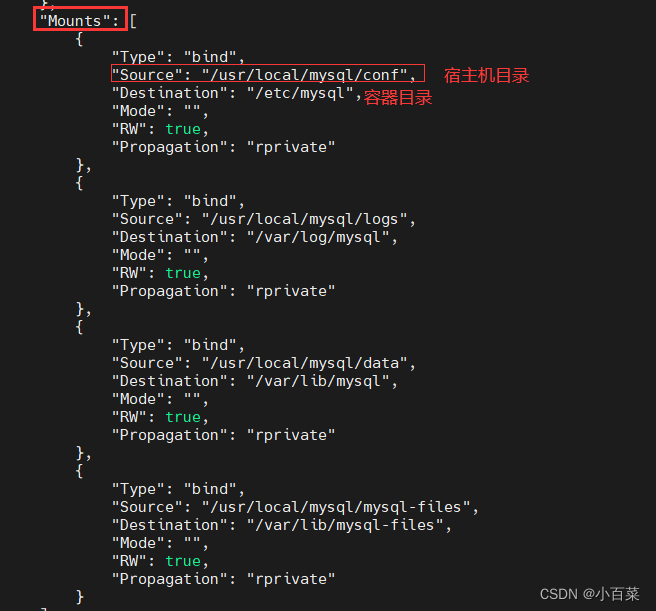
3)-v 用于指定挂载目录,如果本地目录(宿主机目录)不存在, Docker 会自动为你按照挂载目录进行目录的创建。查看挂载目录信息
docker inspect 容器名或容器id
4、Docker镜像操作
下载 Docker镜像,其实就是下载一个CentOS 镜像。
假如是自己制作镜像,都会先下载一个空的centos镜像,假如后面我们要自己做镜像,都需要这样的一个空的系统镜像文件。
冒号:7表示指定版本。
docker pull centos:7查看centos7镜像文件
docker images运行镜像
通过docker启动运行 centos7镜像
docker run -it xxxx bashxxxx - 镜像名, 或 image id
-it 这是两个参数,一个是 -i:交互式操作,一个是 -t 终端。-d表示后台运行。我们这里打算进入 bash 执行一些命令并查看返回结果,因此我们需要交互式终端。
bash 放在镜像名后的是命令,这里我们希望有个交互式 Shell,因此用的是 bash。比如通过名字启动:docker run -it centos:7 bash
比如通过image id启动:docker run -it eeb6ee3f44bd bash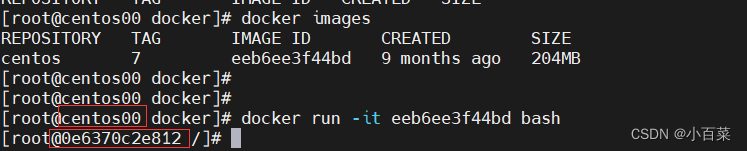
可以看到,启动容器以后,直接就进入了容器系统这个操作系统中了。
后面的操作,其实就是在容器系统这个操作系统中操作了,exit退出,就会退出容器那个操作系统,回到宿主系统中。
5、数据卷操作(了解)
创建数据卷
docker volume create container-vol查看所有数据卷
docker volume ls查看指定 数据卷 的信息
docker volume inspect container-vol
启动挂载数据卷的容器
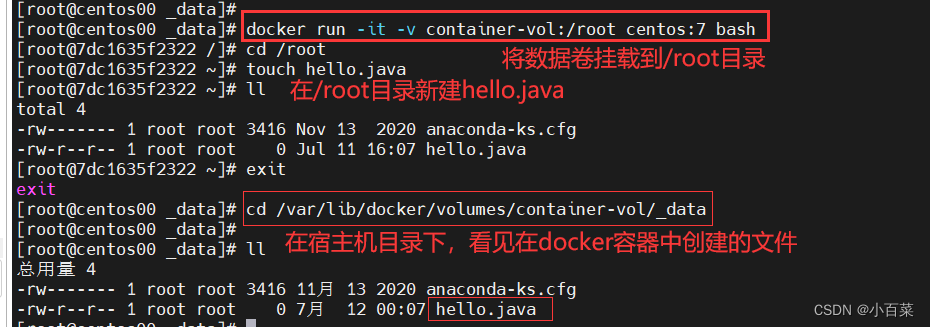
docker run -it --mount source=container-vol,target=/root centos:7 bash简写:
docker run -it -v container-vol:/root centos:7 bash-v container-vol:/root 把数据卷 container-vol 挂载到容器的 /root 目录
删除数据卷(如果数据卷被容器使用则无法删除)
docker volume rm container-vol清理无主数据卷(就是把数据卷在宿主机上的目录给删除了,比如上面的/var/lib/docker/volumes/container-vol/_data)
docker volume prune6、挂载主机目录(常用)
docker run -it -v /usr/app:/opt/app centos:7 bash其中:
1)/usr/app:为宿主机目录
2)/opt/app: 为启动容器的一个目录3)-v 用于指定挂载目录,如果本地目录(宿主机目录)不存在, Docker 会自动为你按照挂载目录进行目录的创建。
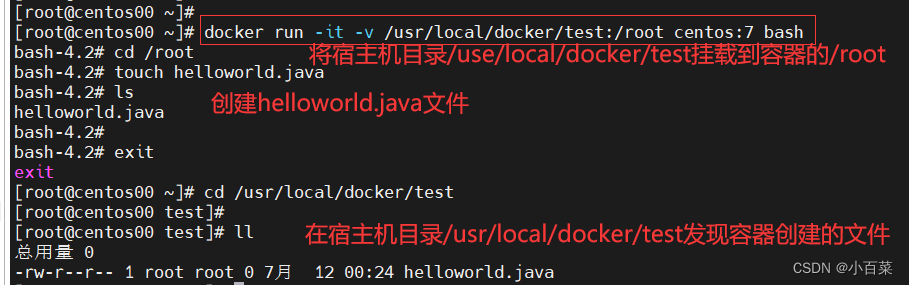
比如将宿主机目录/usr/local/docker/test挂载到容器的/root目录
docker run -it -v /usr/local/docker/test:/root centos:7 bash
查看挂载目录信息
docker ps -all
docker inspect 容器id

7、镜像制作-Dockerfile文件
Dockerfile 是一个用来构建镜像的文本文件,文本内容包含了一条条构建镜像所需的指令和说明。我们通常会基于此文件创建docker镜像。
准备工作
1)centos:7镜像 (所有的镜像文件创建时都需要有一个空的centos镜像,就类似通过一个空的光盘或u盘创建一个系统启动盘是一样的)
docker pull centos:72)jdk压缩包jdk-8u311-linux-x64.tar.gz(可以从官网去下载:oracle.org),基于此压缩包,制作jdk镜像。
Dockerfile文件
在创建新的镜像时都需要有一个Dockerfile文件(文件名一定要注意大小写),这个文件要与你的资源放在一起(例如你下载的jdk)
编辑Dockerfile文件
vi Dockerfile
- FROM centos:7
- ADD jdk-8u311-linux-x64.tar.gz /usr/local/docker
- ENV JAVA_HOME=/usr/local/docker/jdk1.8.0_311 \
- PATH=/usr/local/docker/jdk1.8.0_311/bin:$PATH
- CMD ['bash']
编写FROM语句(关键字一定要大写,例如FROM不能写小写)
FROM centos:7
通过ADD命令将宿主机中的压缩包传入镜像容器中的指定目录,并同时解压缩
ADD jdk-8u311-linux-x64.tar.gz /usr/local/docker
设置环境变量(通过ENV关键字实现,目录启动容器中的目录) 注意:\表示换行。:$PATH表示保留以前的path
ENV JAVA_HOME=/usr/local/docker/jdk1.8.0_311 \
PATH=/usr/local/docker/jdk1.8.0_311/bin:$PATH
指定命令行操作(所有指令与后面内容要有空格)
CMD ['bash']使用 Dockerfile 构建镜像(在Dockerfile所在目录执行docker指令)
docker build -t jdk:8 .注意末尾的点,表示构建过程中从当前目录寻找文件,jdk:8为我们创建的镜像名。

我们制作的这个镜像,依赖了一个空白的centos:7镜像,所以我们制作的jdk:8镜像是已经包含了centos:7镜像。
8、运行镜像文件
docker run -it jdk:8 bashjava -version

也可以不进入 bash ,直接运行 java version命令
docker run -it jdk:8 java -version
9、镜像导出导入操作
镜像导出,导出后给他人使用
docker save jdk:8 | gzip > /root/jdk8.tar.gz
镜像导入docker load < /root/jdk8.tar.gz或者
docker load -i /root/jdk8.tar.gz

Docker 镜像资源安装
安装MySql数据库
在https://hub.docker.com/上搜索 mysql 镜像

拉取版本指定版本mysql
docker pull mysql:8.0.23
启动运行mysql镜像
- docker run -p 3307:3306 --name mysql \
- -v /usr/local/mysql/mysql-files:/var/lib/mysql-files \
- -v /usr/local/mysql/conf:/etc/mysql \
- -v /usr/local/mysql/logs:/var/log/mysql \
- -v /usr/local/mysql/data:/var/lib/mysql \
- -e MYSQL_ROOT_PASSWORD=root \
- -d mysql:8.0.23
-p 3307:3306 指端口映射,访问宿主机端口3307,相当于访问的是mysql容器的3306端口,
--name 给容器设置一个名字,若没有设置默为镜像名。
-v 指挂载,比如将 宿主机目录/usr/local/docker/mysql/mysql-files挂载到容器目录/var/lib/mysql-files
-e 给mysql设置密码为root
-d 后台运行
mysql:8.0.23 要运行的容器名:版本号- #停止mysql服务
- docker stop mysql
- #启动mysql服务
- docker start mysql
- #设置mysql开机自启动
- docker update mysql --restart=always
查看正则运行的容器
docker ps
进入容器 (退出容器用exit)
sudo docker exec -it mysql bash登陆mysql(上面设置的密码为root)
mysql -uroot -proot
外部连接mysql
- #创建mysql账户。用户名和密码都是tony
- create user 'tony'@'%' identified by 'tony';
- #授权
- grant all on *.* to 'tony'@'%'

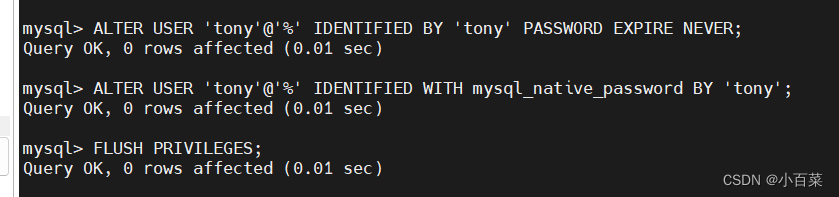
出现Plugin caching_sha2_password could not be load错误(出现这个错误往往与数据库的版本有关系,mysql8.0以后改变对远程客户端的校验方式)分别执行如下三个指令
- ALTER USER 'tony'@'%' IDENTIFIED BY 'tony' PASSWORD EXPIRE NEVER;
- ALTER USER 'tony'@'%' IDENTIFIED WITH mysql_native_password BY 'tony';
- FLUSH PRIVILEGES;
开启宿主机端口3307
- #开启端口3307
- firewall-cmd --permanent --add-port=3307/tcp
- #重启防火墙是修改生效
- firewall-cmd --reload
- #查询有哪些端口是开启的
- firewall-cmd --list-port
安装Nacos
在https://hub.docker.com/上搜索 nacos镜像

拉取指定版本nacos
docker pull nacos/nacos-server:1.4.1
在nacos官网https://github.com/alibaba/nacos/releases下载nacos-server.zip后解压,需要根据conf/nacos-mysql.sql创建nacos需要用到的数据库和表结构。
GitHub网速不好点这里下载https://download.csdn.net/download/u014644574/86730745
由于上面安装MySQL宿主机挂载的目录是/usr/local/mysql/conf,这里将nacos-server.zip后解压后的conf/nacos-mysql.sql文件上传到宿主机的/usr/local/mysql/conf目录。
进入MySQL容器
docker exec -it mysql bash登录mysql
mysql -uroot -proot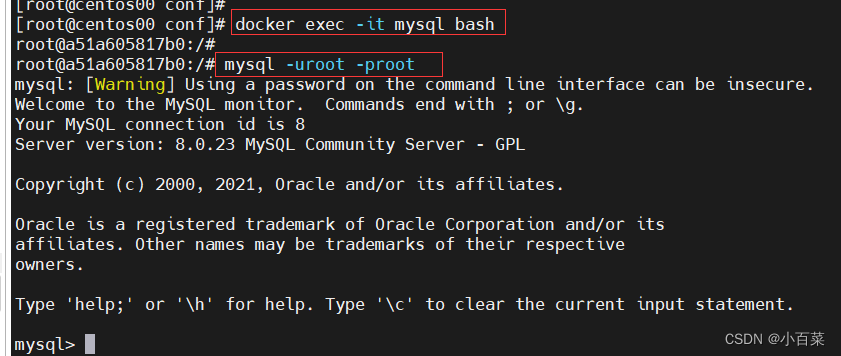
导入nacos依赖的数据库sql
source /etc/mysql/nacos-mysql.sql

创建nacos容器
- docker run \
- -e TZ="Asia/Shanghai" \
- -e MODE=standalone \
- -e SPRING_DATASOURCE_PLATFORM=mysql \
- -e MYSQL_DATABASE_NUM=1 \
- -e MYSQL_SERVICE_HOST=192.168.111.199 \
- -e MYSQL_SERVICE_PORT=3307 \
- -e MYSQL_SERVICE_USER=root \
- -e MYSQL_SERVICE_PASSWORD=root \
- -e MYSQL_SERVICE_DB_NAME=nacos_config \
- -p 8848:8848 \
- --name nacos \
- --restart=always \
- -d nacos/nacos-server:1.4.1
-e 指定容器环境变量
TZ,指定时区。
MODE=standalone,单机模式
SPRING_DATASOURCE_PLATFORM=mysql 连接数据库类型为mysql|
MYSQL_SERVICE_HOST=192.168.111.199连接数据库地址(这里是docker的宿主机地址)
MYSQL_SERVICE_PORT=3307 数据库端口号,这里注意,容器之间不能直接访问,需要使用宿主机的映射端口。
MYSQL_SERVICE_USER=root 数据库用户名
MYSQL_SERVICE_PASSWORD=root 数据库密码
MYSQL_SERVICE_DB_NAME=nacos_config 数据库名
-p 8848:8848 指端口映射,访问宿主机端口8848,相当于访问的是nacos容器的8848端口
--name 给容器设置一个名字,若没有设置默为镜像名。
--restart always 设置容器开机自启动
-d 后台运行
nacos/nacos-server:1.4.1 要运行的容器名:版本号请求地址:http://192.168.111.199:8848/nacos
用户名/密码:nacos/nacos
如果想保存nacos的配置文件和日志,可以做后面操作。后面步骤可以不管,一般不需要保存nacos。
保存nacos的配置文件,这一步把就是 cp (复制)指令,将容器中的/home/nacos 目录复制到宿主机的/usr/local/nacos目录下。
docker cp -a nacos:/home/nacos /usr/local/nacos停止nacos容器,并删除
- docker stop nacos
- docker rm nacos
nacos容器启动配置,这次将上面保存/usr/local/nacos下的配置文件挂载在nacos容器中
- docker run \
- -e TZ="Asia/Shanghai" \
- -e MODE=standalone \
- -e SPRING_DATASOURCE_PLATFORM=mysql \
- -e MYSQL_DATABASE_NUM=1 \
- -e MYSQL_SERVICE_HOST=192.168.111.199 \
- -e MYSQL_SERVICE_PORT=3307 \
- -e MYSQL_SERVICE_USER=root \
- -e MYSQL_SERVICE_PASSWORD=root \
- -e MYSQL_SERVICE_DB_NAME=nacos_config \
- -v /usr/local/nacos:/home/nacos \
- -p 8848:8848 \
- --name nacos \
- --restart=always \
- -d nacos/nacos-server:1.4.1
-v 挂载目录,宿主机目录:容器目录
安装Redis
在https://hub.docker.com/上搜索 redis镜像

拉取版本指定版本redis
docker pull redis:5.0.14
创建redis配置文件目录
mkdir -p /usr/local/redis/conf在配置文件录下创建redis.conf配置文件,
touch /usr/local/redis/conf/redis.confredis.conf可以在官网下载
- # Redis configuration file example.
- #
- # Note that in order to read the configuration file, Redis must be
- # started with the file path as first argument:
- #
- # ./redis-server /path/to/redis.conf
- # Note on units: when memory size is needed, it is possible to specify
- # it in the usual form of 1k 5GB 4M and so forth:
- #
- # 1k => 1000 bytes
- # 1kb => 1024 bytes
- # 1m => 1000000 bytes
- # 1mb => 1024*1024 bytes
- # 1g => 1000000000 bytes
- # 1gb => 1024*1024*1024 bytes
- #
- # units are case insensitive so 1GB 1Gb 1gB are all the same.
- ################################## INCLUDES ###################################
- # Include one or more other config files here. This is useful if you
- # have a standard template that goes to all Redis servers but also need
- # to customize a few per-server settings. Include files can include
- # other files, so use this wisely.
- #
- # Notice option "include" won't be rewritten by command "CONFIG REWRITE"
- # from admin or Redis Sentinel. Since Redis always uses the last processed
- # line as value of a configuration directive, you'd better put includes
- # at the beginning of this file to avoid overwriting config change at runtime.
- #
- # If instead you are interested in using includes to override configuration
- # options, it is better to use include as the last line.
- #
- # include /path/to/local.conf
- # include /path/to/other.conf
- ################################## MODULES #####################################
- # Load modules at startup. If the server is not able to load modules
- # it will abort. It is possible to use multiple loadmodule directives.
- #
- # loadmodule /path/to/my_module.so
- # loadmodule /path/to/other_module.so
- ################################## NETWORK #####################################
- # By default, if no "bind" configuration directive is specified, Redis listens
- # for connections from all the network interfaces available on the server.
- # It is possible to listen to just one or multiple selected interfaces using
- # the "bind" configuration directive, followed by one or more IP addresses.
- #
- # Examples:
- #
- # bind 192.168.1.100 10.0.0.1
- # bind 127.0.0.1 ::1
- #
- # ~~~ WARNING ~~~ If the computer running Redis is directly exposed to the
- # internet, binding to all the interfaces is dangerous and will expose the
- # instance to everybody on the internet. So by default we uncomment the
- # following bind directive, that will force Redis to listen only into
- # the IPv4 loopback interface address (this means Redis will be able to
- # accept connections only from clients running into the same computer it
- # is running).
- #
- # IF YOU ARE SURE YOU WANT YOUR INSTANCE TO LISTEN TO ALL THE INTERFACES
- # JUST COMMENT THE FOLLOWING LINE.
- # ~~~~~~~~~~~~~~~~~~~~~~~~~~~~~~~~~~~~~~~~~~~~~~~~~~~~~~~~~~~~~~~~~~~~~~~~
- bind 127.0.0.1
- # Protected mode is a layer of security protection, in order to avoid that
- # Redis instances left open on the internet are accessed and exploited.
- #
- # When protected mode is on and if:
- #
- # 1) The server is not binding explicitly to a set of addresses using the
- # "bind" directive.
- # 2) No password is configured.
- #
- # The server only accepts connections from clients connecting from the
- # IPv4 and IPv6 loopback addresses 127.0.0.1 and ::1, and from Unix domain
- # sockets.
- #
- # By default protected mode is enabled. You should disable it only if
- # you are sure you want clients from other hosts to connect to Redis
- # even if no authentication is configured, nor a specific set of interfaces
- # are explicitly listed using the "bind" directive.
- protected-mode yes
- # Accept connections on the specified port, default is 6379 (IANA #815344).
- # If port 0 is specified Redis will not listen on a TCP socket.
- port 6379
- # TCP listen() backlog.
- #
- # In high requests-per-second environments you need an high backlog in order
- # to avoid slow clients connections issues. Note that the Linux kernel
- # will silently truncate it to the value of /proc/sys/net/core/somaxconn so
- # make sure to raise both the value of somaxconn and tcp_max_syn_backlog
- # in order to get the desired effect.
- tcp-backlog 511
- # Unix socket.
- #
- # Specify the path for the Unix socket that will be used to listen for
- # incoming connections. There is no default, so Redis will not listen
- # on a unix socket when not specified.
- #
- # unixsocket /tmp/redis.sock
- # unixsocketperm 700
- # Close the connection after a client is idle for N seconds (0 to disable)
- timeout 0
- # TCP keepalive.
- #
- # If non-zero, use SO_KEEPALIVE to send TCP ACKs to clients in absence
- # of communication. This is useful for two reasons:
- #
- # 1) Detect dead peers.
- # 2) Take the connection alive from the point of view of network
- # equipment in the middle.
- #
- # On Linux, the specified value (in seconds) is the period used to send ACKs.
- # Note that to close the connection the double of the time is needed.
- # On other kernels the period depends on the kernel configuration.
- #
- # A reasonable value for this option is 300 seconds, which is the new
- # Redis default starting with Redis 3.2.1.
- tcp-keepalive 300
- ################################# GENERAL #####################################
- # By default Redis does not run as a daemon. Use 'yes' if you need it.
- # Note that Redis will write a pid file in /var/run/redis.pid when daemonized.
- daemonize no
- # If you run Redis from upstart or systemd, Redis can interact with your
- # supervision tree. Options:
- # supervised no - no supervision interaction
- # supervised upstart - signal upstart by putting Redis into SIGSTOP mode
- # supervised systemd - signal systemd by writing READY=1 to $NOTIFY_SOCKET
- # supervised auto - detect upstart or systemd method based on
- # UPSTART_JOB or NOTIFY_SOCKET environment variables
- # Note: these supervision methods only signal "process is ready."
- # They do not enable continuous liveness pings back to your supervisor.
- supervised no
- # If a pid file is specified, Redis writes it where specified at startup
- # and removes it at exit.
- #
- # When the server runs non daemonized, no pid file is created if none is
- # specified in the configuration. When the server is daemonized, the pid file
- # is used even if not specified, defaulting to "/var/run/redis.pid".
- #
- # Creating a pid file is best effort: if Redis is not able to create it
- # nothing bad happens, the server will start and run normally.
- pidfile /var/run/redis_6379.pid
- # Specify the server verbosity level.
- # This can be one of:
- # debug (a lot of information, useful for development/testing)
- # verbose (many rarely useful info, but not a mess like the debug level)
- # notice (moderately verbose, what you want in production probably)
- # warning (only very important / critical messages are logged)
- loglevel notice
- # Specify the log file name. Also the empty string can be used to force
- # Redis to log on the standard output. Note that if you use standard
- # output for logging but daemonize, logs will be sent to /dev/null
- logfile ""
- # To enable logging to the system logger, just set 'syslog-enabled' to yes,
- # and optionally update the other syslog parameters to suit your needs.
- # syslog-enabled no
- # Specify the syslog identity.
- # syslog-ident redis
- # Specify the syslog facility. Must be USER or between LOCAL0-LOCAL7.
- # syslog-facility local0
- # Set the number of databases. The default database is DB 0, you can select
- # a different one on a per-connection basis using SELECT
where - # dbid is a number between 0 and 'databases'-1
- databases 16
- # By default Redis shows an ASCII art logo only when started to log to the
- # standard output and if the standard output is a TTY. Basically this means
- # that normally a logo is displayed only in interactive sessions.
- #
- # However it is possible to force the pre-4.0 behavior and always show a
- # ASCII art logo in startup logs by setting the following option to yes.
- always-show-logo yes
- ################################ SNAPSHOTTING ################################
- #
- # Save the DB on disk:
- #
- # save
- #
- # Will save the DB if both the given number of seconds and the given
- # number of write operations against the DB occurred.
- #
- # In the example below the behaviour will be to save:
- # after 900 sec (15 min) if at least 1 key changed
- # after 300 sec (5 min) if at least 10 keys changed
- # after 60 sec if at least 10000 keys changed
- #
- # Note: you can disable saving completely by commenting out all "save" lines.
- #
- # It is also possible to remove all the previously configured save
- # points by adding a save directive with a single empty string argument
- # like in the following example:
- #
- # save ""
- save 900 1
- save 300 10
- save 60 10000
- # By default Redis will stop accepting writes if RDB snapshots are enabled
- # (at least one save point) and the latest background save failed.
- # This will make the user aware (in a hard way) that data is not persisting
- # on disk properly, otherwise chances are that no one will notice and some
- # disaster will happen.
- #
- # If the background saving process will start working again Redis will
- # automatically allow writes again.
- #
- # However if you have setup your proper monitoring of the Redis server
- # and persistence, you may want to disable this feature so that Redis will
- # continue to work as usual even if there are problems with disk,
- # permissions, and so forth.
- stop-writes-on-bgsave-error yes
- # Compress string objects using LZF when dump .rdb databases?
- # For default that's set to 'yes' as it's almost always a win.
- # If you want to save some CPU in the saving child set it to 'no' but
- # the dataset will likely be bigger if you have compressible values or keys.
- rdbcompression yes
- # Since version 5 of RDB a CRC64 checksum is placed at the end of the file.
- # This makes the format more resistant to corruption but there is a performance
- # hit to pay (around 10%) when saving and loading RDB files, so you can disable it
- # for maximum performances.
- #
- # RDB files created with checksum disabled have a checksum of zero that will
- # tell the loading code to skip the check.
- rdbchecksum yes
- # The filename where to dump the DB
- dbfilename dump.rdb
- # The working directory.
- #
- # The DB will be written inside this directory, with the filename specified
- # above using the 'dbfilename' configuration directive.
- #
- # The Append Only File will also be created inside this directory.
- #
- # Note that you must specify a directory here, not a file name.
- dir ./
- ################################# REPLICATION #################################
- # Master-Replica replication. Use replicaof to make a Redis instance a copy of
- # another Redis server. A few things to understand ASAP about Redis replication.
- #
- # +------------------+ +---------------+
- # | Master | ---> | Replica |
- # | (receive writes) | | (exact copy) |
- # +------------------+ +---------------+
- #
- # 1) Redis replication is asynchronous, but you can configure a master to
- # stop accepting writes if it appears to be not connected with at least
- # a given number of replicas.
- # 2) Redis replicas are able to perform a partial resynchronization with the
- # master if the replication link is lost for a relatively small amount of
- # time. You may want to configure the replication backlog size (see the next
- # sections of this file) with a sensible value depending on your needs.
- # 3) Replication is automatic and does not need user intervention. After a
- # network partition replicas automatically try to reconnect to masters
- # and resynchronize with them.
- #
- # replicaof
- # If the master is password protected (using the "requirepass" configuration
- # directive below) it is possible to tell the replica to authenticate before
- # starting the replication synchronization process, otherwise the master will
- # refuse the replica request.
- #
- # masterauth
- # When a replica loses its connection with the master, or when the replication
- # is still in progress, the replica can act in two different ways:
- #
- # 1) if replica-serve-stale-data is set to 'yes' (the default) the replica will
- # still reply to client requests, possibly with out of date data, or the
- # data set may just be empty if this is the first synchronization.
- #
- # 2) if replica-serve-stale-data is set to 'no' the replica will reply with
- # an error "SYNC with master in progress" to all the kind of commands
- # but to INFO, replicaOF, AUTH, PING, SHUTDOWN, REPLCONF, ROLE, CONFIG,
- # SUBSCRIBE, UNSUBSCRIBE, PSUBSCRIBE, PUNSUBSCRIBE, PUBLISH, PUBSUB,
- # COMMAND, POST, HOST: and LATENCY.
- #
- replica-serve-stale-data yes
- # You can configure a replica instance to accept writes or not. Writing against
- # a replica instance may be useful to store some ephemeral data (because data
- # written on a replica will be easily deleted after resync with the master) but
- # may also cause problems if clients are writing to it because of a
- # misconfiguration.
- #
- # Since Redis 2.6 by default replicas are read-only.
- #
- # Note: read only replicas are not designed to be exposed to untrusted clients
- # on the internet. It's just a protection layer against misuse of the instance.
- # Still a read only replica exports by default all the administrative commands
- # such as CONFIG, DEBUG, and so forth. To a limited extent you can improve
- # security of read only replicas using 'rename-command' to shadow all the
- # administrative / dangerous commands.
- replica-read-only yes
- # Replication SYNC strategy: disk or socket.
- #
- # -------------------------------------------------------
- # WARNING: DISKLESS REPLICATION IS EXPERIMENTAL CURRENTLY
- # -------------------------------------------------------
- #
- # New replicas and reconnecting replicas that are not able to continue the replication
- # process just receiving differences, need to do what is called a "full
- # synchronization". An RDB file is transmitted from the master to the replicas.
- # The transmission can happen in two different ways:
- #
- # 1) Disk-backed: The Redis master creates a new process that writes the RDB
- # file on disk. Later the file is transferred by the parent
- # process to the replicas incrementally.
- # 2) Diskless: The Redis master creates a new process that directly writes the
- # RDB file to replica sockets, without touching the disk at all.
- #
- # With disk-backed replication, while the RDB file is generated, more replicas
- # can be queued and served with the RDB file as soon as the current child producing
- # the RDB file finishes its work. With diskless replication instead once
- # the transfer starts, new replicas arriving will be queued and a new transfer
- # will start when the current one terminates.
- #
- # When diskless replication is used, the master waits a configurable amount of
- # time (in seconds) before starting the transfer in the hope that multiple replicas
- # will arrive and the transfer can be parallelized.
- #
- # With slow disks and fast (large bandwidth) networks, diskless replication
- # works better.
- repl-diskless-sync no
- # When diskless replication is enabled, it is possible to configure the delay
- # the server waits in order to spawn the child that transfers the RDB via socket
- # to the replicas.
- #
- # This is important since once the transfer starts, it is not possible to serve
- # new replicas arriving, that will be queued for the next RDB transfer, so the server
- # waits a delay in order to let more replicas arrive.
- #
- # The delay is specified in seconds, and by default is 5 seconds. To disable
- # it entirely just set it to 0 seconds and the transfer will start ASAP.
- repl-diskless-sync-delay 5
- # Replicas send PINGs to server in a predefined interval. It's possible to change
- # this interval with the repl_ping_replica_period option. The default value is 10
- # seconds.
- #
- # repl-ping-replica-period 10
- # The following option sets the replication timeout for:
- #
- # 1) Bulk transfer I/O during SYNC, from the point of view of replica.
- # 2) Master timeout from the point of view of replicas (data, pings).
- # 3) Replica timeout from the point of view of masters (REPLCONF ACK pings).
- #
- # It is important to make sure that this value is greater than the value
- # specified for repl-ping-replica-period otherwise a timeout will be detected
- # every time there is low traffic between the master and the replica.
- #
- # repl-timeout 60
- # Disable TCP_NODELAY on the replica socket after SYNC?
- #
- # If you select "yes" Redis will use a smaller number of TCP packets and
- # less bandwidth to send data to replicas. But this can add a delay for
- # the data to appear on the replica side, up to 40 milliseconds with
- # Linux kernels using a default configuration.
- #
- # If you select "no" the delay for data to appear on the replica side will
- # be reduced but more bandwidth will be used for replication.
- #
- # By default we optimize for low latency, but in very high traffic conditions
- # or when the master and replicas are many hops away, turning this to "yes" may
- # be a good idea.
- repl-disable-tcp-nodelay no
- # Set the replication backlog size. The backlog is a buffer that accumulates
- # replica data when replicas are disconnected for some time, so that when a replica
- # wants to reconnect again, often a full resync is not needed, but a partial
- # resync is enough, just passing the portion of data the replica missed while
- # disconnected.
- #
- # The bigger the replication backlog, the longer the time the replica can be
- # disconnected and later be able to perform a partial resynchronization.
- #
- # The backlog is only allocated once there is at least a replica connected.
- #
- # repl-backlog-size 1mb
- # After a master has no longer connected replicas for some time, the backlog
- # will be freed. The following option configures the amount of seconds that
- # need to elapse, starting from the time the last replica disconnected, for
- # the backlog buffer to be freed.
- #
- # Note that replicas never free the backlog for timeout, since they may be
- # promoted to masters later, and should be able to correctly "partially
- # resynchronize" with the replicas: hence they should always accumulate backlog.
- #
- # A value of 0 means to never release the backlog.
- #
- # repl-backlog-ttl 3600
- # The replica priority is an integer number published by Redis in the INFO output.
- # It is used by Redis Sentinel in order to select a replica to promote into a
- # master if the master is no longer working correctly.
- #
- # A replica with a low priority number is considered better for promotion, so
- # for instance if there are three replicas with priority 10, 100, 25 Sentinel will
- # pick the one with priority 10, that is the lowest.
- #
- # However a special priority of 0 marks the replica as not able to perform the
- # role of master, so a replica with priority of 0 will never be selected by
- # Redis Sentinel for promotion.
- #
- # By default the priority is 100.
- replica-priority 100
- # It is possible for a master to stop accepting writes if there are less than
- # N replicas connected, having a lag less or equal than M seconds.
- #
- # The N replicas need to be in "online" state.
- #
- # The lag in seconds, that must be <= the specified value, is calculated from
- # the last ping received from the replica, that is usually sent every second.
- #
- # This option does not GUARANTEE that N replicas will accept the write, but
- # will limit the window of exposure for lost writes in case not enough replicas
- # are available, to the specified number of seconds.
- #
- # For example to require at least 3 replicas with a lag <= 10 seconds use:
- #
- # min-replicas-to-write 3
- # min-replicas-max-lag 10
- #
- # Setting one or the other to 0 disables the feature.
- #
- # By default min-replicas-to-write is set to 0 (feature disabled) and
- # min-replicas-max-lag is set to 10.
- # A Redis master is able to list the address and port of the attached
- # replicas in different ways. For example the "INFO replication" section
- # offers this information, which is used, among other tools, by
- # Redis Sentinel in order to discover replica instances.
- # Another place where this info is available is in the output of the
- # "ROLE" command of a master.
- #
- # The listed IP and address normally reported by a replica is obtained
- # in the following way:
- #
- # IP: The address is auto detected by checking the peer address
- # of the socket used by the replica to connect with the master.
- #
- # Port: The port is communicated by the replica during the replication
- # handshake, and is normally the port that the replica is using to
- # listen for connections.
- #
- # However when port forwarding or Network Address Translation (NAT) is
- # used, the replica may be actually reachable via different IP and port
- # pairs. The following two options can be used by a replica in order to
- # report to its master a specific set of IP and port, so that both INFO
- # and ROLE will report those values.
- #
- # There is no need to use both the options if you need to override just
- # the port or the IP address.
- #
- # replica-announce-ip 5.5.5.5
- # replica-announce-port 1234
- ################################## SECURITY ###################################
- # Require clients to issue AUTH
before processing any other - # commands. This might be useful in environments in which you do not trust
- # others with access to the host running redis-server.
- #
- # This should stay commented out for backward compatibility and because most
- # people do not need auth (e.g. they run their own servers).
- #
- # Warning: since Redis is pretty fast an outside user can try up to
- # 150k passwords per second against a good box. This means that you should
- # use a very strong password otherwise it will be very easy to break.
- #
- # requirepass foobared
- # Command renaming.
- #
- # It is possible to change the name of dangerous commands in a shared
- # environment. For instance the CONFIG command may be renamed into something
- # hard to guess so that it will still be available for internal-use tools
- # but not available for general clients.
- #
- # Example:
- #
- # rename-command CONFIG b840fc02d524045429941cc15f59e41cb7be6c52
- #
- # It is also possible to completely kill a command by renaming it into
- # an empty string:
- #
- # rename-command CONFIG ""
- #
- # Please note that changing the name of commands that are logged into the
- # AOF file or transmitted to replicas may cause problems.
- ################################### CLIENTS ####################################
- # Set the max number of connected clients at the same time. By default
- # this limit is set to 10000 clients, however if the Redis server is not
- # able to configure the process file limit to allow for the specified limit
- # the max number of allowed clients is set to the current file limit
- # minus 32 (as Redis reserves a few file descriptors for internal uses).
- #
- # Once the limit is reached Redis will close all the new connections sending
- # an error 'max number of clients reached'.
- #
- # maxclients 10000
- ############################## MEMORY MANAGEMENT ################################
- # Set a memory usage limit to the specified amount of bytes.
- # When the memory limit is reached Redis will try to remove keys
- # according to the eviction policy selected (see maxmemory-policy).
- #
- # If Redis can't remove keys according to the policy, or if the policy is
- # set to 'noeviction', Redis will start to reply with errors to commands
- # that would use more memory, like SET, LPUSH, and so on, and will continue
- # to reply to read-only commands like GET.
- #
- # This option is usually useful when using Redis as an LRU or LFU cache, or to
- # set a hard memory limit for an instance (using the 'noeviction' policy).
- #
- # WARNING: If you have replicas attached to an instance with maxmemory on,
- # the size of the output buffers needed to feed the replicas are subtracted
- # from the used memory count, so that network problems / resyncs will
- # not trigger a loop where keys are evicted, and in turn the output
- # buffer of replicas is full with DELs of keys evicted triggering the deletion
- # of more keys, and so forth until the database is completely emptied.
- #
- # In short... if you have replicas attached it is suggested that you set a lower
- # limit for maxmemory so that there is some free RAM on the system for replica
- # output buffers (but this is not needed if the policy is 'noeviction').
- #
- # maxmemory
- # MAXMEMORY POLICY: how Redis will select what to remove when maxmemory
- # is reached. You can select among five behaviors:
- #
- # volatile-lru -> Evict using approximated LRU among the keys with an expire set.
- # allkeys-lru -> Evict any key using approximated LRU.
- # volatile-lfu -> Evict using approximated LFU among the keys with an expire set.
- # allkeys-lfu -> Evict any key using approximated LFU.
- # volatile-random -> Remove a random key among the ones with an expire set.
- # allkeys-random -> Remove a random key, any key.
- # volatile-ttl -> Remove the key with the nearest expire time (minor TTL)
- # noeviction -> Don't evict anything, just return an error on write operations.
- #
- # LRU means Least Recently Used
- # LFU means Least Frequently Used
- #
- # Both LRU, LFU and volatile-ttl are implemented using approximated
- # randomized algorithms.
- #
- # Note: with any of the above policies, Redis will return an error on write
- # operations, when there are no suitable keys for eviction.
- #
- # At the date of writing these commands are: set setnx setex append
- # incr decr rpush lpush rpushx lpushx linsert lset rpoplpush sadd
- # sinter sinterstore sunion sunionstore sdiff sdiffstore zadd zincrby
- # zunionstore zinterstore hset hsetnx hmset hincrby incrby decrby
- # getset mset msetnx exec sort
- #
- # The default is:
- #
- # maxmemory-policy noeviction
- # LRU, LFU and minimal TTL algorithms are not precise algorithms but approximated
- # algorithms (in order to save memory), so you can tune it for speed or
- # accuracy. For default Redis will check five keys and pick the one that was
- # used less recently, you can change the sample size using the following
- # configuration directive.
- #
- # The default of 5 produces good enough results. 10 Approximates very closely
- # true LRU but costs more CPU. 3 is faster but not very accurate.
- #
- # maxmemory-samples 5
- # Starting from Redis 5, by default a replica will ignore its maxmemory setting
- # (unless it is promoted to master after a failover or manually). It means
- # that the eviction of keys will be just handled by the master, sending the
- # DEL commands to the replica as keys evict in the master side.
- #
- # This behavior ensures that masters and replicas stay consistent, and is usually
- # what you want, however if your replica is writable, or you want the replica to have
- # a different memory setting, and you are sure all the writes performed to the
- # replica are idempotent, then you may change this default (but be sure to understand
- # what you are doing).
- #
- # Note that since the replica by default does not evict, it may end using more
- # memory than the one set via maxmemory (there are certain buffers that may
- # be larger on the replica, or data structures may sometimes take more memory and so
- # forth). So make sure you monitor your replicas and make sure they have enough
- # memory to never hit a real out-of-memory condition before the master hits
- # the configured maxmemory setting.
- #
- # replica-ignore-maxmemory yes
- ############################# LAZY FREEING ####################################
- # Redis has two primitives to delete keys. One is called DEL and is a blocking
- # deletion of the object. It means that the server stops processing new commands
- # in order to reclaim all the memory associated with an object in a synchronous
- # way. If the key deleted is associated with a small object, the time needed
- # in order to execute the DEL command is very small and comparable to most other
- # O(1) or O(log_N) commands in Redis. However if the key is associated with an
- # aggregated value containing millions of elements, the server can block for
- # a long time (even seconds) in order to complete the operation.
- #
- # For the above reasons Redis also offers non blocking deletion primitives
- # such as UNLINK (non blocking DEL) and the ASYNC option of FLUSHALL and
- # FLUSHDB commands, in order to reclaim memory in background. Those commands
- # are executed in constant time. Another thread will incrementally free the
- # object in the background as fast as possible.
- #
- # DEL, UNLINK and ASYNC option of FLUSHALL and FLUSHDB are user-controlled.
- # It's up to the design of the application to understand when it is a good
- # idea to use one or the other. However the Redis server sometimes has to
- # delete keys or flush the whole database as a side effect of other operations.
- # Specifically Redis deletes objects independently of a user call in the
- # following scenarios:
- #
- # 1) On eviction, because of the maxmemory and maxmemory policy configurations,
- # in order to make room for new data, without going over the specified
- # memory limit.
- # 2) Because of expire: when a key with an associated time to live (see the
- # EXPIRE command) must be deleted from memory.
- # 3) Because of a side effect of a command that stores data on a key that may
- # already exist. For example the RENAME command may delete the old key
- # content when it is replaced with another one. Similarly SUNIONSTORE
- # or SORT with STORE option may delete existing keys. The SET command
- # itself removes any old content of the specified key in order to replace
- # it with the specified string.
- # 4) During replication, when a replica performs a full resynchronization with
- # its master, the content of the whole database is removed in order to
- # load the RDB file just transferred.
- #
- # In all the above cases the default is to delete objects in a blocking way,
- # like if DEL was called. However you can configure each case specifically
- # in order to instead release memory in a non-blocking way like if UNLINK
- # was called, using the following configuration directives:
- lazyfree-lazy-eviction no
- lazyfree-lazy-expire no
- lazyfree-lazy-server-del no
- replica-lazy-flush no
- ############################## APPEND ONLY MODE ###############################
- # By default Redis asynchronously dumps the dataset on disk. This mode is
- # good enough in many applications, but an issue with the Redis process or
- # a power outage may result into a few minutes of writes lost (depending on
- # the configured save points).
- #
- # The Append Only File is an alternative persistence mode that provides
- # much better durability. For instance using the default data fsync policy
- # (see later in the config file) Redis can lose just one second of writes in a
- # dramatic event like a server power outage, or a single write if something
- # wrong with the Redis process itself happens, but the operating system is
- # still running correctly.
- #
- # AOF and RDB persistence can be enabled at the same time without problems.
- # If the AOF is enabled on startup Redis will load the AOF, that is the file
- # with the better durability guarantees.
- #
- # Please check http://redis.io/topics/persistence for more information.
- appendonly no
- # The name of the append only file (default: "appendonly.aof")
- appendfilename "appendonly.aof"
- # The fsync() call tells the Operating System to actually write data on disk
- # instead of waiting for more data in the output buffer. Some OS will really flush
- # data on disk, some other OS will just try to do it ASAP.
- #
- # Redis supports three different modes:
- #
- # no: don't fsync, just let the OS flush the data when it wants. Faster.
- # always: fsync after every write to the append only log. Slow, Safest.
- # everysec: fsync only one time every second. Compromise.
- #
- # The default is "everysec", as that's usually the right compromise between
- # speed and data safety. It's up to you to understand if you can relax this to
- # "no" that will let the operating system flush the output buffer when
- # it wants, for better performances (but if you can live with the idea of
- # some data loss consider the default persistence mode that's snapshotting),
- # or on the contrary, use "always" that's very slow but a bit safer than
- # everysec.
- #
- # More details please check the following article:
- # http://antirez.com/post/redis-persistence-demystified.html
- #
- # If unsure, use "everysec".
- # appendfsync always
- appendfsync everysec
- # appendfsync no
- # When the AOF fsync policy is set to always or everysec, and a background
- # saving process (a background save or AOF log background rewriting) is
- # performing a lot of I/O against the disk, in some Linux configurations
- # Redis may block too long on the fsync() call. Note that there is no fix for
- # this currently, as even performing fsync in a different thread will block
- # our synchronous write(2) call.
- #
- # In order to mitigate this problem it's possible to use the following option
- # that will prevent fsync() from being called in the main process while a
- # BGSAVE or BGREWRITEAOF is in progress.
- #
- # This means that while another child is saving, the durability of Redis is
- # the same as "appendfsync none". In practical terms, this means that it is
- # possible to lose up to 30 seconds of log in the worst scenario (with the
- # default Linux settings).
- #
- # If you have latency problems turn this to "yes". Otherwise leave it as
- # "no" that is the safest pick from the point of view of durability.
- no-appendfsync-on-rewrite no
- # Automatic rewrite of the append only file.
- # Redis is able to automatically rewrite the log file implicitly calling
- # BGREWRITEAOF when the AOF log size grows by the specified percentage.
- #
- # This is how it works: Redis remembers the size of the AOF file after the
- # latest rewrite (if no rewrite has happened since the restart, the size of
- # the AOF at startup is used).
- #
- # This base size is compared to the current size. If the current size is
- # bigger than the specified percentage, the rewrite is triggered. Also
- # you need to specify a minimal size for the AOF file to be rewritten, this
- # is useful to avoid rewriting the AOF file even if the percentage increase
- # is reached but it is still pretty small.
- #
- # Specify a percentage of zero in order to disable the automatic AOF
- # rewrite feature.
- auto-aof-rewrite-percentage 100
- auto-aof-rewrite-min-size 64mb
- # An AOF file may be found to be truncated at the end during the Redis
- # startup process, when the AOF data gets loaded back into memory.
- # This may happen when the system where Redis is running
- # crashes, especially when an ext4 filesystem is mounted without the
- # data=ordered option (however this can't happen when Redis itself
- # crashes or aborts but the operating system still works correctly).
- #
- # Redis can either exit with an error when this happens, or load as much
- # data as possible (the default now) and start if the AOF file is found
- # to be truncated at the end. The following option controls this behavior.
- #
- # If aof-load-truncated is set to yes, a truncated AOF file is loaded and
- # the Redis server starts emitting a log to inform the user of the event.
- # Otherwise if the option is set to no, the server aborts with an error
- # and refuses to start. When the option is set to no, the user requires
- # to fix the AOF file using the "redis-check-aof" utility before to restart
- # the server.
- #
- # Note that if the AOF file will be found to be corrupted in the middle
- # the server will still exit with an error. This option only applies when
- # Redis will try to read more data from the AOF file but not enough bytes
- # will be found.
- aof-load-truncated yes
- # When rewriting the AOF file, Redis is able to use an RDB preamble in the
- # AOF file for faster rewrites and recoveries. When this option is turned
- # on the rewritten AOF file is composed of two different stanzas:
- #
- # [RDB file][AOF tail]
- #
- # When loading Redis recognizes that the AOF file starts with the "REDIS"
- # string and loads the prefixed RDB file, and continues loading the AOF
- # tail.
- aof-use-rdb-preamble yes
- ################################ LUA SCRIPTING ###############################
- # Max execution time of a Lua script in milliseconds.
- #
- # If the maximum execution time is reached Redis will log that a script is
- # still in execution after the maximum allowed time and will start to
- # reply to queries with an error.
- #
- # When a long running script exceeds the maximum execution time only the
- # SCRIPT KILL and SHUTDOWN NOSAVE commands are available. The first can be
- # used to stop a script that did not yet called write commands. The second
- # is the only way to shut down the server in the case a write command was
- # already issued by the script but the user doesn't want to wait for the natural
- # termination of the script.
- #
- # Set it to 0 or a negative value for unlimited execution without warnings.
- lua-time-limit 5000
- ################################ REDIS CLUSTER ###############################
- # Normal Redis instances can't be part of a Redis Cluster; only nodes that are
- # started as cluster nodes can. In order to start a Redis instance as a
- # cluster node enable the cluster support uncommenting the following:
- #
- # cluster-enabled yes
- # Every cluster node has a cluster configuration file. This file is not
- # intended to be edited by hand. It is created and updated by Redis nodes.
- # Every Redis Cluster node requires a different cluster configuration file.
- # Make sure that instances running in the same system do not have
- # overlapping cluster configuration file names.
- #
- # cluster-config-file nodes-6379.conf
- # Cluster node timeout is the amount of milliseconds a node must be unreachable
- # for it to be considered in failure state.
- # Most other internal time limits are multiple of the node timeout.
- #
- # cluster-node-timeout 15000
- # A replica of a failing master will avoid to start a failover if its data
- # looks too old.
- #
- # There is no simple way for a replica to actually have an exact measure of
- # its "data age", so the following two checks are performed:
- #
- # 1) If there are multiple replicas able to failover, they exchange messages
- # in order to try to give an advantage to the replica with the best
- # replication offset (more data from the master processed).
- # Replicas will try to get their rank by offset, and apply to the start
- # of the failover a delay proportional to their rank.
- #
- # 2) Every single replica computes the time of the last interaction with
- # its master. This can be the last ping or command received (if the master
- # is still in the "connected" state), or the time that elapsed since the
- # disconnection with the master (if the replication link is currently down).
- # If the last interaction is too old, the replica will not try to failover
- # at all.
- #
- # The point "2" can be tuned by user. Specifically a replica will not perform
- # the failover if, since the last interaction with the master, the time
- # elapsed is greater than:
- #
- # (node-timeout * replica-validity-factor) + repl-ping-replica-period
- #
- # So for example if node-timeout is 30 seconds, and the replica-validity-factor
- # is 10, and assuming a default repl-ping-replica-period of 10 seconds, the
- # replica will not try to failover if it was not able to talk with the master
- # for longer than 310 seconds.
- #
- # A large replica-validity-factor may allow replicas with too old data to failover
- # a master, while a too small value may prevent the cluster from being able to
- # elect a replica at all.
- #
- # For maximum availability, it is possible to set the replica-validity-factor
- # to a value of 0, which means, that replicas will always try to failover the
- # master regardless of the last time they interacted with the master.
- # (However they'll always try to apply a delay proportional to their
- # offset rank).
- #
- # Zero is the only value able to guarantee that when all the partitions heal
- # the cluster will always be able to continue.
- #
- # cluster-replica-validity-factor 10
- # Cluster replicas are able to migrate to orphaned masters, that are masters
- # that are left without working replicas. This improves the cluster ability
- # to resist to failures as otherwise an orphaned master can't be failed over
- # in case of failure if it has no working replicas.
- #
- # Replicas migrate to orphaned masters only if there are still at least a
- # given number of other working replicas for their old master. This number
- # is the "migration barrier". A migration barrier of 1 means that a replica
- # will migrate only if there is at least 1 other working replica for its master
- # and so forth. It usually reflects the number of replicas you want for every
- # master in your cluster.
- #
- # Default is 1 (replicas migrate only if their masters remain with at least
- # one replica). To disable migration just set it to a very large value.
- # A value of 0 can be set but is useful only for debugging and dangerous
- # in production.
- #
- # cluster-migration-barrier 1
- # By default Redis Cluster nodes stop accepting queries if they detect there
- # is at least an hash slot uncovered (no available node is serving it).
- # This way if the cluster is partially down (for example a range of hash slots
- # are no longer covered) all the cluster becomes, eventually, unavailable.
- # It automatically returns available as soon as all the slots are covered again.
- #
- # However sometimes you want the subset of the cluster which is working,
- # to continue to accept queries for the part of the key space that is still
- # covered. In order to do so, just set the cluster-require-full-coverage
- # option to no.
- #
- # cluster-require-full-coverage yes
- # This option, when set to yes, prevents replicas from trying to failover its
- # master during master failures. However the master can still perform a
- # manual failover, if forced to do so.
- #
- # This is useful in different scenarios, especially in the case of multiple
- # data center operations, where we want one side to never be promoted if not
- # in the case of a total DC failure.
- #
- # cluster-replica-no-failover no
- # In order to setup your cluster make sure to read the documentation
- # available at http://redis.io web site.
- ########################## CLUSTER DOCKER/NAT support ########################
- # In certain deployments, Redis Cluster nodes address discovery fails, because
- # addresses are NAT-ted or because ports are forwarded (the typical case is
- # Docker and other containers).
- #
- # In order to make Redis Cluster working in such environments, a static
- # configuration where each node knows its public address is needed. The
- # following two options are used for this scope, and are:
- #
- # * cluster-announce-ip
- # * cluster-announce-port
- # * cluster-announce-bus-port
- #
- # Each instruct the node about its address, client port, and cluster message
- # bus port. The information is then published in the header of the bus packets
- # so that other nodes will be able to correctly map the address of the node
- # publishing the information.
- #
- # If the above options are not used, the normal Redis Cluster auto-detection
- # will be used instead.
- #
- # Note that when remapped, the bus port may not be at the fixed offset of
- # clients port + 10000, so you can specify any port and bus-port depending
- # on how they get remapped. If the bus-port is not set, a fixed offset of
- # 10000 will be used as usually.
- #
- # Example:
- #
- # cluster-announce-ip 10.1.1.5
- # cluster-announce-port 6379
- # cluster-announce-bus-port 6380
- ################################## SLOW LOG ###################################
- # The Redis Slow Log is a system to log queries that exceeded a specified
- # execution time. The execution time does not include the I/O operations
- # like talking with the client, sending the reply and so forth,
- # but just the time needed to actually execute the command (this is the only
- # stage of command execution where the thread is blocked and can not serve
- # other requests in the meantime).
- #
- # You can configure the slow log with two parameters: one tells Redis
- # what is the execution time, in microseconds, to exceed in order for the
- # command to get logged, and the other parameter is the length of the
- # slow log. When a new command is logged the oldest one is removed from the
- # queue of logged commands.
- # The following time is expressed in microseconds, so 1000000 is equivalent
- # to one second. Note that a negative number disables the slow log, while
- # a value of zero forces the logging of every command.
- slowlog-log-slower-than 10000
- # There is no limit to this length. Just be aware that it will consume memory.
- # You can reclaim memory used by the slow log with SLOWLOG RESET.
- slowlog-max-len 128
- ################################ LATENCY MONITOR ##############################
- # The Redis latency monitoring subsystem samples different operations
- # at runtime in order to collect data related to possible sources of
- # latency of a Redis instance.
- #
- # Via the LATENCY command this information is available to the user that can
- # print graphs and obtain reports.
- #
- # The system only logs operations that were performed in a time equal or
- # greater than the amount of milliseconds specified via the
- # latency-monitor-threshold configuration directive. When its value is set
- # to zero, the latency monitor is turned off.
- #
- # By default latency monitoring is disabled since it is mostly not needed
- # if you don't have latency issues, and collecting data has a performance
- # impact, that while very small, can be measured under big load. Latency
- # monitoring can easily be enabled at runtime using the command
- # "CONFIG SET latency-monitor-threshold
" if needed. - latency-monitor-threshold 0
- ############################# EVENT NOTIFICATION ##############################
- # Redis can notify Pub/Sub clients about events happening in the key space.
- # This feature is documented at http://redis.io/topics/notifications
- #
- # For instance if keyspace events notification is enabled, and a client
- # performs a DEL operation on key "foo" stored in the Database 0, two
- # messages will be published via Pub/Sub:
- #
- # PUBLISH __keyspace@0__:foo del
- # PUBLISH __keyevent@0__:del foo
- #
- # It is possible to select the events that Redis will notify among a set
- # of classes. Every class is identified by a single character:
- #
- # K Keyspace events, published with __keyspace@
__ prefix. - # E Keyevent events, published with __keyevent@
__ prefix. - # g Generic commands (non-type specific) like DEL, EXPIRE, RENAME, ...
- # $ String commands
- # l List commands
- # s Set commands
- # h Hash commands
- # z Sorted set commands
- # x Expired events (events generated every time a key expires)
- # e Evicted events (events generated when a key is evicted for maxmemory)
- # A Alias for g$lshzxe, so that the "AKE" string means all the events.
- #
- # The "notify-keyspace-events" takes as argument a string that is composed
- # of zero or multiple characters. The empty string means that notifications
- # are disabled.
- #
- # Example: to enable list and generic events, from the point of view of the
- # event name, use:
- #
- # notify-keyspace-events Elg
- #
- # Example 2: to get the stream of the expired keys subscribing to channel
- # name __keyevent@0__:expired use:
- #
- # notify-keyspace-events Ex
- #
- # By default all notifications are disabled because most users don't need
- # this feature and the feature has some overhead. Note that if you don't
- # specify at least one of K or E, no events will be delivered.
- notify-keyspace-events ""
- ############################### ADVANCED CONFIG ###############################
- # Hashes are encoded using a memory efficient data structure when they have a
- # small number of entries, and the biggest entry does not exceed a given
- # threshold. These thresholds can be configured using the following directives.
- hash-max-ziplist-entries 512
- hash-max-ziplist-value 64
- # Lists are also encoded in a special way to save a lot of space.
- # The number of entries allowed per internal list node can be specified
- # as a fixed maximum size or a maximum number of elements.
- # For a fixed maximum size, use -5 through -1, meaning:
- # -5: max size: 64 Kb <-- not recommended for normal workloads
- # -4: max size: 32 Kb <-- not recommended
- # -3: max size: 16 Kb <-- probably not recommended
- # -2: max size: 8 Kb <-- good
- # -1: max size: 4 Kb <-- good
- # Positive numbers mean store up to _exactly_ that number of elements
- # per list node.
- # The highest performing option is usually -2 (8 Kb size) or -1 (4 Kb size),
- # but if your use case is unique, adjust the settings as necessary.
- list-max-ziplist-size -2
- # Lists may also be compressed.
- # Compress depth is the number of quicklist ziplist nodes from *each* side of
- # the list to *exclude* from compression. The head and tail of the list
- # are always uncompressed for fast push/pop operations. Settings are:
- # 0: disable all list compression
- # 1: depth 1 means "don't start compressing until after 1 node into the list,
- # going from either the head or tail"
- # So: [head]->node->node->...->node->[tail]
- # [head], [tail] will always be uncompressed; inner nodes will compress.
- # 2: [head]->[next]->node->node->...->node->[prev]->[tail]
- # 2 here means: don't compress head or head->next or tail->prev or tail,
- # but compress all nodes between them.
- # 3: [head]->[next]->[next]->node->node->...->node->[prev]->[prev]->[tail]
- # etc.
- list-compress-depth 0
- # Sets have a special encoding in just one case: when a set is composed
- # of just strings that happen to be integers in radix 10 in the range
- # of 64 bit signed integers.
- # The following configuration setting sets the limit in the size of the
- # set in order to use this special memory saving encoding.
- set-max-intset-entries 512
- # Similarly to hashes and lists, sorted sets are also specially encoded in
- # order to save a lot of space. This encoding is only used when the length and
- # elements of a sorted set are below the following limits:
- zset-max-ziplist-entries 128
- zset-max-ziplist-value 64
- # HyperLogLog sparse representation bytes limit. The limit includes the
- # 16 bytes header. When an HyperLogLog using the sparse representation crosses
- # this limit, it is converted into the dense representation.
- #
- # A value greater than 16000 is totally useless, since at that point the
- # dense representation is more memory efficient.
- #
- # The suggested value is ~ 3000 in order to have the benefits of
- # the space efficient encoding without slowing down too much PFADD,
- # which is O(N) with the sparse encoding. The value can be raised to
- # ~ 10000 when CPU is not a concern, but space is, and the data set is
- # composed of many HyperLogLogs with cardinality in the 0 - 15000 range.
- hll-sparse-max-bytes 3000
- # Streams macro node max size / items. The stream data structure is a radix
- # tree of big nodes that encode multiple items inside. Using this configuration
- # it is possible to configure how big a single node can be in bytes, and the
- # maximum number of items it may contain before switching to a new node when
- # appending new stream entries. If any of the following settings are set to
- # zero, the limit is ignored, so for instance it is possible to set just a
- # max entires limit by setting max-bytes to 0 and max-entries to the desired
- # value.
- stream-node-max-bytes 4096
- stream-node-max-entries 100
- # Active rehashing uses 1 millisecond every 100 milliseconds of CPU time in
- # order to help rehashing the main Redis hash table (the one mapping top-level
- # keys to values). The hash table implementation Redis uses (see dict.c)
- # performs a lazy rehashing: the more operation you run into a hash table
- # that is rehashing, the more rehashing "steps" are performed, so if the
- # server is idle the rehashing is never complete and some more memory is used
- # by the hash table.
- #
- # The default is to use this millisecond 10 times every second in order to
- # actively rehash the main dictionaries, freeing memory when possible.
- #
- # If unsure:
- # use "activerehashing no" if you have hard latency requirements and it is
- # not a good thing in your environment that Redis can reply from time to time
- # to queries with 2 milliseconds delay.
- #
- # use "activerehashing yes" if you don't have such hard requirements but
- # want to free memory asap when possible.
- activerehashing yes
- # The client output buffer limits can be used to force disconnection of clients
- # that are not reading data from the server fast enough for some reason (a
- # common reason is that a Pub/Sub client can't consume messages as fast as the
- # publisher can produce them).
- #
- # The limit can be set differently for the three different classes of clients:
- #
- # normal -> normal clients including MONITOR clients
- # replica -> replica clients
- # pubsub -> clients subscribed to at least one pubsub channel or pattern
- #
- # The syntax of every client-output-buffer-limit directive is the following:
- #
- # client-output-buffer-limit
- #
- # A client is immediately disconnected once the hard limit is reached, or if
- # the soft limit is reached and remains reached for the specified number of
- # seconds (continuously).
- # So for instance if the hard limit is 32 megabytes and the soft limit is
- # 16 megabytes / 10 seconds, the client will get disconnected immediately
- # if the size of the output buffers reach 32 megabytes, but will also get
- # disconnected if the client reaches 16 megabytes and continuously overcomes
- # the limit for 10 seconds.
- #
- # By default normal clients are not limited because they don't receive data
- # without asking (in a push way), but just after a request, so only
- # asynchronous clients may create a scenario where data is requested faster
- # than it can read.
- #
- # Instead there is a default limit for pubsub and replica clients, since
- # subscribers and replicas receive data in a push fashion.
- #
- # Both the hard or the soft limit can be disabled by setting them to zero.
- client-output-buffer-limit normal 0 0 0
- client-output-buffer-limit replica 256mb 64mb 60
- client-output-buffer-limit pubsub 32mb 8mb 60
- # Client query buffers accumulate new commands. They are limited to a fixed
- # amount by default in order to avoid that a protocol desynchronization (for
- # instance due to a bug in the client) will lead to unbound memory usage in
- # the query buffer. However you can configure it here if you have very special
- # needs, such us huge multi/exec requests or alike.
- #
- # client-query-buffer-limit 1gb
- # In the Redis protocol, bulk requests, that are, elements representing single
- # strings, are normally limited ot 512 mb. However you can change this limit
- # here.
- #
- # proto-max-bulk-len 512mb
- # Redis calls an internal function to perform many background tasks, like
- # closing connections of clients in timeout, purging expired keys that are
- # never requested, and so forth.
- #
- # Not all tasks are performed with the same frequency, but Redis checks for
- # tasks to perform according to the specified "hz" value.
- #
- # By default "hz" is set to 10. Raising the value will use more CPU when
- # Redis is idle, but at the same time will make Redis more responsive when
- # there are many keys expiring at the same time, and timeouts may be
- # handled with more precision.
- #
- # The range is between 1 and 500, however a value over 100 is usually not
- # a good idea. Most users should use the default of 10 and raise this up to
- # 100 only in environments where very low latency is required.
- hz 10
- # Normally it is useful to have an HZ value which is proportional to the
- # number of clients connected. This is useful in order, for instance, to
- # avoid too many clients are processed for each background task invocation
- # in order to avoid latency spikes.
- #
- # Since the default HZ value by default is conservatively set to 10, Redis
- # offers, and enables by default, the ability to use an adaptive HZ value
- # which will temporary raise when there are many connected clients.
- #
- # When dynamic HZ is enabled, the actual configured HZ will be used as
- # as a baseline, but multiples of the configured HZ value will be actually
- # used as needed once more clients are connected. In this way an idle
- # instance will use very little CPU time while a busy instance will be
- # more responsive.
- dynamic-hz yes
- # When a child rewrites the AOF file, if the following option is enabled
- # the file will be fsync-ed every 32 MB of data generated. This is useful
- # in order to commit the file to the disk more incrementally and avoid
- # big latency spikes.
- aof-rewrite-incremental-fsync yes
- # When redis saves RDB file, if the following option is enabled
- # the file will be fsync-ed every 32 MB of data generated. This is useful
- # in order to commit the file to the disk more incrementally and avoid
- # big latency spikes.
- rdb-save-incremental-fsync yes
- # Redis LFU eviction (see maxmemory setting) can be tuned. However it is a good
- # idea to start with the default settings and only change them after investigating
- # how to improve the performances and how the keys LFU change over time, which
- # is possible to inspect via the OBJECT FREQ command.
- #
- # There are two tunable parameters in the Redis LFU implementation: the
- # counter logarithm factor and the counter decay time. It is important to
- # understand what the two parameters mean before changing them.
- #
- # The LFU counter is just 8 bits per key, it's maximum value is 255, so Redis
- # uses a probabilistic increment with logarithmic behavior. Given the value
- # of the old counter, when a key is accessed, the counter is incremented in
- # this way:
- #
- # 1. A random number R between 0 and 1 is extracted.
- # 2. A probability P is calculated as 1/(old_value*lfu_log_factor+1).
- # 3. The counter is incremented only if R < P.
- #
- # The default lfu-log-factor is 10. This is a table of how the frequency
- # counter changes with a different number of accesses with different
- # logarithmic factors:
- #
- # +--------+------------+------------+------------+------------+------------+
- # | factor | 100 hits | 1000 hits | 100K hits | 1M hits | 10M hits |
- # +--------+------------+------------+------------+------------+------------+
- # | 0 | 104 | 255 | 255 | 255 | 255 |
- # +--------+------------+------------+------------+------------+------------+
- # | 1 | 18 | 49 | 255 | 255 | 255 |
- # +--------+------------+------------+------------+------------+------------+
- # | 10 | 10 | 18 | 142 | 255 | 255 |
- # +--------+------------+------------+------------+------------+------------+
- # | 100 | 8 | 11 | 49 | 143 | 255 |
- # +--------+------------+------------+------------+------------+------------+
- #
- # NOTE: The above table was obtained by running the following commands:
- #
- # redis-benchmark -n 1000000 incr foo
- # redis-cli object freq foo
- #
- # NOTE 2: The counter initial value is 5 in order to give new objects a chance
- # to accumulate hits.
- #
- # The counter decay time is the time, in minutes, that must elapse in order
- # for the key counter to be divided by two (or decremented if it has a value
- # less <= 10).
- #
- # The default value for the lfu-decay-time is 1. A Special value of 0 means to
- # decay the counter every time it happens to be scanned.
- #
- # lfu-log-factor 10
- # lfu-decay-time 1
- ########################### ACTIVE DEFRAGMENTATION #######################
- #
- # WARNING THIS FEATURE IS EXPERIMENTAL. However it was stress tested
- # even in production and manually tested by multiple engineers for some
- # time.
- #
- # What is active defragmentation?
- # -------------------------------
- #
- # Active (online) defragmentation allows a Redis server to compact the
- # spaces left between small allocations and deallocations of data in memory,
- # thus allowing to reclaim back memory.
- #
- # Fragmentation is a natural process that happens with every allocator (but
- # less so with Jemalloc, fortunately) and certain workloads. Normally a server
- # restart is needed in order to lower the fragmentation, or at least to flush
- # away all the data and create it again. However thanks to this feature
- # implemented by Oran Agra for Redis 4.0 this process can happen at runtime
- # in an "hot" way, while the server is running.
- #
- # Basically when the fragmentation is over a certain level (see the
- # configuration options below) Redis will start to create new copies of the
- # values in contiguous memory regions by exploiting certain specific Jemalloc
- # features (in order to understand if an allocation is causing fragmentation
- # and to allocate it in a better place), and at the same time, will release the
- # old copies of the data. This process, repeated incrementally for all the keys
- # will cause the fragmentation to drop back to normal values.
- #
- # Important things to understand:
- #
- # 1. This feature is disabled by default, and only works if you compiled Redis
- # to use the copy of Jemalloc we ship with the source code of Redis.
- # This is the default with Linux builds.
- #
- # 2. You never need to enable this feature if you don't have fragmentation
- # issues.
- #
- # 3. Once you experience fragmentation, you can enable this feature when
- # needed with the command "CONFIG SET activedefrag yes".
- #
- # The configuration parameters are able to fine tune the behavior of the
- # defragmentation process. If you are not sure about what they mean it is
- # a good idea to leave the defaults untouched.
- # Enabled active defragmentation
- # activedefrag yes
- # Minimum amount of fragmentation waste to start active defrag
- # active-defrag-ignore-bytes 100mb
- # Minimum percentage of fragmentation to start active defrag
- # active-defrag-threshold-lower 10
- # Maximum percentage of fragmentation at which we use maximum effort
- # active-defrag-threshold-upper 100
- # Minimal effort for defrag in CPU percentage
- # active-defrag-cycle-min 5
- # Maximal effort for defrag in CPU percentage
- # active-defrag-cycle-max 75
- # Maximum number of set/hash/zset/list fields that will be processed from
- # the main dictionary scan
- # active-defrag-max-scan-fields 1000
- # It is possible to pin different threads and processes of Redis to specific
- # CPUs in your system, in order to maximize the performances of the server.
- # This is useful both in order to pin different Redis threads in different
- # CPUs, but also in order to make sure that multiple Redis instances running
- # in the same host will be pinned to different CPUs.
- #
- # Normally you can do this using the "taskset" command, however it is also
- # possible to this via Redis configuration directly, both in Linux and FreeBSD.
- #
- # You can pin the server/IO threads, bio threads, aof rewrite child process, and
- # the bgsave child process. The syntax to specify the cpu list is the same as
- # the taskset command:
- #
- # Set redis server/io threads to cpu affinity 0,2,4,6:
- # server_cpulist 0-7:2
- #
- # Set bio threads to cpu affinity 1,3:
- # bio_cpulist 1,3
- #
- # Set aof rewrite child process to cpu affinity 8,9,10,11:
- # aof_rewrite_cpulist 8-11
- #
- # Set bgsave child process to cpu affinity 1,10,11
- # bgsave_cpulist 1,10-11
- # In some cases redis will emit warnings and even refuse to start if it detects
- # that the system is in bad state, it is possible to suppress these warnings
- # by setting the following config which takes a space delimited list of warnings
- # to suppress
- #
- # ignore-warnings ARM64-COW-BUG
启动运行 redis镜像
- docker run -p 6379:6379 --name redis \
- -v /usr/local/redis/data:/data \
- -v /usr/local/redis/conf/redis.conf:/etc/redis/redis.conf \
- -d redis:5.0.14 redis-server /etc/redis/redis.conf
-p 6379:6379指端口映射,访问宿主机端口6379,相当于访问的是redis容器的6379端口,
--name 给容器设置一个名字,若没有设置默为镜像名。
-v 指挂载,比如将 宿主机目录/usr/local/redis/data挂载到容器目录/data
-d 后台运行
redis:5.0.14 要运行的容器名:版本号
redis-server 在容器中启动redis的命令
/etc/redis/redis.conf 在容器中启动redis的参数
进入容器 (退出容器用exit)
docker exec -it redis bash安装Ngnix
在https://hub.docker.com/上搜索 nginx 镜像
拉取版本指定版本nginx
docker pull nginx:1.22.0简单启动(这个目的是为了拿到 nginx的默认资源文件,默认会释放到/etc/nginx目录)
docker run --name nginx -d nginx:1.22.0拷贝容器中安装好的nginx配置文件 到宿主机中
- docker cp -a 容器名:容器目录 宿主机目录
- #例如
- docker cp -a nginx:/etc/nginx /usr/local/nginx
强制卸载刚刚安装的nginx
docker rm -f nginx启动运行 nginx镜像
- docker run -p 80:80 --restart always --name nginx \
- -v /usr/local/nginx/:/etc/nginx/ \
- -v /usr/local/nginx/conf.d:/etc/nginx/conf.d \
- -d nginx:1.22.0
--restart always 设置容器开机自启动
-p 80:80 指端口映射,访问宿主机端口80,相当于访问的是nginx容器的80端口,
--name 给容器设置一个名字,若没有设置默为镜像名。
-v 指挂载,比如将 宿主机目录/usr/local/nginx/挂载到容器目录/etc/nginx/
-d 后台运行
nginx:1.22.0 要运行的容器名:版本号Nginx配置
docker中nginx配置文件 nginx.conf 有一个导入 include /etc/nginx/conf.d/*.conf;(这里地址不是错误的,因为已经挂载到了容器)的操作,说明docker nginx使用了局部配置文件,我们以后要在nginx/conf.d/目录下配置nginx。这里使用的是nginx/conf.d/default.conf
运行3个测试jar包
- docker run -p 8901:8901 --name tomcat8901 \
- -v /root/servers:/usr/local/tomcat \
- -d jdk:8 \
- java -jar /usr/local/tomcat/tomcat8901.jar
- docker run -p 8902:8902 --name tomcat8902 \
- -v /root/servers:/usr/local/tomcat \
- -d jdk:8 \
- java -jar /usr/local/tomcat/tomcat8902.jar
- docker run -p 8903:8903 --name tomcat8903 \
- -v /root/servers:/usr/local/tomcat \
- -d jdk:8 \
- java -jar /usr/local/tomcat/tomcat8903.jar
反向代理负载均衡配置 vi nginx/conf.d/default.conf
- upstream myserver{
- server 192.168.111.199:8901;
- server 192.168.111.199:8902;
- server 192.168.111.199:8903;
- }
- location / {
- proxy_pass http://myserver;
- }

修改好配置文件后,重启ngingx命令
docker restart nginx浏览器访问http://192.168.111.199/hello
在容器中运行jar包
第一步:将zikin,sentinel拷贝宿主机指定目录,例如/root/servers目录(servers目录不存在可以自己创建)。
第二步:启动镜像容器,通过java执行运行web服务清除已经没有使用的容器:docker container prune
查询容器日志:docker container logs 容器id基于jdk:8镜像启动运行zipkin服务(服务启动后可在宿主机通过localhost:9411进行访问).
- docker run -p 9411:9411 --name zipkin \
- -v /root/servers:/usr/local/zipkin \
- -d jdk:8 \
- java -jar /usr/local/zipkin/zipkin-server-2.23.16-exec.jar
请求地址http://192.168.111.199:9411/zipkin/
基于jdk:8镜像启动运行sentinel服务(服务启动后可在宿主机通过localhost:8180进行访问)
- docker run -p 8180:8080 --name sentinel \
- -v /root/servers:/usr/local/sentinel \
- -d jdk:8 \
- java -jar /usr/local/sentinel/sentinel-dashboard-1.8.0.jar
请求地址http://192.168.111.199:8180/
用户名/密码:sentinel/sentinel虚拟网络
二、虚拟网络
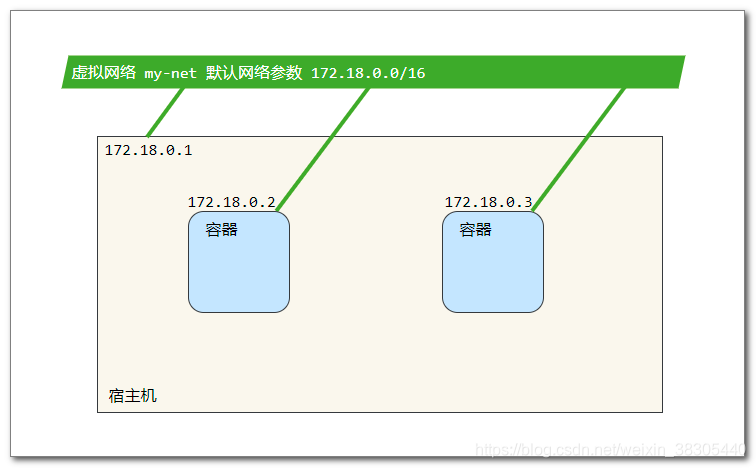
容器键互联可以使用 Docker 的虚拟网络来连接。在 Docker 中可以创建任意多个虚拟网络,容器之间可以通过虚拟网络互联互通。创建虚拟网络时宿主机也会连接到虚拟网络。
- # 新建虚拟网络 my-net
- docker network create my-net
- # 查看虚拟网络
- docker network ls
- # 查看网络描述信息
- docker inspect my-net
- # 查看宿主机新建的虚拟网卡
- ifconfig
- # 清理容器
- docker rm -f $(docker ps -aq)
- # 新建两个容器 cat1 和 cat2
- # 连接到虚拟网络 my-net
- docker run -d --name cat1 \
- --net my-net \
- tomcat
- docker run -d --name cat2 \
- --net my-net \
- tomcat
- # 查看两个容器的虚拟网络ip
- docker inspect cat1
- docker inspect cat2
- # 测试网络能否互联互通
- # 从宿主机ping两个容器
- ping 172.18.0.2
- ping 172.18.0.3
- # 进入cat1,ping宿主机和cat2
- docker exec -it cat1 ping 172.18.0.1
- docker exec -it cat1 ping 172.18.0.3
- # 从容器访问另一个容器,可以使用容器名称访问,容器内部实现了解析环境
- docker exec -it cat1 ping cat2
-
相关阅读:
探寻欧洲市场的机遇:深度剖析欧洲跨境电商
FairLearn 中的 API (一)
MybatisPlus多表关联分页返回结果异常
2652. 倍数求和
Ubuntu14.04离线安装gcc-5.3.0
MATLAB平台学习(13)一些感悟
C#多线程学习(二) 如何操纵一个线程
C#界面里的winform AutoScroll属性
【操作系统笔记】内存分配
使用Wesky.Net.OpenTools包来快速实现嵌套型结构体数据转换功能
- 原文地址:https://blog.csdn.net/u014644574/article/details/125730634
