-
剑指 Offer 06. 从尾到头打印链表
题目地址:https://leetcode.cn/problems/cong-wei-dao-tou-da-yin-lian-biao-lcof/
题目主要信息:
- 输入一个链表的头节点,按链表从尾到头的顺序返回每个节点的值。
- 返回值保存在数组中。
一、栈
注意:用这种方式要求链表有长度限制,否则链表过长可能会导致栈溢出。
解题思路: 按链表从尾到头的顺序返回每个节点的值,符合栈 后进先出 的原则。
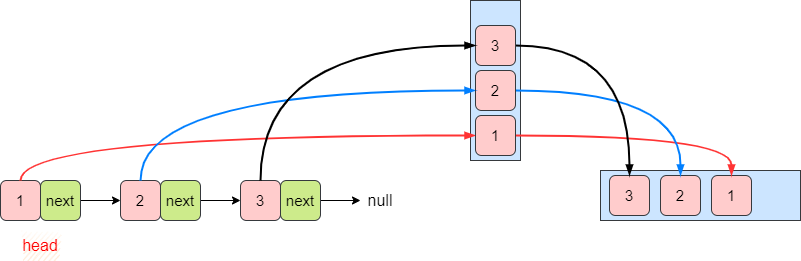
具体做法:
-
step 1:遍历单链表,将链表的值 push 压入到栈中。
-
step 2:依次 pop 弹出栈顶元素,添加到 ArrayList 中。
import java.util.Arrays;
import java.util.Stack;

public class Solution {

    public static void main(String[] args) {
        ListNode listNode_01 = new ListNode(1);  // 头节点
        ListNode listNode_02 = new ListNode(2);
        ListNode listNode_03 = new ListNode(3);
        listNode_01.next = listNode_02;
        listNode_02.next = listNode_03;
        listNode_03.next = null;

        int[] ints = new Solution().reversePrint(listNode_01); // 传入一个头节点

        System.out.println(Arrays.toString(ints));
    }

    // 节点类
    static class ListNode {
        int val;
        ListNode next = null;

        ListNode(int val) {
            this.val = val;
        }
    }

    // write your code in this method
    public int[] reversePrint(ListNode head) {
        // 遍历链表,将链表值入栈
        Stack<Integer> stack = new Stack<>();
        while(head != null){
            stack.push(head.val);
            head = head.next;
        }

        // 将链表值出栈,加入数组中
        int len = stack.size();
        int[] res = new int[len];
        for (int i = 0; i < len; i++) {
            res[i] = stack.pop();
        }

        return res;
    }

}
复杂度分析:
-
时间复杂度是: O ( n ) O(n) O(n),入栈和出战都需要 O ( n ) O(n) O(n) 的时间复杂度。
-
空间复杂度是: O ( n ) O(n) O(n),栈需要 O ( n ) O(n) O(n) 的时间复杂度,数组属于必要空间,而不是额外辅助空间。
二、头插法-反转链表(推荐)
单链表的反转,可以参考:http://c.biancheng.net/view/8105.html
解题思路: 所谓头插法,是指在原有链表的基础上,依次将位于链表头部的节点摘下,然后采用从头部插入的方式生成一个新链表,则此链表即为原链表的反转版。

具体做法:
-
step 1:遍历链表,获取链表长度。
-
step 2:创建返回数组,长度和链表长度一样。
-
step 3:遍历原链表,将位于链表头部的节点摘下来,插入新链表 ( 反转链表 ) 的头部。
-
step 4:遍历反转后的链表,将链表的值添加到数组中。
import java.util.Arrays;

public class Solution {

    public static void main(String[] args) {
        ListNode listNode_01 = new ListNode(1);  // 头节点
        ListNode listNode_02 = new ListNode(2);
        ListNode listNode_03 = new ListNode(3);
        listNode_01.next = listNode_02;
        listNode_02.next = listNode_03;
        listNode_03.next = null;

        int[] ints = new Solution().reversePrint(listNode_01); // 传入一个头节点

        System.out.println(Arrays.toString(ints));
    }

    // 节点类
    static class ListNode {
        int val;
        ListNode next = null;

        ListNode(int val) {
            this.val = val;
        }
    }

    public int[] reversePrint(ListNode head) {
        // 获取链表长度
        int len = 0;
        ListNode pHead = head;
        while(pHead != null){
            len++;
            pHead = pHead.next;
        }

        // 创建返回数组,长度和链表长度相等
        int[] res = new int[len];

        // 头插法-反转链表
        ListNode new_head = null;  // 新的反转链表的头节点
        ListNode temp = null;   // 辅助节点
        // 遍历链表
        while(head != null){
            temp = head;
            // 将 head 从链表中移除
            head = head.next;
            // 将 temp 插入到 new_head 的头部
            temp.next = new_head;
            new_head = temp;
        }

        // 遍历反转后的单链表,将链表的值 添加到 数组中
        int i = 0;
        while(new_head != null){
            res[i] = new_head.val;
            i++;
            new_head = new_head.next;
        }

        return res;
    }
}
复杂度分析:
-
时间复杂度是: O ( n ) O(n) O(n)。获取链表长度的时间复杂度为 O ( n ) O(n) O(n),反转链表的时间复杂度为 O ( n ) O(n) O(n),遍历新链表向数组添加元素的时间复杂度为 O ( n ) O(n) O(n)。因此总体时间复杂度为 O ( n + n + n ) O(n + n + n) O(n+n+n) = O ( n ) O(n) O(n)
-
空间复杂度是: O ( 1 ) O(1) O(1),常量级变量,无额外辅助空间。( 数组属于必要空间,而不是额外辅助空间 )
三、反向思维(从数组尾部往前添加元素)(推荐)
解题思路: 打破数组从左往右添加元素的固定思维,我们可以从右往左添加元素,达到一个反序的效果。
具体做法:
- step 1:遍历单链表,统计节点个数。
- step 2:定义一个辅助数组,长度为链表节点数量。
- step 3:遍历单链表,将链表的值从右往左添加到数组中。
import java.util.Arrays;

public class Solution {

    public static void main(String[] args) {
        ListNode listNode_01 = new ListNode(1);  // 头节点
        ListNode listNode_02 = new ListNode(2);
        ListNode listNode_03 = new ListNode(3);
        listNode_01.next = listNode_02;
        listNode_02.next = listNode_03;
        listNode_03.next = null;

        int[] ints = new Solution().reversePrint(listNode_01); // 传入一个头节点

        System.out.println(Arrays.toString(ints));
    }

    // 节点类
    static class ListNode {
        int val;
        ListNode next = null;

        ListNode(int val) {
            this.val = val;
        }
    }

    // write your code in this method
    public int[] reversePrint(ListNode head) {
        // 获取链表长度
        int len = 0;
        ListNode pNode = head;
        while(pNode != null){
            len++;
            // 移动指针,指向下一个节点
            pNode = pNode.next;
        }

        // 辅助数组,长度等于链表长度
        int[] res = new int[len];

        int index = len - 1;
        // 遍历单链表,将链表的值从右往左添加到数组中
        while(head != null){
            res[index] = head.val;
            index--;
            // 移动指针,指向下一个链表节点
            head = head.next;
        }

        return res;
    }

}
复杂度分析:
-
时间复杂度是: O ( n ) O(n) O(n),两次遍历链表都需要 O ( n ) O(n) O(n) 的时间复杂度。
-
空间复杂度是: O ( 1 ) O(1) O(1),常量级变量,无额外辅助空间。( 数组属于必要空间,而不是额外辅助空间 )
-
相关阅读:
java for循环内执行多线程
程序员追星 - Gerald Jay Sussman
聊聊HttpClient的HttpRoutePlanner
【光学】Matlab实现色散曲线拟合
2022-05-20每日刷题打卡
Git知识点总结
反射(类加载、加载流程、加载的五个阶段、获取类结构信息、反射暴破创建实例、操作属性、操作方法)
【C++】string常用函数总结及其模拟实现
【Linux私房菜】第四期——管理
云栖大会72小时沉浸式精彩回顾
- 原文地址:https://blog.csdn.net/weixin_42950079/article/details/127116083