-
(一)JavaScript 面向对象
https://docs.mphy.top/#/JS-Advance/ch01
一、面向对象编程介绍
1 、两大编程思想
- 面向过程
- 面向对象
2、面向过程编程
面向过程 编程,即POP(Process-oriented programming)。面向过程就是分析出解决问题所需要的步骤,然后用函数把这些步骤一步一步实现,使用的时候再一个一个的依次调用就可以了。
3、面向对象编程
面向对象 编程,即 OOP(Object Oriented Programming) 面向对象是把事务分解成为一个个对象,然后由对象之间分工与合作。
在面向对象程序开发思想中,每—个对象都是功能中心,具有明确分工。 面向对象编程具有灵活、代码可复用、容易维护和开发的优点,更适合多人合作的大型软件项目。
面向对象的特性:
- 封装性
- 继承性
- 多态性
4、面向过程和面向对象的对比
- 面向过程
优点:性能比面向对象高,适合跟硬件联系很紧密的东西,例如单片机就采用的面向过程编程。
缺点:没有面向对象易维护、易复用、易扩展。 - 面向对象
优点:易维护、易复用、易扩展,由于面向对象有封装、继承、多态性的特性,可以设计出低耦合的系统,使系统更加灵活、更加易于维护
缺点:性能比面向过程低。
二、ES6 中的类和对象
1、对象
现实生活中:万物皆对象,对象是 一个具体的事物,看得见摸得着的实物。例如,一本书、一辆汽车、一个人可以是“对象”,一个数据库、一张网页、一个与远程服务器的连接也可以是“对象”。
在 JavaScript 中,对象是一组无序的相关属性和方法的集合,所有的事物都是对象,例如字符串、数值、数组、函数等。
对象是由属性和方法组成的:
- 属性:事物的 特征,在对象中用 属性 来表示(常用名词)
- 方法:事物的 行为,在对象中用 方法 来表示(常用动词)
2、类 class
在 ES6 中新增加了类的概念,可以使用 class 关键字声明—个类,之后以这个类来实例化对象。
- 类 抽象了对象的公共部分,它泛指某一大类(class)
- 对象 特指某一个,通过类实例化一个具体的对象
面向对象的思维特点:
- 抽取(抽象)对象共用的属性和行为组织(封装)成—个类(模板)
- 对类进行实例化,获取类的对象
3、创建类和对象
语法:
class ClassName { // class body }- 1
- 2
- 3
创建实例:
let obj = new ClassName();- 1
类必须使用 new 实例化对象
4、类 constructor 构造函数
constructor()方法是类的构造函数(默认方法),用于传递参数,返回实例对象,通过new命令生成对象实例时,自动调用该方法。如果没有显示定义,类内部会自动给我们创建一个constructor()语法:
// 创建一个学生类 class Student { constructor(uname, age, major) { this.uname = uname; this.age = age; this.major = major; } }- 1
- 2
- 3
- 4
- 5
- 6
- 7
- 8
类的实例化——创建对象:
let peter = new Student("Peter", 21, "CS"); console.log(peter.uname); // Peter- 1
- 2
注意:
通过class关键字创建类, 类名我们还是习惯性定义首字母大写;
类里面有个constructor函数,可以接受传递过来的参数,同时返回实例对象;
constructor 函数 只要new生成实例时,就会自动调用这个函数, 如果我们不写这个函数,类也会自动生成这个函数;
生成实例new不能省略;
最后注意语法规范, 创建类:类名后面不要加小括号。生成实例:类名后面加小括号, 构造函数不需要加function;5、类中添加方法
语法:直接在类中写方法名和括号即可,如下所示。
class Student { constructor(uname, age, major) { this.uname = uname; this.age = age; this.major = major; } // 类中添加方法 sing() { console.log(this.uname + "会唱歌"); } }- 1
- 2
- 3
- 4
- 5
- 6
- 7
- 8
- 9
- 10
- 11
创建实例:
let peter = new Student("Peter", 18, "化学"); peter.sing(); // Peter会唱歌- 1
- 2
方法之间不能加逗号分隔,同时方法不需要添加 function 关键字。
6、static 静态成员
给成员属性或成员方法添加
static,该成员就成为静态成员,静态成员只能由该类调用。class Person { static eat() { console.log('eat'); } } let p = new Person(); Person.eat(); // eat p.eat(); // 报错- 1
- 2
- 3
- 4
- 5
- 6
- 7
- 8
三、类的继承
1、继承:子类可以继承父类的—些属性和方法。
语法:使用
extends关键字class Son extends Father { // class body }- 1
- 2
- 3
2、super 关键字
super关键字用于访问和调用对象父类上的函数。可以调用父类的构造函数,也可以调用父类的普通函数。语法
super([arguments]); // 调用 父对象/父类 的构造函数 super.functionOnParent([arguments]); // 调用 父对象/父类 上的方法- 1
- 2
- 3
- 4
- 5
示例:
class Person { constructor (uname, age) { this.uname =uname; this.age = age; } } class Student extends Person { constructor (uname, age, major) { // super 将子类的参数传递给父类构造函数,减少代码量 super(uname, age); // 子类可以有自己独有的属性 this.major = major; } } let rick = new Student("Rick", 22, "数学");- 1
- 2
- 3
- 4
- 5
- 6
- 7
- 8
- 9
- 10
- 11
- 12
- 13
- 14
- 15
注意: 子类在构造函数中使用 super, 必须放到 this 前面(必须先调用父类的构造方法,再使用子类构造方法)
(1) super 传值问题
观察以下代码,运行将产生错误。
class Father { constructor(x, y) { this.x = x; this.y = y; } sum() { console.log(this.x + this.y); } } class Son extends Father { constructor(x, y) { this.x = this.x; this.y = this.y; } } let obj = new Son(10, 20); obj.sum();- 1
- 2
- 3
- 4
- 5
- 6
- 7
- 8
- 9
- 10
- 11
- 12
- 13
- 14
- 15
- 16
- 17
解释说明:若子类没有写构造函数
constructor,则实例化时默认调用父类的,这时候程序运行无误。若子类写了构造函数,那么子类在调用 sum 方法的时候,参数的值没有传给父类,而是传给了子类的this.x和this.y,父类没有得到参数,无法调用参数的值,也就无法执行 sum 方法。正确:加入 super。
class Father { constructor(x, y) { this.x = x; this.y = y; } sum() { console.log(this.x + this.y); } } class Son extends Father { constructor(x, y) { super(x, y); } } let obj = new Son(10, 20); obj.sum(); // 30- 1
- 2
- 3
- 4
- 5
- 6
- 7
- 8
- 9
- 10
- 11
- 12
- 13
- 14
- 15
- 16
改成super(x,y)后,子类的x和y得到了参数,并利用super讲参数传给了父类的this.x和this.y
(2) super 调用父类普通函数
class Parent { sayHi() { return "Father: hello"; } } class Child extends Parent { sayHi() { // super 调用父类普通函数 console.log(super.sayHi()); } } let man = new Child(); man.sayHi(); // Father: hello- 1
- 2
- 3
- 4
- 5
- 6
- 7
- 8
- 9
- 10
- 11
- 12
- 13
(3) 继承中属性和方法查找原则
继承中的属性或者方法查找原则:就近原则
- 继承中,如果实例化子类输出一个方法,先看子类有没有这个方法,如果有就先执行子类的
- 继承中,如果子类里面没有,就去查找父类有没有这个方法,如果有,就执行父类的这个方法(就近原则)
class Parent { sayHi() { console.log("Father: hello"); } } class Child extends Parent { sayHi() { console.log("Son: hello"); } } let man = new Child(); man.sayHi(); // Son: hello- 1
- 2
- 3
- 4
- 5
- 6
- 7
- 8
- 9
- 10
- 11
- 12
- 13
(4) super 必须放到子类 this 之前
子类在构造函数中使用
super, 必须放到this前面。class Father { constructor(x, y) { this.x = x; this.y = y; } sum(){ console.log(this.x+this.y) } } class Son extends Father { constructor(x, y,z) { super(x, y); //① this.z = z; //② } summ(){ console.log(this.x+this.y+this.z) } } let son = new Son(3,5,8); son.sum() //8 son.summ() //16- 1
- 2
- 3
- 4
- 5
- 6
- 7
- 8
- 9
- 10
- 11
- 12
- 13
- 14
- 15
- 16
- 17
- 18
- 19
- 20
- 21
若①和②顺序颠倒,则会报错,
super必须放在this之前3、使用类的注意点
- 在 ES6 中类没有变量提升,所以必须先定义类,才能通过类实例化对象
- 类里面的共有属性和方法一定要加
this使用
class Star{ constructor(uname,age){ this.uname = uname this.age = age } sing(){ console.log(uname); //① } } let p = new Star('刘德华') p.sing()- 1
- 2
- 3
- 4
- 5
- 6
- 7
- 8
- 9
- 10
- 11
上面代码报错,是因为
uname是sing中的,但是sing没有参数传给他,想要的是constructor中的uname,即想要实例化对象中的uname,而this正好指向实例化对象,所以①处应该改成,console.log(this.uname)
如果constructor中想要加入方法,也要用this.方法()- 类里面的 this 指向问题:
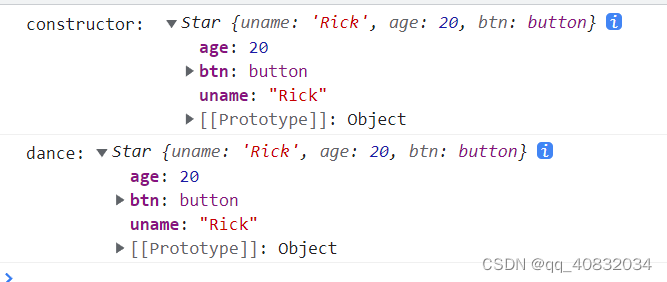
constructor里面的this指向实例对象, 方法里面的this指向这个方法的调用者(dance是对象调用的,就指向对象,sing是按钮调用的,就指向按钮,而按钮中没有uname这个属性,所以①处要用that.uname)
let that; class Star { constructor (uname, age) { that = this; this.uname = uname; this.age = age; // btn按钮调用sing方法 this.btn = document.querySelector("button"); this.btn.onclick = this.sing; // constructor 里面的this 指向的是 创建的实例对象 console.log("constructor: ", this); } sing() { // 这个sing方法里面的 this 指向的是 btn 这个按钮,因为这个按钮调用了这个函数 console.log("sing:", this); // button console.log(that.uname); // that里面存储的是constructor里面的this //① } dance() { // 这个dance里面的this 指向的是实例对象 ldh 因为ldh 调用了这个函数 console.log("dance:", this); } } let rick = new Star("Rick", 20); rick.dance();- 1
- 2
- 3
- 4
- 5
- 6
- 7
- 8
- 9
- 10
- 11
- 12
- 13
- 14
- 15
- 16
- 17
- 18
- 19
- 20
- 21
- 22
- 23
- 24
- 25
- 26
四、综合案例–面向对象版tab栏切换

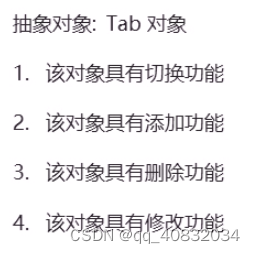
类的基本架构
class Tab { constructor(id) { // 获取相关元素节点 // 根据传入的id选择器构建主节点 this.main = document.querySelector(id); } // 初始化,绑定各个事件 init() {} // 更新节点,同步整个状态 updateNode() {} // 1. 切换功能 toggleTab() {} // 2. 添加功能 addTab() {} // 3. 删除功能 removeTab() {} // 4. 修改功能 editTab() {} }- 1
- 2
- 3
- 4
- 5
- 6
- 7
- 8
- 9
- 10
- 11
- 12
- 13
- 14
- 15
- 16
- 17
- 18
- 19
一些要点
- 在
init()中绑定事件时,不需要即时执行的话,则事件名后面不加括号。 - 若需要主节点,则声明一个
that变量,在constructor()里面赋值that = this。 insertAdjacentHTML()方法:可以在指定元素的指定位置添加一个节点字符串。 (MDN insertAdjacentHTML)appendChild不支持追加字符串的子元素,insertAdjacentHTML支持追加字符串的元素node是某一个节点,在其上绑定节点的时候需要提前判断该节点存在再绑定事件,可使用node && node.click()。- 自动执行某事件而不需要手动触发,使用
node.click()、node.blur()等等。 - 双击事件:
ondblick。 - 双击禁止选中文字:
window.getSelection ? window.getSelection().removeAllRanges() : document.selection.empty();- 1
- 双击禁止选中文字(CSS做法):
user-select: none;
-
相关阅读:
minio文件上传
八、Thmeleaf
缓存穿透,击穿,雪崩
【2024秋招】2023-9-14 最右后端开发线下一面
26. 删除有序数组中的重复项-遍历数组
瑕疵全记录,数据库毛刺问题的排查与解决
598. 区间加法 II
旅游景区地图导览系统,传统导览智慧新升级
【题目讲解】序列变换
学习Source Generators之输出生成的文件
- 原文地址:https://blog.csdn.net/qq_40832034/article/details/126856104