-
28李沐动手学深度学习v2/卷积神经网络,LeNet
LeNet实现
import torch from torch import nn from d2l import torch as d2l class Reshape(torch.nn.Module): def forward(self,x): # view用来reshape,-1这一维由计算得出,1单通道 return x.view(-1,1,28,28) net=nn.Sequential( # reshape层。原来的图片是32*32的已经padding好了,现在28*28把padding删除了 Reshape(), # 2维卷积,1输入通道数,6输出通道数,5x5,(28+2+2-5+1)/1=28 # 常用卷积核大小2x2,5x5,7x7,11x11;padding=核大小/2,为了降低输出的shape nn.Conv2d(1,6,kernel_size=5,padding=2), # 激活函数,非线性单元,可以由简单函数模拟复杂函数的关键 nn.Sigmoid(), # 作用,降低卷积对位置的敏感度,一般放到卷积层之后 # 池化层对每个通道单独做池化,不改变通道数量 # (28+0+0-2+2)/2=16,通过stride减半输出shape nn.AvgPool2d(kernel_size=2,stride=2), # 6输入通道数,16输出通道数,通过增加输出通道保留信息 # (16+0+0-5+1)/1=10,stride默认就是1 nn.Conv2d(6,16,kernel_size=5), nn.Sigmoid(), # (10+0+0-2+2)/2=5 nn.AvgPool2d(kernel_size=2,stride=2), # 展平层,展平之后才能进行全连接 nn.Flatten(), # 通道数16*5*5,(输入单元数量,输出单元数量) nn.Linear(16*5*5,120), nn.Sigmoid(), nn.Linear(120,84), nn.Sigmoid(), nn.Linear(84,10) ) # 检查模型 # !1个输入,1个通道,28*28的图片 # !4个括号4个维度,shape看括号里面的元素数量 X=torch.rand(size=(1,1,28,28),dtype=torch.float32) for layer in net: X=layer(X) print(layer.__class__.__name__,'output shape:\t',X.shape)- 1
- 2
- 3
- 4
- 5
- 6
- 7
- 8
- 9
- 10
- 11
- 12
- 13
- 14
- 15
- 16
- 17
- 18
- 19
- 20
- 21
- 22
- 23
- 24
- 25
- 26
- 27
- 28
- 29
- 30
- 31
- 32
- 33
- 34
- 35
- 36
- 37
- 38
- 39
- 40
- 41
- 42
- 43
- 44
Reshape output shape: torch.Size([1, 1, 28, 28]) Conv2d output shape: torch.Size([1, 6, 28, 28]) Sigmoid output shape: torch.Size([1, 6, 28, 28]) AvgPool2d output shape: torch.Size([1, 6, 14, 14]) Conv2d output shape: torch.Size([1, 16, 10, 10]) Sigmoid output shape: torch.Size([1, 16, 10, 10]) AvgPool2d output shape: torch.Size([1, 16, 5, 5]) Flatten output shape: torch.Size([1, 400]) Linear output shape: torch.Size([1, 120]) Sigmoid output shape: torch.Size([1, 120]) Linear output shape: torch.Size([1, 84]) Sigmoid output shape: torch.Size([1, 84]) Linear output shape: torch.Size([1, 10])- 1
- 2
- 3
- 4
- 5
- 6
- 7
- 8
- 9
- 10
- 11
- 12
- 13
# !4个括号4个维度,shape看括号里面的元素数量 # 第1个括号里面1个元素,第2个括号里面2个元素,第3个括号里面2个元素,第3个括号里面2个元素 torch.tensor([[ [ [1,2], [3,4] ], [ [1,2], [3,4] ] ]]).shape- 1
- 2
- 3
- 4
- 5
- 6
- 7
- 8
- 9
- 10
- 11
- 12
torch.Size([1, 2, 2, 2])- 1
LeNet在Fashion-MNIST数据集上的表现
batch_size=256 train_iter,test_iter=d2l.load_data_fashion_mnist(batch_size=batch_size)- 1
- 2
修改评估函数,在gpu上运行模型
def evaluate_accuracy_gpu(net,data_iter,device=None): ''' 评估精度,在gpu上运行模型 :return 平均精度=总精度/输出元素数量 ''' if isinstance(net,nn.Module): # !!模型评估 net.eval() # 如果device=None,没有给定设备,看第1个参数在那个设备上 if not device: # net.Parameters()是可迭代对象 # next(iter(可迭代对象))获取可迭代对象的下1个值 # 这里next只调用了1次,就获取了第1个参数 # 迭代所有的参数获取每个参数的设备 device=next(iter(net.parameters())).device # 创建2个维度的累加器 metric=d2l.Accumulator(2) # 评估模型时不需要计算梯度 # 上下文管理器 # 进入with语句时自动调用__enter__()魔术方法 # 退出with语句时自动调用__exit__()魔术方法 with torch.no_grad(): for X,y in data_iter: # 如果X是list类型 if isinstance(X,list): # 以这种方式放入device X=[x.to(device) for x in X] else: # 否则以这种方式放入device X=X.to(device) y=y.to(device) # numel() 元素数量 metric.add(d2l.accuracy(net(X),y),y.numel()) # 平均精度=总精度/输出元素数量 return metric[0]/metric[1]- 1
- 2
- 3
- 4
- 5
- 6
- 7
- 8
- 9
- 10
- 11
- 12
- 13
- 14
- 15
- 16
- 17
- 18
- 19
- 20
- 21
- 22
- 23
- 24
- 25
- 26
- 27
- 28
- 29
- 30
- 31
- 32
- 33
- 34
- 35
修改训练函数,在gpu上训练模型
def train_ch6(net,train_iter,test_iter,num_epochs,lr,device): ''' 在gpu上训练模型(在第六章定义) ''' def init_weights(m): if type(m)==nn.Linear or type(m)==nn.Conv2d: # 数值稳定性,防止梯度爆炸和梯度消失 # 数值稳定性,前向每一层输出的方差应该尽量相等,后向梯度的方差应该尽量相等 # 数值稳定性,稳定输入输出,让每层的输出的方差差不多,防止开始训练时模型就梯度爆炸或消失 # 数值稳定性 # - 正向每层输出期望=0,方差为常数 # - 反向每层梯度期望=0,方差为常数 # xavier参数初始化,提高数值稳定性,防止梯度爆炸或消失 # - 数值稳定性,每一层输出的方差应该尽量相等,为此,每层的权重应该满足哪些条件 # - xavier参数初始化,防止梯度爆炸或消失 # - 限制参数的选择范围,使得最终的函数曲线更平滑,泛化能力更强 # - 它表示权重和梯度期望=0,权重和梯度的方差由第t层输入和输出的神经元数量决定 nn.init.xavier_uniform_(m.weight) net.apply(init_weights) print('training on', device) # 将模型放到GPU上 net.to(device) # 优化函数 optimizer = torch.optim.SGD(net.parameters(), lr=lr) # 损失函数,交叉熵 loss = nn.CrossEntropyLoss() # 动画展示损失函数 animator = d2l.Animator(xlabel='epoch', xlim=[1, num_epochs], legend=['train loss', 'train acc', 'test acc']) # num_batches总批量数 timer, num_batches = d2l.Timer(), len(train_iter) for epoch in range(num_epochs): metric = d2l.Accumulator(3) # !!训练 net.train() # 获取索引i而使用枚举enumerate for i, (X, y) in enumerate(train_iter): timer.start() # !清空梯度,默认会梯度累积 optimizer.zero_grad() # !数据放到gpu上 # 在计算之前放到gpu上 X, y = X.to(device), y.to(device) # !前向传播,魔法函数自动调用forward() y_hat = net(X) # !计算损失 l = loss(y_hat, y) # !后向传播 l.backward() # !优化1步 optimizer.step() # 记录训练过程不需要计算梯度 # 什么时候不能计算梯度,需要梯度的变量在非训练步骤中不能计算梯度 with torch.no_grad(): metric.add(l * X.shape[0], d2l.accuracy(y_hat, y), X.shape[0]) timer.stop() # l=loss,训练损失*样本数量/样本数量=训练损失 train_l = metric[0] / metric[2] # 匹配label数量/样本数量=训练精度 train_acc = metric[1] / metric[2] # //下取整,训练5个批量或到最后1个批量时输出1次 if (i + 1) % (num_batches // 5) == 0 or i == num_batches - 1: animator.add(epoch + (i + 1) / num_batches, (train_l, train_acc, None)) # 1epoch,验证1次平均精度 test_acc = evaluate_accuracy_gpu(net, test_iter) # 绘图 animator.add(epoch + 1, (None, None, test_acc)) # l=loss print(f'loss {train_l:.3f}, train acc {train_acc:.3f}, ' f'test acc {test_acc:.3f}') # 耗时 样本总数量/耗时,1s中训练多少个样本 print(f'{metric[2] * num_epochs / timer.sum():.1f} examples/sec ' f'on {str(device)}')- 1
- 2
- 3
- 4
- 5
- 6
- 7
- 8
- 9
- 10
- 11
- 12
- 13
- 14
- 15
- 16
- 17
- 18
- 19
- 20
- 21
- 22
- 23
- 24
- 25
- 26
- 27
- 28
- 29
- 30
- 31
- 32
- 33
- 34
- 35
- 36
- 37
- 38
- 39
- 40
- 41
- 42
- 43
- 44
- 45
- 46
- 47
- 48
- 49
- 50
- 51
- 52
- 53
- 54
- 55
- 56
- 57
- 58
- 59
- 60
- 61
- 62
- 63
- 64
- 65
- 66
- 67
- 68
- 69
- 70
- 71
- 72
- 73
- 74
- 75
开始训练
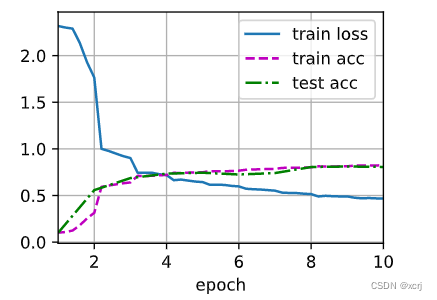
# 没有overfitting可能就是underfitting lr, num_epochs = 0.9, 10 train_ch6(net, train_iter, test_iter, num_epochs, lr, d2l.try_gpu())- 1
- 2
- 3
loss 0.467, train acc 0.824, test acc 0.807 48045.4 examples/sec on cuda:0- 1
- 2
总结
涉及- 数据(训练集 验证集合,测试集合)
- 模型
- 超参数
- 损失函数
- 优化函数 优化损失函数,获取模型参数
- 训练
- 评估
过程
- num_epochs
- 获取batch_size数据
- 数据放到设备上
- 前向传播
- 计算损失函数值
- 后向传播
- 优化函数优化1步
模型超参数
- 卷积层:kernel_size,padding,stride,channel
- 池化层:kernel_size,padding,stride
超参数
- num_epochs
- batch_size
- lr
正则化超参数
- weight_decay
- p 丢弃概率
没有overfitting可能就是underfitting
- overfitting后可以通过某些方式调整
query
卷积层的输出将输入宽高减半,通道数增加1倍
- 答:将抽象后的信息保存到了通道中。同样的1个像素保存了更多信息,更多的通道作用到了这1个像素中
view和reshape的区别
- 答:reshape的功能比view更强大。view视图是原有tensor的视图,不开辟新的存储空间,返回原有存储空间的引用。view只适用于连续性的tensor
6通道到16通道
- 答:16x6x二维卷积核
poloclub.github.io/cnn-explainer/
- 答:可视化cnn学到的东西
-
相关阅读:
GeoServer + openlayers
【【萌新的STM32学习-27--USART异步通信配置步骤】】
java selenium使用总结
运维自动化:提高效率的秘诀
【C++】模板特化、模板分离编译
C++基础学习笔记-类与对象
办理400电话客服中心的申请步骤及注意事项
猿创征文|最长回文子串-力扣
C语言学习:14、递归函数
Java线程的实现
- 原文地址:https://blog.csdn.net/baidu_35805755/article/details/126914560
