-
MyBatis 执行原理,源码解读,基于SpringBoot讲解
视频地址 https://www.bilibili.com/video/BV1sP4y1o7kB
约定
因为不同类型的SQL执行其实是有些不一样的,这里就以最简单的一个类型为例讲解
public interface TestMapper { String funOne(@Param("userId") String userId,@Param("status") Integer status); } <select id="funOne" resultType="java.lang.String"> SELECT user_id FROM xdx_test_one WHERE user_id = ${userId} <if test="status != null and status == 0"> AND 1 = 1 </if> LIMIT 1 </select>- 1
- 2
- 3
- 4
- 5
- 6
- 7
- 8
- 9
- 10
- 11
- 12
- 13
注:这里是讲解MyBatis执行的逻辑的一个基础版本,虽说如此,但东西已经很多了,可以先理解个大概,然后再逐步去细化理解,比如
- xml具体是如何解析的
- 事务是如何执行的
- 缓存是如何处理的
- 怎么创建自定义插件、插件在何时执行
- …
一、自动注入(基本配置完成)
现在我们几乎都是在 SpringBoot 里面去使用的,我们会引入 mybatis-spring-boot-starter
几乎任何的 starter 都会有一个自从注入的类,我们找到这个类,看看它默认的时候做了些什么
1-1、MybatisAutoConfiguration
删除了里面的逻辑代码,里面会注入2个bean
- SqlSessionFactory
- SqlSessionTemplate
@org.springframework.context.annotation.Configuration @ConditionalOnClass({ SqlSessionFactory.class, SqlSessionFactoryBean.class }) @ConditionalOnSingleCandidate(DataSource.class) @EnableConfigurationProperties(MybatisProperties.class) @AutoConfigureAfter({ DataSourceAutoConfiguration.class, MybatisLanguageDriverAutoConfiguration.class }) public class MybatisAutoConfiguration implements InitializingBean { @Bean @ConditionalOnMissingBean public SqlSessionFactory sqlSessionFactory(DataSource dataSource) throws Exception { // ... } @Bean @ConditionalOnMissingBean public SqlSessionTemplate sqlSessionTemplate(SqlSessionFactory sqlSessionFactory) { // ... } }- 1
- 2
- 3
- 4
- 5
- 6
- 7
- 8
- 9
- 10
- 11
- 12
- 13
- 14
- 15
- 16
- 17
- 18
- 19
1-2、SqlSessionFactory
@Bean @ConditionalOnMissingBean public SqlSessionFactory sqlSessionFactory(DataSource dataSource) throws Exception { // 创建一个 SqlSessionFactoryBean SqlSessionFactoryBean factory = new SqlSessionFactoryBean(); // 赋值数据源 factory.setDataSource(dataSource); factory.setVfs(SpringBootVFS.class); if (StringUtils.hasText(this.properties.getConfigLocation())) { factory.setConfigLocation(this.resourceLoader.getResource(this.properties.getConfigLocation())); } // 申请 Configuration applyConfiguration(factory); // 设置 mybatis 外部配置文件 // this.properties 就是我们的mybatis配置文件了 if (this.properties.getConfigurationProperties() != null) { factory.setConfigurationProperties(this.properties.getConfigurationProperties()); } // 设置mybatis 插件(其实就是拦截器) if (!ObjectUtils.isEmpty(this.interceptors)) { factory.setPlugins(this.interceptors); } // 设置databaseId if (this.databaseIdProvider != null) { factory.setDatabaseIdProvider(this.databaseIdProvider); } // 设置实体包别名 if (StringUtils.hasLength(this.properties.getTypeAliasesPackage())) { factory.setTypeAliasesPackage(this.properties.getTypeAliasesPackage()); } // 设置包别名类型 if (this.properties.getTypeAliasesSuperType() != null) { factory.setTypeAliasesSuperType(this.properties.getTypeAliasesSuperType()); } // 设置类型处理器的包 if (StringUtils.hasLength(this.properties.getTypeHandlersPackage())) { factory.setTypeHandlersPackage(this.properties.getTypeHandlersPackage()); } // 设置类型处理器 if (!ObjectUtils.isEmpty(this.typeHandlers)) { factory.setTypeHandlers(this.typeHandlers); } if (!ObjectUtils.isEmpty(this.properties.resolveMapperLocations())) { factory.setMapperLocations(this.properties.resolveMapperLocations()); } Set<String> factoryPropertyNames = Stream .of(new BeanWrapperImpl(SqlSessionFactoryBean.class).getPropertyDescriptors()).map(PropertyDescriptor::getName) .collect(Collectors.toSet()); Class<? extends LanguageDriver> defaultLanguageDriver = this.properties.getDefaultScriptingLanguageDriver(); if (factoryPropertyNames.contains("scriptingLanguageDrivers") && !ObjectUtils.isEmpty(this.languageDrivers)) { // Need to mybatis-spring 2.0.2+ factory.setScriptingLanguageDrivers(this.languageDrivers); if (defaultLanguageDriver == null && this.languageDrivers.length == 1) { defaultLanguageDriver = this.languageDrivers[0].getClass(); } } if (factoryPropertyNames.contains("defaultScriptingLanguageDriver")) { // Need to mybatis-spring 2.0.2+ factory.setDefaultScriptingLanguageDriver(defaultLanguageDriver); } applySqlSessionFactoryBeanCustomizers(factory); // 返回当前的 SqlSessionFactory return factory.getObject(); }- 1
- 2
- 3
- 4
- 5
- 6
- 7
- 8
- 9
- 10
- 11
- 12
- 13
- 14
- 15
- 16
- 17
- 18
- 19
- 20
- 21
- 22
- 23
- 24
- 25
- 26
- 27
- 28
- 29
- 30
- 31
- 32
- 33
- 34
- 35
- 36
- 37
- 38
- 39
- 40
- 41
- 42
- 43
- 44
- 45
- 46
- 47
- 48
- 49
- 50
- 51
- 52
- 53
- 54
- 55
- 56
- 57
- 58
- 59
- 60
- 61
- 62
- 63
- 64
1-3、applyConfiguration
通过配置文件生成 configuration
private void applyConfiguration(SqlSessionFactoryBean factory) { Configuration configuration = this.properties.getConfiguration(); if (configuration == null && !StringUtils.hasText(this.properties.getConfigLocation())) { configuration = new Configuration(); } if (configuration != null && !CollectionUtils.isEmpty(this.configurationCustomizers)) { for (ConfigurationCustomizer customizer : this.configurationCustomizers) { customizer.customize(configuration); } } factory.setConfiguration(configuration); }- 1
- 2
- 3
- 4
- 5
- 6
- 7
- 8
- 9
- 10
- 11
- 12
1-4、SqlSessionTemplate
在创建 SqlSessionTemplate 的时候,会判断当前的ExecutorType 类型,可以在配置文件里面配置,但一般我们都是不用配置的,也就是走下面的 else 会有一个默认的执行类型,默认是 SIMPLE
@Bean @ConditionalOnMissingBean public SqlSessionTemplate sqlSessionTemplate(SqlSessionFactory sqlSessionFactory) { ExecutorType executorType = this.properties.getExecutorType(); if (executorType != null) { return new SqlSessionTemplate(sqlSessionFactory, executorType); } else { return new SqlSessionTemplate(sqlSessionFactory); } } public SqlSessionTemplate(SqlSessionFactory sqlSessionFactory) { this(sqlSessionFactory, sqlSessionFactory.getConfiguration().getDefaultExecutorType()); } protected ExecutorType defaultExecutorType = ExecutorType.SIMPLE;- 1
- 2
- 3
- 4
- 5
- 6
- 7
- 8
- 9
- 10
- 11
- 12
- 13
- 14
- 15
- 16
一路点进去最后的实现方法如下 ( 注意这个的 SqlSessionTemplate 也是基于代理生成的,生成的时候加了一个 拦截器 SqlSessionInterceptor )
public SqlSessionTemplate(SqlSessionFactory sqlSessionFactory, ExecutorType executorType, PersistenceExceptionTranslator exceptionTranslator) { notNull(sqlSessionFactory, "Property 'sqlSessionFactory' is required"); notNull(executorType, "Property 'executorType' is required"); this.sqlSessionFactory = sqlSessionFactory; this.executorType = executorType; this.exceptionTranslator = exceptionTranslator; this.sqlSessionProxy = (SqlSession) newProxyInstance(SqlSessionFactory.class.getClassLoader(), new Class[] { SqlSession.class }, new SqlSessionInterceptor()); }- 1
- 2
- 3
- 4
- 5
- 6
- 7
- 8
- 9
- 10
- 11
- 12
1-5、MappedStatement
在xml里面的每一个 select、insert、update、delete 都会解析成为一个MappedStatement
我们看来一下,我们上面这个 select 会被解析成什么样的 MappedStatement
![[图片]](https://1000bd.com/contentImg/2023/11/08/054111956.png)
下面我们来看一下这个 MappedStatement 是何时注入进去的(具体如何注入的就不细说了,涉及到xml的解析还是很复杂的,可以自己去细看)
上面我们不是创建了一个 SqlSessionFactoryBean 它实现了 InitializingBean 接口,并且重写了里面的afterPropertiesSet方法,也就是在bean初始化之后会去执行这个方法
@Override public void afterPropertiesSet() throws Exception { notNull(dataSource, "Property 'dataSource' is required"); notNull(sqlSessionFactoryBuilder, "Property 'sqlSessionFactoryBuilder' is required"); state((configuration == null && configLocation == null) || !(configuration != null && configLocation != null), "Property 'configuration' and 'configLocation' can not specified with together"); this.sqlSessionFactory = buildSqlSessionFactory(); } protected SqlSessionFactory buildSqlSessionFactory() throws Exception { final Configuration targetConfiguration; XMLConfigBuilder xmlConfigBuilder = null; // 配置 configuration if (this.configuration != null) { targetConfiguration = this.configuration; if (targetConfiguration.getVariables() == null) { targetConfiguration.setVariables(this.configurationProperties); } else if (this.configurationProperties != null) { targetConfiguration.getVariables().putAll(this.configurationProperties); } } else if (this.configLocation != null) { xmlConfigBuilder = new XMLConfigBuilder(this.configLocation.getInputStream(), null, this.configurationProperties); targetConfiguration = xmlConfigBuilder.getConfiguration(); } else { LOGGER.debug( () -> "Property 'configuration' or 'configLocation' not specified, using default MyBatis Configuration"); targetConfiguration = new Configuration(); Optional.ofNullable(this.configurationProperties).ifPresent(targetConfiguration::setVariables); } // 参数校验 Optional.ofNullable(this.objectFactory).ifPresent(targetConfiguration::setObjectFactory); Optional.ofNullable(this.objectWrapperFactory).ifPresent(targetConfiguration::setObjectWrapperFactory); Optional.ofNullable(this.vfs).ifPresent(targetConfiguration::setVfsImpl); // 加载包别名 if (hasLength(this.typeAliasesPackage)) { scanClasses(this.typeAliasesPackage, this.typeAliasesSuperType).stream() .filter(clazz -> !clazz.isAnonymousClass()).filter(clazz -> !clazz.isInterface()) .filter(clazz -> !clazz.isMemberClass()).forEach(targetConfiguration.getTypeAliasRegistry()::registerAlias); } // 加载类型别名 if (!isEmpty(this.typeAliases)) { Stream.of(this.typeAliases).forEach(typeAlias -> { targetConfiguration.getTypeAliasRegistry().registerAlias(typeAlias); LOGGER.debug(() -> "Registered type alias: '" + typeAlias + "'"); }); } // 添加插件(拦截器) if (!isEmpty(this.plugins)) { Stream.of(this.plugins).forEach(plugin -> { targetConfiguration.addInterceptor(plugin); LOGGER.debug(() -> "Registered plugin: '" + plugin + "'"); }); } // 配置类型处理器包 if (hasLength(this.typeHandlersPackage)) { scanClasses(this.typeHandlersPackage, TypeHandler.class).stream().filter(clazz -> !clazz.isAnonymousClass()) .filter(clazz -> !clazz.isInterface()).filter(clazz -> !Modifier.isAbstract(clazz.getModifiers())) .forEach(targetConfiguration.getTypeHandlerRegistry()::register); } // 配置类型处理器 if (!isEmpty(this.typeHandlers)) { Stream.of(this.typeHandlers).forEach(typeHandler -> { targetConfiguration.getTypeHandlerRegistry().register(typeHandler); LOGGER.debug(() -> "Registered type handler: '" + typeHandler + "'"); }); } // 设置默认枚举处理器 targetConfiguration.setDefaultEnumTypeHandler(defaultEnumTypeHandler); if (!isEmpty(this.scriptingLanguageDrivers)) { Stream.of(this.scriptingLanguageDrivers).forEach(languageDriver -> { targetConfiguration.getLanguageRegistry().register(languageDriver); LOGGER.debug(() -> "Registered scripting language driver: '" + languageDriver + "'"); }); } Optional.ofNullable(this.defaultScriptingLanguageDriver) .ifPresent(targetConfiguration::setDefaultScriptingLanguage); if (this.databaseIdProvider != null) {// fix #64 set databaseId before parse mapper xmls try { targetConfiguration.setDatabaseId(this.databaseIdProvider.getDatabaseId(this.dataSource)); } catch (SQLException e) { throw new NestedIOException("Failed getting a databaseId", e); } } Optional.ofNullable(this.cache).ifPresent(targetConfiguration::addCache); if (xmlConfigBuilder != null) { try { xmlConfigBuilder.parse(); LOGGER.debug(() -> "Parsed configuration file: '" + this.configLocation + "'"); } catch (Exception ex) { throw new NestedIOException("Failed to parse config resource: " + this.configLocation, ex); } finally { ErrorContext.instance().reset(); } } targetConfiguration.setEnvironment(new Environment(this.environment, this.transactionFactory == null ? new SpringManagedTransactionFactory() : this.transactionFactory, this.dataSource)); // 判断当前xml不为空 if (this.mapperLocations != null) { if (this.mapperLocations.length == 0) { LOGGER.warn(() -> "Property 'mapperLocations' was specified but matching resources are not found."); } else { // 循环每一个xml资源 for (Resource mapperLocation : this.mapperLocations) { if (mapperLocation == null) { continue; } try { XMLMapperBuilder xmlMapperBuilder = new XMLMapperBuilder(mapperLocation.getInputStream(), targetConfiguration, mapperLocation.toString(), targetConfiguration.getSqlFragments()); // 处理xml资源,也是在这里进去创建添加 MappedStatement 的 xmlMapperBuilder.parse(); } catch (Exception e) { throw new NestedIOException("Failed to parse mapping resource: '" + mapperLocation + "'", e); } finally { ErrorContext.instance().reset(); } LOGGER.debug(() -> "Parsed mapper file: '" + mapperLocation + "'"); } } } else { LOGGER.debug(() -> "Property 'mapperLocations' was not specified."); } return this.sqlSessionFactoryBuilder.build(targetConfiguration); }- 1
- 2
- 3
- 4
- 5
- 6
- 7
- 8
- 9
- 10
- 11
- 12
- 13
- 14
- 15
- 16
- 17
- 18
- 19
- 20
- 21
- 22
- 23
- 24
- 25
- 26
- 27
- 28
- 29
- 30
- 31
- 32
- 33
- 34
- 35
- 36
- 37
- 38
- 39
- 40
- 41
- 42
- 43
- 44
- 45
- 46
- 47
- 48
- 49
- 50
- 51
- 52
- 53
- 54
- 55
- 56
- 57
- 58
- 59
- 60
- 61
- 62
- 63
- 64
- 65
- 66
- 67
- 68
- 69
- 70
- 71
- 72
- 73
- 74
- 75
- 76
- 77
- 78
- 79
- 80
- 81
- 82
- 83
- 84
- 85
- 86
- 87
- 88
- 89
- 90
- 91
- 92
- 93
- 94
- 95
- 96
- 97
- 98
- 99
- 100
- 101
- 102
- 103
- 104
- 105
- 106
- 107
- 108
- 109
- 110
- 111
- 112
- 113
- 114
- 115
- 116
- 117
- 118
- 119
- 120
- 121
- 122
- 123
- 124
- 125
- 126
- 127
- 128
- 129
- 130
- 131
- 132
- 133
- 134
- 135
- 136
- 137
- 138
- 139
- 140
- 141
- 142
parse
public void parse() { if (!configuration.isResourceLoaded(resource)) { // 下一步 configurationElement(parser.evalNode("/mapper")); configuration.addLoadedResource(resource); bindMapperForNamespace(); } parsePendingResultMaps(); parsePendingCacheRefs(); parsePendingStatements(); }- 1
- 2
- 3
- 4
- 5
- 6
- 7
- 8
- 9
- 10
- 11
- 12
configurationElement
private void configurationElement(XNode context) { try { String namespace = context.getStringAttribute("namespace"); if (namespace == null || namespace.isEmpty()) { throw new BuilderException("Mapper's namespace cannot be empty"); } builderAssistant.setCurrentNamespace(namespace); cacheRefElement(context.evalNode("cache-ref")); cacheElement(context.evalNode("cache")); parameterMapElement(context.evalNodes("/mapper/parameterMap")); resultMapElements(context.evalNodes("/mapper/resultMap")); sqlElement(context.evalNodes("/mapper/sql")); // 下一步 buildStatementFromContext(context.evalNodes("select|insert|update|delete")); } catch (Exception e) { throw new BuilderException("Error parsing Mapper XML. The XML location is '" + resource + "'. Cause: " + e, e); } }- 1
- 2
- 3
- 4
- 5
- 6
- 7
- 8
- 9
- 10
- 11
- 12
- 13
- 14
- 15
- 16
- 17
- 18
buildStatementFromContext
private void buildStatementFromContext(List<XNode> list) { if (configuration.getDatabaseId() != null) { buildStatementFromContext(list, configuration.getDatabaseId()); } buildStatementFromContext(list, null); } private void buildStatementFromContext(List<XNode> list, String requiredDatabaseId) { for (XNode context : list) { final XMLStatementBuilder statementParser = new XMLStatementBuilder(configuration, builderAssistant, context, requiredDatabaseId); try { // 下一步 statementParser.parseStatementNode(); } catch (IncompleteElementException e) { configuration.addIncompleteStatement(statementParser); } } }- 1
- 2
- 3
- 4
- 5
- 6
- 7
- 8
- 9
- 10
- 11
- 12
- 13
- 14
- 15
- 16
- 17
- 18
parseStatementNode
public void parseStatementNode() { // ... // 创建MappedStatement 并加入到 configuration builderAssistant.addMappedStatement(id, sqlSource, statementType, sqlCommandType, fetchSize, timeout, parameterMap, parameterTypeClass, resultMap, resultTypeClass, resultSetTypeEnum, flushCache, useCache, resultOrdered, keyGenerator, keyProperty, keyColumn, databaseId, langDriver, resultSets); }- 1
- 2
- 3
- 4
- 5
- 6
- 7
- 8
- 9
二、mapper代理怎么注册到bean容器
2-1、入口 @MapperScan
我们在使用Mybatis的时候都会加上一个 @MapperScan ,这个注解上面加了一个注解 @Import(MapperScannerRegistrar.class)

2-2、MapperScannerRegistrar
public class MapperScannerRegistrar implements ImportBeanDefinitionRegistrar, ResourceLoaderAware
ImportBeanDefinitionRegistrar 接口里面有一个方法 registerBeanDefinitions,通过这个方法会把bean 注册到 BeanDefinitionRegistry 里面BeanDefinitionRegistry 其实就是spring的bean容器,默认实现是 DefaultListableBeanFactory,所有的bean都以key-value的形式存入 currentHashMap
我们来看看MapperScannerRegistrar 重写的 registerBeanDefinitions方法
@Override public void registerBeanDefinitions(AnnotationMetadata importingClassMetadata, BeanDefinitionRegistry registry) { // 获取 MapperScan 注解的参数值 AnnotationAttributes mapperScanAttrs = AnnotationAttributes .fromMap(importingClassMetadata.getAnnotationAttributes(MapperScan.class.getName())); if (mapperScanAttrs != null) { registerBeanDefinitions(importingClassMetadata, mapperScanAttrs, registry, generateBaseBeanName(importingClassMetadata, 0)); } } void registerBeanDefinitions(AnnotationMetadata annoMeta, AnnotationAttributes annoAttrs, BeanDefinitionRegistry registry, String beanName) { // 构建一个 MapperScannerConfigurer 类型的 BeanDefinition BeanDefinitionBuilder builder = BeanDefinitionBuilder.genericBeanDefinition(MapperScannerConfigurer.class); builder.addPropertyValue("processPropertyPlaceHolders", true); // 设置 MapperScannerConfigurer 类的参数值, addPropertyValue 可以简单理解成class的set方法 Class<? extends Annotation> annotationClass = annoAttrs.getClass("annotationClass"); if (!Annotation.class.equals(annotationClass)) { builder.addPropertyValue("annotationClass", annotationClass); } // 下面都是类似的判断并赋值,这里简化一下,只保留赋值过程,方便阅读,后续大家可以去参看源码 builder.addPropertyValue("markerInterface", markerInterface); builder.addPropertyValue("nameGenerator", BeanUtils.instantiateClass(generatorClass)); builder.addPropertyValue("mapperFactoryBeanClass", mapperFactoryBeanClass); builder.addPropertyValue("sqlSessionTemplateBeanName", annoAttrs.getString("sqlSessionTemplateRef")); builder.addPropertyValue("sqlSessionFactoryBeanName", annoAttrs.getString("sqlSessionFactoryRef")); builder.addPropertyValue("lazyInitialization", lazyInitialization); builder.addPropertyValue("defaultScope", defaultScope); builder.addPropertyValue("basePackage", StringUtils.collectionToCommaDelimitedString(basePackages)); builder.setRole(BeanDefinition.ROLE_INFRASTRUCTURE); // 注册到bean容器里面去 registry.registerBeanDefinition(beanName, builder.getBeanDefinition()); }- 1
- 2
- 3
- 4
- 5
- 6
- 7
- 8
- 9
- 10
- 11
- 12
- 13
- 14
- 15
- 16
- 17
- 18
- 19
- 20
- 21
- 22
- 23
- 24
- 25
- 26
- 27
- 28
- 29
- 30
- 31
- 32
- 33
2-3、MapperScannerConfigurer
上面我们往
BeanDefinitionRegistry里面注册了一个MapperScannerConfigurer现在我们就来看看这个类public class MapperScannerConfigurer implements BeanDefinitionRegistryPostProcessor, InitializingBean, ApplicationContextAware, BeanNameAware
它实现了一个 BeanDefinitionRegistryPostProcessor 接口,里面有一个方法 postProcessBeanDefinitionRegistry 这个方法可以对注册到 BeanDefinitionRegistry 里面的 BeanDefinition 进行进一步的处理MapperScannerConfigurer 重写的 postProcessBeanDefinitionRegistry 方法如下
@Override public void postProcessBeanDefinitionRegistry(BeanDefinitionRegistry registry) { if (this.processPropertyPlaceHolders) { processPropertyPlaceHolders(); } // 创建一个 ClassPathMapperScanner 对象并对里面的数据赋值 ClassPathMapperScanner scanner = new ClassPathMapperScanner(registry); scanner.setAddToConfig(this.addToConfig); scanner.setAnnotationClass(this.annotationClass); scanner.setMarkerInterface(this.markerInterface); scanner.setSqlSessionFactory(this.sqlSessionFactory); scanner.setSqlSessionTemplate(this.sqlSessionTemplate); scanner.setSqlSessionFactoryBeanName(this.sqlSessionFactoryBeanName); scanner.setSqlSessionTemplateBeanName(this.sqlSessionTemplateBeanName); scanner.setResourceLoader(this.applicationContext); scanner.setBeanNameGenerator(this.nameGenerator); scanner.setMapperFactoryBeanClass(this.mapperFactoryBeanClass); if (StringUtils.hasText(lazyInitialization)) { scanner.setLazyInitialization(Boolean.valueOf(lazyInitialization)); } if (StringUtils.hasText(defaultScope)) { scanner.setDefaultScope(defaultScope); } // 对scanner 一些数据进行过滤 scanner.registerFilters(); scanner.scan( StringUtils.tokenizeToStringArray(this.basePackage, ConfigurableApplicationContext.CONFIG_LOCATION_DELIMITERS)); }- 1
- 2
- 3
- 4
- 5
- 6
- 7
- 8
- 9
- 10
- 11
- 12
- 13
- 14
- 15
- 16
- 17
- 18
- 19
- 20
- 21
- 22
- 23
- 24
- 25
- 26
- 27
- 28
2-4、ClassPathMapperScanner
public class ClassPathMapperScanner extends ClassPathBeanDefinitionScanner
ClassPathBeanDefinitionScanner 通过包路径把下面的 beanDefinition 注册到 BeanDefinitionRegistry 里面上一步调用了 scanner.scan() 方法,子类没有,调用父类的,代码如下
public int scan(String... basePackages) { int beanCountAtScanStart = this.registry.getBeanDefinitionCount(); doScan(basePackages); // Register annotation config processors, if necessary. if (this.includeAnnotationConfig) { AnnotationConfigUtils.registerAnnotationConfigProcessors(this.registry); } return (this.registry.getBeanDefinitionCount() - beanCountAtScanStart); }- 1
- 2
- 3
- 4
- 5
- 6
- 7
- 8
- 9
子类重写了 doScan 方法,我们来看下子类的方法
@Override public Set<BeanDefinitionHolder> doScan(String... basePackages) { // 调用父类的 doScan 方法,把包下的beanDefinition 注入 Set<BeanDefinitionHolder> beanDefinitions = super.doScan(basePackages); if (beanDefinitions.isEmpty()) { LOGGER.warn(() -> "No MyBatis mapper was found in '" + Arrays.toString(basePackages) + "' package. Please check your configuration."); } else { // 对 beanDefinition 进行进一步完善 processBeanDefinitions(beanDefinitions); } return beanDefinitions; }- 1
- 2
- 3
- 4
- 5
- 6
- 7
- 8
- 9
- 10
- 11
- 12
- 13
父类的doScan 方法,返回全部的 beanDefinition
protected Set<BeanDefinitionHolder> doScan(String... basePackages) { Assert.notEmpty(basePackages, "At least one base package must be specified"); Set<BeanDefinitionHolder> beanDefinitions = new LinkedHashSet<>(); for (String basePackage : basePackages) { Set<BeanDefinition> candidates = findCandidateComponents(basePackage); for (BeanDefinition candidate : candidates) { ScopeMetadata scopeMetadata = this.scopeMetadataResolver.resolveScopeMetadata(candidate); candidate.setScope(scopeMetadata.getScopeName()); String beanName = this.beanNameGenerator.generateBeanName(candidate, this.registry); if (candidate instanceof AbstractBeanDefinition) { postProcessBeanDefinition((AbstractBeanDefinition) candidate, beanName); } if (candidate instanceof AnnotatedBeanDefinition) { AnnotationConfigUtils.processCommonDefinitionAnnotations((AnnotatedBeanDefinition) candidate); } if (checkCandidate(beanName, candidate)) { BeanDefinitionHolder definitionHolder = new BeanDefinitionHolder(candidate, beanName); definitionHolder = AnnotationConfigUtils.applyScopedProxyMode(scopeMetadata, definitionHolder, this.registry); beanDefinitions.add(definitionHolder); registerBeanDefinition(definitionHolder, this.registry); } } } return beanDefinitions; }- 1
- 2
- 3
- 4
- 5
- 6
- 7
- 8
- 9
- 10
- 11
- 12
- 13
- 14
- 15
- 16
- 17
- 18
- 19
- 20
- 21
- 22
- 23
- 24
- 25
- 26
processBeanDefinitions
private void processBeanDefinitions(Set<BeanDefinitionHolder> beanDefinitions) { AbstractBeanDefinition definition; BeanDefinitionRegistry registry = getRegistry(); for (BeanDefinitionHolder holder : beanDefinitions) { definition = (AbstractBeanDefinition) holder.getBeanDefinition(); // ... // 设置 bean的类型,这里设置为 MapperFactoryBean 后面会用代理生成 MapperFactoryBean definition.setBeanClass(this.mapperFactoryBeanClass); // ... } }- 1
- 2
- 3
- 4
- 5
- 6
- 7
- 8
- 9
- 10
- 11
2-5、MapperFactoryBean
public class MapperFactoryBean extends SqlSessionDaoSupport implements FactoryBean
FactoryBean 它是一个工程bean,里面有一个 getObject 方法,调用它返回真正的 beanMapperFactoryBean重写的 getObject 方法
@Override public T getObject() throws Exception { return getSqlSession().getMapper(this.mapperInterface); } // 这里的getSqlSeesion 实际上是 sqlSessionTemplate,在上面的自动注入的时候注入的 public SqlSession getSqlSession() { return this.sqlSessionTemplate; }- 1
- 2
- 3
- 4
- 5
- 6
- 7
- 8
- 9
一路点进去的,最终实现如下,生成了一个代理对象
public T newInstance(SqlSession sqlSession) { final MapperProxy<T> mapperProxy = new MapperProxy<>(sqlSession, mapperInterface, methodCache); return newInstance(mapperProxy); } protected T newInstance(MapperProxy<T> mapperProxy) { return (T) Proxy.newProxyInstance(mapperInterface.getClassLoader(), new Class[] { mapperInterface }, mapperProxy); }- 1
- 2
- 3
- 4
- 5
- 6
- 7
三、mapper代理怎么执行
通过上面的流程,我们知道写的接口最终都会生成 MapperProxy 代理 ,既然是代理真正执行的肯定是
invoke方法
2-1、MapperProxy的invoke
简化后代码,主要分三步
- 创建 MapperMethod
- 基于MapperMethod 创建 PlainMethodInvoker
- 调用 PlainMethodInvoker 的 invoke 方法
MapperProxy的invoke方法
@Override public Object invoke(Object proxy, Method method, Object[] args) throws Throwable { return cachedInvoker(method).invoke(proxy, method, args, sqlSession); } private MapperMethodInvoker cachedInvoker(Method method) throws Throwable { try { return MapUtil.computeIfAbsent(methodCache, method, m -> { if (m.isDefault()) { // ... } else { return new PlainMethodInvoker(new MapperMethod(mapperInterface, method, sqlSession.getConfiguration())); } }); } catch (RuntimeException re) { Throwable cause = re.getCause(); throw cause == null ? re : cause; } }- 1
- 2
- 3
- 4
- 5
- 6
- 7
- 8
- 9
- 10
- 11
- 12
- 13
- 14
- 15
- 16
- 17
- 18
- 19
- 20
MapperMethod 的构造方法
public MapperMethod(Class<?> mapperInterface, Method method, Configuration config) { this.command = new SqlCommand(config, mapperInterface, method); this.method = new MethodSignature(config, mapperInterface, method); }- 1
- 2
- 3
- 4
PlainMethodInvoker 是MapperProxy的 私有静态内部类
interface MapperMethodInvoker { Object invoke(Object proxy, Method method, Object[] args, SqlSession sqlSession) throws Throwable; } private static class PlainMethodInvoker implements MapperMethodInvoker { private final MapperMethod mapperMethod; public PlainMethodInvoker(MapperMethod mapperMethod) { super(); this.mapperMethod = mapperMethod; } @Override public Object invoke(Object proxy, Method method, Object[] args, SqlSession sqlSession) throws Throwable { return mapperMethod.execute(sqlSession, args); } }- 1
- 2
- 3
- 4
- 5
- 6
- 7
- 8
- 9
- 10
- 11
- 12
- 13
- 14
- 15
- 16
- 17
通过上面的代理构建我们知道,现在的sqlSession实际上是 SqlSessionTemplate ,在这个模板里面有一个拦截器,执行之前,我们需要先执行这个拦截在自动注入 SqlSessionTemplate 的时候说了这个拦截器
org.mybatis.spring.SqlSessionTemplate.SqlSessionInterceptor
// 简化后代码 public Object invoke(Object proxy, Method method, Object[] args) throws Throwable { SqlSession sqlSession = getSqlSession(SqlSessionTemplate.this.sqlSessionFactory, SqlSessionTemplate.this.executorType, SqlSessionTemplate.this.exceptionTranslator); Object result = method.invoke(sqlSession, args); }- 1
- 2
- 3
- 4
- 5
- 6
- 7
里面有一步是 getSqlSession 这个,这里面会进行事务处理和创建所需的 Executor (这里我们创建的是SimpleExecutor)
public static SqlSession getSqlSession(SqlSessionFactory sessionFactory, ExecutorType executorType, PersistenceExceptionTranslator exceptionTranslator) { // ... session = sessionFactory.openSession(executorType); registerSessionHolder(sessionFactory, executorType, exceptionTranslator, session); return session; } @Override public SqlSession openSession(ExecutorType execType) { return openSessionFromDataSource(execType, null, false); } private SqlSession openSessionFromDataSource(ExecutorType execType, TransactionIsolationLevel level, boolean autoCommit) { Transaction tx = null; try { final Environment environment = configuration.getEnvironment(); final TransactionFactory transactionFactory = getTransactionFactoryFromEnvironment(environment); tx = transactionFactory.newTransaction(environment.getDataSource(), level, autoCommit); final Executor executor = configuration.newExecutor(tx, execType); return new DefaultSqlSession(configuration, executor, autoCommit); } catch (Exception e) { closeTransaction(tx); // may have fetched a connection so lets call close() throw ExceptionFactory.wrapException("Error opening session. Cause: " + e, e); } finally { ErrorContext.instance().reset(); } }- 1
- 2
- 3
- 4
- 5
- 6
- 7
- 8
- 9
- 10
- 11
- 12
- 13
- 14
- 15
- 16
- 17
- 18
- 19
- 20
- 21
- 22
- 23
- 24
- 25
- 26
- 27
- 28
- 29
- 30
2-2、mapperMethod.execute
public Object execute(SqlSession sqlSession, Object[] args) { // 定义返回值 Object result; // 判断当前执行的类型 switch (command.getType()) { case INSERT: { Object param = method.convertArgsToSqlCommandParam(args); result = rowCountResult(sqlSession.insert(command.getName(), param)); break; } case UPDATE: { Object param = method.convertArgsToSqlCommandParam(args); result = rowCountResult(sqlSession.update(command.getName(), param)); break; } case DELETE: { Object param = method.convertArgsToSqlCommandParam(args); result = rowCountResult(sqlSession.delete(command.getName(), param)); break; } case SELECT: // 根据返回值的类型不同,去执行对应的方法 if (method.returnsVoid() && method.hasResultHandler()) { executeWithResultHandler(sqlSession, args); result = null; } else if (method.returnsMany()) { result = executeForMany(sqlSession, args); } else if (method.returnsMap()) { result = executeForMap(sqlSession, args); } else if (method.returnsCursor()) { result = executeForCursor(sqlSession, args); } else { // 构建入参 Object param = method.convertArgsToSqlCommandParam(args); // 下一步去执行,并返回结果 result = sqlSession.selectOne(command.getName(), param); if (method.returnsOptional() && (result == null || !method.getReturnType().equals(result.getClass()))) { result = Optional.ofNullable(result); } } break; case FLUSH: result = sqlSession.flushStatements(); break; default: throw new BindingException("Unknown execution method for: " + command.getName()); } if (result == null && method.getReturnType().isPrimitive() && !method.returnsVoid()) { throw new BindingException("Mapper method '" + command.getName() + " attempted to return null from a method with a primitive return type (" + method.getReturnType() + ")."); } return result; }- 1
- 2
- 3
- 4
- 5
- 6
- 7
- 8
- 9
- 10
- 11
- 12
- 13
- 14
- 15
- 16
- 17
- 18
- 19
- 20
- 21
- 22
- 23
- 24
- 25
- 26
- 27
- 28
- 29
- 30
- 31
- 32
- 33
- 34
- 35
- 36
- 37
- 38
- 39
- 40
- 41
- 42
- 43
- 44
- 45
- 46
- 47
- 48
- 49
- 50
- 51
- 52
- 53
- 54
2-3、入参构造
public Object convertArgsToSqlCommandParam(Object[] args) { return paramNameResolver.getNamedParams(args); } // 其实就是以 names 里面的数据为key,args 里面的数据为 values,构造一个 map 返回 private final SortedMap<Integer, String> names; public Object getNamedParams(Object[] args) { final int paramCount = names.size(); if (args == null || paramCount == 0) { return null; } else if (!hasParamAnnotation && paramCount == 1) { Object value = args[names.firstKey()]; return wrapToMapIfCollection(value, useActualParamName ? names.get(0) : null); } else { final Map<String, Object> param = new ParamMap<>(); int i = 0; for (Map.Entry<Integer, String> entry : names.entrySet()) { param.put(entry.getValue(), args[entry.getKey()]); // add generic param names (param1, param2, ...) final String genericParamName = GENERIC_NAME_PREFIX + (i + 1); // ensure not to overwrite parameter named with @Param if (!names.containsValue(genericParamName)) { param.put(genericParamName, args[entry.getKey()]); } i++; } return param; } }- 1
- 2
- 3
- 4
- 5
- 6
- 7
- 8
- 9
- 10
- 11
- 12
- 13
- 14
- 15
- 16
- 17
- 18
- 19
- 20
- 21
- 22
- 23
- 24
- 25
- 26
- 27
- 28
- 29
- 30
我们来看一下这个 names 是怎么来的
- names 是ParamNameResolver 类里面的一个参数
- ParamNameResolver 是MethodSignature类里面的一个参数
- MethodSignature 是MapperMethod 里面的私有静态内部类
现在我们回到刚刚创建 MapperMethod 的时候,MapperMethod的构造方法在上面
public MapperMethod(Class<?> mapperInterface, Method method, Configuration config) { this.command = new SqlCommand(config, mapperInterface, method); this.method = new MethodSignature(config, mapperInterface, method); } public MethodSignature(Configuration configuration, Class<?> mapperInterface, Method method) { // .... this.paramNameResolver = new ParamNameResolver(configuration, method); }- 1
- 2
- 3
- 4
- 5
- 6
- 7
- 8
- 9
ParamNameResolver 构造方法,获取接口的参数存放在 names 里面
- 如果参数有 @Param 注解,就直接用注解里面的名字
- 如果没有注解,就判断 useActualParamName 配置是否等于 ture (默认就是ture),是的话就用字段的名字
- 如果上述都不满足,就用 0、1、2 …
public ParamNameResolver(Configuration config, Method method) { this.useActualParamName = config.isUseActualParamName(); final Class<?>[] paramTypes = method.getParameterTypes(); final Annotation[][] paramAnnotations = method.getParameterAnnotations(); final SortedMap<Integer, String> map = new TreeMap<>(); int paramCount = paramAnnotations.length; // get names from @Param annotations for (int paramIndex = 0; paramIndex < paramCount; paramIndex++) { if (isSpecialParameter(paramTypes[paramIndex])) { // skip special parameters continue; } String name = null; for (Annotation annotation : paramAnnotations[paramIndex]) { if (annotation instanceof Param) { hasParamAnnotation = true; name = ((Param) annotation).value(); break; } } if (name == null) { // @Param was not specified. if (useActualParamName) { name = getActualParamName(method, paramIndex); } if (name == null) { // use the parameter index as the name ("0", "1", ...) // gcode issue #71 name = String.valueOf(map.size()); } } map.put(paramIndex, name); } names = Collections.unmodifiableSortedMap(map); }- 1
- 2
- 3
- 4
- 5
- 6
- 7
- 8
- 9
- 10
- 11
- 12
- 13
- 14
- 15
- 16
- 17
- 18
- 19
- 20
- 21
- 22
- 23
- 24
- 25
- 26
- 27
- 28
- 29
- 30
- 31
- 32
- 33
- 34
- 35
2-4、sqlSession.selectOne
通过上面的代理构建我们知道,现在的sqlSession实际上是 SqlSessionTemplate
SqlSessionTemplate 的 selectOne 方法
@Override public <T> T selectOne(String statement, Object parameter) { return this.sqlSessionProxy.selectOne(statement, parameter); }- 1
- 2
- 3
- 4
当前代理只有一个默认实现类
DefaultSqlSessionDefaultSqlSession 的 selectOne 方法 @Override public <T> T selectOne(String statement, Object parameter) { // Popular vote was to return null on 0 results and throw exception on too many. List<T> list = this.selectList(statement, parameter); if (list.size() == 1) { return list.get(0); } else if (list.size() > 1) { throw new TooManyResultsException("Expected one result (or null) to be returned by selectOne(), but found: " + list.size()); } else { return null; } }- 1
- 2
- 3
- 4
- 5
- 6
- 7
- 8
- 9
- 10
- 11
- 12
- 13
2-5、MappedStatement
通过上面的 selectList 方法我们一路点,最后来到这个方法,也是 DefaultSqlSession 里面的,下面就是通过 configuration 获取MappedStatement,然后调用 MappedStatement 的query方法
private <E> List<E> selectList(String statement, Object parameter, RowBounds rowBounds, ResultHandler handler) { try { MappedStatement ms = configuration.getMappedStatement(statement); return executor.query(ms, wrapCollection(parameter), rowBounds, handler); } catch (Exception e) { throw ExceptionFactory.wrapException("Error querying database. Cause: " + e, e); } finally { ErrorContext.instance().reset(); } }- 1
- 2
- 3
- 4
- 5
- 6
- 7
- 8
- 9
- 10
configuration.getMappedStatement
protected final Map<String, MappedStatement> mappedStatements public MappedStatement getMappedStatement(String id) { return this.getMappedStatement(id, true); } public MappedStatement getMappedStatement(String id, boolean validateIncompleteStatements) { if (validateIncompleteStatements) { buildAllStatements(); } return mappedStatements.get(id); }- 1
- 2
- 3
- 4
- 5
- 6
- 7
- 8
- 9
- 10
- 11
- 12
configuration 里面的 MappedStatement 是在项目启动的时候构建 SqlSessionFactoryBean 的时候初始化的,上面也讲到了
org.mybatis.spring.SqlSessionFactoryBean#getObject
@Override public SqlSessionFactory getObject() throws Exception { if (this.sqlSessionFactory == null) { // 这个方法会初始化mappedStatements afterPropertiesSet(); } return this.sqlSessionFactory; }- 1
- 2
- 3
- 4
- 5
- 6
- 7
- 8
- 9
2-6、executor.query
通过上面的内容,我们知道当前的这个 excutor 其实是 SimpleExecutor 我们看一下这个 Excutor 的继承关系

SimpleExcutor 里面没有 query方法,所以执行父类 BaseExcutor 的query方法
@Override public <E> List<E> query(MappedStatement ms, Object parameter, RowBounds rowBounds, ResultHandler resultHandler) throws SQLException { BoundSql boundSql = ms.getBoundSql(parameter); CacheKey key = createCacheKey(ms, parameter, rowBounds, boundSql); return query(ms, parameter, rowBounds, resultHandler, key, boundSql); }- 1
- 2
- 3
- 4
- 5
- 6
2-7、ms.getBoundSql(parameter)
这一步就是对动态SQL进行拼接,解析xml里面的那些个动态标签
public BoundSql getBoundSql(Object parameterObject) { BoundSql boundSql = sqlSource.getBoundSql(parameterObject); // ... return boundSql; }- 1
- 2
- 3
- 4
- 5
- 6
- 7
sqlSource 有四个实现类,我们这个sql属于动态sql,所以就是 DynamicSqlSource

public class DynamicSqlSource implements SqlSource { private final Configuration configuration; private final SqlNode rootSqlNode; public DynamicSqlSource(Configuration configuration, SqlNode rootSqlNode) { this.configuration = configuration; this.rootSqlNode = rootSqlNode; } @Override public BoundSql getBoundSql(Object parameterObject) { DynamicContext context = new DynamicContext(configuration, parameterObject); rootSqlNode.apply(context); SqlSourceBuilder sqlSourceParser = new SqlSourceBuilder(configuration); Class<?> parameterType = parameterObject == null ? Object.class : parameterObject.getClass(); SqlSource sqlSource = sqlSourceParser.parse(context.getSql(), parameterType, context.getBindings()); BoundSql boundSql = sqlSource.getBoundSql(parameterObject); context.getBindings().forEach(boundSql::setAdditionalParameter); return boundSql; } }- 1
- 2
- 3
- 4
- 5
- 6
- 7
- 8
- 9
- 10
- 11
- 12
- 13
- 14
- 15
- 16
- 17
- 18
- 19
- 20
- 21
- 22
- 23
这里我们暂时只先关注动态SQL解析的过程,sqlNode 属于解析xml的产物,其实它的实现类就对应动态sql标签的解析了
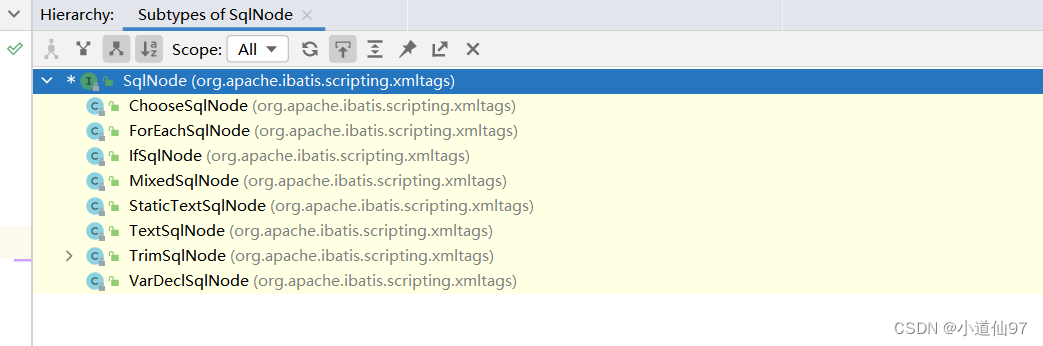
我们这里是当然就是混合类型了,所以看
MixedSqlNode
这个混合类型也很简单,就是依次循环去执行每一种标签public class MixedSqlNode implements SqlNode { private final List<SqlNode> contents; public MixedSqlNode(List<SqlNode> contents) { this.contents = contents; } @Override public boolean apply(DynamicContext context) { contents.forEach(node -> node.apply(context)); return true; } }- 1
- 2
- 3
- 4
- 5
- 6
- 7
- 8
- 9
- 10
- 11
- 12
- 13
我们来打断点看看我们的 if 解析过程

2-8、TextSqlNode
![[图片]](https://1000bd.com/contentImg/2023/11/08/054112313.png)
我们这个SQL被解析了成了三个sqlNode,下面我们来主要看看 TextSqlNode, 我们有一道面试题
# 和 $ 的区别$就是在这里解析的,我们来看看为何它不能防止sql注入
apply
@Override public boolean apply(DynamicContext context) { GenericTokenParser parser = createParser(new BindingTokenParser(context, injectionFilter)); context.appendSql(parser.parse(text)); return true; } private GenericTokenParser createParser(TokenHandler handler) { return new GenericTokenParser("${", "}", handler); }- 1
- 2
- 3
- 4
- 5
- 6
- 7
- 8
- 9
- 10
GenericTokenParser
这个类可以理解成一个正则处理器,根据提供的 openToken、closeToken、handler 进行处理,如果匹配上了前后Token 就调用 handler处理
通过代码我们可以看到当使用 ${} 的时候,是基于字符串拼接的,所以不能防止sql注入
public class GenericTokenParser { private final String openToken; private final String closeToken; private final TokenHandler handler; public GenericTokenParser(String openToken, String closeToken, TokenHandler handler) { this.openToken = openToken; this.closeToken = closeToken; this.handler = handler; } public String parse(String text) { if (text == null || text.isEmpty()) { return ""; } // search open token int start = text.indexOf(openToken); do { // ... // 如果匹配到 就调用 handler 获取返回值 append 进去 builder.append(handler.handleToken(expression.toString())); // ... } while (start > -1); if (offset < src.length) { builder.append(src, offset, src.length - offset); } return builder.toString(); } }- 1
- 2
- 3
- 4
- 5
- 6
- 7
- 8
- 9
- 10
- 11
- 12
- 13
- 14
- 15
- 16
- 17
- 18
- 19
- 20
- 21
- 22
- 23
- 24
- 25
- 26
- 27
- 28
- 29
- 30
- 31
org.apache.ibatis.scripting.xmltags.TextSqlNode.BindingTokenParser#handleToken
其实就是根据参数名(content 就是参数名)获取到对应的参数数据,校验后返回
@Override public String handleToken(String content) { Object parameter = context.getBindings().get("_parameter"); if (parameter == null) { context.getBindings().put("value", null); } else if (SimpleTypeRegistry.isSimpleType(parameter.getClass())) { context.getBindings().put("value", parameter); } Object value = OgnlCache.getValue(content, context.getBindings()); String srtValue = value == null ? "" : String.valueOf(value); // issue #274 return "" instead of "null" checkInjection(srtValue); return srtValue; }- 1
- 2
- 3
- 4
- 5
- 6
- 7
- 8
- 9
- 10
- 11
- 12
- 13
2-9、query
分析完动态SQL解析,我们继续回到刚刚的query,复制一下
@Override public <E> List<E> query(MappedStatement ms, Object parameter, RowBounds rowBounds, ResultHandler resultHandler) throws SQLException { BoundSql boundSql = ms.getBoundSql(parameter); // 这个 CacheKey 里面存了一个集合,把各种参数复制存入,尽可能地形成一个唯一地缓存key CacheKey key = createCacheKey(ms, parameter, rowBounds, boundSql); return query(ms, parameter, rowBounds, resultHandler, key, boundSql); } public <E> List<E> query(MappedStatement ms, Object parameter, RowBounds rowBounds, ResultHandler resultHandler, CacheKey key, BoundSql boundSql) throws SQLException { // ... // 从缓存中获取数据 list = resultHandler == null ? (List<E>) localCache.getObject(key) : null; if (list != null) { handleLocallyCachedOutputParameters(ms, key, parameter, boundSql); } else { // 执行查询逻辑 list = queryFromDatabase(ms, parameter, rowBounds, resultHandler, key, boundSql); } // ... return list; }- 1
- 2
- 3
- 4
- 5
- 6
- 7
- 8
- 9
- 10
- 11
- 12
- 13
- 14
- 15
- 16
- 17
- 18
- 19
- 20
- 21
queryFromDatabase
private <E> List<E> queryFromDatabase(MappedStatement ms, Object parameter, RowBounds rowBounds, ResultHandler resultHandler, CacheKey key, BoundSql boundSql) throws SQLException { List<E> list; // 先把缓存占位 localCache.putObject(key, EXECUTION_PLACEHOLDER); try { // 执行具体的方法 list = doQuery(ms, parameter, rowBounds, resultHandler, boundSql); } finally { // 删除缓存占位 localCache.removeObject(key); } // 缓存新结果 localCache.putObject(key, list); // 如果是 CALLABLE 类型,增加一个缓存 if (ms.getStatementType() == StatementType.CALLABLE) { localOutputParameterCache.putObject(key, parameter); } return list; }- 1
- 2
- 3
- 4
- 5
- 6
- 7
- 8
- 9
- 10
- 11
- 12
- 13
- 14
- 15
- 16
- 17
- 18
- 19
2-10、doQuery
上面我们知道 当前的excutor 是 simpleExcutor 所以我们直接去里面看看
@Override public <E> List<E> doQuery(MappedStatement ms, Object parameter, RowBounds rowBounds, ResultHandler resultHandler, BoundSql boundSql) throws SQLException { Statement stmt = null; try { // 获取配置 Configuration configuration = ms.getConfiguration(); // 获取处理器 StatementHandler handler = configuration.newStatementHandler(wrapper, ms, parameter, rowBounds, resultHandler, boundSql); // 设置参数 stmt = prepareStatement(handler, ms.getStatementLog()); // 执行查询 return handler.query(stmt, resultHandler); } finally { closeStatement(stmt); } }- 1
- 2
- 3
- 4
- 5
- 6
- 7
- 8
- 9
- 10
- 11
- 12
- 13
- 14
- 15
- 16
2-11、newStatementHandler
- 根据不同的类型,创建对应的处理器
- 把处理器加入到 拦截插件里面去
public StatementHandler newStatementHandler(Executor executor, MappedStatement mappedStatement, Object parameterObject, RowBounds rowBounds, ResultHandler resultHandler, BoundSql boundSql) { StatementHandler statementHandler = new RoutingStatementHandler(executor, mappedStatement, parameterObject, rowBounds, resultHandler, boundSql); statementHandler = (StatementHandler) interceptorChain.pluginAll(statementHandler); return statementHandler; }- 1
- 2
- 3
- 4
- 5
public RoutingStatementHandler(Executor executor, MappedStatement ms, Object parameter, RowBounds rowBounds, ResultHandler resultHandler, BoundSql boundSql) { switch (ms.getStatementType()) { case STATEMENT: delegate = new SimpleStatementHandler(executor, ms, parameter, rowBounds, resultHandler, boundSql); break; case PREPARED: delegate = new PreparedStatementHandler(executor, ms, parameter, rowBounds, resultHandler, boundSql); break; case CALLABLE: delegate = new CallableStatementHandler(executor, ms, parameter, rowBounds, resultHandler, boundSql); break; default: throw new ExecutorException("Unknown statement type: " + ms.getStatementType()); } }- 1
- 2
- 3
- 4
- 5
- 6
- 7
- 8
- 9
- 10
- 11
- 12
- 13
- 14
- 15
- 16
2-12、prepareStatement
private Statement prepareStatement(StatementHandler handler, Log statementLog) throws SQLException { Statement stmt; // 获取连接 Connection connection = getConnection(statementLog); // 设置事务超时时间 stmt = handler.prepare(connection, transaction.getTimeout()); // 设置查询参数 handler.parameterize(stmt); return stmt; }- 1
- 2
- 3
- 4
- 5
- 6
- 7
- 8
- 9
- 10
StatementHandler 的实现类
![[图片]](https://1000bd.com/contentImg/2023/11/08/054112275.png)
我们这个当然是 PreparedStatementHandler
@Override public void parameterize(Statement statement) throws SQLException { parameterHandler.setParameters((PreparedStatement) statement); } @Override public void setParameters(PreparedStatement ps) { ErrorContext.instance().activity("setting parameters").object(mappedStatement.getParameterMap().getId()); List<ParameterMapping> parameterMappings = boundSql.getParameterMappings(); if (parameterMappings != null) { for (int i = 0; i < parameterMappings.size(); i++) { // ... typeHandler.setParameter(ps, i + 1, value, jdbcType); // ... } } } @Override public void setParameter(PreparedStatement ps, int i, T parameter, JdbcType jdbcType) throws SQLException { // ... setNonNullParameter(ps, i, parameter, jdbcType); // ... }- 1
- 2
- 3
- 4
- 5
- 6
- 7
- 8
- 9
- 10
- 11
- 12
- 13
- 14
- 15
- 16
- 17
- 18
- 19
- 20
- 21
- 22
- 23
- 24
![[图片]](https://1000bd.com/contentImg/2023/11/08/054112768.png)
我们以 Integer 类型的参数为例,看看实现类
底层是调用 PreparedStatement 的 setXxx 方法
@Override public void setNonNullParameter(PreparedStatement ps, int i, Integer parameter, JdbcType jdbcType) throws SQLException { ps.setInt(i, parameter); }- 1
- 2
- 3
- 4
- 5
2-13、 handler.query
@Override public <E> List<E> query(Statement statement, ResultHandler resultHandler) throws SQLException { PreparedStatement ps = (PreparedStatement) statement; ps.execute(); return resultSetHandler.handleResultSets(ps); }- 1
- 2
- 3
- 4
- 5
- 6
-
相关阅读:
4.6 x64dbg 内存扫描与查壳实现
Java毕设项目——智能仓储系统(java+SSM+Maven+Mysql+Jsp)
一个例子形象的理解异步和多线程的区别
SEO优化怎么发外链,SEO外链发布的技巧
Win10 + Ubuntu 双系统完美避坑删除 Ubuntu 教程
静态代理、动态代理与Mybatis的理解
ESPRIT 2019初学到走心机编程视频教程
2023年思维100秋季赛报名中,比赛安排、阶段、形式和5年真题资源
Java通用转换地图坐标系离线算法,天地图和超图WGS84坐标系、高德GCJ-02坐标系和百度BD-09坐标系三个坐标系互相转换
彻底改变日常生活:面向消费类应用的物联网
- 原文地址:https://blog.csdn.net/Tomwildboar/article/details/126908578
