-
【多线程】优雅使用线程池结合CompletableFuture实现异步编排
参考
【Java多线程】CompletableFuture实现多线程异步编排
另外一种接收文件集合上传返回图片链接的上传方式:【OSS】SpringBoot搭配线程池整合阿里云OSS实现图片异步上传
1、线程池引入
所谓线程池,通俗来讲,就是一个管理线程的池子。它可以容纳多个线程,其中的线程可以反复利用,省去了频繁创建线程对象的操作。
在 Java 并发编程框架中的线程池是运用场景最多的技术,几乎所有需要异步或并发执行任务的程序都可以使用线程池。在开发过程中,合理地使用线程池能够带来至少以下4个好处:
-
降低资源消耗。通过重复利用已创建的线程降低线程创建和销毁造成的消耗;
-
提高响应速度。当任务到达时,任务可以不需要等到线程创建就能立即执行;
-
提高线程的可管理性。线程是稀缺资源,如果无限制地创建,不仅会消耗系统资源,还会降低系统的稳定性,使用线程池可以进行统一分配、调优和监控。
-
提供更强大的功能,比如延时定时线程池;
2、Executors
2.1、概述
Executors 是一个Java中的工具类。提供工厂方法来创建不同类型的线程池。
核心概念:这四个线程池的本质都是ThreadPoolExecutor对象:
-
newFiexedThreadPool(int Threads): 创建固定数目线程的线程池。 -
newCachedThreadPool(): 创建一个可缓存的线程池,调用execute 将重用以前构造的线程(如果线程可用)。如果没有可用的线程,则创建一个新线程并添加到池中。终止并从缓存中移除那些已有 60 秒钟未被使用的线程。 -
newSingleThreadExecutor(): 创建一个单线程化的Executor。 -
newScheduledThreadPool(int corePoolSize): 创建一个支持定时及周期性的任务执行的线程池,多数情况下可用来替代Timer类。
2.2、Executors缺陷
在阿里巴巴Java开发手册中明确指出,不允许使用Executors创建线程池,这是因为使用Executors创建线程池可能会导致OOM(OutOfMemory ,内存溢出)。

3、优雅的创建线程池
3.1、正确挑选方法
避免使用Executors创建线程池,主要是避免使用其中的默认实现,那么我们可以自己直接调用
ThreadPoolExecutor的构造函数来自己创建线程池。在创建的同时,给BlockQueue指定容量就可以了。public ThreadPoolExecutor(int corePoolSize, int maximumPoolSize, long keepAliveTime, TimeUnit unit, BlockingQueue<Runnable> workQueue, ThreadFactory threadFactory, RejectedExecutionHandler handler)- 1
- 2
- 3
- 4
- 5
- 6
- 7
上面放出来的是ThreadPoolExecutor的全参构造函数,其中的参数分别为:
corePoolSize:线程池中的核心线程数。指定线程数回一直存在与线程池中,除非设置了 allowCoreThreadTimeOut参数。当创建完成之后就会准备好等待接收异步任务去执行;maximumPoolSize:最大线程数。当请求的线程超过最大线程数时,将会扩充线程数量到最大线程数,但不会无限扩充,达到控制资源的效果;keepAliveTime:非核心线程的存活时间。如果当前存活的线程数量大于核心线程数corePoolSize,则会释放空闲的线程直到线程数回到最大线程数corePoolSize;unit:keepAliveTime 参数的时间单位,如TimeUnit.SECONDS;workQueue:阻塞队列。用于保存多余的任务,如果任务很多,就会将多的任务存放进队列中,只要有空闲的线程就会去队列中取出新的任务执行直到队列为空;threadFactory:线程池工厂,标识线程,即为线程起一个具有意义的名称,可自定义;handler:拒绝策略。如果阻塞队列满了,就会按照我们指定的拒绝策略拒绝后续任务,默认为丢弃任务。
在线程创建过程中有一个细节,即创建阻塞队列时,队列默认的最大值为Integer的最大值,这很显然是不合理的,容易内存不够造成oom,因此一般都需要在创建时设定容量,如
new LinkedBlockingDeque<>(1000)3.2、线程池配置类
在开发过程中一般会将线程池的创建抽取成一个配置类,其中的各类参数则会配置在配置文件中去。
这里有个细节,就是创建线程池的时候并不会立马准备好
corePoolSize数量的线程来准备接收任务,而是要等到有任务提交时才会启动。这一部分在下面的4、线程池执行流程/线程池创建中也有提及,这里使用了
prestartCoreThread方法在初始化线程池的时候开启一个核心线程,避免在执行异步操作的时候初始化核心线程耗时巨大(可自行尝试,在后面的例子中因为加上了这一方法,接口的耗时减少了50倍)@Configuration public class ThreadPoolConfig { @Bean public ThreadPoolExecutor threadPoolExecutor( @Value("${thread.pool.coreSize}") Integer coreSize, @Value("${thread.pool.maxSize}") Integer maxSize, @Value("${thread.pool.keepalive}") Integer keepalive, @Value("${thread.pool.blockQueueSize}") Integer blockQueueSize ) { ThreadPoolExecutor executor = new ThreadPoolExecutor( coreSize, maxSize, keepalive, TimeUnit.SECONDS, new ArrayBlockingQueue<>(blockQueueSize), Executors.defaultThreadFactory(), new ThreadPoolExecutor.AbortPolicy() ); executor.prestartCoreThread(); return executor; } }- 1
- 2
- 3
- 4
- 5
- 6
- 7
- 8
- 9
- 10
- 11
- 12
- 13
- 14
- 15
- 16
- 17
- 18
- 19
- 20
- 21
- 22
- 23
4、线程池执行流程
当向线程池提交一个任务之后,线程池是如何处理这个任务的呢?下面就先来看一下它的主要处理流程。

下面详细介绍线程池的详细运行流程:
-
线程池创建,但是并不会立马准备好
corePoolSize数量的线程来准备接收任务,线程并不会立即启动,而是要等到有任务提交时才会启动。除非调用了prestartCoreThread/prestartAllCoreThreads事先启动核心线程:1.1. prestartCoreThread:Starts a core thread, causing it to idly wait for work. This overrides the default policy of starting core threads only when new t asks are executed;
1.2. prestartAllCoreThreads:Starts all core threads。
-
任务到来,用准备好的
corePoolSize个空闲线程执行:2.1. 核心线程数已满,就将再进来的任务放入阻塞队列中,期间如果运行中的线程小于核心线程数时,就会去阻塞队列中获取任务执行;
2.2. 阻塞队列已满,就会创建新线程去执行阻塞队列中的任务,但最大只能创建到最大线程数
maximumPoolSize;2.3. 存活且运行的线程数达到最大线程数
maximumPoolSize,即线程已满时,根据设定的拒绝策略handler来对后来任务进行相应处理;2.4. 当所有线程都执行完,在指定时间
keepAliveTime之后,将会自动销毁线程,最终保持在corePoolSize大小。 -
在线程创建过程中,所有的线程都由指定的工厂
threadFactory进行创建,并为线程设置标识,即起名。
线程池场景模拟:
一个线程池corePoolSize为7,maximumPoolSize为20,阻塞队列最大50,100并发进来怎么分配的?
答案:先有7个线程能够直接处理7个任务,接下来50个进入队列排队,再多开13个继续执行。此时所有线程池和阻塞队列都已满,但只有70个被安排上,剩下的30个走设定好的拒绝策略进行相对应操作。
最终以一张图来总结和概括下线程池的执行示意图:

5、CompletableFuture
5.1、概述
在Java 8中, 新增加了一个包含50个方法左右的类: CompletableFuture,提供了非常强大的Future的扩展功能,可以帮助我们简化异步编程的复杂性,提供了函数式编程的能力,可以通过回调的方式处理计算结果,并且提供了转换和组合CompletableFuture的方法。
CompletableFuture类实现了Future接口,所以你还是可以像以前一样通过get方法阻塞或者轮询的方式获得结果,但是这种方式不推荐使用。
CompletableFuture和FutureTask同属于Future接口的实现类,都可以获取线程的执行结果。

5.2、核心三词
在CompletableFuture中API众多,其中对于线程串行化方法的可大致分为三种类型,而三种类型对应着三种不同的单词前缀:
- run:不能接收上次任务的执行结果,也没有返回值;
- accept:可以接收上次任务的执行结果,但没有返回值;
- apply:可以接收上次任务的执行结果,也拥有返回值。
5.4、单异步任务
5.4.1、runAsync
runAsync为单个异步任务中其中之一的API,其没有返回值。
public void testRunAsync() { for (int i = 0; i < 5; i++) { System.err.println("第" + i + "个循环开始……"); CompletableFuture.runAsync(() -> { System.out.println("当前线程" + Thread.currentThread().getId()); int calc = 10 / 2; System.out.println("运行结果:" + calc); }, executor); System.err.println("第" + i + "个循环结束……"); } }- 1
- 2
- 3
- 4
- 5
- 6
- 7
- 8
- 9
- 10
- 11
运行结果:

5.4.2、supplyAsync
supplyAsync相对于前面的runAsyns的方法,则是多了一个返回值,其可以结合以下两个方法进行使用:
- whenComplete:能感知异常,能感知结果,但无返回值。当执行完成supplyAsync时会执行方法中的逻辑;
- exceptionally:能感知异常,不能感知结果,有返回值。当执行supplyAsync时出现异常终端之后会先执行whenComplete方法再执行本方法,对异常进行处理;
- handle:相当于整合了上面的两个方法,即可感知结果,也可处理异常。
public void testSupplyAsync() { CompletableFuture<Integer> exceptionally = CompletableFuture.supplyAsync(() -> { System.out.println("当前线程" + Thread.currentThread().getId()); int calc = 10 / 0; System.out.println("运行结果:" + calc); return calc; }, executor).whenComplete((res, exception) -> { // 当执行完成之后获取任务执行结果和异常 System.out.println("异步任务成功完成...结果是:" + res + ";异常是:" + exception); }).exceptionally(throwable -> { // 异常之后对结果进行处理 return 10; }); System.out.println(exceptionally.join()); System.err.println("=====不严谨的分割线====="); CompletableFuture<Integer> future = CompletableFuture.supplyAsync(() -> { System.out.println("当前线程" + Thread.currentThread().getId()); int i = 10 / 4; System.out.println("运行结果:" + i); return i; }, executor).handle((res, exception) -> { // 当执行完成之后获取任务执行结果和异常 if (exception != null) { // 存在异常,处理结果 return 0; } else { // 正常运行,返回正确处理后的结果 return res; } }); }- 1
- 2
- 3
- 4
- 5
- 6
- 7
- 8
- 9
- 10
- 11
- 12
- 13
- 14
- 15
- 16
- 17
- 18
- 19
- 20
- 21
- 22
- 23
- 24
- 25
- 26
- 27
- 28
- 29
- 30
- 31
运行结果:

5.4、双异步任务
5.4.1、thenRunAsync
thenRunAsync是CompletableFuture中线程串行化方法中的其中之一,其不能接收上一次的执行结果,也没返回值。
public void testThenRunAsync() { CompletableFuture.supplyAsync(() -> { System.out.println("当前线程" + Thread.currentThread().getId()); int i = 10 / 4; System.out.println("运行结果:" + i); return i; }, executor).thenRunAsync(() -> { System.out.println("任务2启动了..."); }, executor); }- 1
- 2
- 3
- 4
- 5
- 6
- 7
- 8
- 9
- 10
运行结果:

5.4.2、thenAcceptAsync
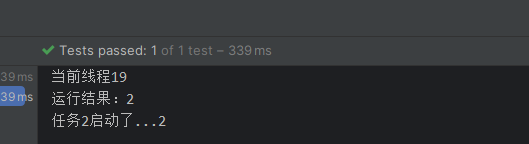
正如5.2中所说,accept与上方的run不同,是可以获取到返回值的,但是其本身则是没有返回值。
public void testThenAcceptAsync() { CompletableFuture.supplyAsync(() -> { System.out.println("当前线程" + Thread.currentThread().getId()); int i = 10 / 4; System.out.println("运行结果:" + i); return i; }, executor).thenAcceptAsync(res -> { System.out.println("任务2启动了..." + res); }, executor); }- 1
- 2
- 3
- 4
- 5
- 6
- 7
- 8
- 9
- 10
运行结果:
5.4.3、thenApplyAsync
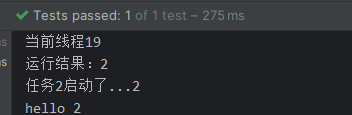
同样如5.2中所说,apply是拥有返回值,同样与前面的两个不同,其是存在返回值的。
public void test() { CompletableFuture<String> future = CompletableFuture.supplyAsync(() -> { System.out.println("当前线程" + Thread.currentThread().getId()); int i = 10 / 4; System.out.println("运行结果:" + i); return i; }, executor).thenApplyAsync(res -> { System.out.println("任务2启动了..." + res); return "hello " + res; }, executor); System.out.println(future.join()); }- 1
- 2
- 3
- 4
- 5
- 6
- 7
- 8
- 9
- 10
- 11
- 12
运行结果:
5.5、多异步任务
5.5.1、前置准备
因为是多异步任务的形式,因此在这里先准备好三个任务供下面的共用。
public CompletableFuture<Object> getFuture01() { return CompletableFuture.supplyAsync(() -> { System.out.println("任务1线程" + Thread.currentThread().getId()); int i = 10 / 4; System.out.println("任务1结束:"); return i; }, executor); } public CompletableFuture<Object> getFuture02() { return CompletableFuture.supplyAsync(() -> { System.out.println("任务2线程" + Thread.currentThread().getId()); try { Thread.sleep(3000); System.out.println("任务2结束:"); } catch (InterruptedException e) { e.printStackTrace(); } return "hello"; }, executor); } public CompletableFuture<Object> getFuture03() { return CompletableFuture.supplyAsync(() -> { System.out.println("任务3线程" + Thread.currentThread().getId()); System.out.println("任务3结束:"); return "haha"; }, executor); }- 1
- 2
- 3
- 4
- 5
- 6
- 7
- 8
- 9
- 10
- 11
- 12
- 13
- 14
- 15
- 16
- 17
- 18
- 19
- 20
- 21
- 22
- 23
- 24
- 25
- 26
- 27
- 28
5.5.2、runAfterBothAsync
runAfterBothAsync是针对于有两个前置任务的一个方法,其会等待任务01 任务02都完成了,再开始执行后续任务,不感知任务1、2的结果的,也没返回值。
public void testRunAfterBothAsync() { System.out.println("starting……"); // 等待任务一和任务二完成之后再执行action即箭头函数中的任务 CompletableFuture<Void> future = getFuture01().runAfterBothAsync(getFuture02(), () -> { System.out.println("任务一和任务二都完成了"); }, executor); System.out.println("ending……"); }- 1
- 2
- 3
- 4
- 5
- 6
- 7
- 8
运行结果:

5.5.3、thenAcceptBothAsync
thenAcceptBothAsync同样是针对有两个前置任务的一个方法,其会等待任务01 任务02都完成了,再开始执行任务3,能感知到任务1、2的结果,但没返回值。
public void testRun() { System.out.println("start……"); CompletableFuture<Object> future01 = getFuture01(); CompletableFuture<Object> future02 = getFuture02(); // 等待任务一和任务二完成之后再执行action即箭头函数中的任务,且可以获取到任务一和任务二的返回结果 future01.thenAcceptBothAsync(future02, (f1, f2) -> { System.out.println("任务一和任务二都完成了"); System.out.println("任务一拿到结果:" + f1); System.out.println("任务二拿到结果:" + f2); }, executor); System.out.println("ending……"); }- 1
- 2
- 3
- 4
- 5
- 6
- 7
- 8
- 9
- 10
- 11
- 12
运行结果:

5.5.4、thenCombineAsync
thenCombineAsync也是针对有两个前置任务的一个方法,其会等待任务01 任务02都完成了,再开始执行任务3,能感知到任务1、2的结果,而且自己可以带返回值。
public void testThenCombineAsync() { System.out.println("start……"); CompletableFuture<Object> future01 = getFuture01(); CompletableFuture<Object> future02 = getFuture02(); // 等待任务一和任务二完成之后再执行action即箭头函数中的任务,且可以获取到任务一和任务二的返回结果并返回结果 CompletableFuture<String> future = future01.thenCombineAsync(future02, (f1, f2) -> { System.out.println("任务一和任务二都完成了"); return "任务一拿到结果:" + f1 + "任务二拿到结果:" + f2; }, executor); System.out.println("ending……"); System.out.println(future.join()); }- 1
- 2
- 3
- 4
- 5
- 6
- 7
- 8
- 9
- 10
- 11
- 12
运行结果:

5.5.5、runAfterEitherAsync
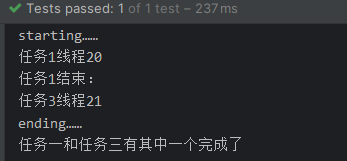
与runAfterBothAsync不同的是,runAfterEitherAsync两个任务只要有一个完成,就执行任务3,不感知结果,自己没返回值。
public void testRunAfterEitherAsync() { System.out.println("starting……"); // 等待任务一和任务二完成之后再执行action即箭头函数中的任务 getFuture01().runAfterEitherAsync(getFuture02(), () -> { System.out.println("任务一和任务二有其中一个完成了"); }, executor); System.out.println("ending……"); }- 1
- 2
- 3
- 4
- 5
- 6
- 7
- 8
运行结果:
5.5.6、acceptEitherAsync
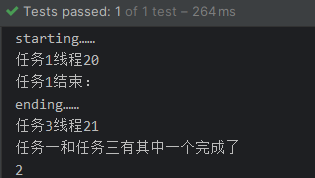
与thenAcceptBothAsync不同的是,acceptEitherAsync两个任务只要有一个完成,就执行任务3,感知结果,自己没返回值。
public void testAcceptEitherAsync() { System.out.println("starting……"); // 等待任务一和任务二完成之后再执行action即箭头函数中的任务 getFuture01().acceptEitherAsync(getFuture03(), (res) -> { System.out.println("任务一和任务三有其中一个完成了"); System.out.println(res); }, executor); System.out.println("ending……"); }- 1
- 2
- 3
- 4
- 5
- 6
- 7
- 8
- 9
运行结果:
5.5.7、applyToEitherAsync
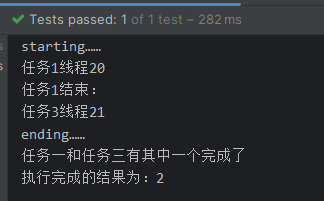
与thenCombineAsync不同的是,applyToEitherAsync两个任务只要有一个完成,就执行任务3,感知结果,自己有返回值。
public void testApplyToEitherAsync() { System.out.println("starting……"); // 等待任务一和任务二完成之后再执行action即箭头函数中的任务 CompletableFuture<Object> future = getFuture01().applyToEitherAsync(getFuture03(), (res) -> { System.out.println("任务一和任务三有其中一个完成了"); return res; }, executor); System.out.println("ending……"); System.out.println("执行完成的结果为:" + future.join()); }- 1
- 2
- 3
- 4
- 5
- 6
- 7
- 8
- 9
- 10
运行结果:
-
-
相关阅读:
ActiveMQ、RabbitMQ、RocketMQ、Kafka介绍
Jackson公司蛋白质印迹指南丨样品制备
软件开发毕业4年后,靠自学自动化测试月入2W,本人亲身经历供大家参考
pytest框架之fixture测试夹具详解
【RL+Transformer综述】A Survey on Transformers in Reinforcement Learning论文笔记
【甄选靶场】Vulnhub百个项目渗透——项目二十八:zico2-1(目录遍历,sqlite数据库写入,脏牛提权)
最近少更新的原因
thinkphp6 入门(4)--数据库操作 增删改查
QML(26)——多层qml界面传递信号
ZooKeeper常见面试题
- 原文地址:https://blog.csdn.net/Aqting/article/details/126863478