-
Programming Languages PartC Week2学习笔记——OOP(面向对象) vs FD(函数式)
OOP Versus Functional Decomposition
面向对象与函数式(或过程式)编程的分解对比

例子:不同的变量和操作构成了二维矩阵。
面向对象和函数式的思维方式不同。

函数式编程的做法:通过函数填充每一列


面向对象编程:通过类填充每一行

对Ruby而言:


对Java而言:


所以,事实上函数式编程FP和面向对象编程OOP都能做到同样的事情,但他们用了两种几乎相反的方式。具体使用什么方式,取决于做的事情和个人喜好。

Adding Operations or Variants
这一节涉及到对已有程序的维护迭代。例如分别以FP和OOP的视角来看增加操作或变量。
对于FP:

代码中增加方法非常容易,只需要增加一个函数即可,但增加变量对象就相对麻烦一些,不仅需要在原有定义的结构中添加新的变量,而且需要修改前面定义的所有方法,让其适应新的变量。这很容易理解。


对于OOP:

恰恰相反,添加一个变量只需要添加一个新的类(对象),但添加新的方法则需要修改已有的所有类(尽管可以使用继承或者一些设计模式来简化这一过程)。总之,也不难理解。

当然,我们总是希望能简化这个过程,让我们在使用某种方式编写程序(FP或OOP)时也能够使用另一种方式的优势(FP擅长新操作/方法,OOP擅长新变量/类)

最后是关于程序扩展性的一些编程哲学。

Binary Methods with Functional Decomposition
假如有一个操作需要定义在众多参数(而不是某个单个变量调用)的基础上,例如二元操作

例子:这里的矩阵有所不同,不是变量Variants和操作Operation的关系,而是两个变量之间的关系。

ML的例子:因为要处理各个变体之间的关系,Add就不需要抛出异常

我们的eval过程需要定义所有情况(函数分解),就像绿色矩阵中那样

Double Dispatch
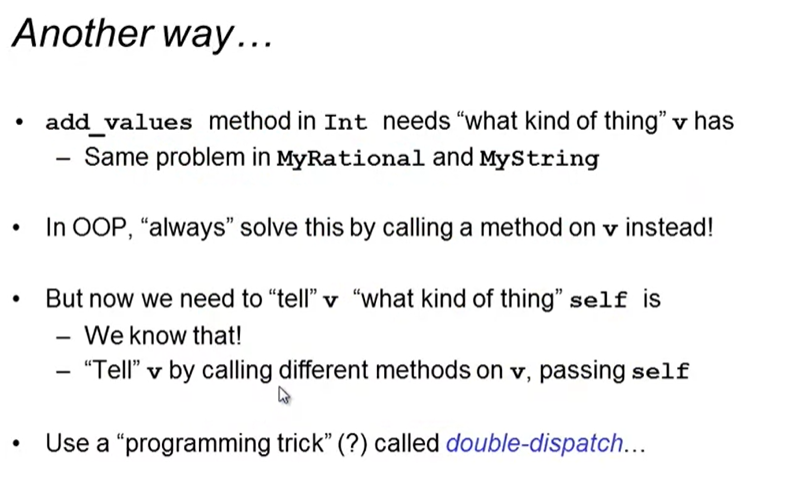
与上一节类似,本节要在Ruby中使用OOP的方式来实现类似的add_values操作,使用叫做双重分派的方式。

同样的,先定义数据结构,如下,Rational也类似。


我们在某个类中总是需要识别其他对象的类,所以需要调用v对象的方法,但类似上述例子不是面向对象的方式(显式的判断v的类型)。我们确实需要“告诉”v,self是什么类型,这一点使用动态分派可以做到,这个技巧称为double-dispatch(即分派两次)。
这里直接参考代码:
每个类仍然需要定义三个方法(addInt、addRational、addString),核心思想就是在每个类的add_values中调用v的对应方法,由于类本身是确定的,所以也能确定v使用的对应方法,例如
v.addInt self,至于v是什么子类调用哪个子类方法,由动态分派决定,这是第一次分派。然后
v.addInt方法中的参数v就是之前的self,是确定的(从程序员角度),但程序调用v.i方法仍然需要动态分派确定哪个子类的方法,这是第二次分派。# Section 8: Binary Methods with OOP: Double Dispatch # Note: If Exp and Value are empty classes, we do not need them in a # dynamically typed language, but they help show the structure and they # can be useful places for code that applies to multiple subclasses. class Exp # could put default implementations or helper methods here end class Value < Exp # this is overkill here, but is useful if you have multiple kinds of # /values/ in your language that can share methods that do not make sense # for non-value expressions end class Int < Value attr_reader :i def initialize i @i = i end def eval # no argument because no environment self end def toString @i.to_s end def hasZero i==0 end def noNegConstants if i < 0 Negate.new(Int.new(-i)) else self end end # double-dispatch for adding values def add_values v # first dispatch v.addInt self end def addInt v # second dispatch: other is Int Int.new(v.i + i) end def addString v # second dispatch: other is MyString (notice order flipped) MyString.new(v.s + i.to_s) end def addRational v # second dispatch: other is MyRational MyRational.new(v.i+v.j*i,v.j) end end # new value classes -- avoiding name-conflict with built-in String, Rational class MyString < Value attr_reader :s def initialize s @s = s end def eval self end def toString s end def hasZero false end def noNegConstants self end # double-dispatch for adding values def add_values v # first dispatch v.addString self end def addInt v # second dispatch: other is Int (notice order is flipped) MyString.new(v.i.to_s + s) end def addString v # second dispatch: other is MyString (notice order flipped) MyString.new(v.s + s) end def addRational v # second dispatch: other is MyRational (notice order flipped) MyString.new(v.i.to_s + "/" + v.j.to_s + s) end end class MyRational < Value attr_reader :i, :j def initialize(i,j) @i = i @j = j end def eval self end def toString i.to_s + "/" + j.to_s end def hasZero i==0 end def noNegConstants if i < 0 && j < 0 MyRational.new(-i,-j) elsif j < 0 Negate.new(MyRational.new(i,-j)) elsif i < 0 Negate.new(MyRational.new(-i,j)) else self end end # double-dispatch for adding values def add_values v # first dispatch v.addRational self end def addInt v # second dispatch v.addRational self # reuse computation of commutative operation end def addString v # second dispatch: other is MyString (notice order flipped) MyString.new(v.s + i.to_s + "/" + j.to_s) end def addRational v # second dispatch: other is MyRational (notice order flipped) a,b,c,d = i,j,v.i,v.j MyRational.new(a*d+b*c,b*d) end end class Negate < Exp attr_reader :e def initialize e @e = e end def eval Int.new(-e.eval.i) # error if e.eval has no i method end def toString "-(" + e.toString + ")" end def hasZero e.hasZero end def noNegConstants Negate.new(e.noNegConstants) end end class Add < Exp attr_reader :e1, :e2 def initialize(e1,e2) @e1 = e1 @e2 = e2 end def eval e1.eval.add_values e2.eval end def toString "(" + e1.toString + " + " + e2.toString + ")" end def hasZero e1.hasZero || e2.hasZero end def noNegConstants Add.new(e1.noNegConstants,e2.noNegConstants) end end class Mult < Exp attr_reader :e1, :e2 def initialize(e1,e2) @e1 = e1 @e2 = e2 end def eval Int.new(e1.eval.i * e2.eval.i) # error if e1.eval or e2.eval has no i method end def toString "(" + e1.toString + " * " + e2.toString + ")" end def hasZero e1.hasZero || e2.hasZero end def noNegConstants Mult.new(e1.noNegConstants,e2.noNegConstants) end end- 1
- 2
- 3
- 4
- 5
- 6
- 7
- 8
- 9
- 10
- 11
- 12
- 13
- 14
- 15
- 16
- 17
- 18
- 19
- 20
- 21
- 22
- 23
- 24
- 25
- 26
- 27
- 28
- 29
- 30
- 31
- 32
- 33
- 34
- 35
- 36
- 37
- 38
- 39
- 40
- 41
- 42
- 43
- 44
- 45
- 46
- 47
- 48
- 49
- 50
- 51
- 52
- 53
- 54
- 55
- 56
- 57
- 58
- 59
- 60
- 61
- 62
- 63
- 64
- 65
- 66
- 67
- 68
- 69
- 70
- 71
- 72
- 73
- 74
- 75
- 76
- 77
- 78
- 79
- 80
- 81
- 82
- 83
- 84
- 85
- 86
- 87
- 88
- 89
- 90
- 91
- 92
- 93
- 94
- 95
- 96
- 97
- 98
- 99
- 100
- 101
- 102
- 103
- 104
- 105
- 106
- 107
- 108
- 109
- 110
- 111
- 112
- 113
- 114
- 115
- 116
- 117
- 118
- 119
- 120
- 121
- 122
- 123
- 124
- 125
- 126
- 127
- 128
- 129
- 130
- 131
- 132
- 133
- 134
- 135
- 136
- 137
- 138
- 139
- 140
- 141
- 142
- 143
- 144
- 145
- 146
- 147
- 148
- 149
- 150
- 151
- 152
- 153
- 154
- 155
- 156
- 157
- 158
- 159
- 160
- 161
- 162
- 163
- 164
- 165
- 166
- 167
- 168
- 169
- 170
- 171
- 172
- 173
- 174
- 175
- 176
- 177
- 178
- 179
- 180
- 181
- 182
- 183
- 184
- 185
- 186
- 187
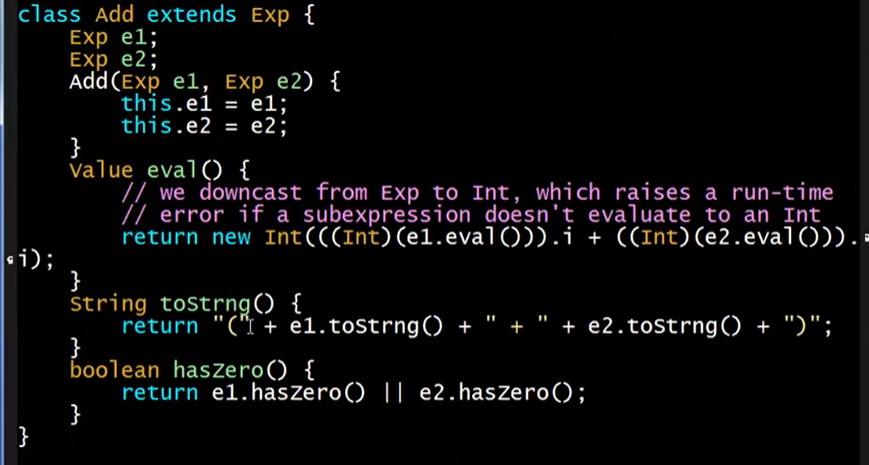
对于操作Add而言,其eval方法需要首先调用自身e1和e2的eval(可能是Int等数据结构的eval也可能是操作Add的eval递归调用,动态分派,让e1、e2自己决定调用子类方法)。


对于静态类型语言例如Java,也同样适用双重分派,所以double-dispatch是一种实现OOP二元操作的重要方法。

下面看看Java代码:
// Section 8: Binary Methods with OOP: Double Dispatch abstract class Exp { abstract Value eval(); // no argument because no environment abstract String toStrng(); // renaming b/c toString in Object is public abstract boolean hasZero(); abstract Exp noNegConstants(); } abstract class Value extends Exp { abstract Value add_values(Value other); // first dispatch abstract Value addInt(Int other); // second dispatch abstract Value addString(MyString other); // second dispatch abstract Value addRational(Rational other); // second dispatch } class Int extends Value { public int i; Int(int i) { this.i = i; } Value eval() { return this; } String toStrng() { return "" + i; } boolean hasZero() { return i==0; } Exp noNegConstants() { if(i < 0) return new Negate(new Int(-i)); else return this; } Value add_values(Value other) { return other.addInt(this); } Value addInt(Int other) { return new Int(other.i + i); } Value addString(MyString other) { return new MyString(other.s + i); } Value addRational(Rational other) { return new Rational(other.i+other.j*i,other.j); } } class MyString extends Value { public String s; MyString(String s) { this.s = s; } Value eval() { return this; } String toStrng() { return s; } boolean hasZero() { return false; } Exp noNegConstants() { return this; } Value add_values(Value other) { return other.addString(this); } Value addInt(Int other) { return new MyString("" + other.i + s); } Value addString(MyString other) { return new MyString(other.s + s); } Value addRational(Rational other) { return new MyString("" + other.i + "/" + other.j + s); } } class Rational extends Value { int i; int j; Rational(int i, int j) { this.i = i; this.j = j; } Value eval() { return this; } String toStrng() { return "" + i + "/" + j; } boolean hasZero() { return i==0; } Exp noNegConstants() { if(i < 0 && j < 0) return new Rational(-i,-j); else if(j < 0) return new Negate(new Rational(i,-j)); else if(i < 0) return new Negate(new Rational(-i,j)); else return this; } Value add_values(Value other) { return other.addRational(this); } Value addInt(Int other) { return other.addRational(this); // reuse computation of commutative operation } Value addString(MyString other) { return new MyString(other.s + i + "/" + j); } Value addRational(Rational other) { int a = i; int b = j; int c = other.i; int d = other.j; return new Rational(a*d+b*c,b*d); } } class Negate extends Exp { public Exp e; Negate(Exp e) { this.e = e; } Value eval() { // we downcast from Exp to Int, which will raise a run-time error // if the subexpression does not evaluate to an Int return new Int(- ((Int)(e.eval())).i); } String toStrng() { return "-(" + e.toStrng() + ")"; } boolean hasZero() { return e.hasZero(); } Exp noNegConstants() { return new Negate(e.noNegConstants()); } } class Add extends Exp { Exp e1; Exp e2; Add(Exp e1, Exp e2) { this.e1 = e1; this.e2 = e2; } Value eval() { return e1.eval().add_values(e2.eval()); } String toStrng() { return "(" + e1.toStrng() + " + " + e2.toStrng() + ")"; } boolean hasZero() { return e1.hasZero() || e2.hasZero(); } Exp noNegConstants() { return new Add(e1.noNegConstants(), e2.noNegConstants()); } } class Mult extends Exp { Exp e1; Exp e2; Mult(Exp e1, Exp e2) { this.e1 = e1; this.e2 = e2; } Value eval() { // we downcast from Exp to Int, which will raise a run-time error // if either subexpression does not evaluate to an Int return new Int(((Int)(e1.eval())).i * ((Int)(e2.eval())).i); } String toStrng() { return "(" + e1.toStrng() + " * " + e2.toStrng() + ")"; } boolean hasZero() { return e1.hasZero() || e2.hasZero(); } Exp noNegConstants() { return new Mult(e1.noNegConstants(), e2.noNegConstants()); } }- 1
- 2
- 3
- 4
- 5
- 6
- 7
- 8
- 9
- 10
- 11
- 12
- 13
- 14
- 15
- 16
- 17
- 18
- 19
- 20
- 21
- 22
- 23
- 24
- 25
- 26
- 27
- 28
- 29
- 30
- 31
- 32
- 33
- 34
- 35
- 36
- 37
- 38
- 39
- 40
- 41
- 42
- 43
- 44
- 45
- 46
- 47
- 48
- 49
- 50
- 51
- 52
- 53
- 54
- 55
- 56
- 57
- 58
- 59
- 60
- 61
- 62
- 63
- 64
- 65
- 66
- 67
- 68
- 69
- 70
- 71
- 72
- 73
- 74
- 75
- 76
- 77
- 78
- 79
- 80
- 81
- 82
- 83
- 84
- 85
- 86
- 87
- 88
- 89
- 90
- 91
- 92
- 93
- 94
- 95
- 96
- 97
- 98
- 99
- 100
- 101
- 102
- 103
- 104
- 105
- 106
- 107
- 108
- 109
- 110
- 111
- 112
- 113
- 114
- 115
- 116
- 117
- 118
- 119
- 120
- 121
- 122
- 123
- 124
- 125
- 126
- 127
- 128
- 129
- 130
- 131
- 132
- 133
- 134
- 135
- 136
- 137
- 138
- 139
- 140
- 141
- 142
- 143
- 144
- 145
- 146
- 147
- 148
- 149
- 150
- 151
- 152
- 153
- 154
- 155
- 156
- 157
- 158
- 159
- 160
- 161
- 162
- 163
- 164
- 165
- 166
- 167
- 168
- 169
- 170
- 171
- 172
- 173
- 174
- 175
- 176
- 177
- 178
- 179
- 180
- 181
- 182
- 183
- 184
- 185
- 186
- 187
- 188
- 189
- 190
- 191
- 192
- 193
Optional: Multimethods
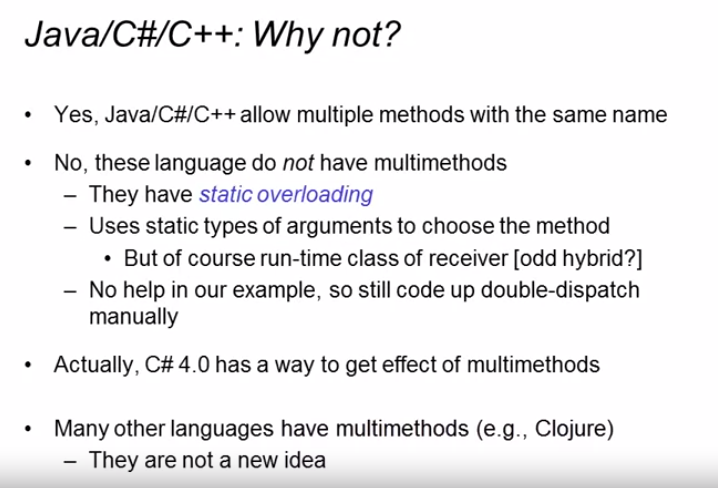
使用multimethod可以避免使用double-dispatch来实现二元操作(本质上就是方法重载)

使用重载的多个方法,但也存在缺点,容易造成方法调用的混淆。

虽然通过不同子类的参数来重载方法在其他语言很常见,但在ruby中很难做到,主要有两点原因:
(1)首先ruby动态类型语言,没有对方法的参数添加类型限制
(2)其次ruby不允许除了覆写以外的同名函数(同名就意味着覆写override,而不是重载overload)

但在其他静态的面向对象语言中,虽然提供了多种方法重载,但只是静态重载。在编写时需要指定静态类型(尽管运行时仍然动态分派)。但这就与我们课程例子所谓的二元操作关系不大了,因为课程中的两个操作对象,可能是Int、Rational或String,但显然在Java等语言中,这个操作对象的类型是确定的。
C# 4.0中加入了动态类型,因此也能够实现multimethod
Multiple Inheritance
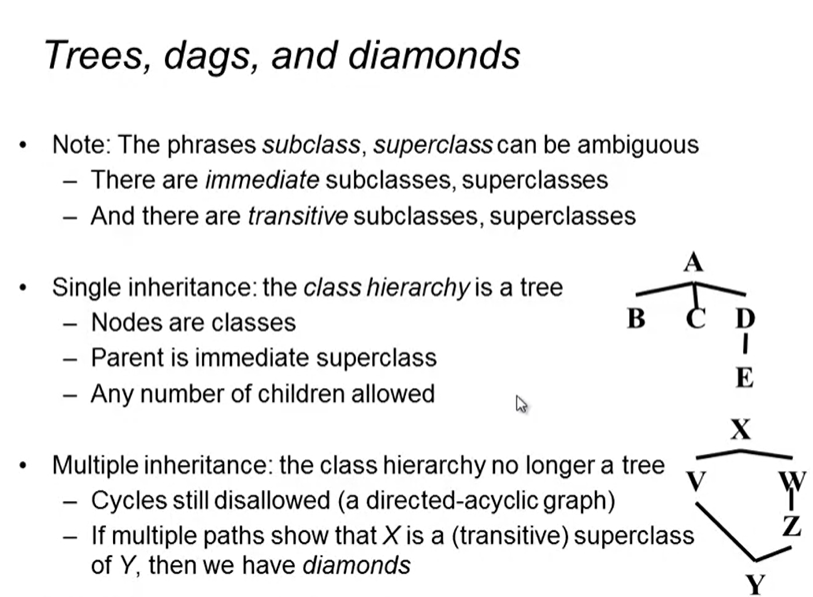
多继承,也是OOP老生常谈的话题。

多继承的优势和劣势:

继承结构间可能存在歧义:
Mixins
mixins是指一个方法的合集,与类的区别在于没有实例。
ruby的modules就是mixins

例子:
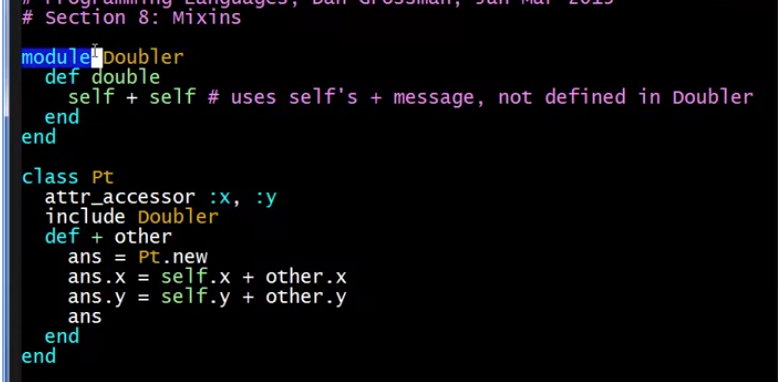

mixin的改变了方法的查找规则,先在类中寻找,然后在mixin中寻找,再在超类中寻找,再在超类的mixin中寻找,以此类推。
对于对象变量,mixin方法可能会造成问题:

ruby中最有用的两个mixins,Comparable比较和Enumerable枚举。
其中>,<等比较运算符是定义在<=>之上的(即<,>,=等运算调用<=>比较)
其他的迭代器则是定义在each上

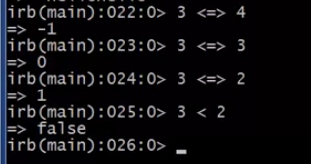
例子:
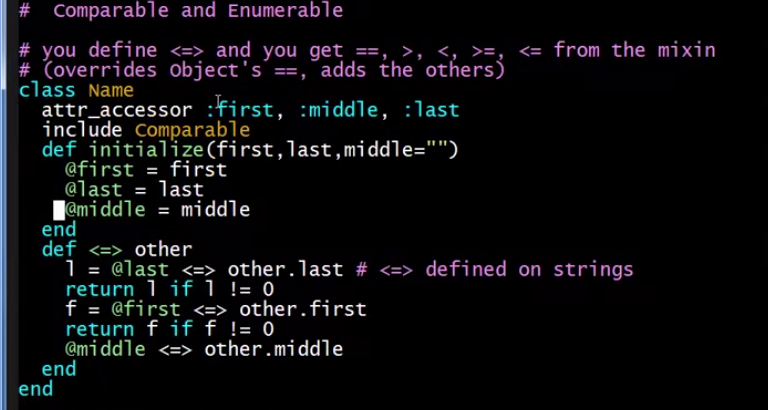


Interfaces
比较多继承与mixins ,和接口的区别

接口的事情学过Java应该都很熟悉了


接口可以与mixins共同使用,保证某些方法一定被类实现(例如Comparable需要实现<=>,Enumerable需要实现each)

Optional: Abstract Methods
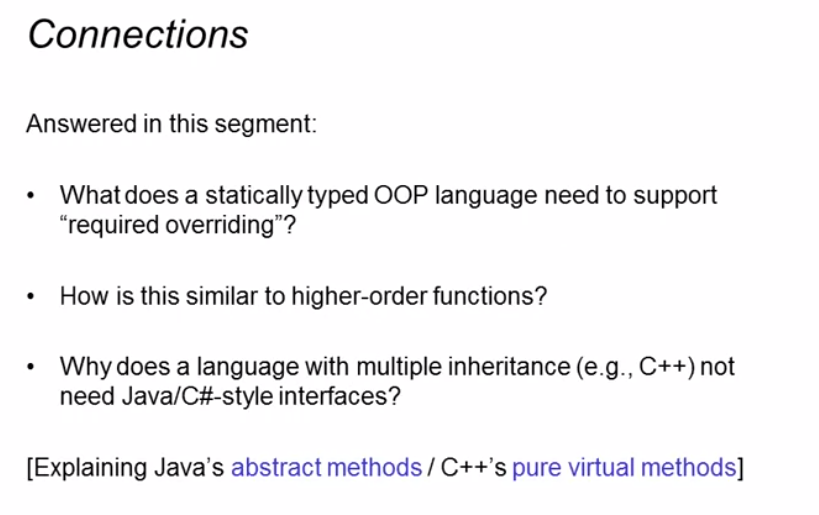
这一节是为了更详细的介绍OOP,所以介绍抽象方法,比如Java的抽象方法和C++的纯虚函数。
一般会存在超类定义了某些子类必须覆写的方法,在Ruby中我们可以(例如下面的例子),我们可以不定义m2,却直接在m1中使用它,此时的m2就是子类必须定义的内容,并且我们不能单独A.new创建A的实例,否则会method-missing。
值得特别注意的是,在静态语言中是不允许这样做的,父类无法调用只在子类中声明定义的方法;ruby是可以在父类中直接调用只在子类声明定义的方法的,总的来说宽松一些(只有运行时才能判断该方法是否被父类或子类定义)。

在静态类型语言中,type chcker会保证m2必须在父类中被声明定义,因此我们需要一些多余的语句(例如下面例子的raise语句部分),这样会非常冗余。

因此有了抽象方法,只声明而不定义,留给子类(每一个子类必须)定义。这样同时也限制了父类的实例创建。

OOP的代码传递与FP的代码传递对比:
OOP的方式:通过子类定义的m2传递到超类的m1中(即使超类m1定义时不会知道m2具体是什么内容,因为m2的定义是运行时才被动态分派的)
FP的方式:高等函数传递代码,高等函数也无法知晓具体内容(例如f中的g,虽然会根据语法认定为函数,但只有运行时才会知晓g具体是什么)。对于定义的f,存在caller(调用者例如h),调用者h提供g的定义,传递到被调用者f中。
总的来说,两者是类似的,都是在超类/callee中定义方法m,这个方法m中包含一些其他方法n(只有运行时才会知道定义的方法),而这个n的定义(额外信息/需要传递的代码)由子类或者caller调用者来提供。
这是一种常用编程手段。

最后讨论没有接口的C++,接口可以通过类与全部抽象方法(纯虚函数)实现,然后接口实现通过类继承(多重继承)来实现。

本章也是在介绍面向对象编程的同时对比了函数式编程,总的来说受益匪浅。 -
相关阅读:
项目_游戏|外星人入侵
【Java从入门到精通 07】:面向对象编程(基础部分)
物联网网关在工业行业的应用案例
一文解读所有HashMap的面试题
day 10.4
acwing算法基础之基础算法--浮点数二分算法
骨传导原理是什么,佩戴骨传导耳机的过程中对于耳道有无损害
【C++】一文解析std::binary_function、std::bind1st、std::bind2nd、std::bind
Attentional Feature Fusion
Java -- 定时任务实现方式
- 原文地址:https://blog.csdn.net/df1445/article/details/126860101
