-
Nginx+Keepalived
1. 规划环境:
主机名称 服务器名称IP用途centosnode1 Nginx_Master192.168.188.223提供负载均衡centosnode2 Nginx_Backup192.168.188.226提供负载均衡VIP192.168.188.100网站的 VIP 地址centosnode3 Web1 服务器192.168.188.227提供 Web 服务centosnode4 Web2 服务器192.168.188.228提供 Web 服务2. 配置Nginx负载均衡,这里通过子配置文件进行配置:
1>. Nginx_Master服务器Nginx是通过源码安装,配置文件在/usr/local/nginx/conf/nginx.conf
2>. Nginx_Backup服务器Nginx使用过yum源安装,配置文件在/etc/nginx/nginx.conf
- ##Nginx_Master服务器Nginx配置
- [root@centosnode1 ~]# vim /usr/local/nginx/conf.d/lb2.conf
- upstream websrvs {
- server 192.168.188.227:80 weight=1;
- server 192.168.188.228:80 weight=1;
- }
- server {
- location / {
- proxy_pass http://websrvs;
- index index.html;
- }
- }
- ##Nginx_Backup服务器Nginx配置
- [root@centosnode2 ~]# vim /etc/nginx/conf.d/lb2.conf
- upstream websrvs {
- server 192.168.188.227:80 weight=1;
- server 192.168.188.228:80 weight=1;
- }
- server {
- location / {
- proxy_pass http://websrvs;
- index index.html;
- }
- }
3. 启动Nginx服务,测试负载均衡是否成功:
- ##启动主,从Nginx服务
- [root@centosnode1 ~]# systemctl start nginx.service
- [root@centosnode2 ~]# systemctl start nginx.service
- ##设置Web1服务器的简单web页面
- [root@centosnode3 ~]# echo "this is page ip : 192.168.188.227" > /var/www/html/index.html
- ##启动Web1服务器的httpd服务
- [root@centosnode3 ~]# systemctl start httpd
- ##设置Web2服务器的简单web页面
- [root@centosnode4 ~]# echo "this is page ip : 192.168.188.228" > /var/www/html/index.html
- ##启动Web2服务器的httpd服务
- [root@centosnode4 ~]# systemctl start httpd
- ##测试Nginx服务负载均衡
- [root@centosnode5 ~]# curl 192.168.188.223
- this is page ip : 192.168.188.227
- [root@centosnode5 ~]# curl 192.168.188.223
- this is page ip : 192.168.188.228
4. 配置Nginx_Master服务器Keepalived服务:
- [root@centosnode1 ~]# vim /etc/keepalived/keepalived.conf
- ! Configuration File for keepalived
- global_defs {
- notification_email {
- acassen@firewall.loc
- failover@firewall.loc
- sysadmin@firewall.loc
- }
- notification_email_from Alexandre.Cassen@firewall.loc
- smtp_server 192.168.200.1
- smtp_connect_timeout 30
- router_id NODE1_MASTER
- }
- vrrp_script chk_nginx {
- script "killall -0 nginx" ##判断nginx服务是否运行,若不运行,则返回状态码非0
- interval 2
- }
- vrrp_instance VI_1 {
- state MASTER
- interface ens33
- virtual_router_id 51
- priority 100
- advert_int 1
- authentication {
- auth_type PASS
- auth_pass 1111
- }
- track_script { ##调用vrrp_script中定义的脚本
- chk_nginx
- }
- virtual_ipaddress {
- 192.168.188.100
- }
- }
5. 配置Nginx_Backup服务器Keepalived服务:
- [root@centosnode2 ~]# vim /etc/keepalived/keepalived.conf
- ! Configuration File for keepalived
- global_defs {
- notification_email {
- acassen@firewall.loc
- failover@firewall.loc
- sysadmin@firewall.loc
- }
- notification_email_from Alexandre.Cassen@firewall.loc
- smtp_server 192.168.200.1
- smtp_connect_timeout 30
- router_id NODE2_BACKUP
- }
- vrrp_script chk_nginx {
- script "killall -0 nginx" ##判断nginx服务是否运行,若不运行,则返回状态码非0
- interval 2
- }
- vrrp_instance VI_1 {
- state BACKUP
- interface ens33
- virtual_router_id 51
- priority 80
- advert_int 1
- authentication {
- auth_type PASS
- auth_pass 1111
- }
- track_script { ##调用vrrp_script中定义的脚本
- chk_nginx
- }
- virtual_ipaddress {
- 192.168.188.100
- }
- }
6. 启动Keepalived服务:
- [root@centosnode1 ~]# systemctl start keepalived.service
- [root@centosnode2 ~]# systemctl start keepalived.service
7. 测试Nginx负载均衡是否正常,访问VIP:
- ##测试Nginx服务负载均衡
- [root@centosnode5 ~]# curl 192.168.188.100
- this is page ip : 192.168.188.227
- [root@centosnode5 ~]# curl 192.168.188.100
- this is page ip : 192.168.188.228
8. 测试故障检查是否正常,停掉一台web后端的web服务,访问VIP是否可以正常访问:
- ##停掉centosnode3的httpd服务
- [root@centosnode3 ~]# systemctl stop httpd
- ##访问vip
- [root@centosnode5 ~]# for ((i=1;i<=5;i++))
- > do
- > curl 192.168.188.100
- > done
- this is page ip : 192.168.188.228
- this is page ip : 192.168.188.228
- this is page ip : 192.168.188.228
- this is page ip : 192.168.188.228
- this is page ip : 192.168.188.228
由此可见,当centosnode3节点的httpd故障时,会自动将其从集群中去除;而且访问vip可以正常访问。当centosnode3节点的httpd恢复时,会自动将其加入到集群中。
9. 测试Keepalived故障转换是否正常,是否会发生ip飘移:

由此可见当前vip地址在centosnode1主机上,然后模拟服务器故障,停掉Nginx服务。
[root@centosnode1 ~]# systemctl stop nginx.service
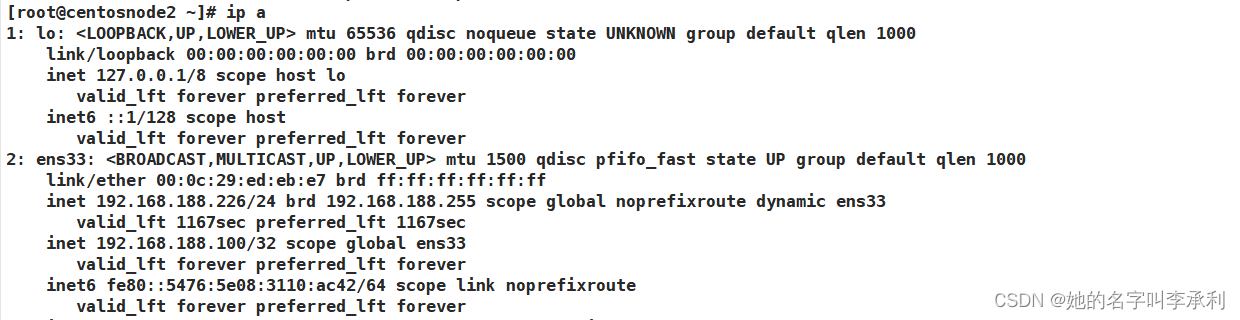
再次查看vip,发现vip飘移到了centosnode2主机上。可以将centosnode1主机的Nginx服务再次开启,会发现vip又会飘移到了centosnode1主机上,因为keepalived默认配置抢占主服务器,优先级高的服务器,将抢占到vip。
[root@centosnode1 ~]# systemctl start nginx.service
- ##监控日志文件
- tail -f 日志文件目录
-
相关阅读:
SpringBootWeb请求响应
java 问题解决
java学习part05
计算机等级考试信息安全三级填空题-二
大学生静态HTML网页源码 我的校园网页设计成品 学校班级网页制作模板 web课程设计 dreamweaver网页作业
基于SpringBoot+thymeleaf的物资管理系统
【蓝桥杯物联网赛项学习日志】Day2 中断矩阵按键
压力测试总共需要几个步骤?思路总结篇
【智能优化算法】基于Jaya算法求解单目标优化问题附matlab代码MOJAYA
王思葱、京西购物网-《软件方法》自测题解析017
- 原文地址:https://blog.csdn.net/NancyLCL/article/details/126751082
