-
2022春季《人工智能》EOJ代码个人汇总(A.八数码问题 到 J.迷宫寻找)
温馨提示:不要光顾着抄代码,想一想原理怎么来的
A.八数码问题

#include#include using namespace std; char direction[] = {'u', 'd', 'l', 'r'}; int flag = 0; string ROAD = "unsolvable"; struct A { string road = ""; int mark = 0; }; int bfs(string& aim, queue<string>& q, map<string,A>& visit) { while(!q.empty()) { string last_now = q.front(); if(aim == last_now)//满足aim的地图了 { ROAD = visit[last_now].road; return 1; //表明已经完成探路 } // cout << last_now << endl; // cout << visit[last_now].road << endl << endl; q.pop(); int x_location = last_now.find('x'); int x_row = x_location / 3; int x_col = x_location % 3; string last_road = visit[last_now].road; for(int i = 0; i < 4; i++) { //每次往不同的方向都要重新初始化 string now = last_now;//初始化现在的地图 string road = last_road;//初始化现在的路径 //cout << x_row << " " << x_col << endl; if(direction[i] == 'u') { if(x_row == 0) continue; else { int temp = now.find('x'); now[temp] = now[temp - 3]; now[temp - 3] = 'x'; road += 'u'; } } else if(direction[i] == 'd') { if(x_row == 2) continue; else { int temp = now.find('x'); now[temp] = now[temp + 3]; now[temp + 3] = 'x'; road += 'd'; } } else if(direction[i] == 'l') { if(x_col == 0) continue; else { int temp = now.find('x'); now[temp] = now[temp - 1]; now[temp - 1] = 'x'; road += 'l'; } } else if(direction[i] == 'r') { if(x_col == 2) continue; else { int temp = now.find('x'); now[temp] = now[temp + 1]; now[temp + 1] = 'x'; road +='r'; } } if(visit[now].mark == 1) { continue; } else { visit[now].road = road; visit[now].mark = 1; q.push(now); } } } return 0; } int main() { string aim = "12345678x"; string now; cin >> now; string road = ""; queue<string>q; map<string, A> visit;//用于记录是否访问过这个状态 //第一个string放记录的地图 第二个放对应的路径road visit[now].road = road; visit[now].mark = 1; q.push(now); bfs(aim, q, visit); cout << ROAD << endl; return 0; } - 1
- 2
- 3
- 4
- 5
- 6
- 7
- 8
- 9
- 10
- 11
- 12
- 13
- 14
- 15
- 16
- 17
- 18
- 19
- 20
- 21
- 22
- 23
- 24
- 25
- 26
- 27
- 28
- 29
- 30
- 31
- 32
- 33
- 34
- 35
- 36
- 37
- 38
- 39
- 40
- 41
- 42
- 43
- 44
- 45
- 46
- 47
- 48
- 49
- 50
- 51
- 52
- 53
- 54
- 55
- 56
- 57
- 58
- 59
- 60
- 61
- 62
- 63
- 64
- 65
- 66
- 67
- 68
- 69
- 70
- 71
- 72
- 73
- 74
- 75
- 76
- 77
- 78
- 79
- 80
- 81
- 82
- 83
- 84
- 85
- 86
- 87
- 88
- 89
- 90
- 91
- 92
- 93
- 94
- 95
- 96
- 97
- 98
- 99
- 100
- 101
- 102
- 103
- 104
- 105
- 106
- 107
- 108
- 109
- 110
- 111
- 112
- 113
- 114
- 115
- 116
- 117
- 118
- 119
- 120
- 121
- 122
- 123
- 124
- 125
- 126
- 127
- 128
- 129
- 130
- 131
B.路径导航

double h(int point)//离终点的预计最小状态 { return distance(t, point); } // double g(int point)//离起点的确切距离 // { // return gi[point]; // } #includepriority_queue<pair<double,int>, vector<pair<double, int>>, greater_equal<pair<double, int>> > pq; double A_star(int s,int t) { //初始化部分 for(int i = 0; i < n; i++) gi[i] = INT_MAX; gi[s] = 0; f[s] = gi[s] + h(s); pq.push(make_pair(f[s], s)); while(!pq.empty()) { int point = pq.top().second; pq.pop(); if(point == t)//找到对应的点 return f[t]; for(int i = 0; i < n; i++)//遍历相邻点 { if(edge[point][i]) { double g_new = gi[point] + distance(point, i); if(g_new < gi[i]) { gi[i] = g_new; f[i] = gi[i] + h(i); pos[i] = point; //i的前一个点为point pq.push(make_pair(f[i], i)); } } } } return f[t]; } - 1
- 2
- 3
- 4
- 5
- 6
- 7
- 8
- 9
- 10
- 11
- 12
- 13
- 14
- 15
- 16
- 17
- 18
- 19
- 20
- 21
- 22
- 23
- 24
- 25
- 26
- 27
- 28
- 29
- 30
- 31
- 32
- 33
- 34
- 35
- 36
- 37
- 38
- 39
- 40
- 41
- 42
- 43
- 44
- 45
C.TSP问题

#include#include using namespace std; int times; int k; vector<int>last; void init() { srand(time(NULL)); t = 11.2; times = 0; k = 110; } bool termi() { return t < 1.5; } vector<int> N(const vector<int> &p) { vector<int> ret(p); int x1 = rand()%(n-1) + 1; int x2 = rand()%(n-1) + 1; if(x1 > x2) swap(x1,x2); while(x1 < x2) { swap(ret[x1], ret[x2]); x1++;x2--; } return ret; } double drop(double t) { //last = p_best; if(times < k*n) { times++; return t; } times = 0; return 0.92*t; } double calc_p() { return pow(exp(1.0), (-f(p_new)+f(p_current))/t); } - 1
- 2
- 3
- 4
- 5
- 6
- 7
- 8
- 9
- 10
- 11
- 12
- 13
- 14
- 15
- 16
- 17
- 18
- 19
- 20
- 21
- 22
- 23
- 24
- 25
- 26
- 27
- 28
- 29
- 30
- 31
- 32
- 33
- 34
- 35
- 36
- 37
- 38
- 39
- 40
- 41
- 42
- 43
- 44
- 45
- 46
- 47
- 48
- 49
- 50
- 51
D. 百万皇后

#includeusing namespace std; int N; int dissa = 0; int* y; int* dia1; int* dia2;//用于记录每一次交换y状态(棋盘)变化时候对角线的状态 int* dia3; int* dia4;//用于记录每次固定下前n列时候的对角线状态 void init() { //srand(time(NULL)); for(int i = 0; i < 2*N-1; i++) { dia1[i] = dia2[i] = dia3[i] = dia4[i] = 0; } } // int my_random(int s, int e) { double ratio = double(rand())/RAND_MAX; if(e > s) return s + (unsigned ll)((e-s) * ratio); else return e; } void swap(int a, int b, int flag) { dia1[y[a] + a]--; dia1[y[b] + b]--; dia2[y[a] - a + N-1]--; dia2[y[b] - b + N-1]--; if(flag == 0) { dia3[y[a] + a]--; dia4[y[a] - a + N-1]--; //用处是flag1之后如果不满足要求再flag=0换回来 } int temp = y[a]; y[a] = y[b]; y[b] = temp; dia1[y[a] + a]++; dia1[y[b] + b]++; dia2[y[a] - a + N-1]++; dia2[y[b] - b + N-1]++; if(flag == 1) { //目的是让y(棋盘)从0到N-1遍历一遍 //每次就可以固定好一个位置 dia3[y[a] + a]++; dia4[y[a] - a + N-1]++; } } //first没问题 void first_test() { init(); for(int i = 0; i < N; i++) { y[i] = i; dia1[y[i] + i]++; dia2[y[i] - i + (N-1) ]++;//这里要N-1 } int j = 0; for(int test_time = 0; j < N && test_time < N * 4; test_time++) { int k = my_random(j, N); swap(j, k, 1); if(dia3[y[j]+j] > 1 || dia4[y[j]-j + N-1] > 1) swap(j, k, 0);//换了还冲突就还回去 else j++;//针对j 直到j不冲突 } for (int i = j; i < N; i++) { int k = my_random(i, N); swap(i, k, 2); } dissa = N - j; } // int totalCollisions(int k) { // return dia2[y[k] - k + N - 1] > 1 || dia1[y[k] + k] > 1; // } void final_test() { //对剩下不满足要求的棋盘进行交换 for(int i = N - dissa - 1; i < N; i++) { int times = 0;//这里需要固定一个迭代次数 //避免过少太偶然也不能太多浪费时间 int b ; if(dia2[y[i] - i + N - 1] > 1 || dia1[y[i] + i] > 1) { do { int j = my_random(0 , N); times++; swap(i, j, 2); int collision1 = (dia2[y[i] - i + N - 1] > 1) || (dia1[y[i] + i] > 1); int collision2 = (dia2[y[j] - j + N - 1] > 1) || (dia1[y[j] + j] > 1); b = collision1 || collision2; if(b) swap(i, j, 2); //如果在一个点超过1w次没有成功则重新再来 if(times > 10000) { first_test(); i = N - dissa - 1; break; } } while (b); } } } int main() { cin >> N; if(N == 1) { cout << 0; return 0; } else if(N == 2 || N == 3 || N < 1) { return 0; } y = new int[N]; dia1 = new int[2*N-1]; dia2 = new int[2*N-1]; dia3 = new int[2*N-1]; dia4 = new int[2*N-1]; srand(time(NULL)); //init(); first_test();//先初始化看看能否一次就可以满足要求 if(dissa > 0) { final_test(); } for(int i = 0; i < N; i++) cout << y[i] << endl; } - 1
- 2
- 3
- 4
- 5
- 6
- 7
- 8
- 9
- 10
- 11
- 12
- 13
- 14
- 15
- 16
- 17
- 18
- 19
- 20
- 21
- 22
- 23
- 24
- 25
- 26
- 27
- 28
- 29
- 30
- 31
- 32
- 33
- 34
- 35
- 36
- 37
- 38
- 39
- 40
- 41
- 42
- 43
- 44
- 45
- 46
- 47
- 48
- 49
- 50
- 51
- 52
- 53
- 54
- 55
- 56
- 57
- 58
- 59
- 60
- 61
- 62
- 63
- 64
- 65
- 66
- 67
- 68
- 69
- 70
- 71
- 72
- 73
- 74
- 75
- 76
- 77
- 78
- 79
- 80
- 81
- 82
- 83
- 84
- 85
- 86
- 87
- 88
- 89
- 90
- 91
- 92
- 93
- 94
- 95
- 96
- 97
- 98
- 99
- 100
- 101
- 102
- 103
- 104
- 105
- 106
- 107
- 108
- 109
- 110
- 111
- 112
- 113
- 114
- 115
- 116
- 117
- 118
- 119
- 120
- 121
- 122
- 123
- 124
- 125
- 126
- 127
- 128
- 129
- 130
- 131
- 132
- 133
- 134
- 135
- 136
- 137
- 138
- 139
- 140
- 141
- 142
- 143
- 144
- 145
- 146
- 147
- 148
- 149
- 150
- 151
- 152
- 153
- 154
- 155
- 156
- 157
- 158
- 159
- 160
E. 地图染色

思路
这个数量级直接DFS就行,甚至不需要过多的剪枝
代码
#include#include #include #include using namespace std; const int maxn = 1005; int n,m; int all = 0x3f3f3f3f;//最小颜色量 int map[maxn][maxn];//图 int color_to_point[maxn][maxn];//一个颜色 int color_num[maxn]; int color[maxn];//最后输出的out int color_final[maxn]; void out()//最终输出 { cout << all << endl; for(int i = 0; i < n; i++) cout << color_final[i] << endl; } void change()//改最小情况 { for(int i = 0; i < n; i++) color_final[i] = color[i]; } void dfs(int seq, int total) // seq 表示第几个人, tot表示已经用了的颜色 { if(total >= all) return; if(seq == n)//鉴定完前n个 { if(all > total)//最优情况迭代 { all = total; change(); } return; } for(int i = 0; i < total; i++) { //遍历所有使用过的颜色 int size = color_num[i]; int not_counter = 0; for(int j = 0; j < size; j++) { int to_judge = color_to_point[i][j]; if(!map[to_judge][seq])//seq对应的点和这个是否相邻? { not_counter++; } } if(not_counter == size)//所有点都不冲突 { color[seq] = i;//保存节点颜色 color_to_point[i][color_num[i]++] = seq;//并储存好 dfs(seq + 1, total); //回溯 color_num[i]--; //color[seq] = -1; } } color[seq] = total;//已经选了的颜色都有冲突 color_to_point[total][color_num[total]++] = seq;//选一个新的颜色 dfs(seq + 1, total + 1); //回溯 color_num[total]--; //color[seq] = -1; } int main() { memset(map, 0 ,sizeof(map)); memset(color_to_point,0, sizeof(color_to_point)); memset(color_num,0,sizeof(color_num)); memset(color, -1, sizeof(color)); memset(color_final, 0 ,sizeof(color_final)); cin >> n >> m;// amounts of points and edges int x, y; for(int i = 0; i < m; i++) { color[i]=-1; cin >> x >> y; map[x][y] = map[y][x] = 1; } dfs(0,0); out();// } - 1
- 2
- 3
- 4
- 5
- 6
- 7
- 8
- 9
- 10
- 11
- 12
- 13
- 14
- 15
- 16
- 17
- 18
- 19
- 20
- 21
- 22
- 23
- 24
- 25
- 26
- 27
- 28
- 29
- 30
- 31
- 32
- 33
- 34
- 35
- 36
- 37
- 38
- 39
- 40
- 41
- 42
- 43
- 44
- 45
- 46
- 47
- 48
- 49
- 50
- 51
- 52
- 53
- 54
- 55
- 56
- 57
- 58
- 59
- 60
- 61
- 62
- 63
- 64
- 65
- 66
- 67
- 68
- 69
- 70
- 71
- 72
- 73
- 74
- 75
- 76
- 77
- 78
- 79
- 80
- 81
- 82
- 83
- 84
- 85
- 86
- 87
- 88
- 89
- 90
- 91
- 92
F.字符路径

思路1
DFS暴力穷举,然后发现平均每次开五个节点
复杂度可以到达 5 26 5^{26} 526次妥妥超时所以找寻DP思路
思路2
利用DP思想,我们可以将每次走“1步“视为一个状态
例如road路径给的是”abcd"
那么每次我们要求的是a->d,那么我们先得求出a->c和a->b的状态
而这里的状态用一个二维数组保存我们先假定a点有n个,b点m个,c点x个
具体的保存形式就是:
a->b 用 n × m n\times m n×m大小得数组进行储存,每个a到b之间的最短距离那么再状态转移的时候,利用floyed或者dijkstra的图算法,来利用b->c和一开始村好的a->b来计算出来 n × x n\times x n×x个a到c的最短路径
最后求到a->d的所有可能,再遍历一遍得到最终的最短路径
代码
思路一代码
#include#include #include #include using namespace std; struct point { int x; int y; int last_point_dis; }; typedef vector<point> vp; typedef map<char,vp> mcv; const int maxn = 1024; int ans = 0x3f3f3f3f; int len; char MAP[maxn][maxn]; int cal_Man(point a, point b) { return abs(a.x - b.x) + abs(a.y-b.y); } void test_map(const mcv& ma) { for(mcv::const_iterator it = ma.begin(); it != ma.end(); it++) { cout << it->first << ":\n"; for(vp::const_iterator itt = it->second.begin(); itt != it->second.end(); itt++) { cout << itt->x << " y: " << itt->y << " dis:" << itt->last_point_dis<< endl; } } } int cmp(point a, point b) { return a.last_point_dis < b.last_point_dis; } void dfs(mcv ma, string& str, point prev, int depth, int cost = 0) //由于避免dfs后续影响前部分内容这里不用引用ma { if(cost > ans) return; if(depth > len) return; if(depth == len) { if(cost < ans) { ans = cost; } return; } char seq = str[depth]; for(vp::iterator it = ma[seq].begin(); it != ma[seq].end(); it++) { it->last_point_dis = cal_Man(*it, prev); } sort(ma[seq].begin(), ma[seq].end(), cmp);//end就不用加size了 //test_map(ma); for(vp::iterator it = ma[seq].begin(); it != ma[seq].end() && it != ma[seq].begin() + 3; it++) { dfs(ma, str, *it, depth + 1, cost + it->last_point_dis); } } int main() { mcv ma; int n, m ,k; cin >> n >> m >> k; for(int i = 0; i < n; i++) for(int j = 0; j < m; j++) { cin >> MAP[i][j]; ma[MAP[i][j]].push_back({j, i, 0}); } //test_map(ma); string road; cin >> road; len = road.length(); char zero = road[0]; for(vp::iterator it = ma[zero].begin(); it !=ma[zero].end(); it++) { dfs(ma, road, *it, 1); } cout << ans; } - 1
- 2
- 3
- 4
- 5
- 6
- 7
- 8
- 9
- 10
- 11
- 12
- 13
- 14
- 15
- 16
- 17
- 18
- 19
- 20
- 21
- 22
- 23
- 24
- 25
- 26
- 27
- 28
- 29
- 30
- 31
- 32
- 33
- 34
- 35
- 36
- 37
- 38
- 39
- 40
- 41
- 42
- 43
- 44
- 45
- 46
- 47
- 48
- 49
- 50
- 51
- 52
- 53
- 54
- 55
- 56
- 57
- 58
- 59
- 60
- 61
- 62
- 63
- 64
- 65
- 66
- 67
- 68
- 69
- 70
- 71
- 72
- 73
- 74
- 75
- 76
- 77
- 78
- 79
- 80
- 81
- 82
- 83
- 84
- 85
- 86
- 87
- 88
- 89
- 90
- 91
- 92
- 93
- 94
思路二
#include#include #include #include using namespace std; struct point { int y; int x; }; typedef vector<point> vp; typedef unordered_map<char,vp> mcv; const int inf = 0x3f3f3f3f; const int maxn = 105; int ans = inf; int len; char MAP[maxn][maxn]; int start_mid[maxn][maxn]; int mid_next[maxn][maxn]; string road; int cal_Man(point a, point b) { return abs(a.x - b.x) + abs(a.y-b.y); } void test_map(const mcv& ma) { for(mcv::const_iterator it = ma.begin(); it != ma.end(); it++) { cout << it->first << ":\n"; for(vp::const_iterator itt = it->second.begin(); itt != it->second.end(); itt++) { cout << itt->x << " y: " << itt->y << endl; } } } void array_init(mcv& ma) { char zero = road[0]; int zero_num = ma[zero].size(); char one = road[1]; int one_num = ma[one].size(); for(int i = 0; i < zero_num; i++) { for(int j = 0; j < one_num; j++) { start_mid[i][j] = cal_Man(ma[zero][i], ma[one][j]); //cout << start_mid[i][j] << " "; }//cout << endl; } } void dp(mcv& ma, int depth) { //test_map(ma); char mid = road[depth - 1]; int mid_num = ma[mid].size(); char next = road[depth]; int next_num = ma[next].size(); for(int i = 0; i < mid_num; i++) { for(int j = 0; j < next_num; j++) { mid_next[i][j] = cal_Man(ma[mid][i], ma[next][j]); } } char zero = road[0]; int zero_num = ma[zero].size(); int temp[maxn][maxn]; memset(temp, inf, sizeof(temp)); // cout << zero_num <<" " << mid_num << " "< // cout << next << endl; // cout << zero << mid << next << endl; for(int k = 0; k < mid_num; k++) for(int i = 0; i < zero_num; i++) for(int j = 0; j < next_num; j++) if(temp[i][j] > start_mid[i][k] + mid_next[k][j]) temp[i][j] = start_mid[i][k] + mid_next[k][j]; for(int i = 0; i < zero_num; i++) for(int j = 0; j < next_num; j++) start_mid[i][j] = temp[i][j]; // for(int i = 0; i < zero_num; i++){ // for(int j = 0; j < next_num; j++) // {cout << temp[i][j] << "..";} // cout << endl;} //cout << "?" << endl; } int main() { int n, m ,k; cin >> n >> m >> k; mcv ma; for(int i = 0; i < n; i++) for(int j = 0; j < m; j++) { cin >> MAP[i][j]; ma[MAP[i][j]].push_back({i,j}); } // for(int i = 0; i < n; i++) // for(int j = 0; j < m; j++) // cout << MAP[i][j] << " "; cin >> road; len = road.length(); array_init(ma);//初始化start_mid; for(int i = 2; i < len; i++) { dp(ma, i); } int zero_num = ma[road[0]].size(); int next_num = ma[road[len-1]].size(); for(int i = 0; i < zero_num; i++) for(int j = 0; j < next_num; j++) //cout << start_mid[i][j] << " "; if(ans > start_mid[i][j]) ans = start_mid[i][j]; cout << ans; } - 1
- 2
- 3
- 4
- 5
- 6
- 7
- 8
- 9
- 10
- 11
- 12
- 13
- 14
- 15
- 16
- 17
- 18
- 19
- 20
- 21
- 22
- 23
- 24
- 25
- 26
- 27
- 28
- 29
- 30
- 31
- 32
- 33
- 34
- 35
- 36
- 37
- 38
- 39
- 40
- 41
- 42
- 43
- 44
- 45
- 46
- 47
- 48
- 49
- 50
- 51
- 52
- 53
- 54
- 55
- 56
- 57
- 58
- 59
- 60
- 61
- 62
- 63
- 64
- 65
- 66
- 67
- 68
- 69
- 70
- 71
- 72
- 73
- 74
- 75
- 76
- 77
- 78
- 79
- 80
- 81
- 82
- 83
- 84
- 85
- 86
- 87
- 88
- 89
- 90
- 91
- 92
- 93
- 94
- 95
- 96
- 97
- 98
- 99
- 100
- 101
- 102
- 103
- 104
- 105
- 106
- 107
- 108
- 109
- 110
- 111
- 112
- 113
- 114
- 115
- 116
- 117
- 118
- 119
- 120
- 121
- 122
- 123
- 124
- 125
- 126
- 127
- 128
- 129
- 130
- 131
- 132
- 133
- 134
- 135
- 136
- 137
- 138
- 139
- 140
- 141
G.决策树


测评代码#includeusing namespace std; // 每个数据或是整数或是浮点数,实际使用时每个数据仅其中一个值有效 struct Val { int i; double d; Val(int _i): i(_i), d(0) {} Val(double _d): i(0), d(_d) {} }; bool operator != (const Val& lhs, const Val& rhs) { return lhs.i != rhs.i || lhs.d != rhs.d; } // 样本,包括每种属性及标签(1 或 -1) struct Sample { vector<Val> atr; int label; Sample(): atr(), label(0) {} }; typedef vector<Sample> Data; // 决策树节点 struct Tnode { int label; // 为 0 说明不为叶节点;否则标识叶节点对应标签 int atrno; // 该节点的划分属性的下标 int tp; // 0 代表连续值;1代表离散值 double par; // 若为连续值, 为划分点的值;若为离散值, 则无效 vector<Tnode> son; // 该节点的所有子节点 Tnode(): label(0), atrno(-1), tp(-1), par(0), son() {} }; string readLine(istream& fin) { string s; // 读入数据并输入到 stringstream if (fin.eof()) { return s; } getline(fin, s); for (int i = 0; i < s.length(); ++i) { if (s[i] == ',') s[i] = ' '; } return s; } void readData(Data& data_all, vector<int>& type_all) { string s; stringstream ss; // 读入数据类型 s = readLine(cin); ss << s; while (true) { int x; ss >> x; if (ss.fail()) break; type_all.push_back(x); } // 读入数据 bool flag = true; while (flag) { string s; stringstream ss; s = readLine(cin); ss << s; Sample sp; for (int t : type_all) { if (t == 0) { double x; ss >> x; if (ss.fail()) { flag = false; break; } sp.atr.push_back(x); } else { int x; ss >> x; if (ss.fail()) { flag = false; break; } sp.atr.push_back(x); } } if (!flag) break; // 读取 label int x; ss >> x; if (ss.fail()) break; sp.label = x; data_all.push_back(sp); } } // 若数据集中所有样本有相同 label,返回该 label 值;否则返回 0 int getLabel(const Data& data_set) { int label = data_set[0].label; for (int i = 1; i < data_set.size(); ++i) { if (data_set[i].label != label) { return 0; } } return label; } // 判断数据集中所有样本是否在 atr_set 中的每个属性上取值都相同 bool sameAtr(const Data& data_set, const vector<int>& atr_set) { Sample sp = data_set[0]; for (int i = 1; i < data_set.size(); ++i) { for (int atrno : atr_set) { if (sp.atr[atrno] != data_set[i].atr[atrno]) { return false; } } } return true; } // 计算数据集中样本数最多的类。若相同,随机取一个 int getMostLabel(const Data& data_set) { map<int, int> mp; mp[-1] = 0; mp[1] = 0; for (auto sp : data_set) { mp[sp.label]++; } if (mp[-1] > mp[1]) return -1; if (mp[-1] < mp[1]) return 1; return rand() % 2 == 0 ? -1 : 1; } // 将数据集按某一属性分割,若为连续值则以 par 为分界点分割 vector<Data> splitData(const Data& data_set, int atrno, double par, const vector<int>& type_all) { int tp = type_all[atrno]; vector<Data> datas(2); if (tp == 0) { for (auto e : data_set) { if (e.atr[atrno].d < par) { datas[0].push_back(e); } else { datas[1].push_back(e); } } } else { for (auto e : data_set) { datas[e.atr[atrno].i].push_back(e); } } return datas; } /** * @brief 对决策树中一个节点的划分方案作出评估 * * @param label_group 当前待评估划分方案的标签。label_group[i][j] 为该划分方案第 i 组中的第 j 个标签。保证标签仅有 -1 和 1 两种取值。 * @return 对划分的评估,数值越大代表该划分越优秀。 */ double calcScore(const vector<vector<int> >& label_group); // 你的代码将被嵌入此处 // 将 datas 中的 label 提取出来,调用 calcScore 获取得分 double getScore(const vector<Data>& datas) { vector<vector<int> > label_group; for (const Data& dt : datas) { vector<int> labels; for (auto sp : dt) { labels.push_back(sp.label); } label_group.push_back(labels); } return calcScore(label_group); } // 获取某一划分的分数及划分点(若为连续变量) pair<double, double> getScoreAndPar(const Data& data_set, int atrno, const vector<int>& type_all) { if (type_all[atrno] == 0) { vector<double> points; for (auto dt : data_set) { points.push_back(dt.atr[atrno].d); } sort(points.begin(), points.end()); points.push_back(points.back() + 1); vector<pair<double, double> > rets; for (int i = 0; i < points.size() - 1; ++i) { if (points[i] == points[i + 1]) continue; double par = (points[i] + points[i + 1]) / 2; vector<Data> datas = splitData(data_set, atrno, par, type_all); rets.push_back({getScore(datas), par}); } assert(!rets.empty()); sort(rets.begin(), rets.end(), greater<pair<double, double> >()); while (rets.size() > 1 && rets.back().first != rets.front().first) { rets.pop_back(); } int no = rand() % rets.size(); return rets[no]; } else { vector<Data> datas = splitData(data_set, atrno, 0, type_all); return {getScore(datas), 0}; } } // 构建决策树 Tnode buildTree(const Data& data_set, const vector<int>& atr_set, const vector<int>& type_all) { Tnode node; // 处理样本类别全部相同的情况 node.label = getLabel(data_set); if (node.label) { // printf("*1*\n"); return node; } // 处理属性集为空或所有样本在属性集上取值全部相同的情况 if (atr_set.empty() || sameAtr(data_set, atr_set)) { // printf("*2*\n"); node.label = getMostLabel(data_set); return node; } // 选择最优属性. 若有多个, 随机选择其中一个 vector<pair<pair<double, double>, int> > v; for (auto atrno : atr_set) { v.push_back({getScoreAndPar(data_set, atrno, type_all), atrno}); } sort(v.begin(), v.end(), greater<pair<pair<double, double>, int> >()); while (v.size() > 1 && v.back().first.first != v.front().first.first) { v.pop_back(); } int no = rand() % v.size(); node.atrno = v[no].second; node.tp = type_all[node.atrno]; node.par = v[no].first.second; // 生成分支 vector<Data> datas = splitData(data_set, node.atrno, node.par, type_all); vector<int> new_atr_set; if (node.tp == 0) { new_atr_set = atr_set; } else { for (auto atrno : atr_set) { if (atrno != node.atrno) new_atr_set.push_back(atrno); } } for (int i = 0; i < 2; ++i) { if (datas[i].empty()) { Tnode nd; nd.label = getMostLabel(data_set); node.son.push_back(nd); } else { node.son.push_back(buildTree(datas[i], new_atr_set, type_all)); } } return node; } void print(const Tnode& now, int tab = 0) { putchar('~'); for (int i = 0; i < tab; ++i) { putchar('|'); } printf("(%d, %d, %d, %f)\n", now.label, now.atrno, now.tp, now.par); if (!now.label) { for (const Tnode& p : now.son) { print(p, tab + 1); } } } // 预测一个数据的值 int fit(const Tnode& root, const Sample& sample_in) { if (root.label != 0) return root.label; if (root.tp == 1) return fit(root.son[sample_in.atr[root.atrno].i], sample_in); if (sample_in.atr[root.atrno].d < root.par) return fit(root.son[0], sample_in); return fit(root.son[1], sample_in); } // 返回一个vector,内容为对每个输入数据的预测 vector<int> predict(const Tnode& root, const Data& data_set) { vector<int> ret; for (auto e : data_set) { ret.push_back(fit(root, e)); } return ret; } double trainAndTest(const Data& data_train, const Data& data_test, const vector<int>& type_all) { vector<int> atr_set; for (int i = 0; i < type_all.size(); ++i) { atr_set.push_back(i); } Tnode root = buildTree(data_train, atr_set, type_all); vector<int> pred = predict(root, data_test); int total_num = data_test.size(); int correct = 0; for (int i = 0; i < total_num; ++i) { if (pred[i] == data_test[i].label) ++correct; } return double(correct) / total_num; } double crossValidate(const Data& data_all, const vector<int>& type_all, int folder_num) { vector<Data> datas(2); for (auto dt : data_all) { if (dt.label == -1) datas[0].push_back(dt); else datas[1].push_back(dt); } for (Data& data : datas) { random_shuffle(data.begin(), data.end()); } vector<Data> data_folder; for (int i = 0; i < folder_num; ++i) { Data folder; for (const Data& data : datas) { int l = i * data.size() / folder_num; int r = (i + 1) * data.size() / folder_num; for (int i = l; i < r; ++i) { folder.push_back(data[i]); } } data_folder.push_back(folder); } double precision = 0; for (int i = 0; i < folder_num; ++i) { Data data_train, data_test; for (int j = 0; j < folder_num; ++j) { if (i == j) { data_test.insert(data_test.end(), data_folder[j].begin(), data_folder[j].end()); } else { data_train.insert(data_train.end(), data_folder[j].begin(), data_folder[j].end()); } } precision += trainAndTest(data_train, data_test, type_all) / folder_num; } return precision; } int main() { Data data_all; vector<int> type_all; srand(19260817); readData(data_all, type_all); double precion = crossValidate(data_all, type_all, 10); // 输出密码,防止偷鸡行为 printf("%.2f\n", precion * 100); return 0; } - 1
- 2
- 3
- 4
- 5
- 6
- 7
- 8
- 9
- 10
- 11
- 12
- 13
- 14
- 15
- 16
- 17
- 18
- 19
- 20
- 21
- 22
- 23
- 24
- 25
- 26
- 27
- 28
- 29
- 30
- 31
- 32
- 33
- 34
- 35
- 36
- 37
- 38
- 39
- 40
- 41
- 42
- 43
- 44
- 45
- 46
- 47
- 48
- 49
- 50
- 51
- 52
- 53
- 54
- 55
- 56
- 57
- 58
- 59
- 60
- 61
- 62
- 63
- 64
- 65
- 66
- 67
- 68
- 69
- 70
- 71
- 72
- 73
- 74
- 75
- 76
- 77
- 78
- 79
- 80
- 81
- 82
- 83
- 84
- 85
- 86
- 87
- 88
- 89
- 90
- 91
- 92
- 93
- 94
- 95
- 96
- 97
- 98
- 99
- 100
- 101
- 102
- 103
- 104
- 105
- 106
- 107
- 108
- 109
- 110
- 111
- 112
- 113
- 114
- 115
- 116
- 117
- 118
- 119
- 120
- 121
- 122
- 123
- 124
- 125
- 126
- 127
- 128
- 129
- 130
- 131
- 132
- 133
- 134
- 135
- 136
- 137
- 138
- 139
- 140
- 141
- 142
- 143
- 144
- 145
- 146
- 147
- 148
- 149
- 150
- 151
- 152
- 153
- 154
- 155
- 156
- 157
- 158
- 159
- 160
- 161
- 162
- 163
- 164
- 165
- 166
- 167
- 168
- 169
- 170
- 171
- 172
- 173
- 174
- 175
- 176
- 177
- 178
- 179
- 180
- 181
- 182
- 183
- 184
- 185
- 186
- 187
- 188
- 189
- 190
- 191
- 192
- 193
- 194
- 195
- 196
- 197
- 198
- 199
- 200
- 201
- 202
- 203
- 204
- 205
- 206
- 207
- 208
- 209
- 210
- 211
- 212
- 213
- 214
- 215
- 216
- 217
- 218
- 219
- 220
- 221
- 222
- 223
- 224
- 225
- 226
- 227
- 228
- 229
- 230
- 231
- 232
- 233
- 234
- 235
- 236
- 237
- 238
- 239
- 240
- 241
- 242
- 243
- 244
- 245
- 246
- 247
- 248
- 249
- 250
- 251
- 252
- 253
- 254
- 255
- 256
- 257
- 258
- 259
- 260
- 261
- 262
- 263
- 264
- 265
- 266
- 267
- 268
- 269
- 270
- 271
- 272
- 273
- 274
- 275
- 276
- 277
- 278
- 279
- 280
- 281
- 282
- 283
- 284
- 285
- 286
- 287
- 288
- 289
- 290
- 291
- 292
- 293
- 294
- 295
- 296
- 297
- 298
- 299
- 300
- 301
- 302
- 303
- 304
- 305
- 306
- 307
- 308
- 309
- 310
- 311
- 312
- 313
- 314
- 315
- 316
- 317
- 318
- 319
- 320
- 321
- 322
- 323
- 324
- 325
- 326
- 327
- 328
- 329
- 330
- 331
- 332
- 333
- 334
- 335
- 336
- 337
- 338
- 339
- 340
- 341
- 342
- 343
- 344
- 345
- 346
- 347
- 348
- 349
- 350
- 351
- 352
- 353
- 354
- 355
- 356
- 357
- 358
- 359
- 360
- 361
- 362
- 363
- 364
- 365
- 366
- 367
- 368
- 369
- 370
- 371
- 372
- 373
- 374
- 375
- 376
- 377
- 378
- 379
- 380
- 381
- 382
- 383
- 384
- 385
- 386
- 387
- 388
- 389
- 390
信息增益
经过测试确实也只有66.16%概率正确
#include#include using namespace std; double calcScore(const vector<vector<int> >& label_group) { double EntD = 0; vector<double>Earray; vector<int>Enum; int all_pos = 0, all_neg = 0; int leni = label_group.size(); for(int i = 0; i < leni; i++) { int part_pos = 0, part_neg = 0; int lenj = label_group[i].size(); for(int j = 0; j < lenj; j++) { int temp = label_group[i][j]; if(temp == 1) { part_pos += 1; all_pos += 1; } else { part_neg += 1; all_neg += 1; } } double EntTemp; int SUM = part_neg + part_pos; if(!part_neg || !part_pos)//存在一个是0 EntTemp = 0; else { double fac1 = (double)part_neg / SUM; double fac2 = (double)part_pos / SUM; EntTemp = -(fac1*log2(fac1) + fac2*log2(fac2)); } Earray.push_back(EntTemp); Enum.push_back(SUM); } double fac1 = (double)all_neg / (all_neg+all_pos); double fac2 = (double)all_pos / (all_neg+all_pos); double res = -(fac1*log2(fac1) + fac2*log2(fac2)); for(int i = 0; i < Earray.size(); i++) res -= Earray[i] * ((double)Enum[i] / (all_neg + all_pos)); return res; } - 1
- 2
- 3
- 4
- 5
- 6
- 7
- 8
- 9
- 10
- 11
- 12
- 13
- 14
- 15
- 16
- 17
- 18
- 19
- 20
- 21
- 22
- 23
- 24
- 25
- 26
- 27
- 28
- 29
- 30
- 31
- 32
- 33
- 34
- 35
- 36
- 37
- 38
- 39
- 40
- 41
- 42
- 43
- 44
- 45
- 46
- 47
- 48
H.K_means

程序主体如下所示。#include#include #include #include using namespace std; const double eps = 1e-6; struct Point { vector<double> coordinate; int groupId; /** * @brief 计算两个 Point 之间的欧氏距离的平方, * 要求两个 Point coordinate 长度相等 */ double distance(const Point &other) const { // 采用欧氏距离平方作为指标. double ans = 0; int sz = max(coordinate.size(), other.coordinate.size()); for (int i = 0; i < sz; ++i) ans += (coordinate[i] - other.coordinate[i]) * (coordinate[i] - other.coordinate[i]); return ans; } /** * @brief 将另一个 Point 赋值给当前 Point */ Point &operator=(const Point &other) { if (this == &other) return *this; coordinate = other.coordinate; groupId = other.groupId; return *this; } /** * @brief 按 coordinate 顺序比较两个 Point 的大小, * 要求两个 Point coordinate 长度相等 */ bool operator<(const Point &other) const { auto sz = max(coordinate.size(), other.coordinate.size()); for (auto i = 0; i < sz; ++i) if (fabs(coordinate[i] - other.coordinate[i]) > eps) return coordinate[i] < other.coordinate[i]; return false; } }; // 你的代码会被嵌入在这 bool vectorIsEqual(const vector<Point> ¢ers, const vector<Point> &temp) { auto v1 = centers; sort(v1.begin(), v1.end()); auto v2 = temp; sort(v2.begin(), v2.end()); auto k = max(v1.size(), v2.size()); for (auto i = 0; i < k; ++i) if (v1[i] < v2[i] || v2[i] < v1[i]) return false; return true; } vector<Point> kMeans(vector<Point> &points, const int k) { vector<Point> centers(k); vector<Point> temp; for (auto i = 0; i < k; ++i) centers[i] = points[i]; do { temp = centers; centers = update(points, temp); } while (!vectorIsEqual(centers, temp)); return centers; } double score(const vector<Point> &points, const vector<Point> ¢ers) { auto n = points.size(); auto ans = 0.0; for (auto i = 0; i < n; ++i) ans += points[i].distance(centers[points[i].groupId]); return ans; } int main() { int n, m; scanf("%d%d", &n, &m); vector<int> target(n); vector<Point> points(n); for (int i = 0; i < n; ++i) { points[i].coordinate.resize(m); for (int j = 0; j < m; ++j) { scanf("%lf", &(points[i].coordinate[j])); } scanf("%d", &target[i]); } auto centers = kMeans(points, 2); printf("%f\n", (double)score(points, centers)); return 0; } - 1
- 2
- 3
- 4
- 5
- 6
- 7
- 8
- 9
- 10
- 11
- 12
- 13
- 14
- 15
- 16
- 17
- 18
- 19
- 20
- 21
- 22
- 23
- 24
- 25
- 26
- 27
- 28
- 29
- 30
- 31
- 32
- 33
- 34
- 35
- 36
- 37
- 38
- 39
- 40
- 41
- 42
- 43
- 44
- 45
- 46
- 47
- 48
- 49
- 50
- 51
- 52
- 53
- 54
- 55
- 56
- 57
- 58
- 59
- 60
- 61
- 62
- 63
- 64
- 65
- 66
- 67
- 68
- 69
- 70
- 71
- 72
- 73
- 74
- 75
- 76
- 77
- 78
- 79
- 80
- 81
- 82
- 83
- 84
- 85
- 86
- 87
- 88
- 89
- 90
- 91
- 92
- 93
- 94
- 95
- 96
- 97
- 98
- 99
代码
vector<Point> update(vector<Point> &points, const vector<Point> &last) { vector<Point> newest(last); vector<int> count; int lenl = last.size(); int lenp = points.size(); int cor_l = last[0].coordinate.size(); //进行迭代 //修改分组 for(int i = 0; i < lenp; i++) { double dis = 0xffffffff; int id = 0; for(int j = 0; j < lenl; j++) { double temp = points[i].distance(last[j]); if(temp < dis) { dis = temp; id = j; } } points[i].groupId = id; }//一开始只进行迭代 就能获得6分 //记录新的组的情况 //清零 int* cnt = new int[lenl]; for(int i = 0; i < lenl; i++) { cnt[i] = 0; for(int j = 0; j < cor_l; j++) { newest[i].coordinate[j] = 0; } }//完成归零这一步能上到35分 //更新最近点 //每个点都加进去,并计算一个集合的数量 for(int i = 0; i < lenp; i++) { cnt[points[i].groupId] ++; for(int j = 0; j < cor_l; j++) { int id = points[i].groupId; newest[id].coordinate[j] += points[i].coordinate[j]; } } //相除 for(int i = 0; i < lenl; i++) { for(int j = 0; j < cor_l; j++) { // if(cnt[i]) newest[i].coordinate[j] /= cnt[i]; } } delete[] cnt; return newest; }- 1
- 2
- 3
- 4
- 5
- 6
- 7
- 8
- 9
- 10
- 11
- 12
- 13
- 14
- 15
- 16
- 17
- 18
- 19
- 20
- 21
- 22
- 23
- 24
- 25
- 26
- 27
- 28
- 29
- 30
- 31
- 32
- 33
- 34
- 35
- 36
- 37
- 38
- 39
- 40
- 41
- 42
- 43
- 44
- 45
- 46
- 47
- 48
- 49
- 50
- 51
- 52
- 53
- 54
- 55
- 56
- 57
- 58
- 59
- 60
- 61
- 62
- 63
- 64
I.神经网络入门

#include "bits/stdc++.h" using namespace std; double mseLoss(double x, double target) { return 0.5 * (x - target) * (x - target); } struct NeuralNetwork { vector<double*> values, caches; vector<double**> weights; }; void standardize(double **data, int dataSize, int featureSize) { for (int j = 0; j <= featureSize; ++j) { double mean = 0; for (int i = 0; i < dataSize; ++i) mean += data[i][j] / dataSize; double variance = 0; for (int i = 0; i < dataSize; ++i) variance += (data[i][j] - mean) * (data[i][j] - mean) / (dataSize - 1); for (int i = 0; i < dataSize; ++i) data[i][j] = (data[i][j] - mean) / sqrt(variance); } } pair<vector<double*>, vector<double*>> make_dataset(int dataSize, int featureNum) { double **data = (double**)malloc(dataSize * sizeof(double*)); for (int i = 0; i < dataSize; ++i) { data[i] = (double*)malloc((featureNum + 2) * sizeof(double)); data[i][0] = 0; for (int j = 0; j <= featureNum; ++j) scanf("%lf", &data[i][j]); } standardize(data, dataSize, featureNum); for (int i = 0; i < dataSize; ++i) { data[i][featureNum + 1] = data[i][featureNum]; data[i][featureNum] = 1; // 偏置项 } int trainSize = 0.8 * dataSize; vector<int> index(dataSize); for (int i = 0; i < dataSize; ++i) index[i] = i; random_shuffle(index.begin(), index.end()); vector<double*> train, valid; for (int i = 0; i < trainSize; ++i) train.push_back(data[index[i]]); for (int i = trainSize; i < dataSize; ++i) valid.push_back(data[index[i]]); return make_pair(train, valid); } NeuralNetwork initNeuralNetwork() { uniform_real_distribution<> random{-1, 1}; default_random_engine eng{0}; NeuralNetwork network{}; double **weight = (double**)malloc(14 * sizeof(double*)); for (int i = 0; i < 14; ++i) { weight[i] = (double*)malloc(3 * sizeof(double)); for (int j = 0; j < 3; ++j) weight[i][j] = random(eng); } network.weights.push_back(weight); weight = (double**)malloc(3 * sizeof(double*)); for (int i = 0; i < 3; ++i) { weight[i] = (double*)malloc(sizeof(double)); for (int j = 0; j < 1; ++j) weight[i][j] = random(eng); } network.weights.push_back(weight); return network; } // 你的代码会被嵌入在这 double evaluate(NeuralNetwork &network, vector<double*> &valid, int featureNum) { double loss = 0; for (int i = 0; i < valid.size(); ++i) { double output = forward(network, valid[i]); loss += mseLoss(output, valid[i][featureNum + 1]); } return loss / valid.size(); } int main() { int dataSize, featureNum; scanf("%d%d", &dataSize, &featureNum); auto pair = make_dataset(dataSize, featureNum); auto train = pair.first, valid = pair.second; uniform_int_distribution<int> random{0, (int)train.size() - 1}; default_random_engine eng{0}; auto network = initNeuralNetwork(); for (int i = 0; i < 10000; ++i) { int idx = random(eng); double output = forward(network, train[idx]); backward(network, output, train[idx][featureNum + 1]); step(network, 0.01); } printf("%lf\n", evaluate(network, valid, featureNum)); return 0; }- 1
- 2
- 3
- 4
- 5
- 6
- 7
- 8
- 9
- 10
- 11
- 12
- 13
- 14
- 15
- 16
- 17
- 18
- 19
- 20
- 21
- 22
- 23
- 24
- 25
- 26
- 27
- 28
- 29
- 30
- 31
- 32
- 33
- 34
- 35
- 36
- 37
- 38
- 39
- 40
- 41
- 42
- 43
- 44
- 45
- 46
- 47
- 48
- 49
- 50
- 51
- 52
- 53
- 54
- 55
- 56
- 57
- 58
- 59
- 60
- 61
- 62
- 63
- 64
- 65
- 66
- 67
- 68
- 69
- 70
- 71
- 72
- 73
- 74
- 75
- 76
- 77
- 78
- 79
- 80
- 81
- 82
- 83
- 84
- 85
- 86
- 87
- 88
- 89
- 90
- 91
- 92
- 93
- 94
- 95
- 96
- 97
- 98
- 99
- 100
- 101
- 102
- 103
- 104
- 105
- 106
思路
这个ppt写的也太抽象了。。。
向前
input 加权得到隐藏层的数据
比如input 1 , 2 , 3 1,2,3 1,2,3
隐藏层第一个点权分别是 0.1 , 0.2 , 0.3 0.1,0.2,0.3 0.1,0.2,0.3
第二个点的权是 0.2 , 0.2 , 0.2 0.2,0.2,0.2 0.2,0.2,0.2于是就有第一个点加权和为
1 × 0.1 + 2 × 0.2 + 3 × 0.3 = 1.4 1\times 0.1 + 2\times 0.2 + 3\times 0.3 = 1.4 1×0.1+2×0.2+3×0.3=1.4第二个点加权和
1 × 0.2 + 2 × 0.2 + 3 × 0.2 = 1.2 1\times 0.2 + 2\times 0.2 + 3\times 0.2 = 1.2 1×0.2+2×0.2+3×0.2=1.2第一个点最后的输出要经过sigmoid函数激活
o u t 1 = 1 1 + e − 1.4 out_1 = \frac{1}{1+e^{-1.4}} out1=1+e−1.41
同理
o u t 2 = 1 1 + e − 1.2 out_2 = \frac{1}{1+e^{-1.2}} out2=1+e−1.21然后拿这两个输出再进行加权和得到最终的output加权
o u t p u t 加权 = o u t 1 × w e i g h t 1 + o u t p u t 2 × w e i g h t 2 output_{加权} = out_1\times weight_1+output_2\times weight_2 output加权=out1×weight1+output2×weight2
o u t p u t f i n a l = o u t 1 = 1 1 + e o u t p u t 加权 output_{final} =out_1 = \frac{1}{1+e^{output_{加权}}} outputfinal=out1=1+eoutput加权1

在forward里面,我们需要保留的是input层,hidden层和output层,也就是第一列,第三列和第五列向后
backward部分由于要找到每个weight 对于output和target的差距的影响
【这里用的是mseLoss函数,就是求output到target距离的一半大小】
要对每个对应的权求微分如何求呢?
我们从近的开始求hidden层的weight变化
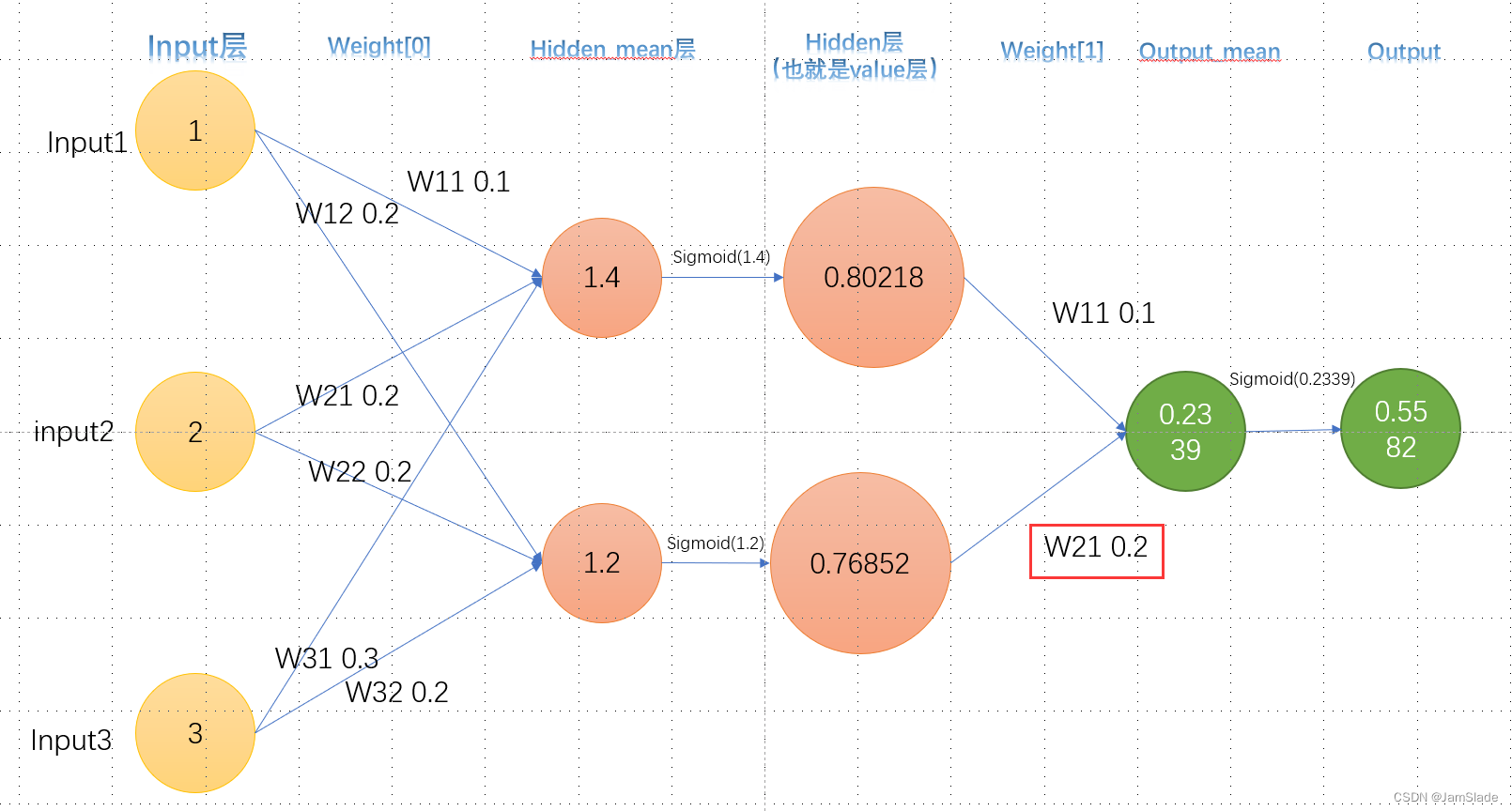
不妨叫这个红色部分的W21为
W 121 : 在 w e i g h t 1 下的第 2 个 h i d d e n 对第 1 个 o u t p u t W_{121}:在weight1下的第2个hidden对第1个output W121:在weight1下的第2个hidden对第1个output我们就是要求
∂ L o s s ∂ W 121 \frac{\partial Loss}{\partial W_{121}} ∂W121∂Loss
Loss是output(在这个图里面就是最后的0.5582)和目标输出的差距
L o s s = 1 2 ( t a r g e t − O ) 2 Loss = \frac{1}{2}( target - O)^2 Loss=21(target−O)2
根据链式求导法则我们可以展开
∂ L o s s ∂ W 121 = ∂ L o s s ∂ O ∂ O ∂ O m e a n ∂ O m e a n ∂ W 121 \frac{\partial Loss}{\partial W_{121}}=\frac{\partial Loss}{\partial O}\frac{\partial O}{\partial O_{mean}}\frac{\partial O_{mean}}{\partial W_{121}} ∂W121∂Loss=∂O∂Loss∂Omean∂O∂W121∂Omean
这里做如下解释- Loss就是上文公式,对O求导得到 ( O − t a r g e t ) (O-target) (O−target)
- O就是第五列的输出,而
O
m
e
a
n
O_{ mean}
Omean指的是第四列,实际上就是对
S
i
g
m
o
i
d
(
O
)
Sigmoid(O)
Sigmoid(O)里面对O求导
∂
S
i
g
m
o
i
d
(
O
)
∂
O
=
S
i
g
m
o
i
d
(
O
)
×
(
1
−
S
i
g
m
o
i
d
(
O
)
)
\frac{\partial Sigmoid(O)}{\partial O} = Sigmoid(O)\times(1-Sigmoid(O))
∂O∂Sigmoid(O)=Sigmoid(O)×(1−Sigmoid(O))
3. O m e a n = H 1 × W 111 + H 2 × W 121 O_{mean} = H_1\times W_{111}+H_2\times W_{121} Omean=H1×W111+H2×W121,所以对Weight求导就是H2了
对应MseLoss的导数以及下图的两个部分

这样我们把上面的式子相乘就可以求 ∂ L o s s ∂ W 121 \frac{\partial Loss}{\partial W_{121}} ∂W121∂Loss
然后我们对这一个 W 121 W_{121} W121进行相减操作
W 121 = W 121 − η ∂ L o s s ∂ W 121 W_{121} = W_{121}-\eta\frac{\partial Loss}{\partial W_{121}} W121=W121−η∂W121∂Loss
其中 η \eta η是学习速率,自己定义即可input的weight变化
接下来求 W 011 W_{011} W011
∂ L o s s ∂ W 011 = ∂ L o s s ∂ H 1 ∂ H 1 ∂ H m e a n ∂ H m e a n ∂ W 011 = ∂ L o s s ∂ O ∂ O ∂ O m e a n ∂ O m e a n ∂ H 1 ∂ H 1 ∂ H m e a n ∂ H m e a n ∂ W 011 \left.∂Loss∂W011=∂Loss∂H1∂H1∂Hmean∂Hmean∂W011=∂Loss∂O∂O∂Omean∂Omean∂H1∂H1∂Hmean∂Hmean∂W011\right. ∂W011∂Loss=∂H1∂Loss∂Hmean∂H1∂W011∂Hmean=∂O∂Loss∂Omean∂O∂H1∂Omean∂Hmean∂H1∂W011∂Hmean
对应为MseLoss的求导和下图的4个部分

从左到右分别是【可以自己求一下偏导试试】
- o u t p u t − t a g e r t output - tagert output−tagert
- S i g m o i d ( O m e a n ) × ( 1 − S i g m o i d ( O m e a n ) ) Sigmoid(O_{mean})\times(1-Sigmoid(O_{mean})) Sigmoid(Omean)×(1−Sigmoid(Omean))
- W 111 W_{111} W111
- S i g m o i d ( H m e a n ) × ( 1 − S i g m o i d ( H m e a n ) ) Sigmoid(H_{mean})\times(1-Sigmoid(H_{mean})) Sigmoid(Hmean)×(1−Sigmoid(Hmean))
- i n p u t 1 input_1 input1
output不止一种的情况
如果最终输出output不止一个,对于第二种情况来说要求的偏导会稍微麻烦一点可以参考这篇文章
一文弄懂神经网络中的反向传播法——BackPropagation
代码
double sigmoid(double x); double dSigmoid(double f); double forward(NeuralNetwork &network, double* data); void backward(NeuralNetwork &network, double output, double target); void step(NeuralNetwork &network, double learning_rate); double sigmoid(double x) { return (1/(1+exp(-x))); } double dSigmoid(double f) { return f*(1-f); } double forward(NeuralNetwork &network, double* data) { network.values.clear(); double* input = new double[14]; double* sig_hidden = new double[3]; double* sig_output = new double[1]; for(int i = 0; i < 14; i++) input[i] = data[i]; double** dp = network.weights[0]; for(int i = 0; i < 3; i++) { double ave_sum = 0.0; for(int j = 0; j < 14; j++) { ave_sum += dp[j][i] * input[j]; } sig_hidden[i] = sigmoid(ave_sum); } dp = network.weights[1]; for(int i = 0; i < 1; i++) { double ave_sum = 0.0; for(int j = 0; j < 3; j++) { ave_sum += dp[j][i] * sig_hidden[j]; } sig_output[i] = sigmoid(ave_sum); } network.values.push_back(input); network.values.push_back(sig_hidden); network.values.push_back(sig_output); return sig_output[0]; } void backward(NeuralNetwork &network, double output, double target) { network.caches.clear(); double* pEloss_pOut_pAve = new double[1]; double* pEloss_pOut_pAve_pHid_pAveHid = new double[3]; pEloss_pOut_pAve[0] = (output - target) * dSigmoid(output); double** dp = network.weights[1]; double* hid = network.values[1]; for(int i = 0; i < 3; i++) { pEloss_pOut_pAve_pHid_pAveHid[i] = pEloss_pOut_pAve[0] \ * dp[i][0] * dSigmoid(hid[i]); } network.caches.push_back(pEloss_pOut_pAve); network.caches.push_back(pEloss_pOut_pAve_pHid_pAveHid); } void step(NeuralNetwork &network, double learning_rate) { for(int i = 0; i < 3; i++) network.weights[1][i][0] -= learning_rate * network.caches[0][0] * network.values[1][i]; for(int i = 0; i < 13; i++) for(int j = 0; j < 3; j++) network.weights[0][i][j] -= learning_rate * network.caches[1][j] * network.values[0][i]; for(int i = 13; i < 14; i++) for(int j = 0; j < 3; j++) network.weights[0][i][j] += learning_rate * network.caches[1][j] * network.values[0][i]; // 需要的是针对第13项(偏置项)需要特殊处理一下,把-=变成+= // 如果不改的话其实单纯调参(修改learning rate)也是可行的 return; }- 1
- 2
- 3
- 4
- 5
- 6
- 7
- 8
- 9
- 10
- 11
- 12
- 13
- 14
- 15
- 16
- 17
- 18
- 19
- 20
- 21
- 22
- 23
- 24
- 25
- 26
- 27
- 28
- 29
- 30
- 31
- 32
- 33
- 34
- 35
- 36
- 37
- 38
- 39
- 40
- 41
- 42
- 43
- 44
- 45
- 46
- 47
- 48
- 49
- 50
- 51
- 52
- 53
- 54
- 55
- 56
- 57
- 58
- 59
- 60
- 61
- 62
- 63
- 64
- 65
- 66
- 67
- 68
- 69
- 70
- 71
- 72
- 73
- 74
- 75
- 76
- 77
- 78
- 79
- 80
- 81
- 82
- 83
- 84
- 85
- 86
- 87
- 88
细节修改版
#includeusing namespace std; struct NeuralNetwork { vector<double*> values, caches; vector<double**> weights; }; double sigmoid(double x); double dSigmoid(double f); double forward(NeuralNetwork &network, double* data); void backward(NeuralNetwork &network, double output, double target); void step(NeuralNetwork &network, double learning_rate); double sigmoid(double x) { return (1 /(1 + exp(-x))); } double dSigmoid(double f) { return f*(1-f); } double forward(NeuralNetwork &network, double* data) { network.values.clear(); double* input = new double[14]; double* sig_hidden = new double[3]; double* sig_out = new double[1]; for(int i = 0; i < 14; i++) input[i] = data[i]; double** dp = network.weights[0]; for(int j = 0; j < 3; j++) { double SUM = 0.0; for(int i = 0; i < 14; i++) { SUM += dp[i][j] * data[i]; } sig_hidden[j] = sigmoid(SUM); } dp = network.weights[1]; for(int j = 0; j < 1; j++) { double SUM = 0.0; for(int i = 0; i < 3; i++) { SUM += dp[i][j] * sig_hidden[i]; } sig_out[0] = sigmoid(SUM); } network.values.push_back(input); network.values.push_back(sig_hidden); network.values.push_back(sig_out); return network.values[2][0]; } void backward(NeuralNetwork &network, double output, double target) { network.caches.clear(); double* temp1 = new double[1]; double* temp2 = new double[1]; double* temp3 = new double[3]; double* temp4 = new double[3]; double* temp5 = new double[14]; double* temp__ = new double[3]; // 第一步,获得mseLoss对 output的求导 temp1[1] = network.values[2][0] - target; // 第二,获取sig_output的导数 temp2[1] = dSigmoid(network.values[2][0]); //第三,获取sig_output对三个sig_hidden对应的权的求导 for(int i = 0; i < 3; i++) { temp3[i] = network.values[1][i]; //也就是sig_hidden } //插入一步 获取权 for(int i = 0; i < 3; i++) { temp__[i] = network.weights[1][i][0]; //也就是sig_hidden } //第四 获取sig_hidden的导数 for(int i = 0; i < 3; i++) { temp4[i] = dSigmoid(network.values[1][i]); //也就是sig_hidden } //第五 获取sig_hidden对input对应的权的导数 for(int i = 0; i < 14; i++) { temp5[i] = network.values[0][i]; //也就是input } network.caches.push_back(temp1); network.caches.push_back(temp2); network.caches.push_back(temp__); network.caches.push_back(temp3); network.caches.push_back(temp4); network.caches.push_back(temp5); } void step(NeuralNetwork &network, double learning_rate) { double** a = network.weights[1]; for(int i = 0; i < 3; i++) { for(int j = 0; j < 1; j++) { a[i][j] -= learning_rate * network.caches[0][j]\ * network.caches[1][j] * network.caches[2][i]; } } a = network.weights[0]; for(int k = 0; k < 14; k++) for(int i = 0; i < 3; i++) { for(int j = 0; j < 1; j++) { a[k][i] -= learning_rate * network.caches[0][j]\ * network.caches[1][j] * network.caches[3][i]\ * network.caches[4][i] * network.caches[5][k]; } } return; } - 1
- 2
- 3
- 4
- 5
- 6
- 7
- 8
- 9
- 10
- 11
- 12
- 13
- 14
- 15
- 16
- 17
- 18
- 19
- 20
- 21
- 22
- 23
- 24
- 25
- 26
- 27
- 28
- 29
- 30
- 31
- 32
- 33
- 34
- 35
- 36
- 37
- 38
- 39
- 40
- 41
- 42
- 43
- 44
- 45
- 46
- 47
- 48
- 49
- 50
- 51
- 52
- 53
- 54
- 55
- 56
- 57
- 58
- 59
- 60
- 61
- 62
- 63
- 64
- 65
- 66
- 67
- 68
- 69
- 70
- 71
- 72
- 73
- 74
- 75
- 76
- 77
- 78
- 79
- 80
- 81
- 82
- 83
- 84
- 85
- 86
- 87
- 88
- 89
- 90
- 91
- 92
- 93
- 94
- 95
- 96
- 97
- 98
- 99
- 100
- 101
- 102
- 103
- 104
- 105
- 106
- 107
- 108
- 109
- 110
- 111
- 112
- 113
- 114
- 115
- 116
- 117
- 118
- 119
- 120
- 121
- 122
- 123
- 124
- 125
- 126
- 127
- 128
- 129
- 130
- 131
- 132
- 133
- 134
- 135
- 136
- 137
- 138
- 139
- 140
- 141
- 142
J.迷宫寻宝

#includeusing namespace std; const int maxn = 21; const int epics = 50000; const int target_success = 5000; const double inf = 1e8; bool cmp(pair<int,double> X, pair<int,double> Y) { if(X.second == Y.second) return X.first < Y.first; return X.second > Y.second; } // 迷宫尺寸 n*m // x,y坐标从1开始 起点(1,1) 终点(n,m) // 对于每个位置(i,j),可以向U,L,R,D四个方向移动,不可走出迷宫边界,不可走到障碍物上 int n,m; // maze[maxn+5][maxn+5]存储迷宫 0代表可走通 1代表陷阱 (maze[i][j], 1<=i<=n,1<=j<=m) // 答案保证有解 即 maze[1][1] = 0, maze[n][m] = 0, 起点与终点之间保证至少存在一条路径 int maze[maxn+5][maxn+5]; // 奖励函数R 设置普通格子奖励为-(abs(i-n)+abs(j-m)) 陷阱奖励为-10000 终点奖励为100000 衰减因子alpha = 0.9 , gama = 0.9 const double alpha = 0.9; const double gama = 0.9; double Reward[maxn+5][maxn+5]; // 状态函数Q 下一步的选取采用1-ϵ贪心 // 关于Qstate[pos]中的pos索引到二维坐标(px,py)的转换: // px = (pos - 1) / m + 1 // py = (pos - (px-1) * m) % (m+1); const double greedy_factor = 0.1; vector< pair<int,double> > Qstate[(maxn+5)*(maxn+5)]; // 存储答案 vector< pair<int,int> > ans; // 初始化奖励函数R和状态函数Q void init_RQ(int i,int j) { // 陷阱不设置奖励函数(可理解成均为-inf) if (maze[i][j] == 1) return; // Up if (Reward[i-1][j]) { Qstate[(i-1)*m+j].push_back({(i-2)*m+j,-1}); } // Left if (Reward[i][j-1]) { Qstate[(i-1)*m+j].push_back({(i-1)*m+j-1,-1}); } // Right if (Reward[i][j+1]) { Qstate[(i-1)*m+j].push_back({(i-1)*m+j+1,-1}); } // Down if (Reward[i+1][j]) { Qstate[(i-1)*m+j].push_back({i*m+j,-1}); } } int success_time = 0; bool isEnd(int i,int j) { if (i == n && j == m) { ++success_time; return true; } if (maze[i][j] == 1) { return true; } return false; } void Qlearning() { int nx = 1 + rand() % n, ny = 1 + rand() % m; int cnt = 0; while (!isEnd(nx,ny) && cnt < n*m) { auto &s0 = Qstate[(nx-1)*m+ny]; int siz = s0.size(); int _next = -1,idx = 0; if (!siz) return; if (siz == 1) _next = s0[0].first; else { sort(s0.begin(),s0.end(),cmp); double p = rand() / double(RAND_MAX); if (p < 1 - greedy_factor) { _next = s0[0].first; } else { idx = 1 + rand() % (siz - 1); _next = s0[idx].first; } } auto &s1 = Qstate[_next]; sort(s1.begin(),s1.end(),cmp); double _nextMax = (int)s1.size() ? s1[0].second : 0.0; nx = (_next - 1) / m + 1;ny = (_next - (nx-1) * m) % (m+1); /********/ // TODO // HINTS: 使用s0[idx].second、alpha、gama、_nextMax、Reward[nx][ny]变量, // 完成Qlearning的状态更新公式 // 你的代码将被嵌在此处 /********/ cnt++; } } int main() { ios::sync_with_stdio(false); srand(2022); cin >> n >> m; for(int i = 1; i <= n; i++) { for(int j = 1; j <= m; j++) { int t; cin >> t; maze[i][j] = t; Reward[i][j] = (t == 0 ? -(abs(i-n)+abs(j-m)) : -10000.0); } } Reward[n][m] = 100000.0; for(int i = 1; i <= n; i++) { for(int j = 1; j <= m; j++) { init_RQ(i,j); } } int cnt = 0; while (cnt < epics && success_time != target_success) { Qlearning(); ++cnt; } cnt = 0; int x = 1, y = 1; while ((x!=n || y!=m) && cnt < n*m) { auto &s = Qstate[(x-1)*m+y]; if (!(int)s.size()) { // 无解情况,可忽略 cout << "Something Wrong!" << endl; return 0; } ans.push_back({x,y}); sort(s.begin(),s.end(),cmp); int _next = s[0].first; x = (_next - 1) / m + 1; y = (_next - (x-1) * m) % (m+1); ++cnt; } ans.push_back({n,m}); cout << (int)ans.size() << endl; for(auto& u : ans) { cout << u.first << ' ' << u.second << endl; } return 0; } - 1
- 2
- 3
- 4
- 5
- 6
- 7
- 8
- 9
- 10
- 11
- 12
- 13
- 14
- 15
- 16
- 17
- 18
- 19
- 20
- 21
- 22
- 23
- 24
- 25
- 26
- 27
- 28
- 29
- 30
- 31
- 32
- 33
- 34
- 35
- 36
- 37
- 38
- 39
- 40
- 41
- 42
- 43
- 44
- 45
- 46
- 47
- 48
- 49
- 50
- 51
- 52
- 53
- 54
- 55
- 56
- 57
- 58
- 59
- 60
- 61
- 62
- 63
- 64
- 65
- 66
- 67
- 68
- 69
- 70
- 71
- 72
- 73
- 74
- 75
- 76
- 77
- 78
- 79
- 80
- 81
- 82
- 83
- 84
- 85
- 86
- 87
- 88
- 89
- 90
- 91
- 92
- 93
- 94
- 95
- 96
- 97
- 98
- 99
- 100
- 101
- 102
- 103
- 104
- 105
- 106
- 107
- 108
- 109
- 110
- 111
- 112
- 113
- 114
- 115
- 116
- 117
- 118
- 119
- 120
- 121
- 122
- 123
- 124
- 125
- 126
- 127
- 128
- 129
- 130
- 131
- 132
- 133
- 134
- 135
- 136
- 137
- 138
- 139
- 140
- 141
- 142
- 143
- 144
- 145
- 146
- 147
- 148
- 149
- 150
- 151
- 152
- 153
- 154
- 155
- 156
- 157
- 158
- 159
- 160
- 161
- 162
- 163
- 164
- 165
- 166
- 167
- 168
- 169
思路
搞清楚每个部分干啥套公式即可
代码
double former = (1 - alpha) * s0[idx].second; double later = alpha * (Reward[nx][ny] + gama * _nextMax); s0[idx].second = former + later;- 1
- 2
- 3
-
相关阅读:
硬盘文件系统系列之FAT
源码规则引擎(Jvs-rules):10月新增功能介绍
【JAVA】-----面向对象知识点2
面试官:请说说flex布局_番茄出品.md
TK域名注册介绍
速盾:使用 CDN 可以隐藏 IP 吗?该怎样应对防御?
MySQL:order by排序查询,group by分组查询
java---贪心---货仓选址(每日一道算法2022.11.5)
七、文件包含漏洞
springboot基于web的在线问答社区系统设计与实现毕业设计源码061628
- 原文地址:https://blog.csdn.net/JamSlade/article/details/126698596