-
SQL面试题之区间合并问题
目录
0 需求
给定多个时间段,每个时间段分为开始时间、结束时间,将相互重叠的多个时间段合并为一个区间
- --数据:id、开始时间、结束时间
- 1 12 15
- 2 57 58
- 3 29 32
- 4 30 31
- 5 17 19
- 6 44 44
- 7 56 57
- 8 16 18
合并后结果如下;
- --结果
- flag start_time end_time
- 1 12 15
- 2 16 19
- 3 29 32
- 4 44 44
- 5 56 58
1 数据准备
- create table test02 as
- select 1 as id, 12 as start_time, 15 as end_time
- union all
- select 2 as id, 57 as start_time, 58 as end_time
- union all
- select 3 as id, 29 as start_time, 32 as end_time
- union all
- select 4 as id, 30 as start_time, 31 as end_time
- union all
- select 5 as id, 17 as start_time, 19 as end_time
- union all
- select 6 as id, 44 as start_time, 44 as end_time
- union all
- select 7 as id, 56 as start_time, 57 as end_time
- union all
- select 8 as id, 16 as start_time, 18 as end_time
2 数据分析
解题要点:如何判断哪些区间是要合并的?
其实换个角度就是哪些区间是交叉的,哪些是重复的?
判断思路:如果将起始时间,和结束时间进行排序,当前行的起始时间小于等于上一行的结束时间,那么日期就存在交叉,存在重复的数据。根据该条件我们可以设置断点,然后用经典的思路sum() over()来获取分组id,问题便得到解决。
第一步:按照起始时间和结束时间进行降序排序,获取上一行的结束时间,目的是为了比较
- select id,
- start_time,
- end_time,
- lag(end_time, 1, end_time) over (order by start_time asc, end_time asc) as lga_end_time
- from test02

第二步:根据lag_end_time进行判断,当当前行的start_time <= lag_end_time时候设置标记值0,否则为1(经典的按条件变化后的分组思路,这里一定是满足条件的时候置为0,不满足条件的时候置为1)
- select id
- , start_time
- , end_time
- , case when start_time <= lga_end_time then 0 else 1 end as flg --条件成立的时候为0,不成立的时候为1
- from (select id,
- start_time,
- end_time,
- lag(end_time, 1, end_time) over (order by start_time asc, end_time asc) as lga_end_time
- from test02

第三步:按照sum() over()的方法获取分组id
- select id
- , start_time
- , end_time
- , sum(flg) over (order by start_time, end_time ) as grp_id
- from (select id
- , start_time
- , end_time
- , case when start_time <= lga_end_time then 0 else 1 end as flg --条件成立的时候为0,不成立的时候为1
- from (select id,
- start_time,
- end_time,
- lag(end_time, 1, end_time) over (order by start_time asc, end_time asc) as lga_end_time
- from test02
- ) t
- ) t
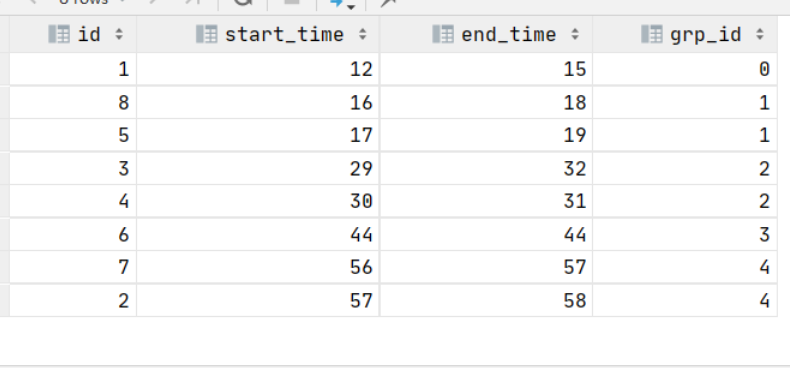
第四步:在分组里获取,最小值及最大值,最小值即为起始点,最大值即为结束点,分组id即为id
最终的SQL如下:
- select grp_id + 1 as id
- , min(start_time) as start_time
- , max(end_time) as end_time
- from (
- select id
- , start_time
- , end_time
- , sum(flg) over (order by start_time, end_time ) as grp_id
- from (select id
- , start_time
- , end_time
- , case when start_time <= lga_end_time then 0 else 1 end as flg --条件成立的时候为0,不成立的时候为1
- from (select id,
- start_time,
- end_time,
- lag(end_time, 1, end_time) over (order by start_time asc, end_time asc) as lga_end_time
- from test02
- ) t
- ) t
- ) t
- group by grp_id

2 小结
本题为区间合并问题,问题比较经典,判断的核心思路是构造条件:
当前行的起始时间<=上一行的结束时间(按照起始时间和结束时间降序排序)。
然后利用经典的分组思路,在一个分组中求最小、最大值即为所求。
-
相关阅读:
RHCSA-VM-Linux安装虚拟机后的基础命令
二十一、操作系统设计(POSIX;Windows API;Micro/Exo/Unikernel)
Vue08 事件的基本使用
数据库的备份和恢复
5G及其后的5G非地面网络:趋势和研究挑战-HARQ部分
被vector动态扩容给坑了!
(附源码)计算机毕业设计SSM基于的扶贫产品展销平台
又拍云 Redis 的改进之路
架构基本概念和架构本质
基于Java微信小程序火锅店点餐系统设计和实现(源码+LW+调试文档+讲解等)
- 原文地址:https://blog.csdn.net/godlovedaniel/article/details/126662876