-
【Linux基础】进程(三)
9. 地址空间
9.1 程序地址空间
- C/C++的程序地址空间

-
修改了值,但是地址却是一样的
#include#include #include int g_val = 100; int main() { pid_t id = fork(); if (id == 0) { int cnt = 5; //child while (cnt--) { printf("I am child, times: %d, g_val = %d, &g_val = %p\n", cnt, g_val, &g_val); sleep(1); if (cnt == 3) { printf("############child change val##############\n"); g_val = 200; printf("##################done####################\n"); } } } else { while (true) { printf("I am parent, g_val = %d, &g_val = %p\n", g_val, &g_val); sleep(1); } } return 0; } - 1
- 2
- 3
- 4
- 5
- 6
- 7
- 8
- 9
- 10
- 11
- 12
- 13
- 14
- 15
- 16
- 17
- 18
- 19
- 20
- 21
- 22
- 23
- 24
- 25
- 26
- 27
- 28
- 29
- 30
- 31
- 32
- 33
- 34
- 35
- 36

子进程修改变量后,父进程打印出来的变量值没变,但两个不同值的变量的地址居然是一样的
如果存储的是真正的物理地址,这种现象不可能发生
程序使用的地址是虚拟地址,而不是实际的物理地址,存放在进程的 struct mm_struct,称为进程地址空间
9.2 进程地址空间
让进程能够以统一的视角看待内存
地址空间本质是内核中的一种数据类型
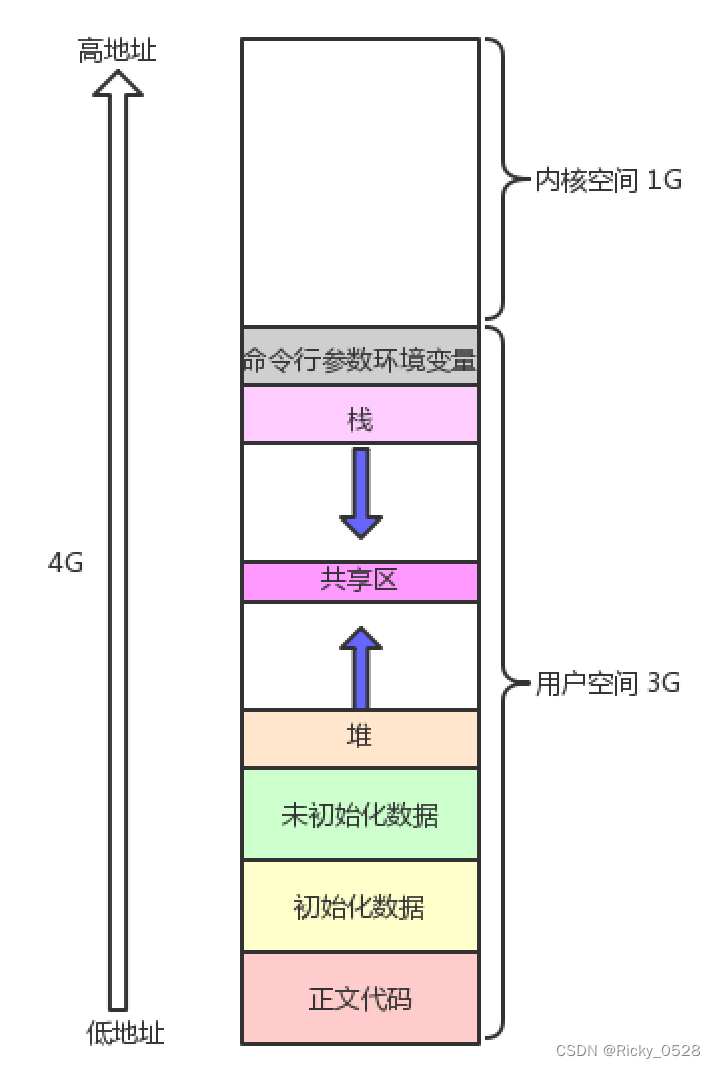
struct mm_struct { // 进程地址空间 },32为机器下大小为4G每个进程都认为地址空间的划分是按照4G空间划分的,即每个进程都认为自己拥有4GB
地址空间上进行区域划分时,对应的先行位置称为虚拟地址
页表 + MMU:MMU通过查页表将虚拟地址转化为物理地址
const char* str = "hello world"*str = 'H'❌定义在字符常量区的变量无法被修改,本质是因为OS给你的权限只有 r 权限
为什么要有地址空间
-
通过添加一层软件层,完成有效的对进程操作内存进行风险管理(权限管理),本质目的是为了保护物理内存及各个进程的数据安全
-
将内存申请和内存使用的概念在时间上划分清除,通过虚拟地址空间来屏蔽底层申请内存的过程,达到进程读写内存和OS进行内存管理操作,进行软件上面的分离
-
站在CPU应用层的角度,进程可以看作统一使用4GB空间,而且每个空间区域的相对位置是比较确定的
OS这样设计的目的是为了达到一个目标:每个进程都认为自己是独占系统资源的(进程具有独立性)
解释了这种现象的原因


- 在未改变
g_val的前,两个页表都指向同一块物理内存,父进程g_val - 但当改变了之后就发生了写时拷贝,在物理内存重写开辟了一块地方,子进程页表指向了子进程
g_val - 但虚拟地址并没有发生改变
子进程的创建时以父进程为模板的,父子进程一般的代码是共享的
#includeint main() { char *p = "hello"; char *q = "hello"; printf("%p\n%p\n", p, q); // 两块地址是一样的 return 0; } - 1
- 2
- 3
- 4
- 5
- 6
- 7
- 8
- 9
- 10
- 11
所以,所有的只读数据一般就只有一份,因为操作系统维护一份的成本是最低的
9.3 地址空间的划分
10. 进程控制
10.1 进程创建fork()
fork函数初始
进程调用fork,当控制转移到内核中的fork代码后,内核做:
- 分配新的内存块和内核数据结构给子进程
- 将父进程部分数据结构内容拷贝至子进程
- 添加子进程到系统进程列表当中
- fork返回,开始调度器调度

注意,fork之后会从fork的下一条语句开始执行,之前的并不会被执行
所以,fork之前父进程独立执行,fork之后父子两个执行流分别执行。而且,fork之后,谁先执行完全由调度器决定
写时拷贝
通常,父子代码共享,父子在不写入时,数据也是共享的,当任意一方试图写入,便以写时拷贝的方式复制一份副本

当进程试图写入时,系统会发生缺页中断,子进程会被暂停,进行写时拷贝
10.2 进程终止
进程退出场景
- 代码运行完毕,结果正确
- 代码运行完毕,结果不正确
- 代码异常终止
进程常见退出方法
正常终止(可以通过
echo $?查看进程退出码)- 从main函数返回(main函数的返回值是进程的退出码,0:结果正确、!0:结果不正确)
- 从main函数return代表进程退出
- 非main函数return代表函数返回
- 调用
stdlib.h下的void exit(int status)- 在任何地方调用都代表终止进程,参数为退出码status
- 使用
unistd.h下的void _exit(int status)- 之前提到printf不带’\n’打印的数据就会被暂时保存在输出缓冲区中,exit和main return本身就会要求系统进行缓冲区刷新
- 而_exit为强制终止进程,不会进行进程后续的收尾工作,比如刷新用户缓冲区

C语言中将错误码转换为字符串描述的函数为
string.h下的strerror
异常退出
- 程序崩溃(除零错)
- Ctrl + C:信号终止
异常退出下,程序的退出码变得没有意义了
进程退出,在系统层面少了一个进程:free PCB,free mm_struct,free 页表和各种映射关系,代码 + 数据,申请的空间也要释放掉
10.3 进程等待
让父进程fork之后,需要通过wait/waitpid等待子进程退出
让父进程等待的原因:
- 通过获取子进程退出的信息,能够得知子进程的执行结果
- 可以保证时序问题,子进程先退出,父进程后退出
- 进程退出的时候会先进入僵尸状态,会造成内存泄露的问题,因此需要通过父进程wait释放该子进程占用的资源
- 另外进程一旦变成僵尸状态,那就刀枪不入,kill -9 也无能为力,因为谁也没有办法杀死一个已经死去的进程
wait方法头文件:
#include和#includepid_t wait(int *status);返回值:
- 成功返回被等待进程pid,失败返回-1。
参数:
- 输出型参数,获取子进程退出状态,不关心则可以设置成为NULL
#include#include #include #include #include int main() { pid_t id = fork(); if (id == 0) { // 子进程 int cnt = 5; while (cnt) { printf("child[%d] is running, cnt is: %d\n", getpid(), cnt); cnt--; sleep(1); } exit(0); } sleep(10); printf("father begin wait\n"); // 父进程 pid_t ret = wait(NULL); if (ret > 0) { printf("father wait: %d, success\n", ret); } else { printf("father wait failed\n"); } sleep(10); return 0; } - 1
- 2
- 3
- 4
- 5
- 6
- 7
- 8
- 9
- 10
- 11
- 12
- 13
- 14
- 15
- 16
- 17
- 18
- 19
- 20
- 21
- 22
- 23
- 24
- 25
- 26
- 27
- 28
- 29
- 30
- 31
- 32
- 33
- 34
- 35
- 36
- 37
- 38

父进程在开始等待之前一共睡眠10s,前5s子进程执行,后5s子进程退出,但父进程没有开始等待,因而子进程进入了僵尸状态,当父进程开始等待之后,子进程就被回收,回收之后父进程又睡眠10s,故只剩一共进程在运行,知道10s后进程全部结束运行
waitpid方法头文件:
#include和#includepid_t waitpid(pid_t pid, int *status, int options);返回值:
-
当正常返回的时候waitpid返回收集到的子进程的进程ID
-
如果设置了选项WNOHANG,而调用中waitpid发现没有已退出的子进程可收集,则返回0
-
如果调用中出错,则返回 -1,这时errno会被设置成相应的值以指示错误所在
参数:
-
pid
-
pid= -1,等待任意一个子进程,与wait等效
-
pid> 0,等待进程ID与pid值相等的子进程
-
-
status(为一个输出型参数,与子进程如何退出的有关,让父进程得到子进程的执行结果)

- 一共是32个比特位,但只使用低16个比特位
- 如果传递NULL,表示不关心子进程的退出状态信息
- 代码正常退出下的退出码就是这里的退出状态
- 代码异常终止,其本质是这个进程因为异常问题,导致自己收到了某种信号,就是这里的终止信号
- core dump暂不关心
- WIFEXITED(status):判断进程是否正常退出
- WEXITSTATUS(status):提取出进程的退出码
-
options
-
0:默认行为,阻塞等待,即一定等到子进程退出才会返回,否则会一直停在这里
阻塞的本质:进程的PCB被放入了等待队列,并将进程的状态改为S状态
返回的本质:进程的PCB从等待队列拿到R队列,从而被CPU调度
-
WNOHANG:设置等待方式为非阻塞,可能需要多次检测——基于非阻塞等待的轮询方案
- 使用WNOHANG需要注意有一种情况是子进程根本还没退出,需要特殊处理一下
看到某些应用或者OS本身卡住了长时间不动,称做应用或程序hang住了
-
示例1——获取退出状态和终止信号:
#include#include #include #include #include int main() { pid_t id = fork(); if (id == 0) { // 子进程 int cnt = 3; while (cnt) { printf("child[%d] is running, cnt is: %d\n", getpid(), cnt); cnt--; sleep(1); } exit(11); } printf("father begin wait\n"); // 父进程 int status = 0; pid_t ret = waitpid(id, &status, 0); if (ret > 0) printf("father wait: %d, success, status exit code: %d, status terminate signal: %d\n", ret, (status >> 8) & 0xff, status & 0x7f); // 获取退出状态和终止信号 else printf("father wait failed\n"); return 0; } - 1
- 2
- 3
- 4
- 5
- 6
- 7
- 8
- 9
- 10
- 11
- 12
- 13
- 14
- 15
- 16
- 17
- 18
- 19
- 20
- 21
- 22
- 23
- 24
- 25
- 26
- 27
- 28
- 29
- 30
- 31
- 32
- 33
-
正常退出的情况

-
异常退出的情况

获取退出码的简洁方式:
int status = 0; pid_t ret = waitpid(id, &status, 0); if (WIFEXITED(status)) // 没有收到任何终止信号 // 即正常结束的,获取对应的退出码 printf("exit code: %d\n", WEXITSTATUS(status)); else printf("error, got a terminate signal\n");- 1
- 2
- 3
- 4
- 5
- 6
- 7
补充:bash是命令行启动的所有进程的父进程,而且bash一定是通过wait方式得到子进程的退出结果,所以用
echo $?能够查到子进程的退出码实例2——非阻塞等待:
#include#include #include #include #include int main() { pid_t id = fork(); if (id == 0) { int cnt = 5; while (cnt) { printf("child[%d] is running, cnt: %d\n", getpid(), cnt); cnt--; sleep(1); } exit(0); } int status = 0; while (1) //轮询等待 { pid_t ret = waitpid(id, &status, WNOHANG); if (ret == 0) // 子进程没有退出,但是waitpid是成功的,需要父进程重复进行等待 printf("Do father's things\n"); else if (ret) { // 子进程退出了,waitpid也成功了,获取到了对应的结果 printf("fahter wait: %d, success, status exit code: %d, status terminate signal: %d\n", ret, (status >> 8) & 0xff, status & 0x7f); break; } else { // 等待失败 perror("waitpid"); break; } sleep(1); } return 0; } - 1
- 2
- 3
- 4
- 5
- 6
- 7
- 8
- 9
- 10
- 11
- 12
- 13
- 14
- 15
- 16
- 17
- 18
- 19
- 20
- 21
- 22
- 23
- 24
- 25
- 26
- 27
- 28
- 29
- 30
- 31
- 32
- 33
- 34
- 35
- 36
- 37
- 38
- 39
- 40
- 41
- 42
- 43
- 44
- 45

10.4 进程程序替换
目前创建子进程的目的是让子进程执行父进程代码的一部分,但如果需要子进程执行一个全新的程序,则使用进程程序替换
进程程序替换:进程不变,仅仅替换当前进程的代码和数据的技术
程序替换的本质就是把程序的进程代码+数据加载到特定的进程上下文中
C/C++程序要运行,必须先加载到内存中
如何加载:使用加载器(exec*)加载
进程程序替换会更改代码区的代码,也要发生写时拷贝
只要进程的程序替换成功,就不会执行后续代码,意味着exec*函数执行成功的时候,不需要返回值检测
只要exec*函数返回了,就一定是因为调用失败了
exec*函数命名理解
- l(list):表示参数采用列表
- v(vector):表示参数用数组
- p(path):表示自动搜索环境变量PATH
- e(env):表示自己维护环境变量
execl方法int execl(const char *path, const char *arg, ...);path:要执行的目标程序的全路径,即 所在路径/文件名
…:可变参数列表
arg, …:要执行的目标程序在命令行上怎么执行,这里的参数就怎么一个一个的传递进去,必须以NULL作为参数传递的结束
#include#include #include int main() { pid_t id = fork(); if (id == 0) { // child printf("I am child, pid: %d\n", getpid()); sleep(5); execl("/usr/bin/ls", "ls", "-a", "-l", NULL); printf("hahahahaha\n"); printf("hahahahaha\n"); printf("hahahahaha\n"); printf("hahahahaha\n"); printf("hahahahaha\n"); printf("hahahahaha\n"); printf("hahahahaha\n"); printf("hahahahaha\n"); printf("hahahahaha\n"); printf("hahahahaha\n"); exit(0); } while (1) { printf("I am father\n"); sleep(1); } return 0; } - 1
- 2
- 3
- 4
- 5
- 6
- 7
- 8
- 9
- 10
- 11
- 12
- 13
- 14
- 15
- 16
- 17
- 18
- 19
- 20
- 21
- 22
- 23
- 24
- 25
- 26
- 27
- 28
- 29
- 30
- 31
- 32
- 33
- 34
- 35
execv方法int execv(const char *path, char *const argv[]);就是将execl的参数列表放到了一个数组里,其余都一样
char* argv[] = { "ls", "-a", "-l", NULL }; execv("/usr/bin/ls", argv);- 1
- 2
- 3
- 4
- 5
- 6
- 7
execlp方法int execlp(const char *file, const char *arg, ...);第一个参数可能会和第二个参数一样,但这两个参数的含义完全不一样
- 第一个参数表示你要执行谁,即你要执行的文件名
- 第二个参数表示如何执行它
execlp("ls", "ls", "-a", "-l", NULL);- 1
execle方法int execle(const char *path, const char *arg, ..., char * const envp[]);model.c
#include#include #include #include #include int main() { if (fork() == 0) { // child // exec* char *envs[] = { "MYENV1=env test", "MYENV2=haha", "MYENV3=xixi", NULL }; execle("./myexe", "myexe", NULL, envs); exit(1); } // parent waitpid(-1, NULL, 0); printf("wait success\n"); return 0; } - 1
- 2
- 3
- 4
- 5
- 6
- 7
- 8
- 9
- 10
- 11
- 12
- 13
- 14
- 15
- 16
- 17
- 18
- 19
- 20
- 21
- 22
- 23
- 24
- 25
- 26
- 27
- 28
- 29
- 30
myexe.c
#includeint main() { printf("this new process is printing envs\n"); extern char** environ; for (int i = 0; environ[i]; i++) printf("%s\n", environ[i]); return 0; } - 1
- 2
- 3
- 4
- 5
- 6
- 7
- 8
- 9
- 10
- 11

execve方法(系统调用)int execvpe(const char *file, char *const argv[], char *const envp[]);model.c
#include#include #include #include #include int main() { if (fork() == 0) { // child // exec* char* argv[] = { "myexe", NULL }; char *envs[] = { "MYENV1=env test", "MYENV2=haha", "MYENV3=xixi", NULL }; execle("./myexe", argv, envs); exit(1); } // parent waitpid(-1, NULL, 0); printf("wait success\n"); return 0; } - 1
- 2
- 3
- 4
- 5
- 6
- 7
- 8
- 9
- 10
- 11
- 12
- 13
- 14
- 15
- 16
- 17
- 18
- 19
- 20
- 21
- 22
- 23
- 24
- 25
- 26
- 27
- 28
- 29
- 30
- 31
- 32
- 33
- 34
myexe.c
#includeint main() { printf("this new process is printing envs\n"); extern char** environ; for (int i = 0; environ[i]; i++) printf("%s\n", environ[i]); return 0; } - 1
- 2
- 3
- 4
- 5
- 6
- 7
- 8
- 9
- 10
- 11
execvp方法int execvp(const char *file, char *const argv[]);char* argv[] = { "ls", "-a", "-l", NULL }; execvp("ls", argv);- 1
- 2
- 3
- 4
- 5
- 6
- 7
execvpe方法int execvpe(const char *file, char *const argv[], char *const envp[]);总结

除了
execve为系统调用,其余的都是库函数,最终都是由execve实现的编写一个简单的shell
#include#include #include #include #include #define NUM 128 #define CMD_NUM 64 int main() { char command[NUM]; for (; ; ) { char* argv[CMD_NUM] = {NULL}; command[0] = '\0'; // C语言字符串以"\0"结尾,这样可以直接清空字符串 printf("[who@hostname dir]# "); fflush(stdout); fgets(command, NUM, stdin); command[strlen(command) - 1] = '\0'; // 清除输入带的"\n" const char* sep = " "; argv[0] = strtok(command, sep); // 将输入的字符串以空格分割 int i = 1; while (argv[i] = strtok(NULL, sep)) i++; // 检测是否是需要shell本身执行的内建命令,如cd命令,要切换的是本身的路径,而不是子进程的 if (strcmp(argv[0], "cd") == 0) { if (argv[1] != NULL) chdir(argv[1]); continue; } // 用子进程进行程序替换 if (fork() == 0) { // child execvp(argv[0], argv); exit(1); } waitpid(-1, NULL, 0); } return 0; } - 1
- 2
- 3
- 4
- 5
- 6
- 7
- 8
- 9
- 10
- 11
- 12
- 13
- 14
- 15
- 16
- 17
- 18
- 19
- 20
- 21
- 22
- 23
- 24
- 25
- 26
- 27
- 28
- 29
- 30
- 31
- 32
- 33
- 34
- 35
- 36
- 37
- 38
- 39
- 40
- 41
- 42
- 43
- 44
- 45
- 46
- 47
-
相关阅读:
vue3+ts 组合式api中(setup)如何使用getCurrentInstance,以及用它替代this
基于微信小程序奶茶店在线点单管理系统ssm框架-计算机毕业设计
【笔试强训选择题】Day38.习题(错题)解析
骨传导耳机会损伤大脑吗?一分钟详细了解骨传导耳机
阿里面试官问我Redis 数据结构,这一篇文章足以征服他
FFmpeg直播能力更新计划与新版本发布
分享一个基于Python和Django的产品销售收入数据分析系统源码
Python内置函数input()详解
QT+OSG/osgEarth编译之二十七:Pixman+Qt编译(一套代码、一套框架,跨平台编译,版本:Pixman-0.42.2)
解除百度文库VIP、语雀、知乎付费限制,原来这么简单
- 原文地址:https://blog.csdn.net/weixin_52665939/article/details/126635532
