-
Hbase 之KeyValue结构详解
源码
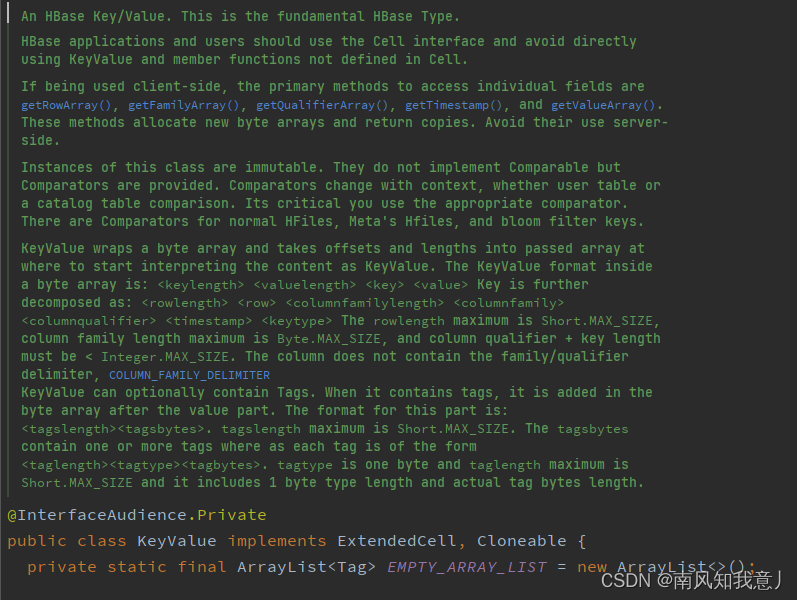
- 源码注释部分翻译
HBase 键值。这是基本的 HBase 类型。 KeyValue 包装一个字节数组,并将偏移量和长度放入传递的数组中,从哪里开始将内容解释为 KeyValue。 字节数组中的 KeyValue 格式为: <keylength> <valuelength> <key> <value> Key 进一步分解为: <rowlength> <row> <columnfamilylength> <columnfamily> <columnqualifier> <timestamp> <keytype> 行长最大值为 Short.MAX_SIZE, 列族长度最大值为 Byte.MAX_SIZE, 列限定符 + 键长度必须 < Integer.MAX_SIZE。 该列不包含 familyqualifier 分隔符 COLUMN_FAMILY_DELIMITER- 1
- 2
- 3
- 4
- 5
- 6
- 7
- 8
- 9
KeyValue结构

- 在KeyValue中,其中的KeyLength为4B:
- ValueLength标识Value在字节数组中所占的长度,为4B:
- Row Length:存储rowkey的长度,为2B
- TimeStamp是Long型,肯定就是占8B:
- KeyType为1B:
从ColumnQualifier开始内容前面不在带有长度了。TimeStamp和KeyType因为所占的长度是固定的,所以不用包含长度信息。而Qualifier的长度信息,则用以下的方式可以得出:
new Ordering[(ImmutableBytesWritable, KeyValue)] { override def compare(x: (ImmutableBytesWritable, KeyValue), y: (ImmutableBytesWritable, KeyValue)): Int = { x._2.getFamilyLength() x._2.getQualifierLength } }- 1
- 2
- 3
- 4
- 5
- 6
KeyValue的实现
在Hbase中,所有数据都是以Byte的形式存在的。在KeyValue中,使用的是byte数组来存储实际内容。
// KeyValue core instance fields. private byte [] bytes = null; // an immutable byte array that contains the KV private int offset = 0; // offset into bytes buffer KV starts at private int length = 0; // length of the KV starting from offset.- 1
- 2
- 3
- 4
其中,bytes数组用来存储KeyValue中的实际内容,
offset表示KeyValue在数组bytes中的起始位置,length则是KeyValue在数组bytes中自起始位置offset后的长度。KeyValue提供了一系列的Offset方法在数组中定位各个字段的的起始位置,如getValueOffset,getRowOffset等。也提供了一系列的length方法来获取KeyValue中各个字段的大小。
操作KeyValue
把keyValue 数据取出放到Map里
Map<String, Object> stringMap = new HashMap<>(); stringMap.put("row", Bytes.toStringBinary(getRowArray(), getRowOffset(), getRowLength())); stringMap.put("family",Bytes.toStringBinary(getFamilyArray(), getFamilyOffset(), getFamilyLength())); stringMap.put("qualifier",Bytes.toStringBinary(getQualifierArray(), getQualifierOffset(), getQualifierLength())); stringMap.put("timestamp", getTimestamp()); stringMap.put("vlen", getValueLength()); Iterator<Tag> tags = getTags(); if (tags != null) { List<String> tagsString = new ArrayList<String>(); while (tags.hasNext()) { tagsString.add(tags.next().toString()); } stringMap.put("tag", tagsString); }- 1
- 2
- 3
- 4
- 5
- 6
- 7
- 8
- 9
- 10
- 11
- 12
- 13
- 14
-
相关阅读:
elasticsearch 8.X新特性
diff算法原理解析
steam搬砖项目,csgo游戏搬砖熟练操作后,可以月入过万~
JNI 使用案例详解(一)
优盘格式化了怎么恢复里面的数据?
【活动回顾】Rust:构建新时代基础设施的首选语言 @Qcon
Cut-Off Wavelength in fiber(光纤的截止波长)
Mysql(库操作)
毕业设计 基于stm32的智能平衡小车 - 单片机 物联网嵌入式
C语⾔内存函数
- 原文地址:https://blog.csdn.net/Lzx116/article/details/126609986