-
django+django-haystack+Whoosh(后期切换引擎为Elasticsearch+ik)+Jieba+mysql
1.前提准备
环境介绍
-
haystack是django的开源搜索框架,该框架支持Solr, Elasticsearch, Whoosh, *Xapian*搜索引擎,不用更改代码,直接切换引擎,减少代码量。
-
搜索引擎使用Whoosh,这是一个由纯Python实现的全文搜索引擎,没有二进制文件等,比较小巧,配置比较简单,当然性能自然略低。whoosh和xapian的性能差距还是比较明显。索引和搜索的速度有近4倍的差距,在full cache情况下的性能差距更是达到了60倍。
-
中文分词+,由于Whoosh自带的是英文分词,对中文的分词支持不是太好,故用jieba替换whoosh的分词组件。
-
Elasticsearch:开源的搜索引擎,本文版本为7.6.0
-
其他:Python3.6.5, Django2.2
安装环境
- pip3 install django==2.2 -i https://pypi.douban.com/simple
- pip3 install whoosh -i https://pypi.douban.com/simple
- pip3 install django-haystack -i https://pypi.douban.com/simple
- pip3 install jieba -i https://pypi.douban.com/simple
- pip3 install pymysql -i https://pypi.douban.com/simple
- pip3 install elasticsearch==7.6.0 -i https://pypi.douban.com/simple/
项目结构
- - Project
- - Project
- - settings.py
- - blog
- - models.py
表结构
models.py
- from django.db import models
- class UserInfo(models.Model):
- username = models.CharField(verbose_name='用户名', max_length=225)
- def __str__(self):
- return self.username
- class Tag(models.Model):
- name = models.CharField(verbose_name='标签名称', max_length=225)
- def __str__(self):
- return self.name
- class Article(models.Model):
- title = models.CharField(verbose_name='标题', max_length=225)
- content = models.CharField(verbose_name='内容', max_length=225)
- # 外键
- username = models.ForeignKey(verbose_name='用户', to='UserInfo', on_delete=models.DO_NOTHING)
- tag = models.ForeignKey(verbose_name='标签', to='Tag', on_delete=models.DO_NOTHING)
- def __str__(self):
- return self.title
图解

本文优势
集全网的django+django-haystack+Whoosh的总结,取其精华,去其糟粕,加入了新的注解。
如果你想你的es或者Whoosh集成到django上,那你来对地方了
django+django-haystack+Whoosh+Jieba+mysql
1. setting.py配置
- # 数据库配置
- DATABASES = {
- 'default': {
- 'ENGINE': 'django.db.backends.mysql',
- 'NAME': 'dj_ha',
- 'USER': 'root',
- 'PASSWORD': 'foobared',
- 'HOST': '106.14.42.253',
- 'PORT': '11111',
- }
- }
- # app
- INSTALLED_APPS = [
- 'haystack',
- ]
- # 本教程使用的是Whoosh,故配置如下
- HAYSTACK_CONNECTIONS = {
- 'default': {
- 'ENGINE': 'haystack.backends.whoosh_backend.WhooshEngine',
- 'PATH': os.path.join(os.path.dirname(__file__), 'whoosh_index'),
- },
- }
- # 自动更新索引
- HAYSTACK_SIGNAL_PROCESSOR = 'haystack.signals.RealtimeSignalProcessor'
- # 设置每页显示的数目,默认为20,可以自己修改
- HAYSTACK_SEARCH_RESULTS_PER_PAGE = 8
2. 为表模型创建索引,search_indexes.py
1. 如果你想针对某个app,例如blog做全文检索,则必须在blog的目录下面,建立search_indexes.py文件,文件名不能修改,必须叫search_indexes.py

- from haystack import indexes
- from .models import Article
- # ArticleIndex:固定写法 表名Index
- class ArticleIndex(indexes.SearchIndex, indexes.Indexable):
- # 固定写法 document=True:haystack和搜索引擎,将给text字段分词,建立索引,使用此字段的内容作为索引进行检索
- # use_template=True,使用自己的模板,与document=True进行搭配,自定义检索字段模板(允许谁可以被全文检索,就是谁被建立索引)
- text = indexes.CharField(document=True, use_template=True)
- # 以下字段作为辅助数据,便于调用,最后也不知道怎么辅助,我注释了,也不影响搜索
- # title:写入引擎的字段名,model_attr='title':相对应的表模型字段名,
- title = indexes.CharField(model_attr='title')
- content = indexes.CharField(model_attr='content')
- username = indexes.CharField(model_attr='username')
- tag = indexes.CharField(model_attr='tag')
- def get_model(self):
- # 需要建立索引的模型
- return Article
- def index_queryset(self, using=None):
- """Used when the entire index for model is updated."""
- # 写入引擎的数据,必须返回queryset类型
- return self.get_model().objects.all()
3. 创建被检索的模板(允许谁可以全文检索)
这个数据模板的作用是对Article.title, Article.content,Article.username.username
这三个字段建立索引,当检索的时候会对这三个字段的内容,做全文检索匹配。
数据模板的路径为yourapp/templates/search/indexes/yourapp/note_text.txt,
例如本例子为blog/templates/search/indexes/blog/article_text.txt 文件名必须为要索引的小写模型类名_text.txt
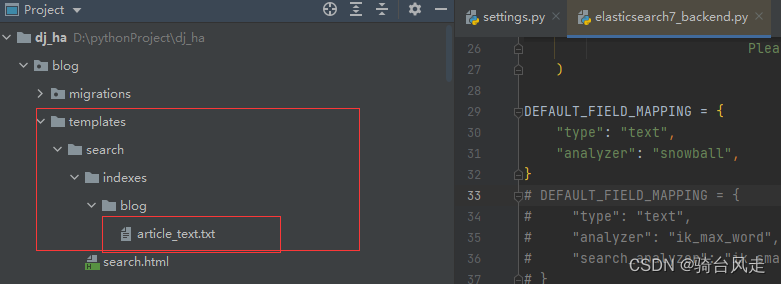
- {{ object.title }}
- {{ object.content }}
- {{ object.username.username }}
4. 路由
urls.py配置(用内置的视图,后期可以自定义,本文也有介绍)
- # urls.py
- from django.contrib import admin
- from django.urls import path, include, re_path
- urlpatterns = [
- path('admin/', admin.site.urls),
- # 配置的搜索路由,路由可以自定义,include('haystack.urls')固定
- re_path(r'^search/', include('haystack.urls')),
- ]
haystack.urls的内容(内置的,只是我拉出来,让你看一下,不需要进行修改)
- from django.urls import path
- from haystack.views import SearchView
- urlpatterns = [path("", SearchView(), name="haystack_search")]
5. search.html
SearchView()视图函数默认使用的html模板为当前app目录下,
路径为app名称,/templates/search/search.html
所以需要在blog/templates/search/下添加search.html文件,内容为
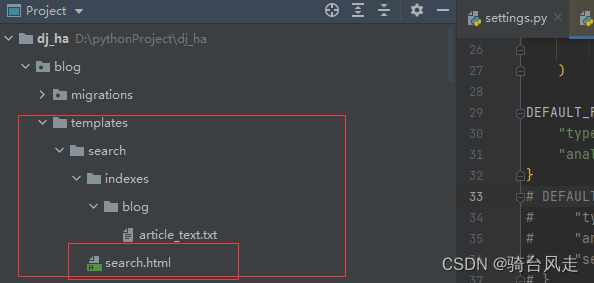
search.html(原生)
- <h2>Searchh2>
- <style>
- span.highlighted {
- color: red;
- }
- style>
- {% load highlight %}
- <form method="get" action=".">
- <table>
- {{ form.as_table }}
- {# {{ form.title.label }}#}
- <tr>
- <td>td>
- <td>
- <input type="submit" value="Search">
- td>
- tr>
- table>
- {% if query %}
- <h3>返回结果h3>
- {% for result in page.object_list %}
- <p>
- {# <a href="{{ result.object.get_absolute_url }}">{{ result.object.title }}a>#}
- <a href="{{ result.object.get_absolute_url }}">{% highlight result.object.title with query %}a>
- p>
- <span>
- {% highlight result.object.content with query %}
- {# {{ result.object.content }}#}
- span>
- {% empty %}
- <p>没有查询到结果!!!p>
- {% endfor %}
- {% if page.has_previous or page.has_next %}
- <div>
- {% if page.has_previous %}<a href="?q={{ query }}&page={{ page.previous_page_number }}">{% endif %}«
- Previous{% if page.has_previous %}a>{% endif %}
- |
- {% if page.has_next %}<a href="?q={{ query }}&page={{ page.next_page_number }}">{% endif %}Next »
- {% if page.has_next %}a>{% endif %}
- div>
- {% endif %}
- {% else %}
- {# Show some example queries to run, maybe query syntax, something else? #}
- {% endif %}
- form>
后端返回数据介绍
- # print(context)
- """
- {
- 'query': '刘',
- 'form': <ModelSearchForm bound=True, valid=True, fields=(q;models)>,
- 'page': <Page 1 of 1>,
- 'paginator': <django.core.paginator.Paginator object at 0x0000017D7E0F3470>,
- 'suggestion': None}
- """
- # print(context.get('page').__dict__)
- """
- {
- 'object_list':
- [
- <SearchResult: blog.article (pk=6)>,
- <SearchResult: blog.article (pk=8)>,
- <SearchResult: blog.article (pk=1)>
- ],
- 'number': 1,
- 'paginator': <django.core.paginator.Paginator object at 0x00000257C11A65C0>
- }
- """
前端返回数据介绍
- {% load highlight %}:高亮加载 内置的会省略搜到的内容,之前的内容
- {% load my_filters_and_tags %}:自定义高亮
- form.as_table:生成表格,里边会自动成成input标签
- query:查询的参数
- page.object_list:返回的查询一页数据
- result:数据对象集
- result.object:当前查询的数据对象
- page.has_previous or page.has_next:分页
6. 高亮配置
- # 7.高亮加载
- <style>
- span.highlighted {
- color: red;
- }
- style>
- # 1.使用默认值
- {% highlight result.summary with query %}
- # 案例
- <a href="{{ result.object.get_absolute_url }}">
- {% highlight result.object.title with query %}
- a>
- # 2.这里我们为 {{ result.summary }}里所有的 {{ query }} 指定了一个<div>div>标签,并且将class设置为highlight_me_please,这样就可以自己通过CSS为{{ query }}添加高亮效果了,怎么样,是不是很科学呢
- {% highlight result.summary with query html_tag "div" css_class "highlight_me_please" %}
- # 3.这里可以限制最终{{ result.summary }}被高亮处理后的长度
- {% highlight result.summary with query max_length 40 %}
- # 5.自定义使用(后面会介绍)
- # 5.4格式
- {% myhighlight <text_block> with <query> [css_class "class_name"] [html_tag "span"] [max_length 200] [start_head True] %}
- # 5.2使用一
- {% myhighlight result.object.content with query css_class "highlighted" html_tag "span" max_length 200 start_head True %}
- # 5.3自定义二
- {% myhighlight result.object.content with query css_class "highlighted" start_head True %}
7.自定义
自定义返回内容
在app下新建一个文件名称search_views

- # 重写SearchView,实现自定义内容
- # blog/search_views.py
- from haystack.views import SearchView
- # 导入模块
- from .models import *
- class MySeachView(SearchView):
- def extra_context(self): # 重载extra_context来添加额外的context内容
- context = super(MySeachView, self).extra_context()
- my_str = '111'
- context['my_str'] = my_str
- # print(context)
- return context
修改路由
- from django.contrib import admin
- from django.urls import path, include, re_path
- from blog import search_views
- urlpatterns = [
- path('admin/', admin.site.urls),
- # 原生的
- # re_path(r'^search/', include('haystack.urls')),
- # 自己的
- re_path(r'^search/', search_views.MySeachView(), name='haystack_search'),
- ]
前端使用
- <div>
- 圆明园:{{ my_str }}
- div>
自定义search.html模板
1. 保证有一个from,get请求,input标签的name=q,value=Search,
- <form method="get" action=".">
- <table>
- <tr>
- <th>
- <label for="id_q">Search:label>
- th>
- <td>
- <input type="search" name="q" value="不得不说" id="id_q">
- td>
- tr>
- <tr>
- <td>
- <input type="submit" value="Search">
- td>
- tr>
- table>
- form>
自定义高亮显示(原生的会省略)
新建文件夹templatetags
添加blog/templatetags/my_filters_and_tags.py 文件和 blog/templatetags/highlighting.py 文件,
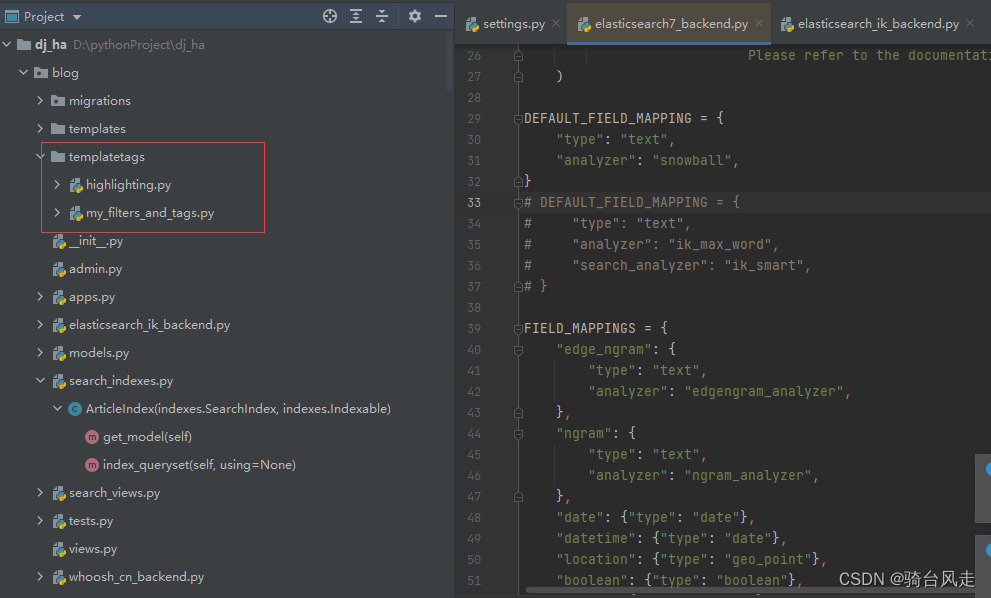
内容如下(源码分别位于haystack/templatetags/lighlight.py 和 haystack/utils/lighlighting.py 中):
my_filters_and_tags.py- # encoding: utf-8
- from __future__ import absolute_import, division, print_function, unicode_literals
- from django import template
- from django.conf import settings
- from django.core.exceptions import ImproperlyConfigured
- from django.utils import six
- from haystack.utils import importlib
- register = template.Library()
- class HighlightNode(template.Node):
- def __init__(self, text_block, query, html_tag=None, css_class=None, max_length=None, start_head=None):
- self.text_block = template.Variable(text_block)
- self.query = template.Variable(query)
- self.html_tag = html_tag
- self.css_class = css_class
- self.max_length = max_length
- self.start_head = start_head
- if html_tag is not None:
- self.html_tag = template.Variable(html_tag)
- if css_class is not None:
- self.css_class = template.Variable(css_class)
- if max_length is not None:
- self.max_length = template.Variable(max_length)
- if start_head is not None:
- self.start_head = template.Variable(start_head)
- def render(self, context):
- text_block = self.text_block.resolve(context)
- query = self.query.resolve(context)
- kwargs = {}
- if self.html_tag is not None:
- kwargs['html_tag'] = self.html_tag.resolve(context)
- if self.css_class is not None:
- kwargs['css_class'] = self.css_class.resolve(context)
- if self.max_length is not None:
- kwargs['max_length'] = self.max_length.resolve(context)
- if self.start_head is not None:
- kwargs['start_head'] = self.start_head.resolve(context)
- # Handle a user-defined highlighting function.
- if hasattr(settings, 'HAYSTACK_CUSTOM_HIGHLIGHTER') and settings.HAYSTACK_CUSTOM_HIGHLIGHTER:
- # Do the import dance.
- try:
- path_bits = settings.HAYSTACK_CUSTOM_HIGHLIGHTER.split('.')
- highlighter_path, highlighter_classname = '.'.join(path_bits[:-1]), path_bits[-1]
- highlighter_module = importlib.import_module(highlighter_path)
- highlighter_class = getattr(highlighter_module, highlighter_classname)
- except (ImportError, AttributeError) as e:
- raise ImproperlyConfigured("The highlighter '%s' could not be imported: %s" % (settings.HAYSTACK_CUSTOM_HIGHLIGHTER, e))
- else:
- from .highlighting import Highlighter
- highlighter_class = Highlighter
- highlighter = highlighter_class(query, **kwargs)
- highlighted_text = highlighter.highlight(text_block)
- return highlighted_text
- @register.tag
- def myhighlight(parser, token):
- """
- Takes a block of text and highlights words from a provided query within that
- block of text. Optionally accepts arguments to provide the HTML tag to wrap
- highlighted word in, a CSS class to use with the tag and a maximum length of
- the blurb in characters.
- Syntax::
- {% highlight
with [css_class "class_name"] [html_tag "span"] [max_length 200] %} - Example::
- # Highlight summary with default behavior.
- {% highlight result.summary with request.query %}
- # Highlight summary but wrap highlighted words with a div and the
- # following CSS class.
- {% highlight result.summary with request.query html_tag "div" css_class "highlight_me_please" %}
- # Highlight summary but only show 40 characters.
- {% highlight result.summary with request.query max_length 40 %}
- """
- bits = token.split_contents()
- tag_name = bits[0]
- if not len(bits) % 2 == 0:
- raise template.TemplateSyntaxError(u"'%s' tag requires valid pairings arguments." % tag_name)
- text_block = bits[1]
- if len(bits) < 4:
- raise template.TemplateSyntaxError(u"'%s' tag requires an object and a query provided by 'with'." % tag_name)
- if bits[2] != 'with':
- raise template.TemplateSyntaxError(u"'%s' tag's second argument should be 'with'." % tag_name)
- query = bits[3]
- arg_bits = iter(bits[4:])
- kwargs = {}
- for bit in arg_bits:
- if bit == 'css_class':
- kwargs['css_class'] = six.next(arg_bits)
- if bit == 'html_tag':
- kwargs['html_tag'] = six.next(arg_bits)
- if bit == 'max_length':
- kwargs['max_length'] = six.next(arg_bits)
- if bit == 'start_head':
- kwargs['start_head'] = six.next(arg_bits)
- return HighlightNode(text_block, query, **kwargs)
highlighting.py
- # encoding: utf-8
- from __future__ import absolute_import, division, print_function, unicode_literals
- from django.utils.html import strip_tags
- class Highlighter(object):
- #默认值
- css_class = 'highlighted'
- html_tag = 'span'
- max_length = 200
- start_head = False
- text_block = ''
- def __init__(self, query, **kwargs):
- self.query = query
- if 'max_length' in kwargs:
- self.max_length = int(kwargs['max_length'])
- if 'html_tag' in kwargs:
- self.html_tag = kwargs['html_tag']
- if 'css_class' in kwargs:
- self.css_class = kwargs['css_class']
- if 'start_head' in kwargs:
- self.start_head = kwargs['start_head']
- self.query_words = set([word.lower() for word in self.query.split() if not word.startswith('-')])
- def highlight(self, text_block):
- self.text_block = strip_tags(text_block)
- highlight_locations = self.find_highlightable_words()
- start_offset, end_offset = self.find_window(highlight_locations)
- return self.render_html(highlight_locations, start_offset, end_offset)
- def find_highlightable_words(self):
- # Use a set so we only do this once per unique word.
- word_positions = {}
- # Pre-compute the length.
- end_offset = len(self.text_block)
- lower_text_block = self.text_block.lower()
- for word in self.query_words:
- if not word in word_positions:
- word_positions[word] = []
- start_offset = 0
- while start_offset < end_offset:
- next_offset = lower_text_block.find(word, start_offset, end_offset)
- # If we get a -1 out of find, it wasn't found. Bomb out and
- # start the next word.
- if next_offset == -1:
- break
- word_positions[word].append(next_offset)
- start_offset = next_offset + len(word)
- return word_positions
- def find_window(self, highlight_locations):
- best_start = 0
- best_end = self.max_length
- # First, make sure we have words.
- if not len(highlight_locations):
- return (best_start, best_end)
- words_found = []
- # Next, make sure we found any words at all.
- for word, offset_list in highlight_locations.items():
- if len(offset_list):
- # Add all of the locations to the list.
- words_found.extend(offset_list)
- if not len(words_found):
- return (best_start, best_end)
- if len(words_found) == 1:
- return (words_found[0], words_found[0] + self.max_length)
- # Sort the list so it's in ascending order.
- words_found = sorted(words_found)
- # We now have a denormalized list of all positions were a word was
- # found. We'll iterate through and find the densest window we can by
- # counting the number of found offsets (-1 to fit in the window).
- highest_density = 0
- if words_found[:-1][0] > self.max_length:
- best_start = words_found[:-1][0]
- best_end = best_start + self.max_length
- for count, start in enumerate(words_found[:-1]):
- current_density = 1
- for end in words_found[count + 1:]:
- if end - start < self.max_length:
- current_density += 1
- else:
- current_density = 0
- # Only replace if we have a bigger (not equal density) so we
- # give deference to windows earlier in the document.
- if current_density > highest_density:
- best_start = start
- best_end = start + self.max_length
- highest_density = current_density
- return (best_start, best_end)
- def render_html(self, highlight_locations=None, start_offset=None, end_offset=None):
- # Start by chopping the block down to the proper window.
- #text_block为内容,start_offset,end_offset分别为第一个匹配query开始和按长度截断位置
- text = self.text_block[start_offset:end_offset]
- # Invert highlight_locations to a location -> term list
- term_list = []
- for term, locations in highlight_locations.items():
- term_list += [(loc - start_offset, term) for loc in locations]
- loc_to_term = sorted(term_list)
- # Prepare the highlight template
- if self.css_class:
- hl_start = '<%s class="%s">' % (self.html_tag, self.css_class)
- else:
- hl_start = '<%s>' % (self.html_tag)
- hl_end = '' % self.html_tag
- # Copy the part from the start of the string to the first match,
- # and there replace the match with a highlighted version.
- #matched_so_far最终求得为text中最后一个匹配query的结尾
- highlighted_chunk = ""
- matched_so_far = 0
- prev = 0
- prev_str = ""
- for cur, cur_str in loc_to_term:
- # This can be in a different case than cur_str
- actual_term = text[cur:cur + len(cur_str)]
- # Handle incorrect highlight_locations by first checking for the term
- if actual_term.lower() == cur_str:
- if cur < prev + len(prev_str):
- continue
- #分别添上每个query+其后面的一部分(下一个query的前一个位置)
- highlighted_chunk += text[prev + len(prev_str):cur] + hl_start + actual_term + hl_end
- prev = cur
- prev_str = cur_str
- # Keep track of how far we've copied so far, for the last step
- matched_so_far = cur + len(actual_term)
- # Don't forget the chunk after the last term
- #加上最后一个匹配的query后面的部分
- highlighted_chunk += text[matched_so_far:]
- #如果不要开头not start_head才加点
- if start_offset > 0 and not self.start_head:
- highlighted_chunk = '...%s' % highlighted_chunk
- if end_offset < len(self.text_block):
- highlighted_chunk = '%s...' % highlighted_chunk
- #可见到目前为止还不包含start_offset前面的,即第一个匹配的前面的部分(text_block[:start_offset]),如需展示(当start_head为True时)便加上
- if self.start_head:
- highlighted_chunk = self.text_block[:start_offset] + highlighted_chunk
- return highlighted_chunk
前端使用
- <style>
- span.highlighted {
- color: red;
- }
- style>
- {% load my_filters_and_tags %}
- {% myhighlight result.object.content with query css_class "highlighted" html_tag "span" max_length 200 start_head True %}
8. 目前位置搜索已经完成,可以重建索引,同步数据,测试一下
python manage.py rebuild_index9.jieba分词器配置
9.1 先从python包中复制whoosh_backend.py到app中,并改名为whoosh_cn_backend.py
文件路径:\site-packages\haystack\backends\whoosh_backend.py

复制到的路径:
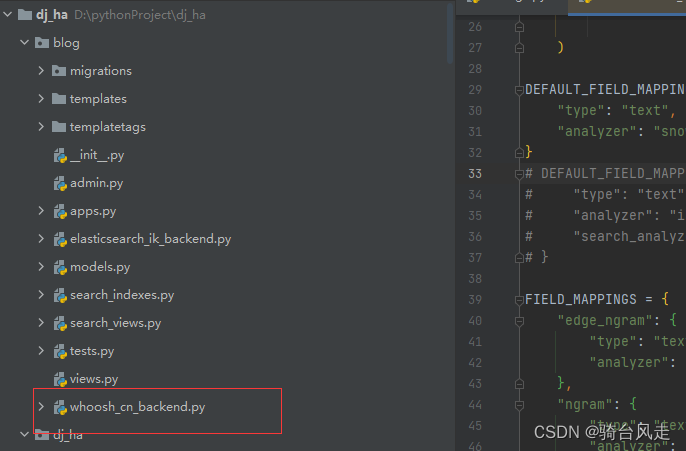
9.2 对whoosh_cn_backend.py做以下修改:
- 1、导入 ChineseAnalyze
- from jieba.analyse import ChineseAnalyzer
- 2、替换schema_fields[field_class.index_fieldname] = TEXT(下的analyzer
- analyzer=ChineseAnalyzer(),

9.3 在django的配置文件中,修改搜索引擎
- HAYSTACK_CONNECTIONS = {
- 'default': {
- # 设置haystack的搜索引擎
- 'ENGINE': 'blog.whoosh_cn_backend.WhooshEngine',
- # 'ENGINE': 'haystack.backends.whoosh_backend.WhooshEngine',
- # 设置索引文件的位置
- 'PATH': os.path.join(BASE_DIR, 'whoosh_index'),
- }
- }
10 django+django-haystack+Elasticsearch7.5+ik+mysql
10.0 切换成es引擎,除了settings.py和把jieba换成ik,其他步骤跟上面的都一样
如果一开始,就是奔着es+ik来的,那步骤9 jieba分词器配置 不用看,直接从步骤8跳到这里来
10.1 安装es,ik
10.2 使用ik重写es7.5引擎
10.2.1 新建elasticsearch_ik_backend.py(在自己的app下)
在 blog应用下新建名为 elasticsearch7_ik_backend.py 的文件,继承 Elasticsearch7SearchBackend(后端) 和 Elasticsearch7SearchEngine(搜索引擎) 并重写建立索引时的分词器设置

- from haystack.backends.elasticsearch7_backend import Elasticsearch7SearchBackend, Elasticsearch7SearchEngine
- """
- 分析器主要有两种情况会被使用:
- 第一种是插入文档时,将text类型的字段做分词然后插入倒排索引,
- 第二种就是在查询时,先对要查询的text类型的输入做分词,再去倒排索引搜索
- 如果想要让 索引 和 查询 时使用不同的分词器,ElasticSearch也是能支持的,只需要在字段上加上search_analyzer参数
- 在索引时,只会去看字段有没有定义analyzer,有定义的话就用定义的,没定义就用ES预设的
- 在查询时,会先去看字段有没有定义search_analyzer,如果没有定义,就去看有没有analyzer,再没有定义,才会去使用ES预设的
- """
- DEFAULT_FIELD_MAPPING = {
- "type": "text",
- "analyzer": "ik_max_word",
- # "analyzer": "ik_smart",
- "search_analyzer": "ik_smart"
- }
- class Elasticsearc7IkSearchBackend(Elasticsearch7SearchBackend):
- def __init__(self, *args, **kwargs):
- self.DEFAULT_SETTINGS['settings']['analysis']['analyzer']['ik_analyzer'] = {
- "type": "custom",
- "tokenizer": "ik_max_word",
- # "tokenizer": "ik_smart",
- }
- super(Elasticsearc7IkSearchBackend, self).__init__(*args, **kwargs)
- class Elasticsearch7IkSearchEngine(Elasticsearch7SearchEngine):
- backend = Elasticsearc7IkSearchBackend
10.3 修改settings.py(切换成功)
- # es 7.x配置
- HAYSTACK_CONNECTIONS = {
- 'default': {
- # 'ENGINE': 'haystack.backends.elasticsearch7_backend.Elasticsearch7SearchEngine',
- 'ENGINE': 'blog.elasticsearch_ik_backend.Elasticsearch7IkSearchEngine',
- # 'URL': 'http://106.14.42.253:9200/',
- 'URL': 'http://106.14.42.253:9200/',
- # elasticsearch建立的索引库的名称,一般使用项目名作为索引库
- 'INDEX_NAME': 'elastic_new',
- },
- }
10.4 重建索引,同步数据
python manage.py rebuild_index10.5 补充
10.5.1 未成功切换成ik
haystack 原先加载的是 ...\venv\Lib\site-packages\haystack\backends 文件夹下的 elasticsearch7_backend.py 文件,打开即可看到 elasticsearch7 引擎的默认配置
若用上述方法建立出来的索引字段仍使用 snowball 分词器,则将原先elasticsearch7_backend.py 文件中的 DEFAULT_FIELD_MAPPING 也修改为 ik 分词器(或许是因为版本问题)
位置:D:\py_virtualenv\dj_ha\Lib\site-packages\haystack\backends\elasticsearch7_backend.py
修改内容:
- DEFAULT_FIELD_MAPPING = {
- "type": "text",
- "analyzer": "ik_max_word",
- "search_analyzer": "ik_smart",
- }
10.5.2 es6版本加入ik,重写引擎
- from haystack.backends.elasticsearch_backend import ElasticsearchSearchBackend
- from haystack.backends.elasticsearch_backend import ElasticsearchSearchEngine
- class IKSearchBackend(ElasticsearchSearchBackend):
- DEFAULT_ANALYZER = "ik_max_word" # 这里将 es 的 默认 analyzer 设置为 ik_max_word
- def __init__(self, connection_alias, **connection_options):
- super().__init__(connection_alias, **connection_options)
- def build_schema(self, fields):
- content_field_name, mapping = super(IKSearchBackend, self).build_schema(fields)
- for field_name, field_class in fields.items():
- field_mapping = mapping[field_class.index_fieldname]
- if field_mapping["type"] == "string" and field_class.indexed:
- if not hasattr(
- field_class, "facet_for"
- ) and not field_class.field_type in ("ngram", "edge_ngram"):
- field_mapping["analyzer"] = getattr(
- field_class, "analyzer", self.DEFAULT_ANALYZER
- )
- mapping.update({field_class.index_fieldname: field_mapping})
- return content_field_name, mapping
- class IKSearchEngine(ElasticsearchSearchEngine):
- backend = IKSearchBackend
11.实时更新索原理:采用信号
配置
- # 在django配置文件中,添加索引值,文章更新的时候,就会自动更新索引值
- HAYSTACK_SIGNAL_PROCESSOR = 'haystack.signals.RealtimeSignalProcessor'
RealtimeSignalProcessor源码如下:
- class RealtimeSignalProcessor(BaseSignalProcessor):
- """
- Allows for observing when saves/deletes fire & automatically updates the
- search engine appropriately.
- 当 检索对象出现保存或者删除的时候更新索引值。
- """
- def setup(self):
- # Naive (listen to all model saves).
- models.signals.post_save.connect(self.handle_save)
- models.signals.post_delete.connect(self.handle_delete)
- # Efficient would be going through all backends & collecting all models
- # being used, then hooking up signals only for those.
- def teardown(self):
- # Naive (listen to all model saves).
- models.signals.post_save.disconnect(self.handle_save)
- models.signals.post_delete.disconnect(self.handle_delete)
- # Efficient would be going through all backends & collecting all models
- # being used, then disconnecting signals only for those.
本文借鉴
Django haystack实现全文搜索 - -零 - 博客园 (cnblogs.com)
(9条消息) django-haystack全文检索详细教程_AC_hell的博客-CSDN博客
(9条消息) Django全文检索Haystack模块_NQ31的博客-CSDN博客_django haystack
(9条消息) django+drf_haystack+elasticsearch_骑台风走的博客-CSDN博客(5条消息) Haystack 使用 Elasticsearch 建立索引时 修改为中文分词器_SevenBerry的博客-CSDN博客_elasticsearch 修改字段分词器
(5条消息) Elasticsearch中analyzer和search_analyzer的区别_chuixue24的博客-CSDN博客
-
-
相关阅读:
信创优选,国产开源。Solon v2.5.3 发布
一次搞懂SpringBoot核心原理:自动配置、事件驱动、Condition
【线性代数基础进阶】向量-part3
第十七章 Excel操作
MySQL数据库的MVCC详解
全世界IT人苦竞业久矣!美国FTC宣布全面废除员工竞业协议
整合小分子物质KGN的壳聚糖-透明质酸水凝胶/基于琥珀酰壳聚糖-氧化透明质酸的水凝胶的研究制备
ImmunoChemistry艾美捷平底MicroTiter平板说明书
L8.linux命令每日一练 -- 第二章 文件和目录操作命令 -- rm和rmdir命令
阿里云云原生一体化数仓—离线实时一体化新能力解读
- 原文地址:https://blog.csdn.net/qq_52385631/article/details/126590931
