-
动态SQL第一部分(重点)
什么是动态sql:
- 动态sql就是根据不同的条件生成不同的sql语句。
- 如果你之前用过 JSTL 或任何基于类 XML 语言的文本处理器,你对动态 SQL 元素可能会感觉似曾相识。
- 在 MyBatis 之前的版本中,需要花时间了解大量的元素。
- 借助功能强大的基于 OGNL 的表达式,MyBatis 3 替换了之前的大部分元素,大大精简了元素种类,现在要学习的元素种类比原来的一半还要少。
包括以下4个模块:
-
if
-
choose (when, otherwise)
-
trim (where, set)
-
foreach
搭建环境
- CREATE TABLE `blog`
- (
- `id` VARCHAR(50) NOT NULL COMMENT '博客id',
- `title` VARCHAR(100) NOT NULL COMMENT '博客标题',
- `author` VARCHAR(30) NOT NULL COMMENT '博客作者',
- `create_time` DATETIME NOT NULL COMMENT '创建时间',
- `views` INT(30) NOT NULL COMMENT '浏览量'
- ) ENGINE = INNODB
- DEFAULT CHARSET = utf8;

创建一个基础工程
(1)导包
(2)编写配置文件
(3)编写实体类
- package com.gt.pojo;
- import lombok.Data;
- import java.util.Date;
- @Data
- public class Blog {
- private String id;
- private String title;
- private String author;
- private Date createTime;
- private int views;
- }

(4)编写实体类对应Mapper接口和Mapper.xml文件
if
- <select id="getBlogList" parameterType="map" resultType="com.gt.pojo.Blog">
- select id,title,author,create_time createTime,views from blog
- where 1=1
- <if test="title != null">
- and title like #{title}
- if>
- <if test="author != null">
- and author = #{author}
- if>
- select>

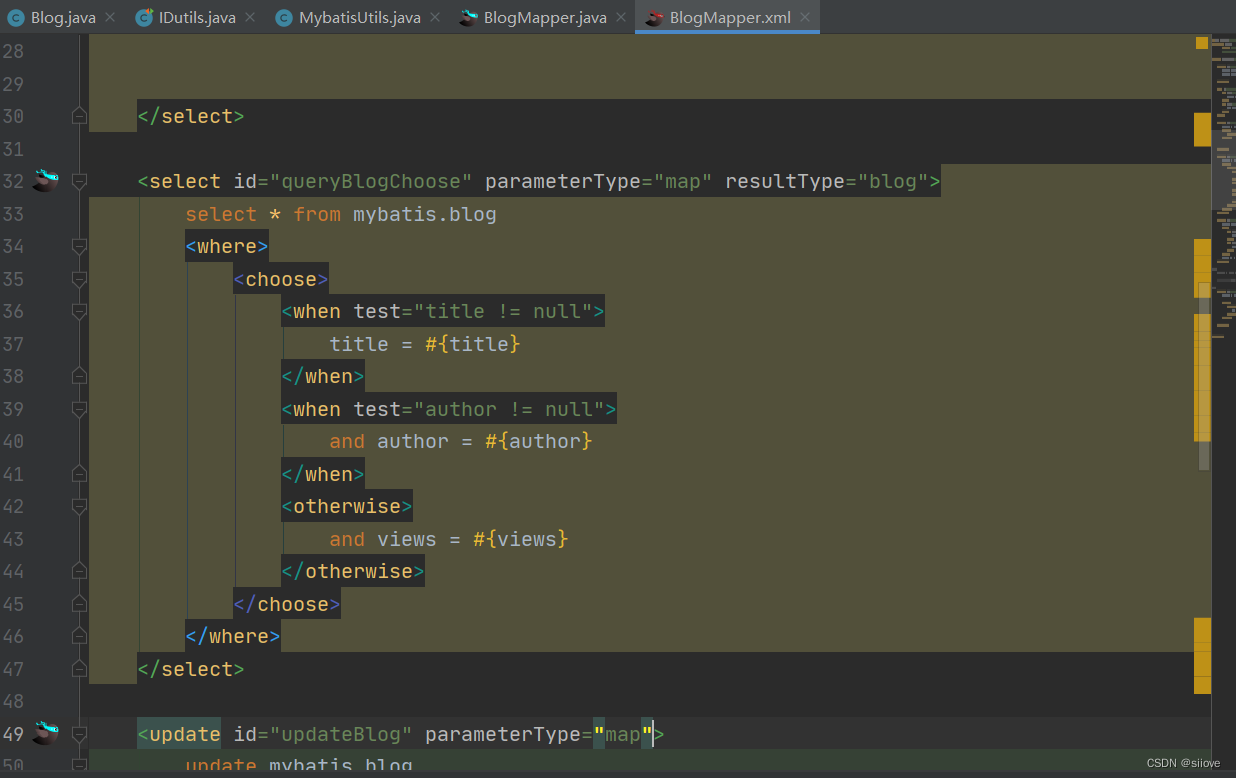
choose (when, otherwise)
- <select id="getBlogList" parameterType="map" resultType="com.gt.pojo.Blog">
- select id,title,author,create_time createTime,views from blog
- <where>
- <choose>
- <when test="title != null">
- title like #{title}
- when>
- <when test="author != null">
- and author = #{author}
- when>
- <otherwise>
- and views=#{views}
- otherwise>
- choose>
- where>
- select>
trim (where, set)
where 元素只会在子元素返回任何内容的情况下才插入 “WHERE” 子句。而且,若子句的开头为 “AND” 或 “OR”,where 元素也会将它们去除。
- <select id="getBlogList" parameterType="map" resultType="com.gt.pojo.Blog">
- select id,title,author,create_time createTime,views from blog
- <where>
- <if test="title != null">
- title like #{title}
- if>
- <if test="author != null">
- and author = #{author}
- if>
- where>
- select>
- <update id="updateBlog" parameterType="map">
- update blog
- <set>
- <if test="title != null">
- title=#{title},
- if>
- <if test="author != null">
- author=#{author}
- if>
- set>
- where id=#{id}
- update>
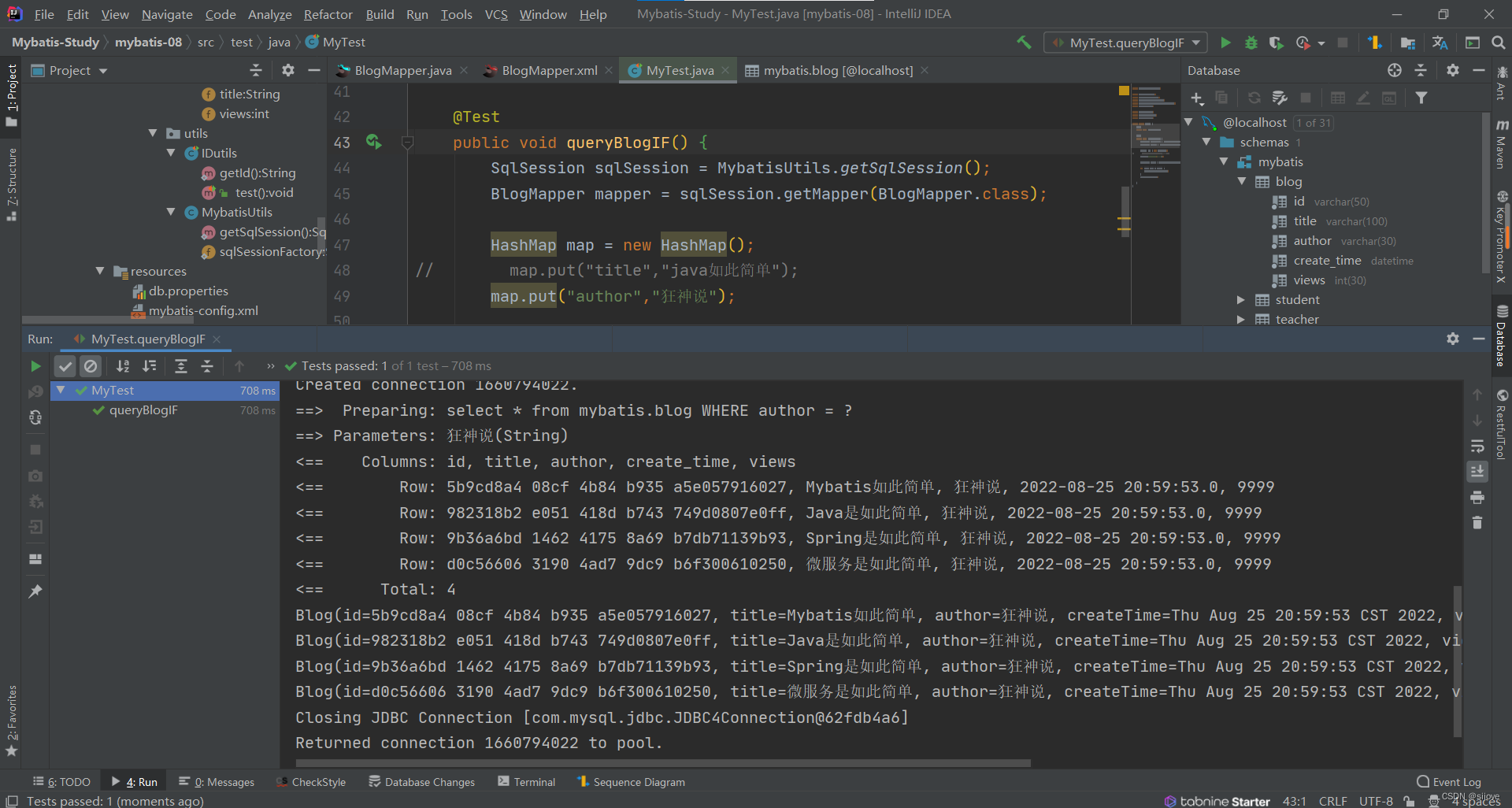
输出结果:
- 如果 where 元素与你期望的不太一样,你也可以通过自定义 trim 元素来定制 where 元素的功能。
- 比如,和 where 元素等价的自定义 trim 元素为:
- <trim prefix="WHERE" prefixOverrides="AND |OR ">
- ...
- trim>
- <trim prefix="SET" suffixOverrides=",">
- ...
- trim>
所谓的动态sql。本质还是sql语句,只是我们可以在sql层面,去执行一个逻辑代码
-
相关阅读:
org.activiti.bpmn
阿里云 linux tomcat 无法访问方法
服务器防御100G是什么意思?够用吗?
一个基于SpringBoot+Vue前后端分离学生宿舍管理系统详细设计实现
SPC 统计过程控制
Java 的 String、StringBuffer 和 StringBuilder(一文讲透)
什么是响应式设计?响应式设计的基本原理是什么?如何兼容低版本的 IE?
面试总结之并发编程
tns-12545 tns-12560 tns00515 linux error 99
【C++】匿名对象 ① ( 匿名对象引入 | 匿名对象简介 | 匿名对象概念 | 匿名对象作用域 - 对象创建与销毁 )
- 原文地址:https://blog.csdn.net/qq_46423017/article/details/126556538
