-
程序环境与预处理笔记
🎭🎭前言
本篇文章学自比特鹏哥,若构成侵权,请及时联系作者,本人一定及时处理
如果您阅读了本文,并觉得本文不错,您的赞👍将是我最大的奖励🙏🙏
本文部分案例使用的时c一 🧩🧩程序的环境分类
- 翻译环境,源代码–>可执行的机械指令
- 执行环境,用于实际执行代码
二 🪢🪢编译和链接
2.1 →→执行过程详解
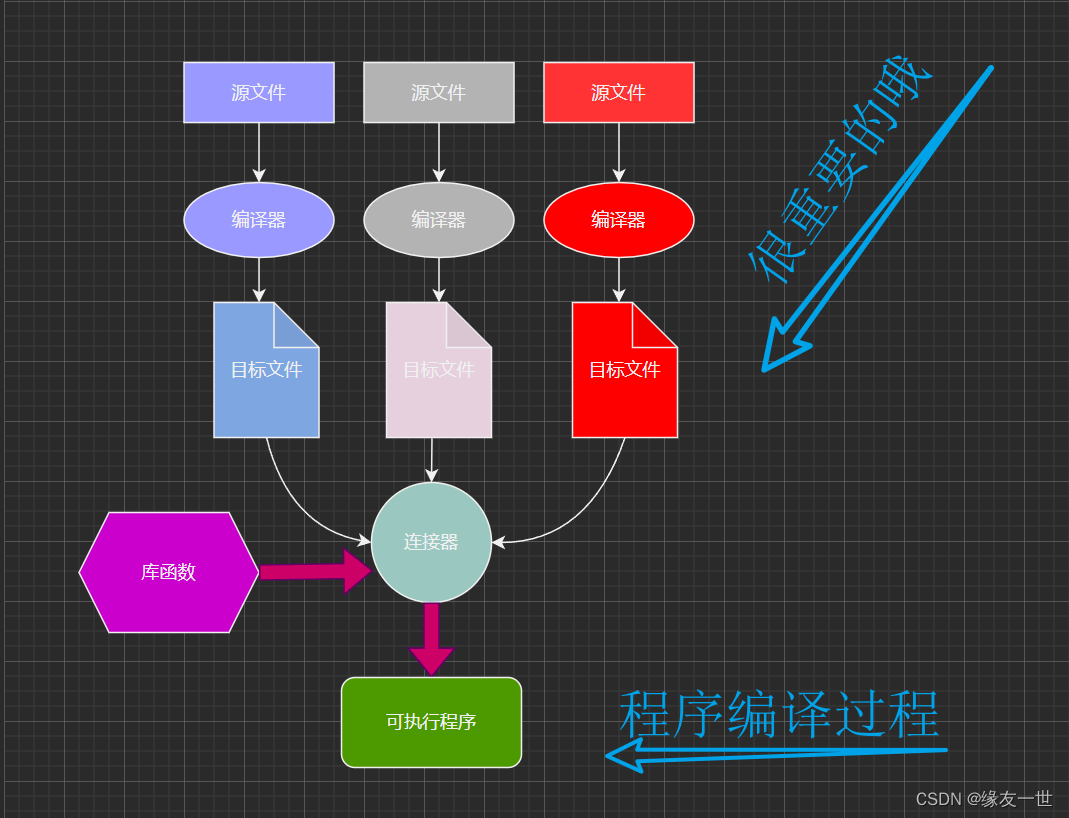
- 组成一个程序的每个源文件通过编译过程分别转化成目标代码
- 每个目标文件由链接器捆绑在一起,形成一个单一完整的可执行程序

- 各个阶段完成的具体任务
阶段 详解 预处理( xxx.c–>xxx.i ) 1. 完成了头文件的包含#include 2. #define定义的符号和宏的定义 3. 删除注释 文本操作 编译(xxx.i–>xxx.s) 把c语言代码转化成汇编代码 1.语法分析 2. 词法分析 3. 语义分析 4. 符号总结 汇编(xxx.s–>xxx.o) ***把汇编代码转化为机器指令(二进制指令)1. 生成符号表 *** 连接(xxx.o–>xxx.out) 多个目标文件和链接库进行连接 2.2 🎡🎡运行环境
- 程序执行的过程
- 1 程序必须载入内存中,【有操作系统的情况下】操作系统自动完成;独立的环境中,程序的载入必须由手工完成
- 2 程序的执行便开始,接着调用main函数
- 3 开始执行程序代码,这个时候程序使用一个运行时堆栈,存储函数的局部变量和返回地址。程序同时也可以使用静态内存,存储于静态内存中的变量在程序的整个执行过程中,一直保留他们的值。
- 4 终止程序。正常终止main函数;或者意外终止。
三 🎞️🎞️预处理详解
3.1 🔣🔣预定义符号
符号分类 详解 FILE 显示正在进行编译的源文件 LINE 当前文件的行号 DATE 文件被编译的日期 TIME 文件按被编译的时间 STDC 如果编译器遵循ANSI C ,其值为1,否则为定义 ANSI C是由美国国家标准协会(ANSI)及国际标准化组织(ISO)推出的关于C语言的标准。ANSI C 主要标准化了现存的实现, 同时增加了一些来自 C++ 的内容 (主要是函数原型) 并支持多国字符集 (包括备受争议的三字符序列)。 ANSI C 标准同时规定了 C 运行期库例程的标准。
- 举例
printf("file:%s line:%d\n",__FILE__,__LINE__);- 1
3.2✔️✔️define
- 语法
#define NAME stuff- 1
- 栗子
//建议不加分号 #define MIN 10 //定义字面量的值 #define reg register//为关键字,创建一个别名 #define do_forever for(;;)//用形象的符号来代替一种实现 #define CASE break;case //在写case时自动把break写上 //如果定义的stuff 太长,可以分行书写,但除了最后一行外,其他每行的后面都加上一个反斜杠(续行符) #define DEBUG_PRINT printf("file:%s \t line:%d\t \ date:%s \t time:%s\n",\ __FILE__,__LINE__, \ __DATE__,__TIME__)- 1
- 2
- 3
- 4
- 5
- 6
- 7
- 8
- 9
- 10
#include#define CASE break;case //在写case时自动把break写上 int main() { int option = 1; switch (option) { case 1: printf("hhh"); CASE 2: CASE 3 : break; } return 0; } - 1
- 2
- 3
- 4
- 5
- 6
- 7
- 8
- 9
- 10
- 11
- 12
- 13
3.2.1 #define定义宏
#define机制包括一个规定,允许把参数替换到文本中
- 宏的声明方式
#define name(name-list) stuff- 1
- 其中的parament-1ist是一个由逗号隔开的符号表,它们可能出现在stuff
- 注意:
- 参数列表的左括号必须与name紧邻
- 如果两者之间有任何空白存在,参数列表就会被解释为stuff的一部分
#includeusing namespace std; #define SQUARE(X) X*X int main() { cout << SQUARE(3 + 1)<<endl;//3+1*3+1 =7 cout << 10*SQUARE(3 + 1)<<endl;//10*3+1*3+1 =34 } - 1
- 2
- 3
- 4
- 5
- 6
- 7
提示:用于对数值表达式进行求值的宏定义都应该加上方括号,避免在使用宏时中的操作符或临近操作符之间不可预料的相互作用
3.2.2 #define替换规则
- 在程序中扩展#define定义符号和宏时,需要涉及几个步骤
-
- 在调用宏时,首先对参数进行检查,看看是否包含任何由#define定义的符号。如果是,它们首先被替换。
-
- 替换文本随后被插入到程序中原来文本的位置。对干宏,参数名被他们的值替换
-
- 最后,再次对结果文件进行扫描,看看它是否包含任何由#define定义的符号。如果是,就重复上述处理过程
-
- 注意:
-
- 宏参数和#define定义中可以出现其他#define定义的变量。但是对于宏,不能出现递归
-
- 当预处理器搜索#define定义的符号的时候,字符串常量的内容并不被搜索
-
#includeusing namespace std; #define M 100 #define MAX(X,Y) ((X)>(Y)?(X):(Y)) int main() { int max = MAX(360, M); cout << max << endl; } - 1
- 2
- 3
- 4
- 5
- 6
- 7
- 8
3.2.3 #和##
- 把参数插入到字符串中
#includeusing namespace std; #define PRINT(X) printf("the value of "#X" is %d\n",X); int main() { int a = 10; PRINT(a); return 0; } - 1
- 2
- 3
- 4
- 5
- 6
- 7
- 8
//把参数插入到字符串中 #includeusing namespace std; #define PRINT(X,FORMAT) printf("the value of "#X" is " FORMAT,X); int main() { int a = 10; PRINT(a,"%d"); return 0; } //拼接字符 #include using namespace std; #define CAT(X,Y,Z) X##Y##Z int main() { int class12 = 100; cout << CAT(class,1,2); return 0; } - 1
- 2
- 3
- 4
- 5
- 6
- 7
- 8
- 9
- 10
- 11
- 12
- 13
- 14
- 15
- 16
- 17
- 18
- 19
3.2.4 🌠🌠带副作用的宏参数
- 当宏参数在宏的定义中出现超过一次的时候,如果参数带有副作用, 那么在使用宏的时候有可能出现危险。
- 副作用:表达式求值的时候出现永久性效果
int a=10; int b=a+1;//b=11,a=10 无副作用 int b=++a;//b=11,a=11 有副作用- 1
- 2
- 3
#includeusing namespace std; #define MAX(X,Y) ((X)>(Y)?(X):(Y)) int main() { int a = 1,b=2; int m = MAX(a++,b++); /* 过程详解 int m=(a++)>(b++)?(a++):(b++) 后置递增:先比较后递增 1<2 返回b++ 即3 然后a、b完成递增 即a=1+1=2,b=3+1=4 */ cout << m<<endl;//3 cout << a << endl;//2 cout << b << endl;//4 return 0; } - 1
- 2
- 3
- 4
- 5
- 6
- 7
- 8
- 9
- 10
- 11
- 12
- 13
- 14
- 15
- 16
- 17
- 18
3.2.5 宏🆚🆚函数
- 宏通常被应用于执行简单的运算,比较两个数中较大的一个
#define MAX(X,Y) ((X)>(Y)?(X):(Y))- 1
-
宏的优势【使用宏进行简单计算而不是用函数的原因】
- 宏比函数在程序的规模和速度方面更胜一筹,用函数和从函数返回的代码可能比实际执行计算所需的时间更多
- 宏是类型无关的。函数的参数必须为特定的类型。而宏可以适用于整形、长整型、浮点型登等等
-
宏的劣势
- 每次使用宏的时候,一份宏定义的代码将插入到程序中。如果宏比较长,肯能增加程序的长度
- 宏是没法调试的
- 宏由于类型无关,不够严谨
- 宏可能会带来运算符优先级的问题,导致容易出错
-
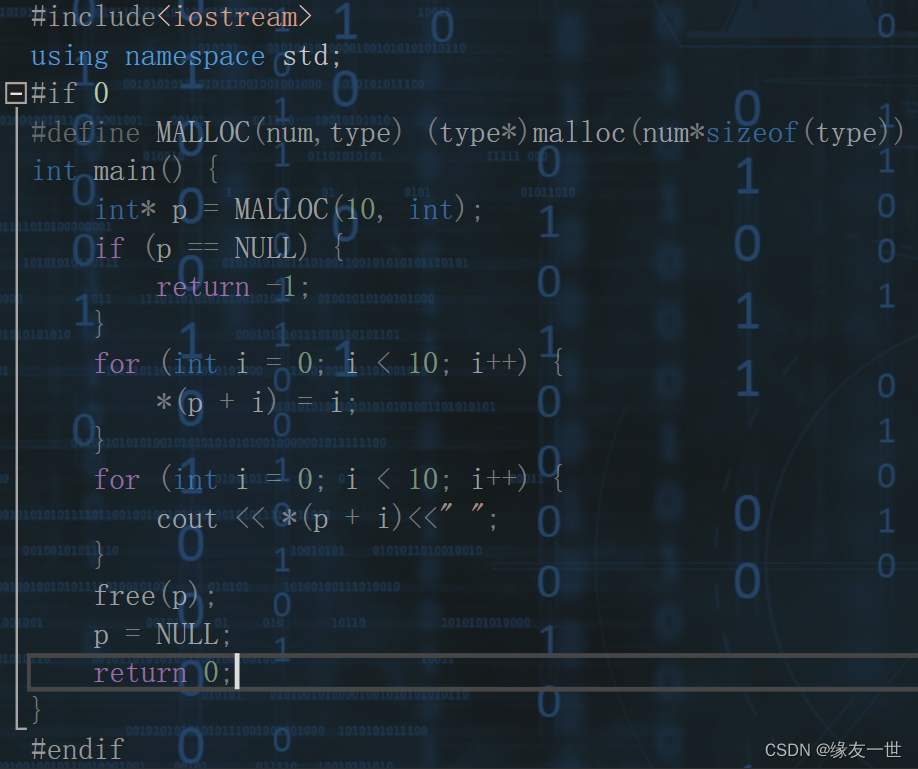
宏有时候可以做到函数做不到的事情:宏的参数可以出现类型
#includeusing namespace std; #define MALLOC(num,type) (type*)malloc(num*sizeof(type)) int main() { int* p = MALLOC(10, int); if (p == NULL) { return -1; } for (int i = 0; i < 10; i++) { *(p + i) = i; } for (int i = 0; i < 10; i++) { cout << *(p + i)<<" "; } free(p); p = NULL; return 0; } - 1
- 2
- 3
- 4
- 5
- 6
- 7
- 8
- 9
- 10
- 11
- 12
- 13
- 14
- 15
- 16
- 17
- 18
属性 #define定义宏 函数 代码长度 每次使用宏,宏代码会插入到程序中。较长的宏,会是程序的长度大幅度增长 函数代码只出现在一个地方;每此时用这个函数时,都调用那个地方的同一份代码 执行速度 更快 存在函数的调用和返回的额外开销,较慢 操作符优先级 宏参数的求值是在所有周围表达式的上下文环境里,除非加上括号,否则邻近操作符的优先级可能会产生不可预料的后果,所以建议宏在书写的时候多些括号 函数参数只在函数调用的时候求值一次,它的结果值传递给函数。表达式的求值结果更容易预测。 带有副作用的参数 参数可能被替换到宏体中的多个位置,所以带有副作用的参数求值可能会产生不可预料的结果。 函数参数只在传参的时候求值一次,结果更容易控制。 递归 宏是不能递归的 函数可以递归 命名约定
宏的名称全部大写
函数名不要全部大写,推荐驼峰命名法3.3 ⛳⛳#undefine
- 这条用于移除一个宏定义
//如果现存的一个名字需要重新被定义,那么它的旧名首先需要被移除 #define NAME- 1
- 2
3.4 📊📊条件编译
- 在编译一个程序的时候,我们如果将一个语句(一组语句)编译或者放弃是很方便的
- 比如:调试的代码,删除可惜,保留碍事,可以选择性的编译
#include#define __DEBUG__ - 1
- 2
- 常见的条件编译命令
//1 单个的条件编译 #if 常量表达式 //... #endif //2多个分支的条件编译 #if 常量表达式 //... #elif 常量表达式 //... #else //... #endif //3 判断是否被定义 #if define(symbol) #ifdef symbol //4 嵌套指令 #if defined(OS_UNIX) #ifdef option1 unix_version_option1(); #endif #ifdef option2 unix_version_option2(); #endif #elif defined(OS_MSDOS) #ifdef option2 msdos_version_option2(); #endif #endif- 1
- 2
- 3
- 4
- 5
- 6
- 7
- 8
- 9
- 10
- 11
- 12
- 13
- 14
- 15
- 16
- 17
- 18
- 19
- 20
- 21
- 22
- 23
- 24
- 25
- 26
- 27
- 28
- 29
- 30
- 31
#includeusing namespace std; int main() { #if 1==2 cout << "1==2"; #elif 2==3 cout << "2==3"; #else cout << "else"; #endif return 0; } - 1
- 2
- 3
- 4
- 5
- 6
- 7
- 8
- 9
- 10
- 11
- 12
#includeusing namespace std; #define TEST 0 int main() { #ifdef TEST cout << "test\n"; #endif #if defined(TEST) cout << "test\n"; #endif #ifndef WHERE cout << "where\n"; #endif // !WHERE #if !defined(WHERE) cout << "where\n"; #endif // !WHERE return 0; } - 1
- 2
- 3
- 4
- 5
- 6
- 7
- 8
- 9
- 10
- 11
- 12
- 13
- 14
- 15
- 16
- 17
- 18
- 19
- 20
- 21
3.5 📦📦文件包含
- #include可以使领域给文件被编译。
- 替换方式:
- 预处理器先删除这条指令,并用包含文件的内容替换
- 一个源文件被包含10次,那么实际就被编译10次
3.5.1 头文件被包含的方式
包含类型 书写类型 查找策略 本地文件包含 #include "filename"现在源文件所在的目录下查找,如果未找到,编译器就像查找库函数头文件一样在准确位置查找头文件;找不到,提示错误 库文件包含 #include直接去库目录下查找 3.5.2 避免出现同一个头文件重复编译
- 方法一:条件编译
#ifdef __自定义名称【推荐头文件名称大写——H】__ #define __自定义名称【推荐头文件名称大写——H】__ /* 头文件内容 */ #endif- 1
- 2
- 3
- 4
- 5
- 6
- 方法二:#pragma once
#pragma once /* 头文件内容 */- 1
- 2
- 3
- 4
- #pragma once是一个比较常用的C/C++预处理指令,只要在头文件的最开始加入这条预处理指令,就能够保证头文件只被编译一次。

- 悄悄的你读过,请带走一片智慧的云霞,只留下一个点赞!

-
相关阅读:
通过业务加强对访问修饰符 public,private,protected,以及不写(默认)时的区别的应用与理解【Java基础题】
C语言K&R圣经笔记 2.7类型转换
python基于django的高校奖学金管理系统
语言基础 - 1
Ubuntu上使用SSH连接到CentOS系统
【记录】Truenas scale|Truenas 的 SSH 服务连不上 VScode,终端能连上
Java IDEA java.lang.IllegalStateException: Failed to introspect Class报错原因和解决办法
力扣练习——48 找到小镇的法官
RabbitMQ 集群 - 普通集群、镜像集群、仲裁队列
P1876 开灯[洛谷]
- 原文地址:https://blog.csdn.net/yang2330648064/article/details/126532223
