-
Java中的StringTable常量池
StringTable常量池与串池的各种联系
一. StringTable常量池与串池的关系
代码:
public class Demo6 { public static void main(String[] args) { String s1 = "a"; String s2 = "b"; String s3 = "ab"; } }- 1
- 2
- 3
- 4
- 5
- 6
- 7
- 8
反编译后:
"C:\Program Files\Java\jdk-11.0.16.1\bin\javap.exe" -v jvm1.Demo6 Classfile /C:/untitled/out/production/myLife/jvm1/Demo6.class Last modified 2022年8月23日; size 477 bytes MD5 checksum ef11e54131b46d597626bc992d2704d3 Compiled from "Demo6.java" public class jvm1.Demo6 minor version: 0 major version: 55 flags: (0x0021) ACC_PUBLIC, ACC_SUPER this_class: #5 // jvm1/Demo6 super_class: #6 // java/lang/Object interfaces: 0, fields: 0, methods: 2, attributes: 1 Constant pool: #1 = Methodref #6.#24 // java/lang/Object."":()V #2 = String #25 // a #3 = String #26 // b #4 = String #27 // ab #5 = Class #28 // jvm1/Demo6 #6 = Class #29 // java/lang/Object #7 = Utf8 <init> #8 = Utf8 ()V #9 = Utf8 Code #10 = Utf8 LineNumberTable #11 = Utf8 LocalVariableTable #12 = Utf8 this #13 = Utf8 Ljvm1/Demo6; #14 = Utf8 main #15 = Utf8 ([Ljava/lang/String;)V #16 = Utf8 args #17 = Utf8 [Ljava/lang/String; #18 = Utf8 s1 #19 = Utf8 Ljava/lang/String; #20 = Utf8 s2 #21 = Utf8 s3 #22 = Utf8 SourceFile #23 = Utf8 Demo6.java #24 = NameAndType #7:#8 // "":()V #25 = Utf8 a #26 = Utf8 b #27 = Utf8 ab #28 = Utf8 jvm1/Demo6 #29 = Utf8 java/lang/Object { public jvm1.Demo6(); descriptor: ()V flags: (0x0001) ACC_PUBLIC Code: stack=1, locals=1, args_size=1 0: aload_0 1: invokespecial #1 // Method java/lang/Object."":()V 4: return LineNumberTable: line 3: 0 LocalVariableTable: Start Length Slot Name Signature 0 5 0 this Ljvm1/Demo6; public static void main(java.lang.String[]); descriptor: ([Ljava/lang/String;)V flags: (0x0009) ACC_PUBLIC, ACC_STATIC Code: stack=1, locals=4, args_size=1 0: ldc #2 // String a 2: astore_1 3: ldc #3 // String b 5: astore_2 6: ldc #4 // String ab 8: astore_3 9: return LineNumberTable: line 5: 0 line 6: 3 line 7: 6 line 8: 9 LocalVariableTable: Start Length Slot Name Signature 0 10 0 args [Ljava/lang/String; 3 7 1 s1 Ljava/lang/String; 6 4 2 s2 Ljava/lang/String; 9 1 3 s3 Ljava/lang/String; } SourceFile: "Demo6.java" Process finished with exit code 0- 1
- 2
- 3
- 4
- 5
- 6
- 7
- 8
- 9
- 10
- 11
- 12
- 13
- 14
- 15
- 16
- 17
- 18
- 19
- 20
- 21
- 22
- 23
- 24
- 25
- 26
- 27
- 28
- 29
- 30
- 31
- 32
- 33
- 34
- 35
- 36
- 37
- 38
- 39
- 40
- 41
- 42
- 43
- 44
- 45
- 46
- 47
- 48
- 49
- 50
- 51
- 52
- 53
- 54
- 55
- 56
- 57
- 58
- 59
- 60
- 61
- 62
- 63
- 64
- 65
- 66
- 67
- 68
- 69
- 70
- 71
- 72
- 73
- 74
- 75
- 76
- 77
- 78
- 79
- 80
- 81
- 82
- 83
- 84
- 85
- 问题分析:
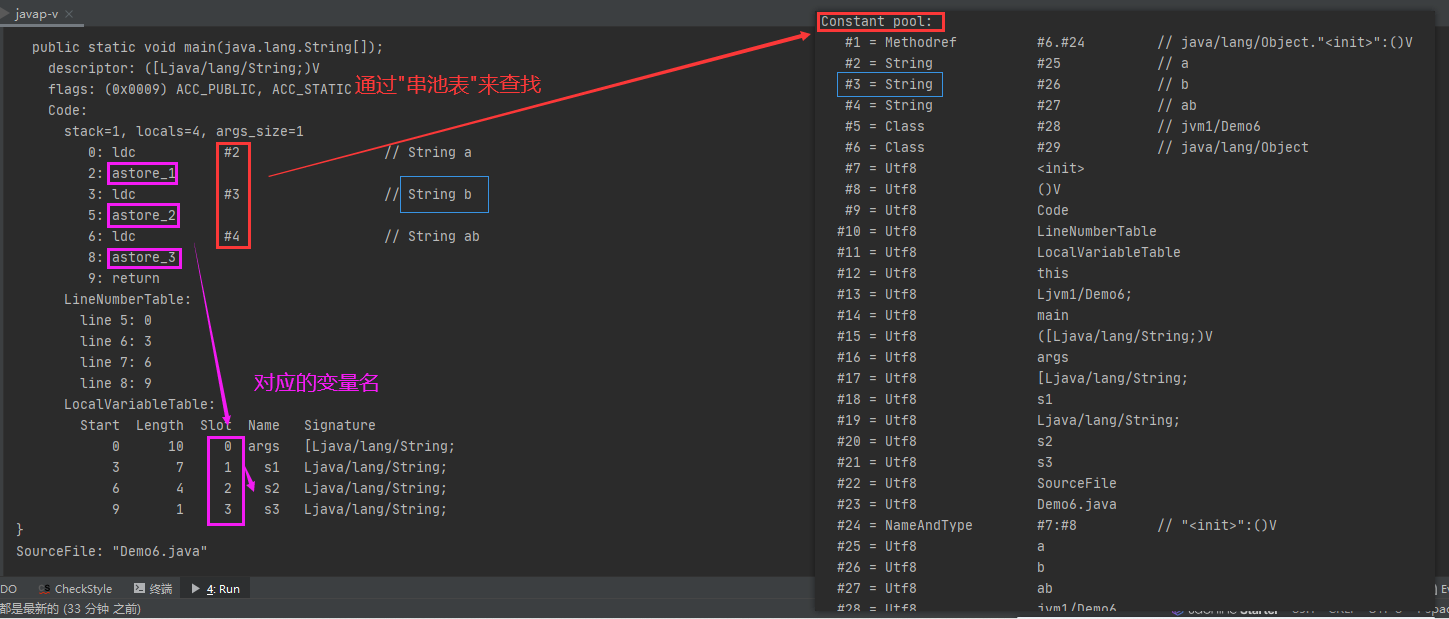
注意:
- StringTable属于Hashtable结构,不能扩容
- Constant pool中的信息,都会被加载到运行时常量池中,这是a b ab都是常量池中的符号,还没有变为java字符串对象
- 例如:
0: ldc #2 会把a符号变为"a"字符串对象(而是用到这行代码才开始创建),此时还要准备StringTable串池[],如果第一次找串池中没有本身对象,那么就要放入串池中为[“a”]。但是如果串池中有,那么只调用 - 不是每个字符串对象事先放在字符串池里,而是用到这行代码才开始创建(属于懒惰行为)
二. StringTable字符串的拼接
问题分析:
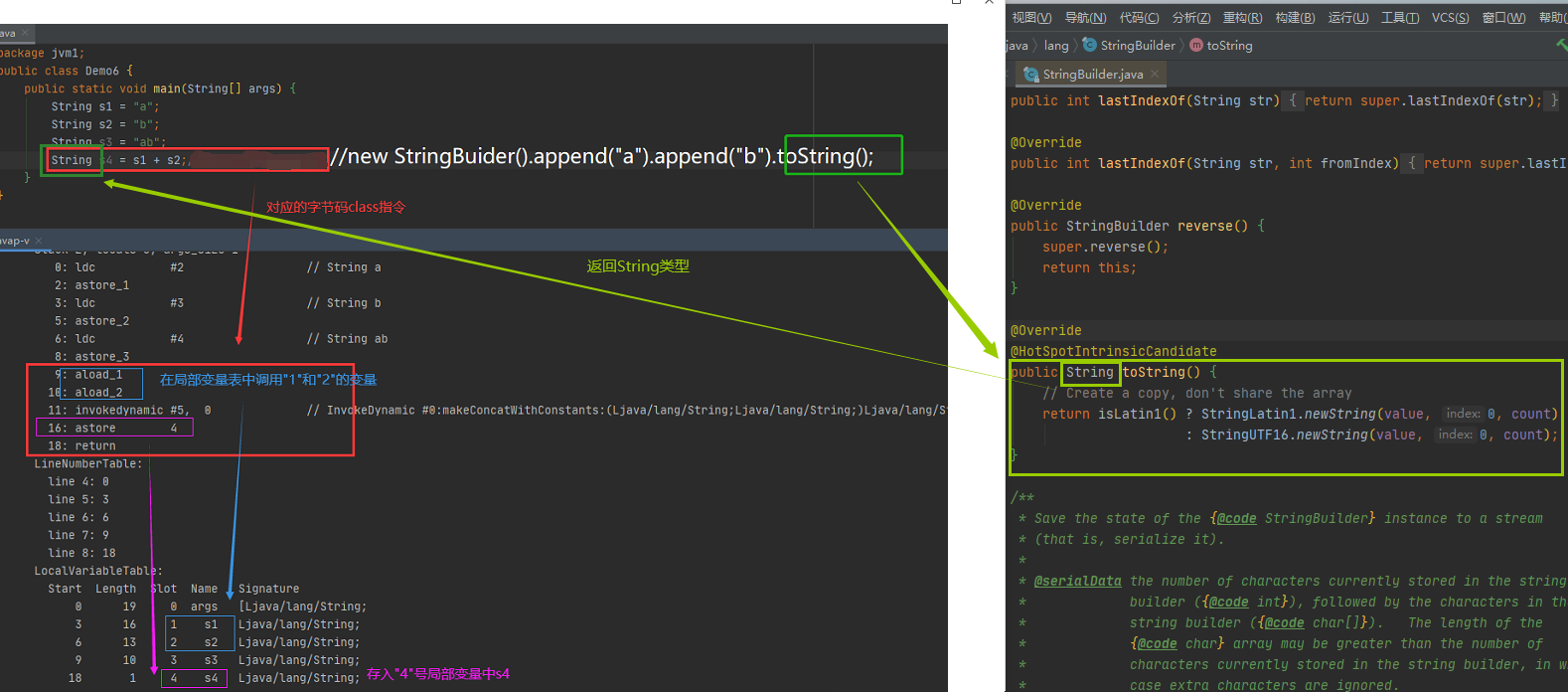
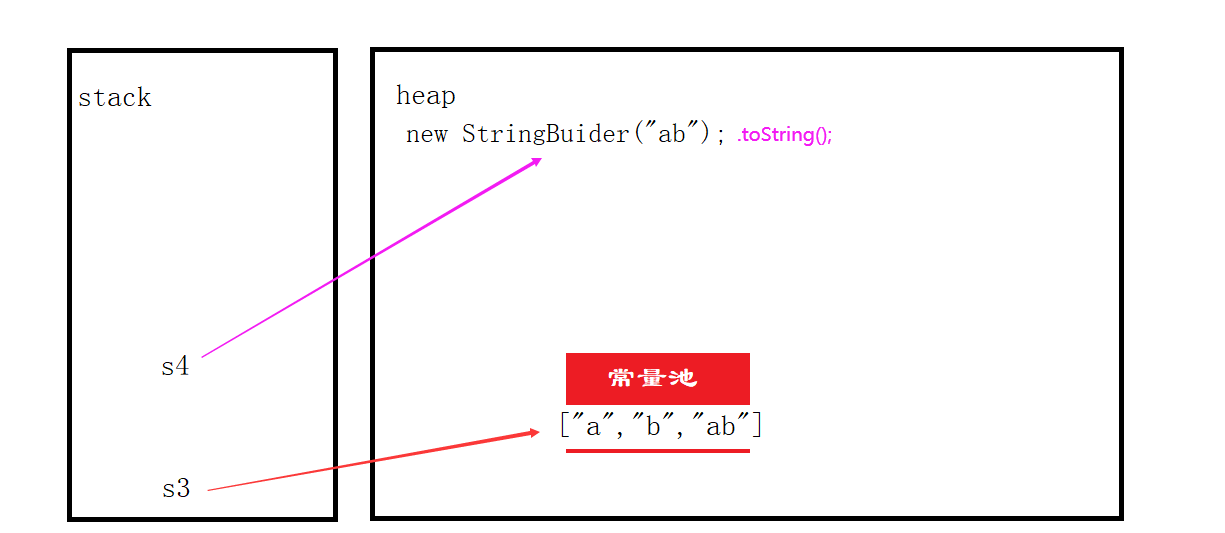
- 问:System.out.println(s3==s4);?
false
原因:s3属于串池中,s4属于堆中,虽然值一样,但是位置不一样
代码:
package jvm1; public class Demo6 { public static void main(String[] args) { String s1 = "a"; String s2 = "b"; String s3 = "ab"; String s4 = s1 + s2; } }- 1
- 2
- 3
- 4
- 5
- 6
- 7
- 8
- 9
源码分析:
public static void main(java.lang.String[]); descriptor: ([Ljava/lang/String;)V flags: (0x0009) ACC_PUBLIC, ACC_STATIC Code: stack=2, locals=5, args_size=1 0: ldc #2 // String a 2: astore_1 3: ldc #3 // String b 5: astore_2 6: ldc #4 // String ab 8: astore_3 9: aload_1 10: aload_2 11: invokedynamic #5, 0 // InvokeDynamic #0:makeConcatWithConstants:(Ljava/lang/String;Ljava/lang/String;)Ljava/lang/String; 16: astore 4 18: return LineNumberTable: line 4: 0 line 5: 3 line 6: 6 line 7: 9 line 9: 18 LocalVariableTable: Start Length Slot Name Signature 0 19 0 args [Ljava/lang/String; 3 16 1 s1 Ljava/lang/String; 6 13 2 s2 Ljava/lang/String; 9 10 3 s3 Ljava/lang/String; 18 1 4 s4 Ljava/lang/String; }- 1
- 2
- 3
- 4
- 5
- 6
- 7
- 8
- 9
- 10
- 11
- 12
- 13
- 14
- 15
- 16
- 17
- 18
- 19
- 20
- 21
- 22
- 23
- 24
- 25
- 26
- 27
- 28
- 29
- 30
- 31
- 32
三. StringTable编译期优化
代码:
package jvm1; public class Demo6 { public static void main(String[] args) { String s1 = "a"; String s2 = "b"; String s3 = "ab"; String s5="a"+"b"; //String s4 = s1 + s2;//new StringBuider().append("a").append("b").toString(); } }- 1
- 2
- 3
- 4
- 5
- 6
- 7
- 8
- 9
- 10
问题分析:

javac 在编译期间的优化,结果已经在编译期间确定为"ab"
四. StringTable字符串延迟加载
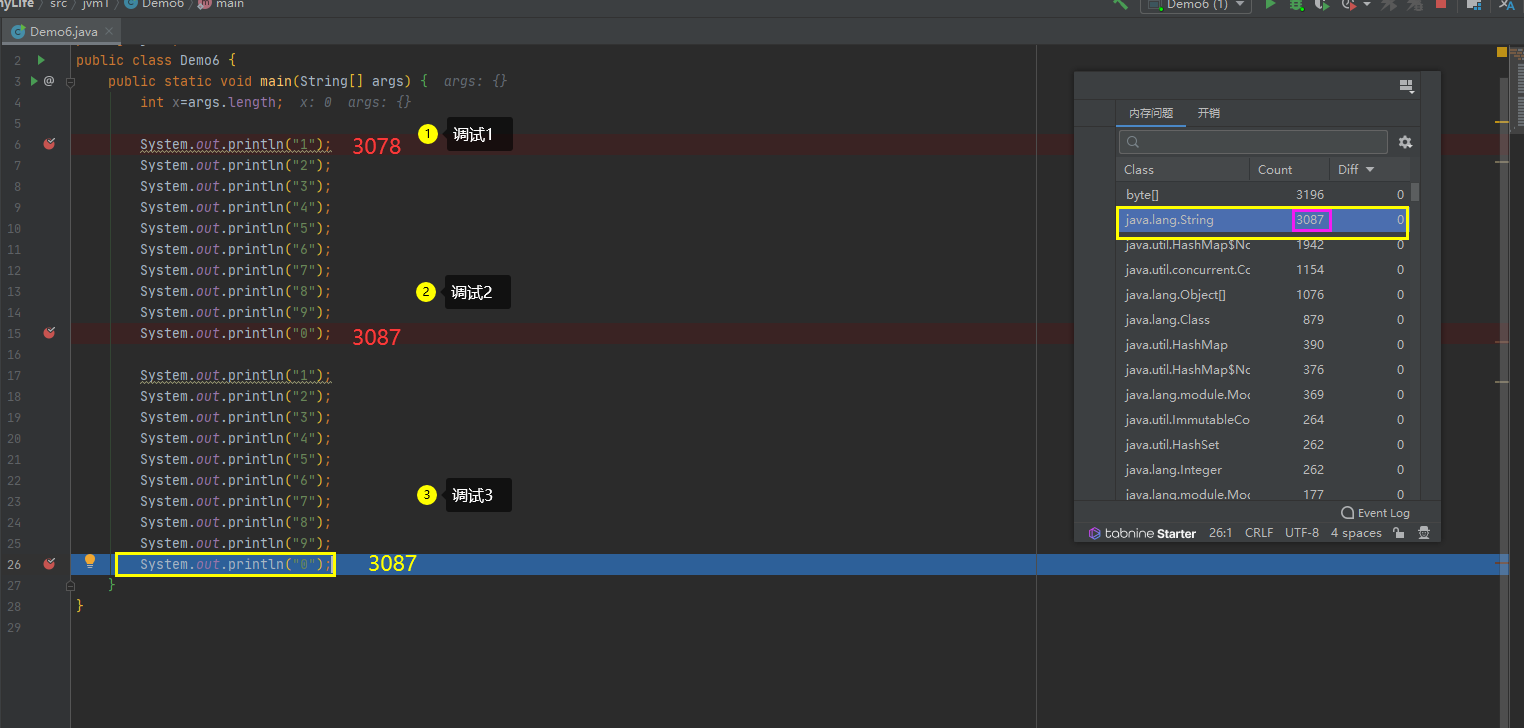
为了查看字符串及其常量池中的变化,这里我采取了IDEA中的调式功能中的Memory(内存问题)子功能
-
调试1

-
调试2

-
调试3
-
说明字符串字面量也是(延迟)成为对象的
五. StringTable特性
-
常量池中的字符串仅是符号,第一次用到时才变为对象
-
利用串池的机制,来避免重复创建字符串对象,串池中的字符串有且仅有一个
-
字符串变量拼接的原理是
StringBuilder (JDK1.8) -
字符串常量拼接的原理是编译期优化(编译即确定)
-
可以使用
intern 方法,主动将串池中还没有的字符串对象放入串池 -
1.8将这个字符串对象尝试放入串池,如果有则并不会放入,如果没有则放入串池, 会把串
池中的对象返回

-
1.6将这个字符串对象尝试放入串池,如果有则并不会放入,如果没有会把此对象复制一份,
放入串池, 会把串池中的对象返回
六. StringTable面试题
package jvm1; public class Demo5 { public static void main(String[] args) { String s1 = "a"; String s2 = "b"; String s3 = "a" + "b";//ab String s4 = s1 + s2;//new String("ab") String s5 = "ab"; String s6 = s4.intern();//由于串池中存入"ab",所以s4还在指向堆中,但是新生成s6是指向串池中的 // 问 System.out.println(s3 == s4);//false System.out.println(s3 == s5);//true System.out.println(s3 == s6);//true String x2 = new String("c") + new String("d");//new String("cd") String x1 = "cd";//"cd" 此时串池中有["cd"] x2.intern();//所以x2返回的值不能放入串池中,仍为堆中 System.out.println(x1 == x2);//false // 问,如果调换了【最后两行代码】的位置呢,如果是jdk1.6呢 System.out.println(x1 == x2); System.out.println(x1 == x2);//true } }- 1
- 2
- 3
- 4
- 5
- 6
- 7
- 8
- 9
- 10
- 11
- 12
- 13
- 14
- 15
- 16
- 17
- 18
- 19
- 20
- 21
- 22
- 23
- 24
- 25
- 26
- 27
- 28
七. StringTable位置
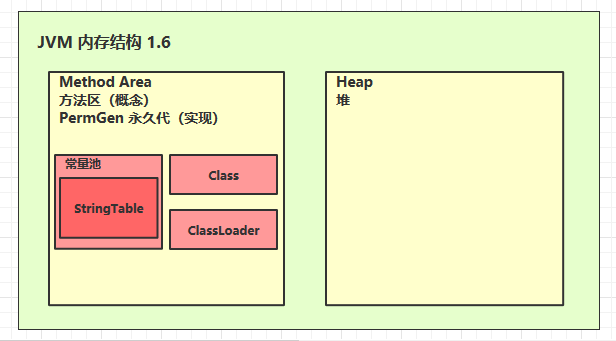
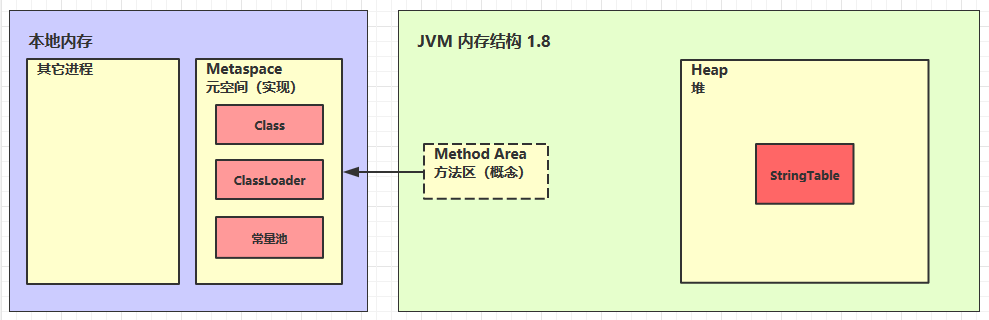
PerGen 永久代(JDK1.6)
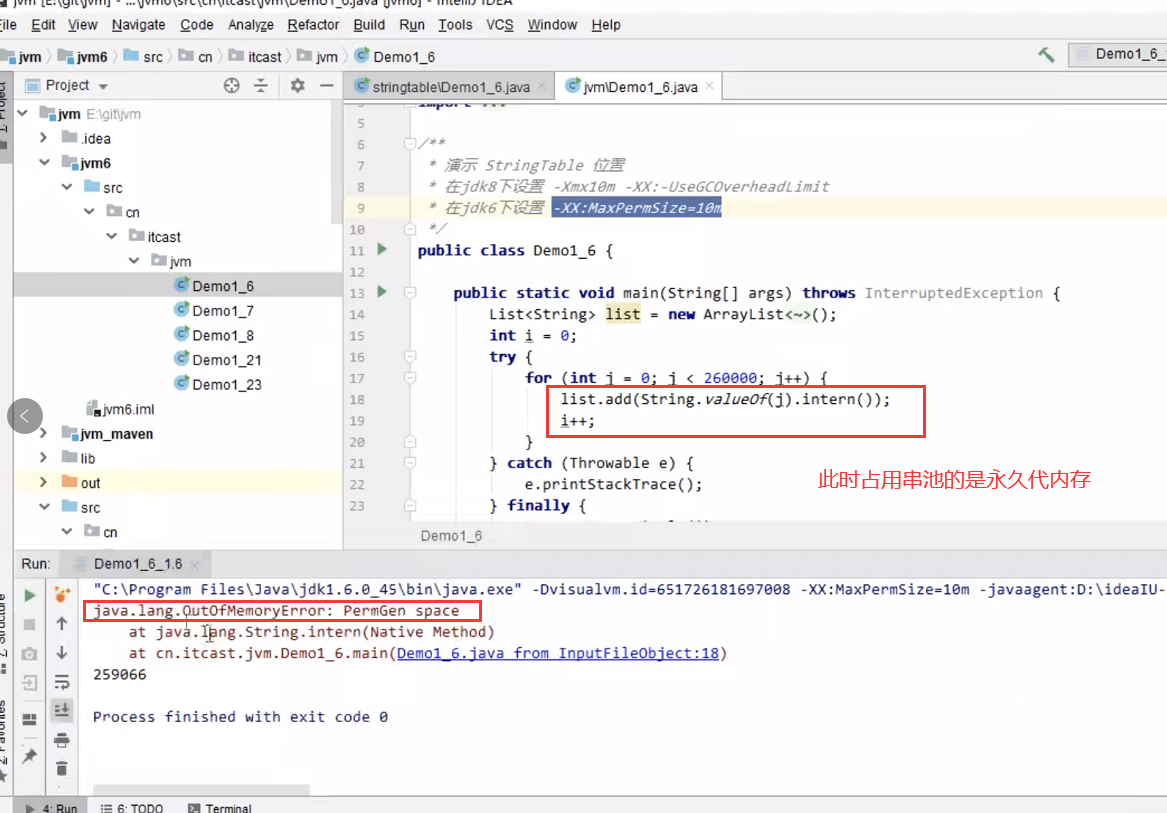
Metaspace 元空间(JDK1.8)- 实例1
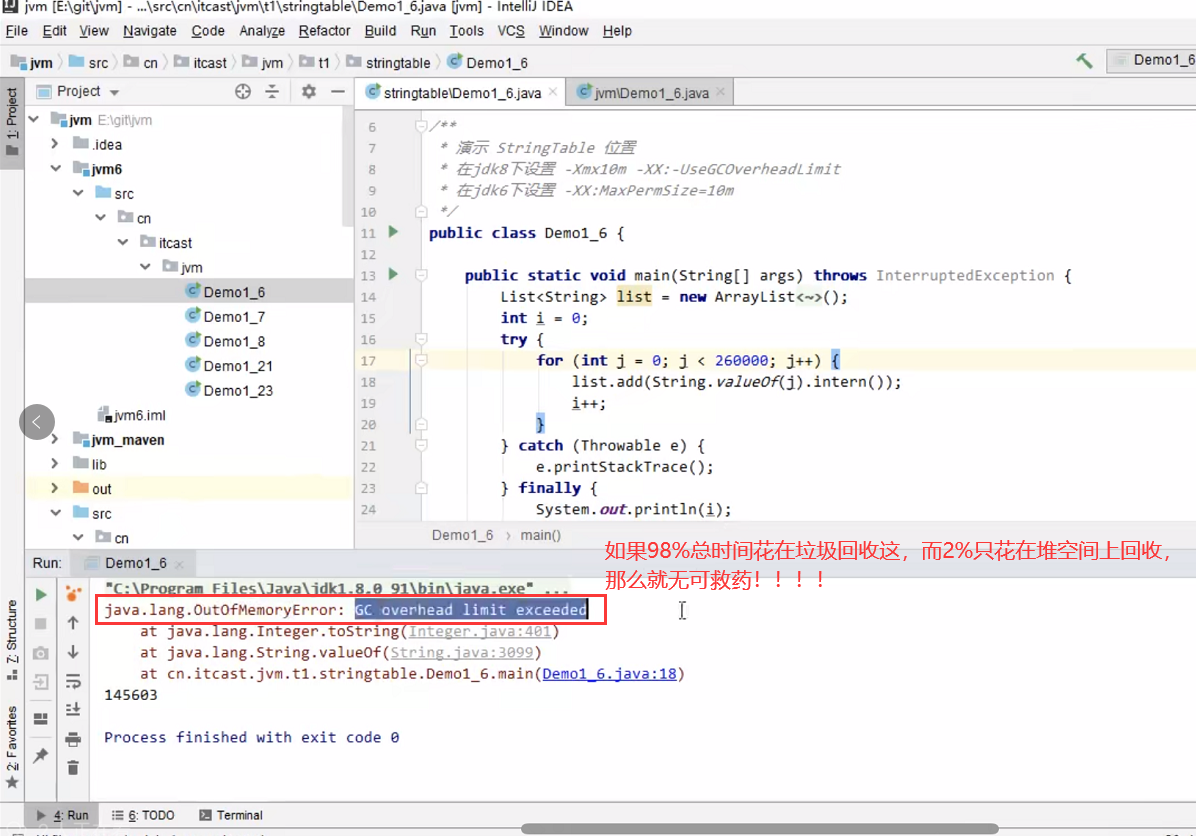
- 实例二(解决后)

- 牵扯的代码
package cn.itcast.jvm.t1.stringtable; import java.util.ArrayList; import java.util.List; /** * 演示 StringTable 位置 * 在jdk8下设置 -Xmx10m -XX:-UseGCOverheadLimit * 在jdk6下设置 -XX:MaxPermSize=10m */ public class Demo1_6 { public static void main(String[] args) throws InterruptedException { List<String> list = new ArrayList<String>(); int i = 0; try { for (int j = 0; j < 260000; j++) { list.add(String.valueOf(j).intern()); i++; } } catch (Throwable e) { e.printStackTrace(); } finally { System.out.println(i); } } }- 1
- 2
- 3
- 4
- 5
- 6
- 7
- 8
- 9
- 10
- 11
- 12
- 13
- 14
- 15
- 16
- 17
- 18
- 19
- 20
- 21
- 22
- 23
- 24
- 25
- 26
- 27
- 28
八. StringTable垃圾回收
演示StringTable垃圾回收
- -Xmx10m 设置JVM虚拟机的堆的值
-XX:+PrintStringTableStatistics打印字符串表的统计信息,可以清楚看到字符串实例的个数和占用的大小信息XX:+PrintGCDetails -verbose:gc显示垃圾回收的次数时间等
-
分析1

-
分析2

-
分析3
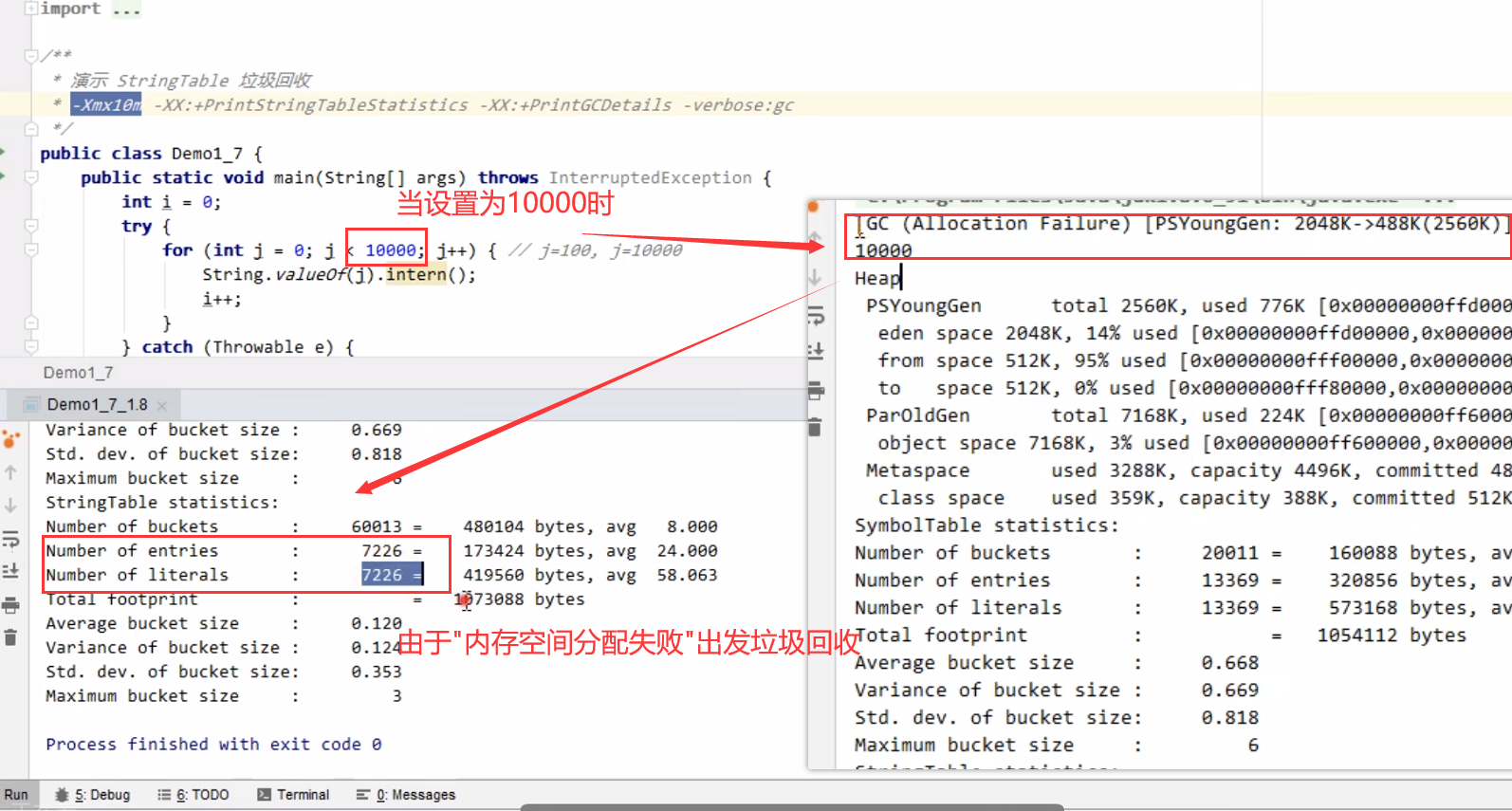
通过分析案例中,我们证明了
StringTable也会发生垃圾回收- 演示的代码
package cn.itcast.jvm.t1.stringtable; import java.util.ArrayList; import java.util.List; /** * 演示 StringTable 垃圾回收 * -Xmx10m -XX:+PrintStringTableStatistics -XX:+PrintGCDetails -verbose:gc */ public class Demo1_7 { public static void main(String[] args) throws InterruptedException { int i = 0; try { for (int j = 0; j < 100000; j++) { // j=100, j=10000 String.valueOf(j).intern(); i++; } } catch (Throwable e) { e.printStackTrace(); } finally { System.out.println(i); } } }- 1
- 2
- 3
- 4
- 5
- 6
- 7
- 8
- 9
- 10
- 11
- 12
- 13
- 14
- 15
- 16
- 17
- 18
- 19
- 20
- 21
- 22
- 23
- 24
- 25
八. StringTable性能调优
调整 -XX:StringTableSize=桶个数
案例:
-
分析1

-
分析2
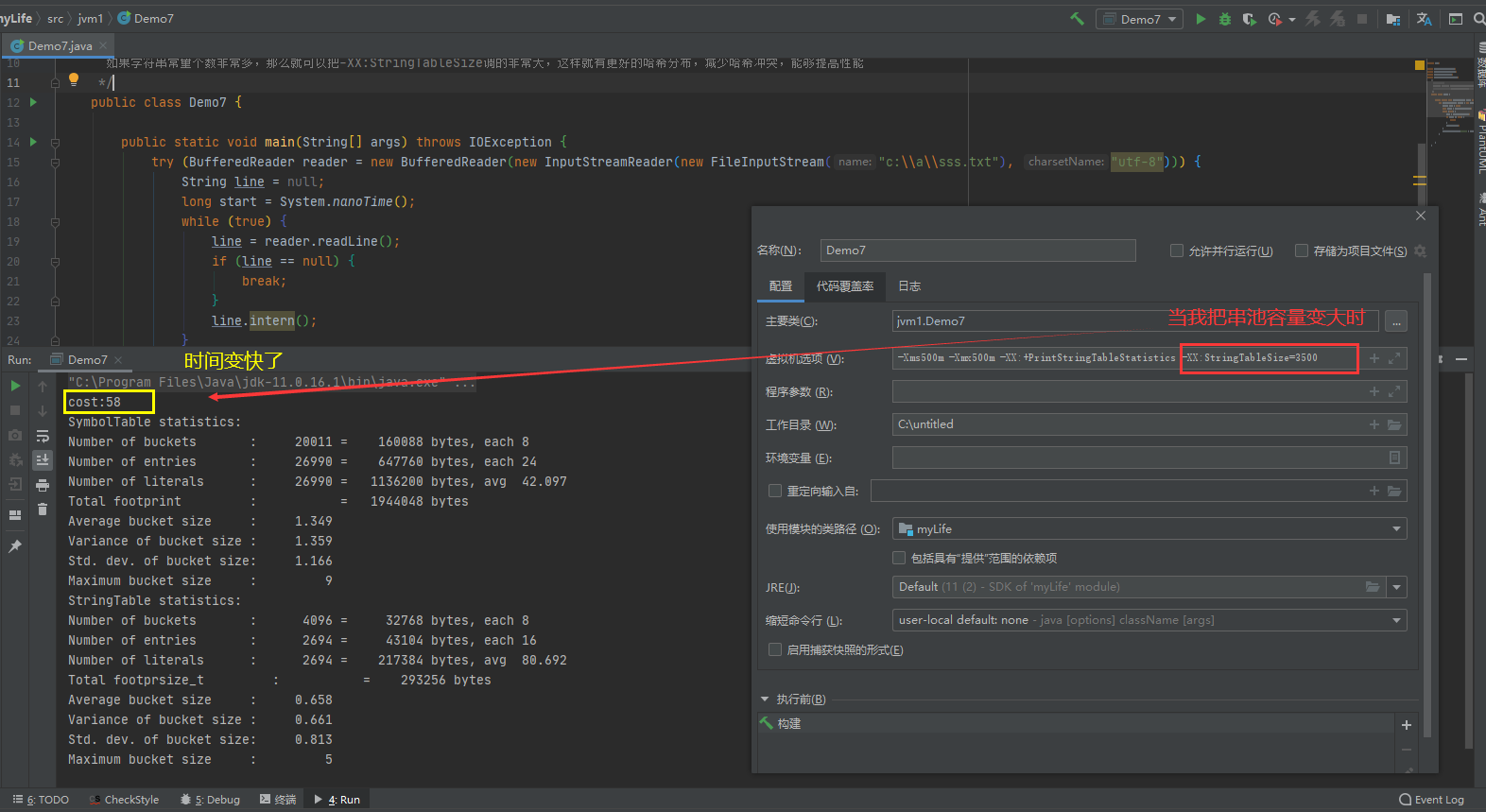
如果字符串常量个数非常多,那么就可以把-XX:StringTableSize调的非常大,这样就有更好的哈希分布,减少哈希冲突,能够提高性能- 代码
package jvm1; import java.io.BufferedReader; import java.io.FileInputStream; import java.io.IOException; import java.io.InputStreamReader; /* 演示串池大小对性能的影响 -Xms500m -Xmx500m -XX:+PrintStringTableStatistics -XX:StringTableSize=1009 */ public class Demo7 { public static void main(String[] args) throws IOException { try (BufferedReader reader = new BufferedReader(new InputStreamReader(new FileInputStream("c:\\a\\sss.txt"), "utf-8"))) { String line = null; long start = System.nanoTime(); while (true) { line = reader.readLine(); if (line == null) { break; } line.intern(); } System.out.println("cost:" + (System.nanoTime() - start) / 1000000); } } }- 1
- 2
- 3
- 4
- 5
- 6
- 7
- 8
- 9
- 10
- 11
- 12
- 13
- 14
- 15
- 16
- 17
- 18
- 19
- 20
- 21
- 22
- 23
- 24
- 25
- 26
- 27
- 28
- 29

考虑将字符串对象是否入池
-
相关阅读:
ZYNQ移植ARM CMSIS_DSP库
[附源码]java毕业设计学生宿舍管理系统设计
C++11——lambda表达式
算法题字符串相关
1225. 报告系统状态的连续日期
算法竞赛进阶指南:士兵(Python)
【C++】GoogleTest进阶之gMock
SpringBoot - 配置 Filter 的几种方式
RocketMQ Promethus Exporter
vue--1.vue开发环境集成、基础指令、属性绑定
- 原文地址:https://blog.csdn.net/o676448/article/details/126480645
