-
yolov7基础知识先导篇
*免责声明:
1\此方法仅提供参考
2\搬了其他博主的操作方法,以贴上路径.
3*场景一:MP
场景二:高效聚合网络
场景三:SPPCSPC
场景四:结构重参数化
场景五:标签分配–>细分方法:simOTA
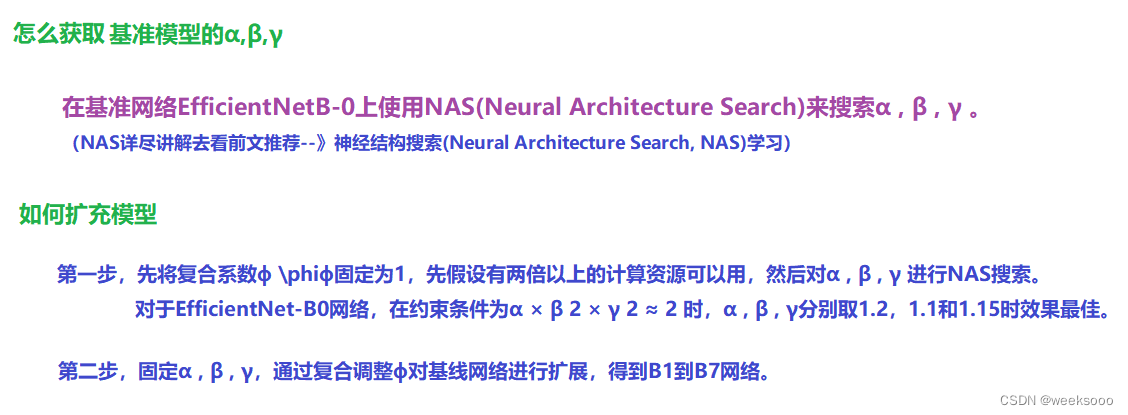
场景六:模型复合缩放
…
场景一:MPC-B、MPC-N
1.1 MPC-B


[-1, 1, MP, []], [-1, 1, Conv, [128, 1, 1]], [-3, 1, Conv, [128, 1, 1]], [-1, 1, Conv, [128, 3, 2]], [[-1, -3], 1, Concat, [1]],- 1
- 2
- 3
- 4
- 5
class MP(nn.Module): def __init__(self, k=2): super(MP, self).__init__() self.m = nn.MaxPool2d(kernel_size=k, stride=k) def forward(self, x): return self.m(x)- 1
- 2
- 3
- 4
- 5
- 6
- 7
1.2 MPC-N

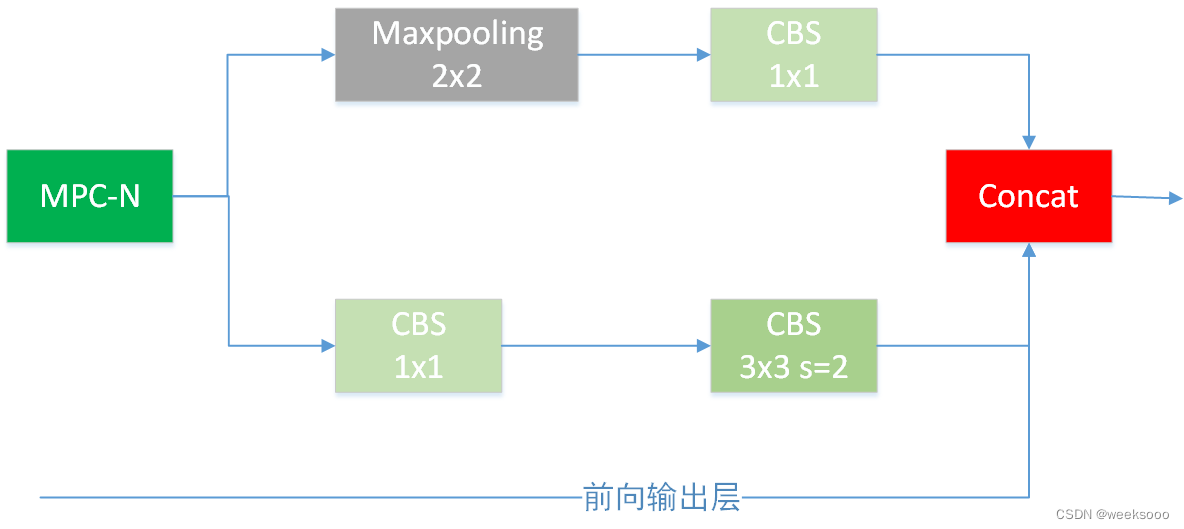
# MPC-H [-1, 1, MP, []], [-1, 1, Conv, [128, 1, 1]], [-3, 1, Conv, [128, 1, 1]], [-1, 1, Conv, [128, 3, 2]], [[-1, -3, 63], 1, Concat, [1]],- 1
- 2
- 3
- 4
- 5
- 6
#MPC-H [-1, 1, MP, []], [-1, 1, Conv, [256, 1, 1]], [-3, 1, Conv, [256, 1, 1]], [-1, 1, Conv, [256, 3, 2]], [[-1, -3, 51], 1, Concat, [1]],- 1
- 2
- 3
- 4
- 5
- 6
…
场景二:高效聚合网络


1.1 VoVNet


1.2 VoVNet v2
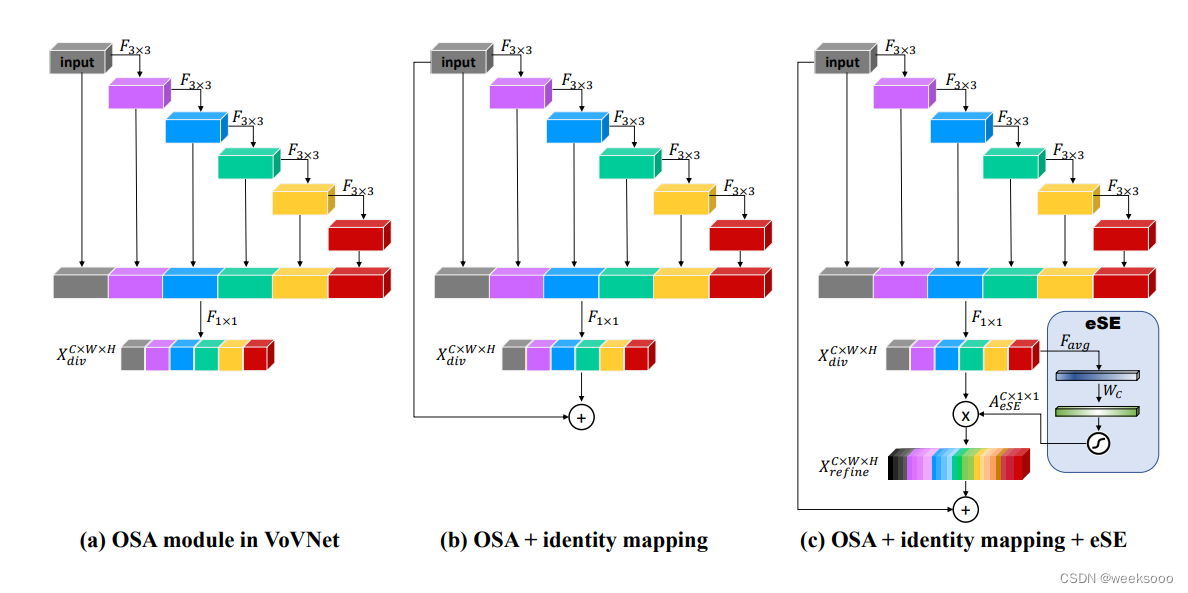
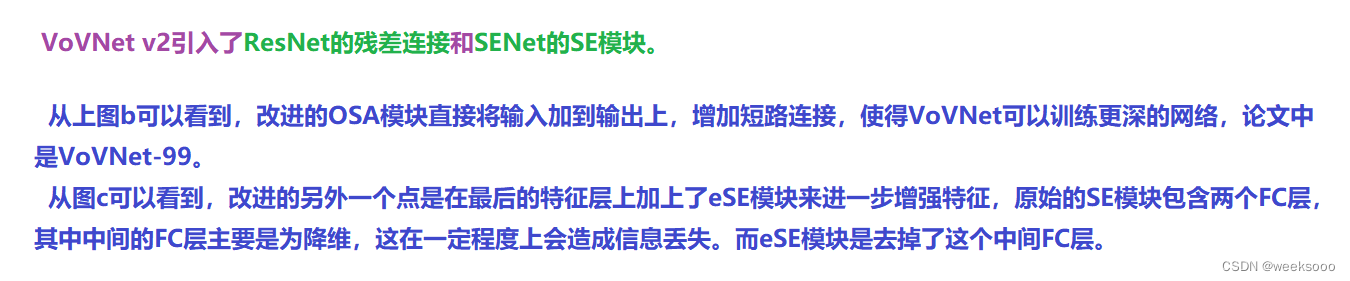
1.3 Yolov7中的ELAN结构


[-1, 1, Conv, [128, 1, 1]], [-2, 1, Conv, [128, 1, 1]], [-1, 1, Conv, [128, 3, 1]], [-1, 1, Conv, [128, 3, 1]], [-1, 1, Conv, [128, 3, 1]], [-1, 1, Conv, [128, 3, 1]], [[-1, -3, -5, -6], 1, Concat, [1]], [-1, 1, Conv, [512, 1, 1]],- 1
- 2
- 3
- 4
- 5
- 6
- 7
- 8
1.4 Yolov7中的ELAN-H结构

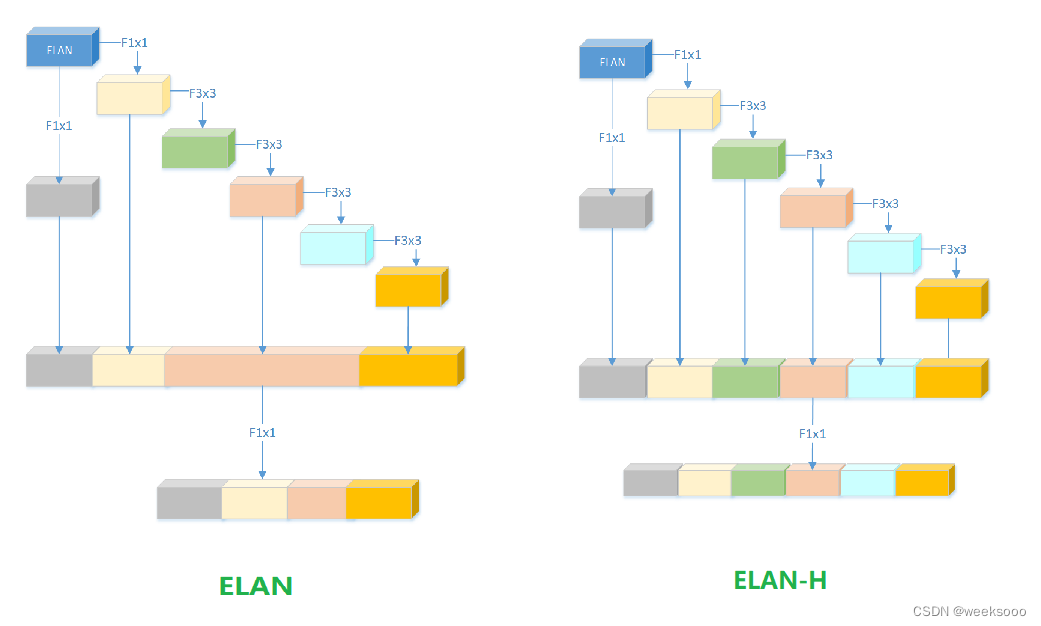
[-1, 1, Conv, [256, 1, 1]], [-2, 1, Conv, [256, 1, 1]], [-1, 1, Conv, [128, 3, 1]], [-1, 1, Conv, [128, 3, 1]], [-1, 1, Conv, [128, 3, 1]], [-1, 1, Conv, [128, 3, 1]], [[-1, -2, -3, -4, -5, -6], 1, Concat, [1]], [-1, 1, Conv, [256, 1, 1]],- 1
- 2
- 3
- 4
- 5
- 6
- 7
- 8
…
场景三:SPPCSPC
空间金字塔池化改进 SPP / SPPF / ASPP / RFB / SPPCSPC
1.1 SPPCSPC
设计理念是什么?????欢迎讨论,很多博主这里结构画错了,这里是正解.

class SPPCSPC(nn.Module): # CSP https://github.com/WongKinYiu/CrossStagePartialNetworks def __init__(self, c1, c2, n=1, shortcut=False, g=1, e=0.5, k=(5, 9, 13)): super(SPPCSPC, self).__init__() c_ = int(2 * c2 * e) # hidden channels self.cv1 = Conv(c1, c_, 1, 1) self.cv2 = Conv(c1, c_, 1, 1) self.cv3 = Conv(c_, c_, 3, 1) self.cv4 = Conv(c_, c_, 1, 1) self.m = nn.ModuleList([nn.MaxPool2d(kernel_size=x, stride=1, padding=x // 2) for x in k]) self.cv5 = Conv(4 * c_, c_, 1, 1) self.cv6 = Conv(c_, c_, 3, 1) self.cv7 = Conv(2 * c_, c2, 1, 1) def forward(self, x): x1 = self.cv4(self.cv3(self.cv1(x))) y1 = self.cv6(self.cv5(torch.cat([x1] + [m(x1) for m in self.m], 1))) y2 = self.cv2(x) return self.cv7(torch.cat((y1, y2), dim=1))- 1
- 2
- 3
- 4
- 5
- 6
- 7
- 8
- 9
- 10
- 11
- 12
- 13
- 14
- 15
- 16
- 17
- 18
- 19
1.2 SPP与SPPF

1.3 SPP3
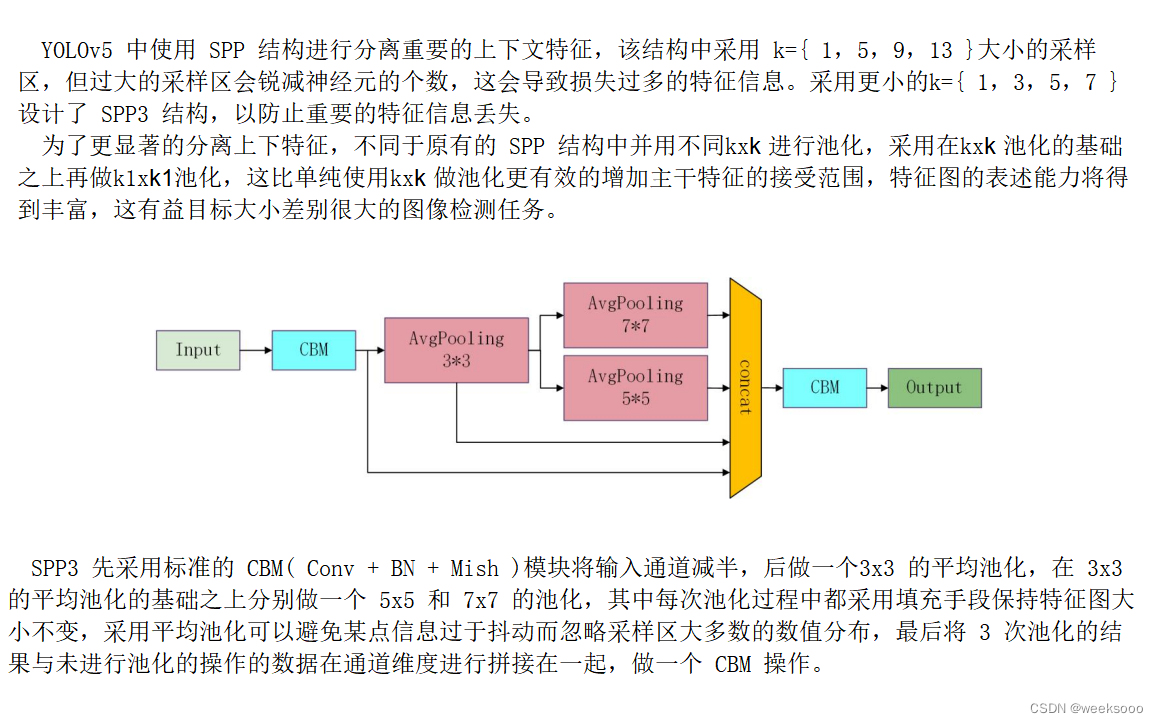
class SPP3(nn.Module): def __init__(self, c1, c2, k1): super().__init__() c_ = c1 // 2 k1, k2, k3 = 3, 5, 7 self.cn1 = Conv(c1, c_, 1, 1) self.cn2 = Conv(c_ * 4, c2, 1, 1) self.m1 = nn.AvgPool2d(kernel_size=k1, stride=1, padding=k1 // 2) self.m2 = nn.AvgPool2d(kernel_size=k2, stride=1, padding=k2 // 2) self.m3 = nn.AvgPool2d(kernel_size=k3, stride=1, padding=k3 // 2) def forward(self, x): x = self.cn1(x) with warnings.catch_warnings(): warnings.simplefilter('ignore') m1 = self.m1(x) m2 = self.m2(m1) m3 = self.m3(m1) return self.cn2(torch.cat([x, m1, m2, m3],1))- 1
- 2
- 3
- 4
- 5
- 6
- 7
- 8
- 9
- 10
- 11
- 12
- 13
- 14
- 15
- 16
- 17
- 18
- 19
…
场景四:结构重参数化
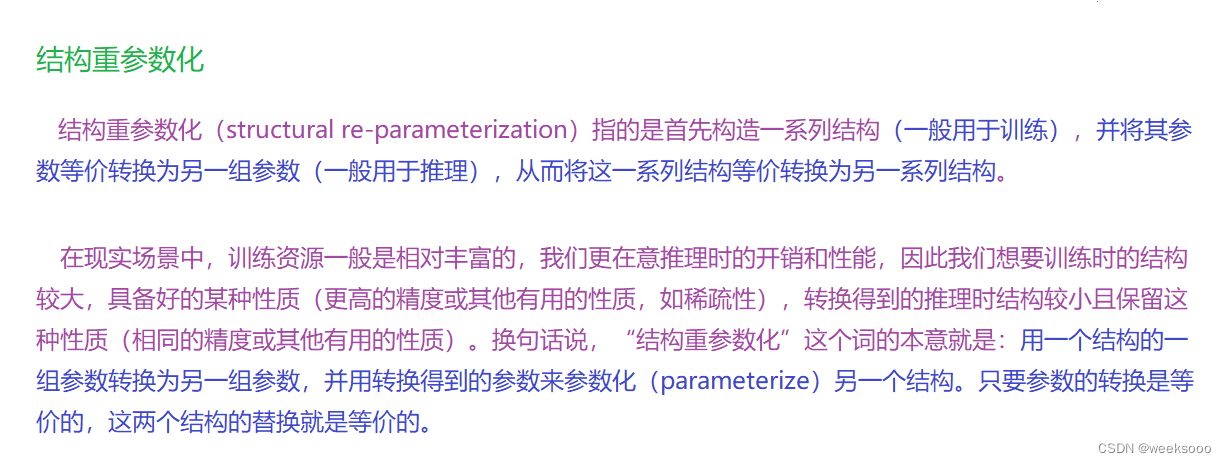
1.1 前言
解读模型压缩6:结构重参数化技术:进可暴力提性能,退可无损做压缩


1.2 ACNet
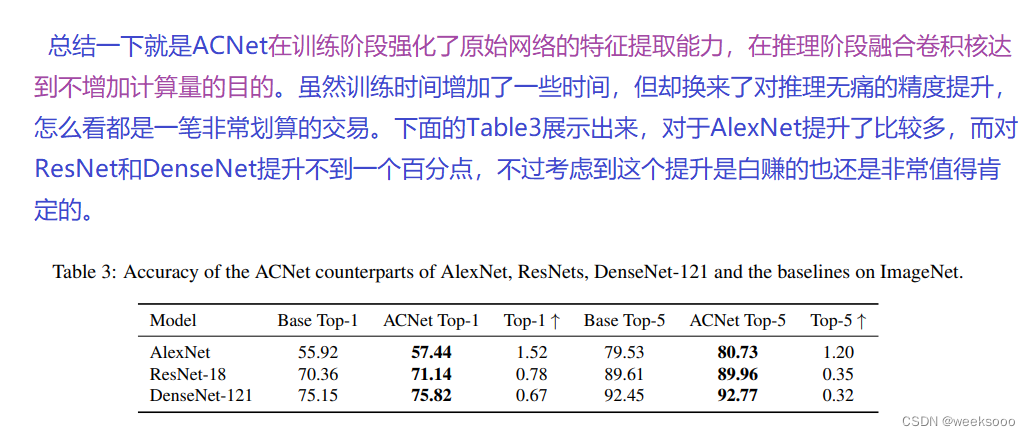
33卷积+13卷积+3*1卷积=白给的精度提升 | ICCV 2019


训练阶段


推理阶段


总结

1.3 RepVGG


训练阶段


推理阶段


不同版本

1.4 Yolov7中的RepConv
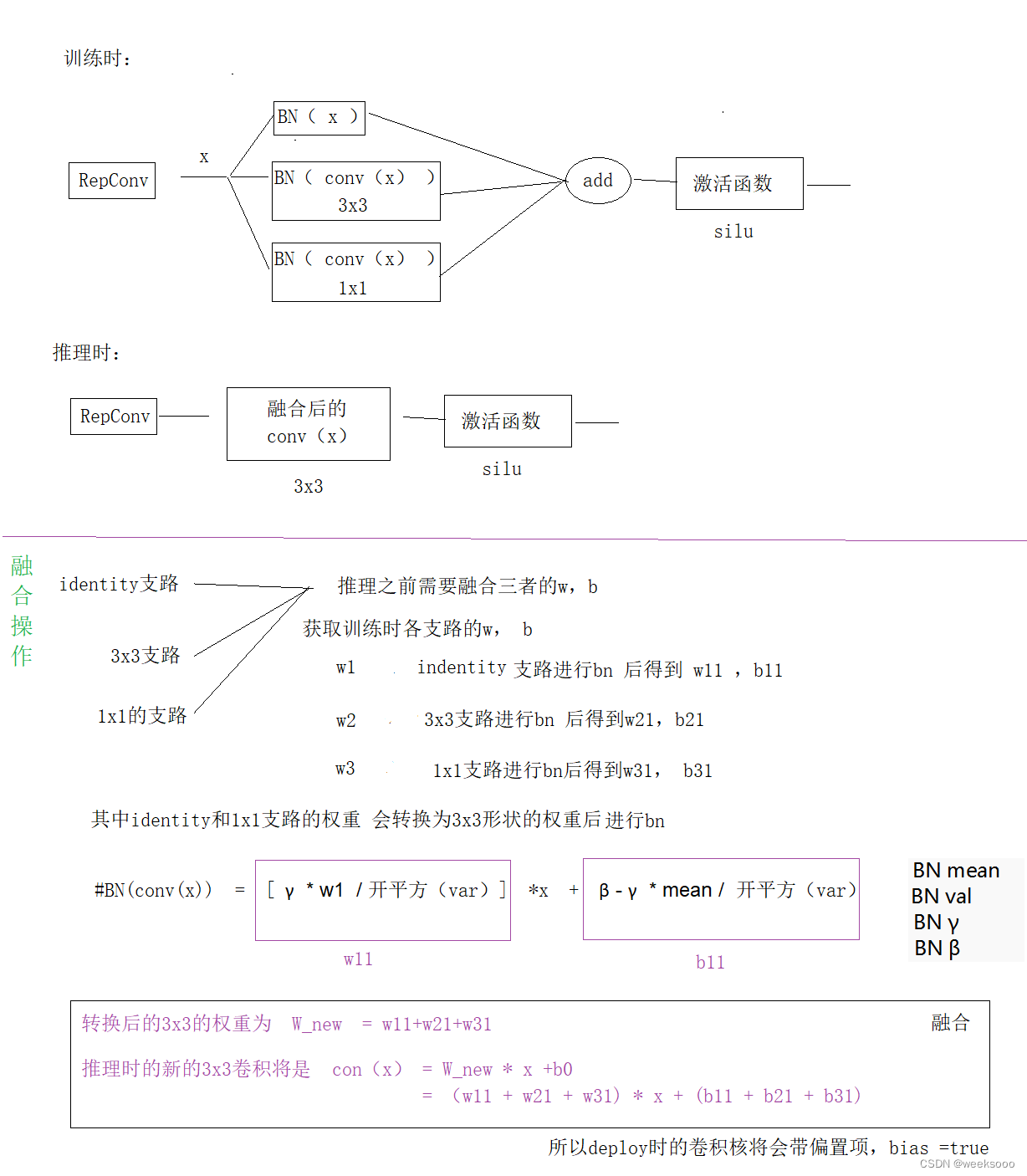
#Yolov7里面的RepConv借鉴的是RepVGG # 重参化结构 class RepConv(nn.Module): #RepVGG网址 https://arxiv.org/abs/2101.03697 def __init__(self, c1, c2, k=3, s=1, p=None, g=1, act=True, deploy=False): super(RepConv, self).__init__() self.deploy = deploy # deploy是推理部署的意思 self.groups = g # 输入的特征层分为几组,这是分组卷积概念,单卡GPU不用考虑,默认为1,分组卷积概念详见下面 self.in_channels = c1 # 输入通道数 self.out_channels = c2 #输出通道数 assert k == 3 assert autopad(k, p) == 1 # 为什么这么设置呢,图像padding=1后经过 3x3 卷积之后图像大小不变 padding_11 = autopad(k, p) - k // 2 self.act = nn.SiLU() if act is True else (act if isinstance(act, nn.Module) else nn.Identity()) # 定义推理模型时,基本block就是一个简单的 conv2D if deploy: self.rbr_reparam = nn.Conv2d(c1, c2, k, s, autopad(k, p), groups=g, bias=True) else: # 定义训练模型时,基本block是 identity、1x1 conv_bn、3x3 conv_bn 组合 # 如果是训练模式,就是执行identity操作+bn ,也就是输入直接+bn self.rbr_identity = (nn.BatchNorm2d(num_features=c1) if c2 == c1 and s == 1 else None) # 普通的3x3的卷积+bn操作 self.rbr_dense = nn.Sequential( nn.Conv2d(c1, c2, k, s, autopad(k, p), groups=g, bias=False), nn.BatchNorm2d(num_features=c2), ) # 普通的1x1的卷积+bn操作 self.rbr_1x1 = nn.Sequential( nn.Conv2d( c1, c2, 1, s, padding_11, groups=g, bias=False), nn.BatchNorm2d(num_features=c2), ) def forward(self, inputs): # hasattr() 函数用于判断对象是否包含对应的属性,也就是如果上面是deploy模式,就有了rbr_reparam属性,也就是重参化参数 if hasattr(self, "rbr_reparam"): return self.act(self.rbr_reparam(inputs)) # 推理阶段, conv2D 后 SiLU if self.rbr_identity is None: #如果bn(x)的操作是0,也就是输入是0,那么输出为0 id_out = 0 else: id_out = self.rbr_identity(inputs) # (返回3x3的卷积+bn) + (1x1的卷积1x1+bn) + (identity+bn的结果) return self.act(self.rbr_dense(inputs) + self.rbr_1x1(inputs) + id_out) #repvgg的转换,也就是训练模式转换为部署模式 def repvgg_convert(self): kernel, bias = self.get_equivalent_kernel_bias() return ( kernel.detach().cpu().numpy(), bias.detach().cpu().numpy(), ) #下面这个函数就是按照论文的方法把1×1卷积和Identity操作转化成3×3卷积的------------------------------------------------------------------ #最后返回的是2个量:kernel3x3 + self._pad_1x1_to_3x3_tensor(kernel1x1) + kernelid和bias3x3 + bias1x1 + biasid。 #分别代表这个等价的3×3卷积的权重和偏置。 def get_equivalent_kernel_bias(self): kernel3x3, bias3x3 = self._fuse_bn_tensor(self.rbr_dense) # BN(3x3 卷积核两个参数 W 和 b)后 提出来 kernel1x1, bias1x1 = self._fuse_bn_tensor(self.rbr_1x1) #BN(1x1 卷积核两个参数 W 和 b)后 提出来 kernelid, biasid = self._fuse_bn_tensor(self.rbr_identity) # 卷积核运算本质就是 W(x)+b,融合的策略是w相加,b相加 ,但是为啥 identity 可以提取W、b?看后面 return ( kernel3x3 + self._pad_1x1_to_3x3_tensor(kernel1x1) + kernelid, bias3x3 + bias1x1 + biasid, ) #将1x1的卷积转换为3x3的卷积 def _pad_1x1_to_3x3_tensor(self, kernel1x1): if kernel1x1 is None: return 0 else: return nn.functional.pad(kernel1x1, [1, 1, 1, 1]) # 这代码讲的是将 1x1 conv padding 一圈成 3x3 conv,填充的是0 # [0 0 0] # [1] >>>padding>>> [0 1 0] # [0 0 0] # 各分支的卷积进行bn操作,返回对应的bn # 融合bn操作,这个函数的作用是“吸BN”,是怎么返回w 核 b def _fuse_bn_tensor(self, branch): if branch is None: return 0, 0 # 当branch不是3x3、1x1、BN,那就返回 W=0, b=0 # 普通的3x3的卷积+bn操作 self.rbr_dense = nn.Sequential( nn.Conv2d(c1, c2, k, s, autopad(k, p), groups=g, bias=False), nn.BatchNorm2d(num_features=c2),) # 普通的1x1的卷积+bn操作 self.rbr_1x1 = nn.Sequential( nn.Conv2d( c1, c2, 1, s, padding_11, groups=g, bias=False), nn.BatchNorm2d(num_features=c2), ) # 当branch是3x3、1x1卷积时候,返回以上数据,为后面做融合 if isinstance(branch, nn.Sequential): kernel = branch[0].weight # conv权重 ,这里不考虑卷积带偏置项的情况 running_mean = branch[1].running_mean # BN mean running_var = branch[1].running_var # BN val gamma = branch[1].weight # BN γ beta = branch[1].bias # BN β eps = branch[1].eps # 防止分母为0 else: #如果是identity的操作,这里branch就是nn.BatchNorm2d ; 前文 self.rbr_identity = (nn.BatchNorm2d(num_features=c1) if c2 == c1 and s == 1 else None) assert isinstance(branch, nn.BatchNorm2d) if not hasattr(self, "id_tensor"): input_dim = self.in_channels // self.groups # 通道分组,单个GPU不用考虑,详情去搜索分组卷积 # 定义 Conv size为(in_channles, input_dim , 3,3)的全0数组 kernel_value = np.zeros( (self.in_channels, input_dim, 3, 3), dtype=np.float32 ) # 将卷积核中心部分部分赋予1, 1x1的卷积-->3x3的卷积的本质是 在1的周围填充0,也就是将(1,1)的位置设置为1 #假如输入输出的通道数是3 , 也就是有3个卷积核 , 每个卷积核有3个1x1的卷积操作, # indentity-->3x3的卷积操作就是 将 (0 , 0 ,1,1) , (1,1,1,1), (2,2,1,1)的位置为0 for i in range(self.in_channels): kernel_value[i, i % input_dim, 1, 1] = 1 self.id_tensor = torch.from_numpy(kernel_value).to(branch.weight.device) #这样操作以后的identity的权重就变为了3x3 kernel = self.id_tensor # conv权重 running_mean = branch.running_mean # BN mean running_var = branch.running_var # BN va gamma = branch.weight # BN γ beta = branch.bias # BN β eps = branch.eps # 防止分母为0 #BN(conv(x)) = [ γ *w / 开平方(var)] *x + β - γ * mean / 开平方(var) std = (running_var + eps).sqrt() #kernel是四维张量,而t是个1维向量,所以会t = (gamma / std).reshape(-1, 1, 1, 1)使其维度和kernel匹配上。 t = (gamma / std).reshape(-1, 1, 1, 1) return kernel * t, beta - running_mean * gamma / std #-------------------------------------------------------------------------------------------------------------------------------------------------- def fuse_conv_bn(self, conv, bn): std = (bn.running_var + bn.eps).sqrt() bias = bn.bias - bn.running_mean * bn.weight / std t = (bn.weight / std).reshape(-1, 1, 1, 1) weights = conv.weight * t bn = nn.Identity() conv = nn.Conv2d(in_channels = conv.in_channels, out_channels = conv.out_channels, kernel_size = conv.kernel_size, stride=conv.stride, padding = conv.padding, dilation = conv.dilation, groups = conv.groups, bias = True, padding_mode = conv.padding_mode) conv.weight = torch.nn.Parameter(weights) conv.bias = torch.nn.Parameter(bias) return conv def fuse_repvgg_block(self): if self.deploy: return print(f"RepConv.fuse_repvgg_block") self.rbr_dense = self.fuse_conv_bn(self.rbr_dense[0], self.rbr_dense[1]) self.rbr_1x1 = self.fuse_conv_bn(self.rbr_1x1[0], self.rbr_1x1[1]) rbr_1x1_bias = self.rbr_1x1.bias weight_1x1_expanded = torch.nn.functional.pad(self.rbr_1x1.weight, [1, 1, 1, 1]) # Fuse self.rbr_identity if (isinstance(self.rbr_identity, nn.BatchNorm2d) or isinstance(self.rbr_identity, nn.modules.batchnorm.SyncBatchNorm)): # print(f"fuse: rbr_identity == BatchNorm2d or SyncBatchNorm") identity_conv_1x1 = nn.Conv2d( in_channels=self.in_channels, out_channels=self.out_channels, kernel_size=1, stride=1, padding=0, groups=self.groups, bias=False) identity_conv_1x1.weight.data = identity_conv_1x1.weight.data.to(self.rbr_1x1.weight.data.device) identity_conv_1x1.weight.data = identity_conv_1x1.weight.data.squeeze().squeeze() # print(f" identity_conv_1x1.weight = {identity_conv_1x1.weight.shape}") identity_conv_1x1.weight.data.fill_(0.0) identity_conv_1x1.weight.data.fill_diagonal_(1.0) identity_conv_1x1.weight.data = identity_conv_1x1.weight.data.unsqueeze(2).unsqueeze(3) # print(f" identity_conv_1x1.weight = {identity_conv_1x1.weight.shape}") identity_conv_1x1 = self.fuse_conv_bn(identity_conv_1x1, self.rbr_identity) bias_identity_expanded = identity_conv_1x1.bias weight_identity_expanded = torch.nn.functional.pad(identity_conv_1x1.weight, [1, 1, 1, 1]) else: # print(f"fuse: rbr_identity != BatchNorm2d, rbr_identity = {self.rbr_identity}") bias_identity_expanded = torch.nn.Parameter( torch.zeros_like(rbr_1x1_bias) ) weight_identity_expanded = torch.nn.Parameter( torch.zeros_like(weight_1x1_expanded) ) #print(f"self.rbr_1x1.weight = {self.rbr_1x1.weight.shape}, ") #print(f"weight_1x1_expanded = {weight_1x1_expanded.shape}, ") #print(f"self.rbr_dense.weight = {self.rbr_dense.weight.shape}, ") self.rbr_dense.weight = torch.nn.Parameter(self.rbr_dense.weight + weight_1x1_expanded + weight_identity_expanded) self.rbr_dense.bias = torch.nn.Parameter(self.rbr_dense.bias + rbr_1x1_bias + bias_identity_expanded) self.rbr_reparam = self.rbr_dense self.deploy = True if self.rbr_identity is not None: del self.rbr_identity self.rbr_identity = None if self.rbr_1x1 is not None: del self.rbr_1x1 self.rbr_1x1 = None if self.rbr_dense is not None: del self.rbr_dense self.rbr_dense = None- 1
- 2
- 3
- 4
- 5
- 6
- 7
- 8
- 9
- 10
- 11
- 12
- 13
- 14
- 15
- 16
- 17
- 18
- 19
- 20
- 21
- 22
- 23
- 24
- 25
- 26
- 27
- 28
- 29
- 30
- 31
- 32
- 33
- 34
- 35
- 36
- 37
- 38
- 39
- 40
- 41
- 42
- 43
- 44
- 45
- 46
- 47
- 48
- 49
- 50
- 51
- 52
- 53
- 54
- 55
- 56
- 57
- 58
- 59
- 60
- 61
- 62
- 63
- 64
- 65
- 66
- 67
- 68
- 69
- 70
- 71
- 72
- 73
- 74
- 75
- 76
- 77
- 78
- 79
- 80
- 81
- 82
- 83
- 84
- 85
- 86
- 87
- 88
- 89
- 90
- 91
- 92
- 93
- 94
- 95
- 96
- 97
- 98
- 99
- 100
- 101
- 102
- 103
- 104
- 105
- 106
- 107
- 108
- 109
- 110
- 111
- 112
- 113
- 114
- 115
- 116
- 117
- 118
- 119
- 120
- 121
- 122
- 123
- 124
- 125
- 126
- 127
- 128
- 129
- 130
- 131
- 132
- 133
- 134
- 135
- 136
- 137
- 138
- 139
- 140
- 141
- 142
- 143
- 144
- 145
- 146
- 147
- 148
- 149
- 150
- 151
- 152
- 153
- 154
- 155
- 156
- 157
- 158
- 159
- 160
- 161
- 162
- 163
- 164
- 165
- 166
- 167
- 168
- 169
- 170
- 171
- 172
- 173
- 174
- 175
- 176
- 177
- 178
- 179
- 180
- 181
- 182
- 183
- 184
- 185
- 186
- 187
- 188
- 189
- 190
- 191
- 192
- 193
- 194
- 195
- 196
- 197
- 198
- 199
- 200
- 201
- 202
- 203
- 204
- 205
- 206
- 207
- 208
- 209
- 210
- 211
- 212
- 213
- 214
- 215
- 216
- 217
- 218
- 219
- 220
- 221
- 222
- 223
- 224
- 225
- 226
- 227
- 228
- 229
- 230
- 231
- 232
- 233
- 234
- 235
- 236
- 237
- 238
- 239
- 240
- 241
- 242
- 243
- 244
- 245
- 246
…
场景五:标签分配–>细分方法:simOTA


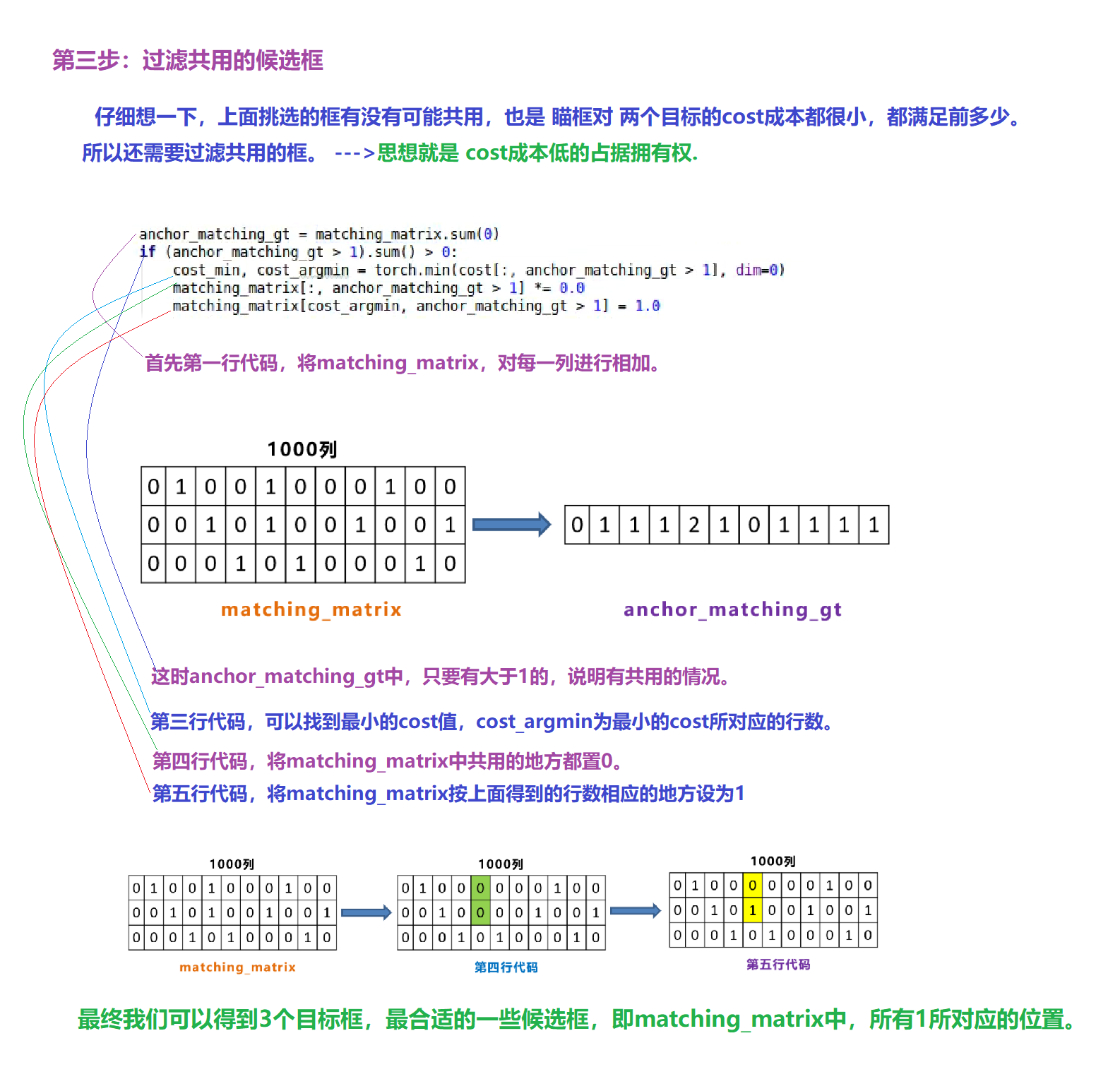
…
场景六:模型复合缩放
1.1 模型缩放


1.2 EfficientNet
【一看就懂】EfficientNet详解。凭什么EfficientNet号称当今最强?
神经结构搜索(Neural Architecture Search, NAS)学习



…
you did it

-
相关阅读:
redis增删改查
使用 Ring Buffer 完成数据传递
k8s--基础--19--DaemonSet
PerfView专题 (第四篇):如何寻找 C# 中程序集泄漏
Flink中的批和流
【深度学习】记录为什么没有调用GPU
C语言详解(文件操作)2
机器人力控制构架
IOC容器加载过程及Bean的生命周期和后置处理器
线上数据问题排查案例分享-因为 HMS 和底层 orc 文件中某字段的数据精度不一致造成的数据丢失问题
- 原文地址:https://blog.csdn.net/qq_41580422/article/details/126317027
