-
NR 物理层 狄拉克函数3 狄拉克傅里叶变换深度剖析
参考:
Explains why the Fourier transform of a sum of delta impulse functions is also a sum of delta impulse functions, but in the frequency domain. Intuitively it might seem like the Fourier transform should be a constant in the frequency domain, since the transform of a single delta function is a constant. But it doesn't work out like that.
前言:
这篇10分钟左右的课程深入的剖析抽样函数的傅里叶变换.
目录:
1: 问题
2: 相位谱解释
一 问题
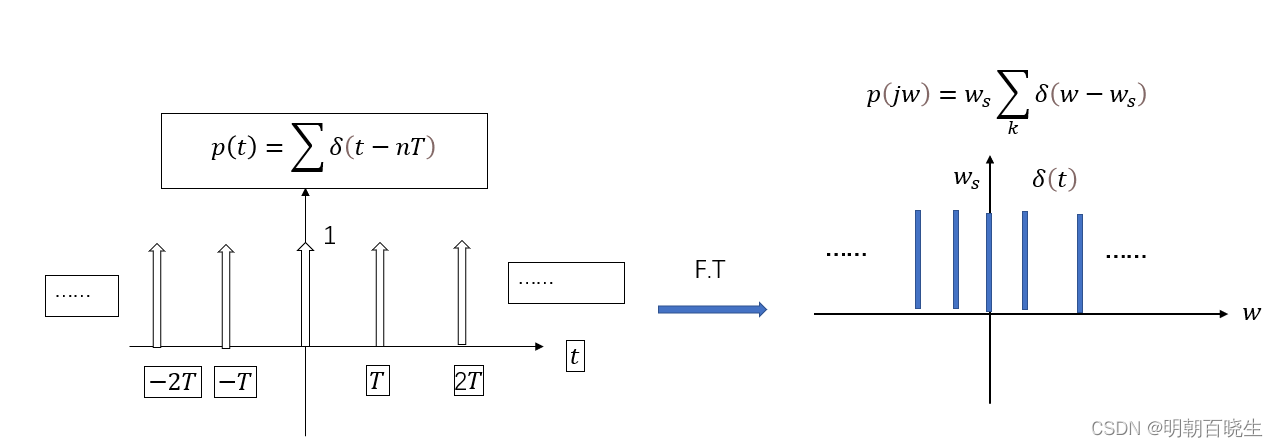
前面我们知道抽样函数的傅里叶变换为


这个有点违反直觉(why is it counter- intuitive?)

我们前面知道单独一个狄拉克函数傅里叶变换是一个常数(flat functions)抽样函数是很多
狄拉克函数的线性和,其傅里叶变换也应该是很多常数的线性和,而不是脉冲串,这个就是
很多人的疑惑点,违反直觉。
二 相位谱解释
产生上述原因,主要是我们忽略了相位谱。
这里结合主要结合相位谱,讨论为什么w 一定要取
 的整数倍
的整数倍主要原理: contribution to the fourier transform at that freqeuency
2.1 n =0,
 傅里叶变换后相位为0
相位

2.2 n=1
 ,傅里叶变换后相位为-wT


这里面固定T,讨论W:
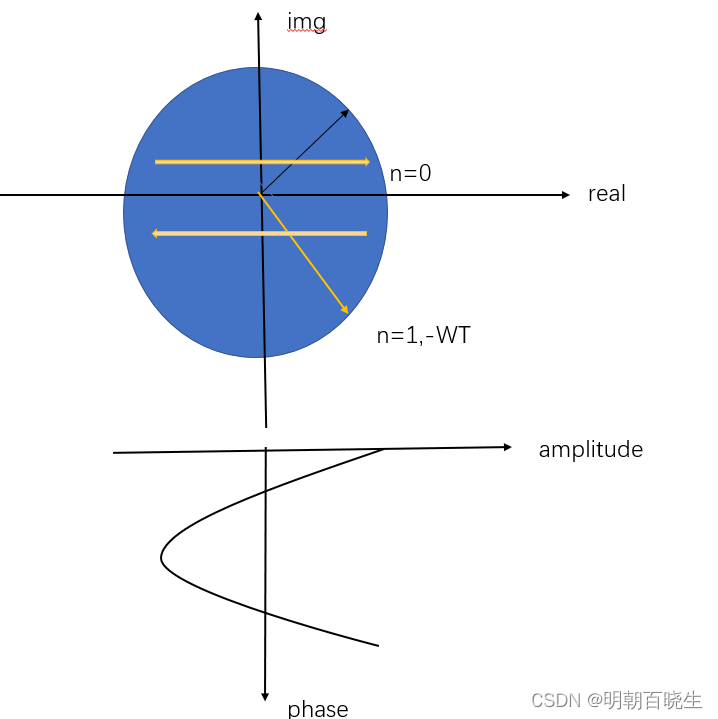
因为是一个复数,我们可以用一个圆来表示,x坐标轴表示实部,y坐标轴表示虚部。
我们从下面图中可以看到虚部,因为w 从负无穷到正无穷,所以相位总是有个相反的相位,
所以虚部投影可以不考虑,被对消了
只考虑在real坐标轴上面的投影:
相当于随着w变化,先减小再增大,周期性变化
固定w,考虑几个特殊情况
1

抽样信号傅里叶变换后,其只有4种相位, 叠加后实部 虚部和都为0
zero contribution to the fourier transform at that frequency .

2

同样
zero contribution to the fourier transform at that frequency .

3
 , 这个时候其和就不是0了,是一个常数,所以
w 必须等于


4


因为抽样信号n从负无穷到正无穷,所以最后傅里叶变换后,整个可以对消掉。
add up all the contributions ,they all cancel.
-
相关阅读:
const常量和基础数据类型
FPGA笔试
MySQL(十一) 用户管理
VLAN间路由:单臂路由与三层交换
18.在springboot中的RedisTemplate序列化,json序列化
【初识Jmeter】【接口自动化】
dpi是什么?如何更改dpi?(仅个人笔记,可能有误)
Android上面做Flash播放器
SQLServer和Oracle,存储过程区别,常用函数对比
NodeJs 中 eval的替代函数
- 原文地址:https://blog.csdn.net/chengxf2/article/details/126365780