-
空间金字塔池化改进 SPP / SPPF / ASPP / RFB / SPPCSPC
更新日志:2022年8月16日上午9:33分前在图片中增加感受野标注🍀
1 原理
1.1 SPP(Spatial Pyramid Pooling)
SPP模块是何凯明大神在2015年的论文《Spatial Pyramid Pooling in Deep Convolutional Networks for Visual Recognition》中被提出。SPP全程为空间金字塔池化结构,主要是为了解决两个问题:- 有效避免了对图像区域裁剪、缩放操作导致的图像失真等问题;
- 解决了卷积神经网络对图相关重复特征提取的问题,大大提高了产生候选框的速度,且节省了计算成本。


class SPP(nn.Module): # Spatial Pyramid Pooling (SPP) layer https://arxiv.org/abs/1406.4729 def __init__(self, c1, c2, k=(5, 9, 13)): super().__init__() c_ = c1 // 2 # hidden channels self.cv1 = Conv(c1, c_, 1, 1) self.cv2 = Conv(c_ * (len(k) + 1), c2, 1, 1) self.m = nn.ModuleList([nn.MaxPool2d(kernel_size=x, stride=1, padding=x // 2) for x in k]) def forward(self, x): x = self.cv1(x) with warnings.catch_warnings(): warnings.simplefilter('ignore') # suppress torch 1.9.0 max_pool2d() warning return self.cv2(torch.cat([x] + [m(x) for m in self.m], 1))- 1
- 2
- 3
- 4
- 5
- 6
- 7
- 8
- 9
- 10
- 11
- 12
- 13
- 14
1.2 SPPF(Spatial Pyramid Pooling - Fast)
这个是YOLOv5作者
Glenn Jocher基于SPP提出的,速度较SPP快很多,所以叫SPP-Fast
class SPPF(nn.Module): # Spatial Pyramid Pooling - Fast (SPPF) layer for YOLOv5 by Glenn Jocher def __init__(self, c1, c2, k=5): # equivalent to SPP(k=(5, 9, 13)) super().__init__() c_ = c1 // 2 # hidden channels self.cv1 = Conv(c1, c_, 1, 1) self.cv2 = Conv(c_ * 4, c2, 1, 1) self.m = nn.MaxPool2d(kernel_size=k, stride=1, padding=k // 2) def forward(self, x): x = self.cv1(x) with warnings.catch_warnings(): warnings.simplefilter('ignore') # suppress torch 1.9.0 max_pool2d() warning y1 = self.m(x) y2 = self.m(y1) return self.cv2(torch.cat((x, y1, y2, self.m(y2)), 1))- 1
- 2
- 3
- 4
- 5
- 6
- 7
- 8
- 9
- 10
- 11
- 12
- 13
- 14
- 15
- 16
1.3 ASPP(Atrous Spatial Pyramid Pooling)
受到
SPP的启发,语义分割模型DeepLabv2中提出了ASPP模块(空洞空间卷积池化金字塔),该模块使用具有不同采样率的多个并行空洞卷积层。为每个采样率提取的特征在单独的分支中进一步处理,并融合以生成最终结果。该模块通过不同的空洞率构建不同感受野的卷积核,用来获取多尺度物体信息,具体结构比较简单如下图所示:
ASPP是在DeepLab中提出来的,在后续的DeepLab版本中对其做了改进,如加入BN层、加入深度可分离卷积等,但基本的思路还是没变。# without BN version class ASPP(nn.Module): def __init__(self, in_channel=512, out_channel=256): super(ASPP, self).__init__() self.mean = nn.AdaptiveAvgPool2d((1, 1)) # (1,1)means ouput_dim self.conv = nn.Conv2d(in_channel,out_channel, 1, 1) self.atrous_block1 = nn.Conv2d(in_channel, out_channel, 1, 1) self.atrous_block6 = nn.Conv2d(in_channel, out_channel, 3, 1, padding=6, dilation=6) self.atrous_block12 = nn.Conv2d(in_channel, out_channel, 3, 1, padding=12, dilation=12) self.atrous_block18 = nn.Conv2d(in_channel, out_channel, 3, 1, padding=18, dilation=18) self.conv_1x1_output = nn.Conv2d(out_channel * 5, out_channel, 1, 1) def forward(self, x): size = x.shape[2:] image_features = self.mean(x) image_features = self.conv(image_features) image_features = F.upsample(image_features, size=size, mode='bilinear') atrous_block1 = self.atrous_block1(x) atrous_block6 = self.atrous_block6(x) atrous_block12 = self.atrous_block12(x) atrous_block18 = self.atrous_block18(x) net = self.conv_1x1_output(torch.cat([image_features, atrous_block1, atrous_block6, atrous_block12, atrous_block18], dim=1)) return net- 1
- 2
- 3
- 4
- 5
- 6
- 7
- 8
- 9
- 10
- 11
- 12
- 13
- 14
- 15
- 16
- 17
- 18
- 19
- 20
- 21
- 22
- 23
- 24
- 25
- 26
- 27
1.4 RFB(Receptive Field Block)
RFB模块是在《ECCV2018:Receptive Field Block Net for Accurate and Fast Object Detection》一文中提出的,该文的出发点是模拟人类视觉的感受野从而加强网络的特征提取能力,在结构上RFB借鉴了Inception的思想,主要是在Inception的基础上加入了空洞卷积,从而有效增大了感受野
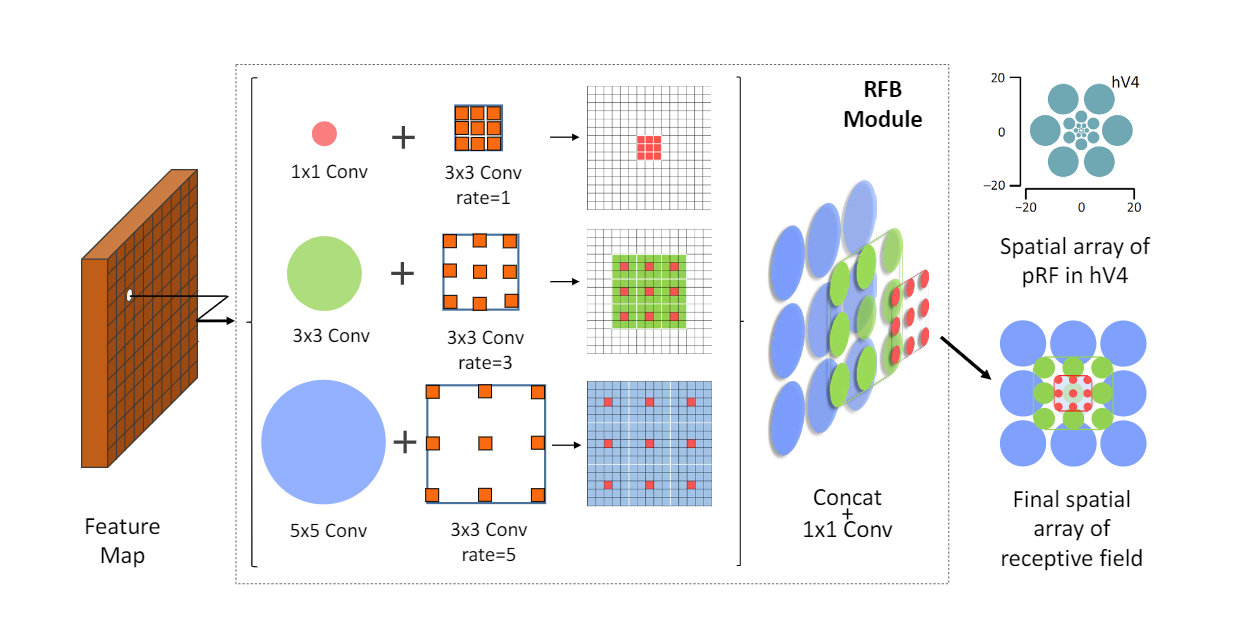
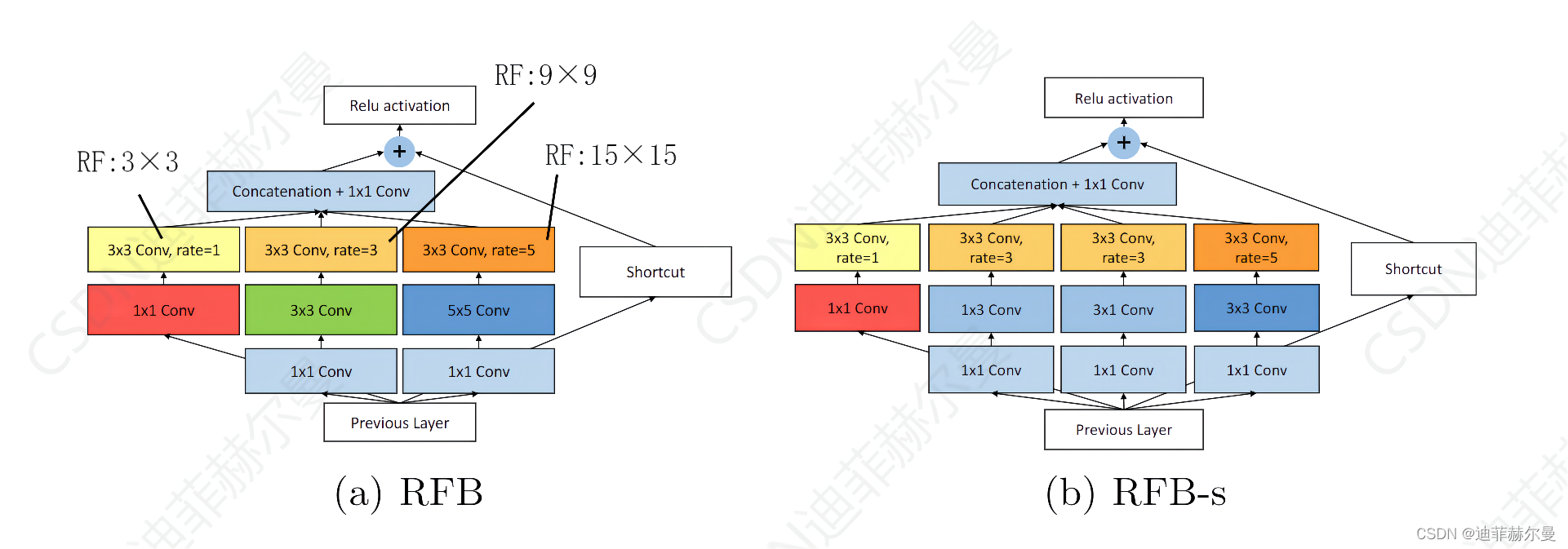
RFB和RFB-s的架构。RFB-s用于在浅层人类视网膜主题图中模拟较小的pRF,使用具有较小内核的更多分支。class BasicConv(nn.Module): def __init__(self, in_planes, out_planes, kernel_size, stride=1, padding=0, dilation=1, groups=1, relu=True, bn=True): super(BasicConv, self).__init__() self.out_channels = out_planes if bn: self.conv = nn.Conv2d(in_planes, out_planes, kernel_size=kernel_size, stride=stride, padding=padding, dilation=dilation, groups=groups, bias=False) self.bn = nn.BatchNorm2d(out_planes, eps=1e-5, momentum=0.01, affine=True) self.relu = nn.ReLU(inplace=True) if relu else None else: self.conv = nn.Conv2d(in_planes, out_planes, kernel_size=kernel_size, stride=stride, padding=padding, dilation=dilation, groups=groups, bias=True) self.bn = None self.relu = nn.ReLU(inplace=True) if relu else None def forward(self, x): x = self.conv(x) if self.bn is not None: x = self.bn(x) if self.relu is not None: x = self.relu(x) return x class BasicRFB(nn.Module): def __init__(self, in_planes, out_planes, stride=1, scale=0.1, map_reduce=8, vision=1, groups=1): super(BasicRFB, self).__init__() self.scale = scale self.out_channels = out_planes inter_planes = in_planes // map_reduce self.branch0 = nn.Sequential( BasicConv(in_planes, inter_planes, kernel_size=1, stride=1, groups=groups, relu=False), BasicConv(inter_planes, 2 * inter_planes, kernel_size=(3, 3), stride=stride, padding=(1, 1), groups=groups), BasicConv(2 * inter_planes, 2 * inter_planes, kernel_size=3, stride=1, padding=vision + 1, dilation=vision + 1, relu=False, groups=groups) ) self.branch1 = nn.Sequential( BasicConv(in_planes, inter_planes, kernel_size=1, stride=1, groups=groups, relu=False), BasicConv(inter_planes, 2 * inter_planes, kernel_size=(3, 3), stride=stride, padding=(1, 1), groups=groups), BasicConv(2 * inter_planes, 2 * inter_planes, kernel_size=3, stride=1, padding=vision + 2, dilation=vision + 2, relu=False, groups=groups) ) self.branch2 = nn.Sequential( BasicConv(in_planes, inter_planes, kernel_size=1, stride=1, groups=groups, relu=False), BasicConv(inter_planes, (inter_planes // 2) * 3, kernel_size=3, stride=1, padding=1, groups=groups), BasicConv((inter_planes // 2) * 3, 2 * inter_planes, kernel_size=3, stride=stride, padding=1, groups=groups), BasicConv(2 * inter_planes, 2 * inter_planes, kernel_size=3, stride=1, padding=vision + 4, dilation=vision + 4, relu=False, groups=groups) ) self.ConvLinear = BasicConv(6 * inter_planes, out_planes, kernel_size=1, stride=1, relu=False) self.shortcut = BasicConv(in_planes, out_planes, kernel_size=1, stride=stride, relu=False) self.relu = nn.ReLU(inplace=False) def forward(self, x): x0 = self.branch0(x) x1 = self.branch1(x) x2 = self.branch2(x) out = torch.cat((x0, x1, x2), 1) out = self.ConvLinear(out) short = self.shortcut(x) out = out * self.scale + short out = self.relu(out) return out- 1
- 2
- 3
- 4
- 5
- 6
- 7
- 8
- 9
- 10
- 11
- 12
- 13
- 14
- 15
- 16
- 17
- 18
- 19
- 20
- 21
- 22
- 23
- 24
- 25
- 26
- 27
- 28
- 29
- 30
- 31
- 32
- 33
- 34
- 35
- 36
- 37
- 38
- 39
- 40
- 41
- 42
- 43
- 44
- 45
- 46
- 47
- 48
- 49
- 50
- 51
- 52
- 53
- 54
- 55
- 56
- 57
- 58
- 59
- 60
- 61
- 62
- 63
- 64
- 65
- 66
1.5 SPPCSPC
该模块是
YOLOv7中使用的SPP结构,在COCO数据集上表现优于SPPF(其它的数据集并不一定)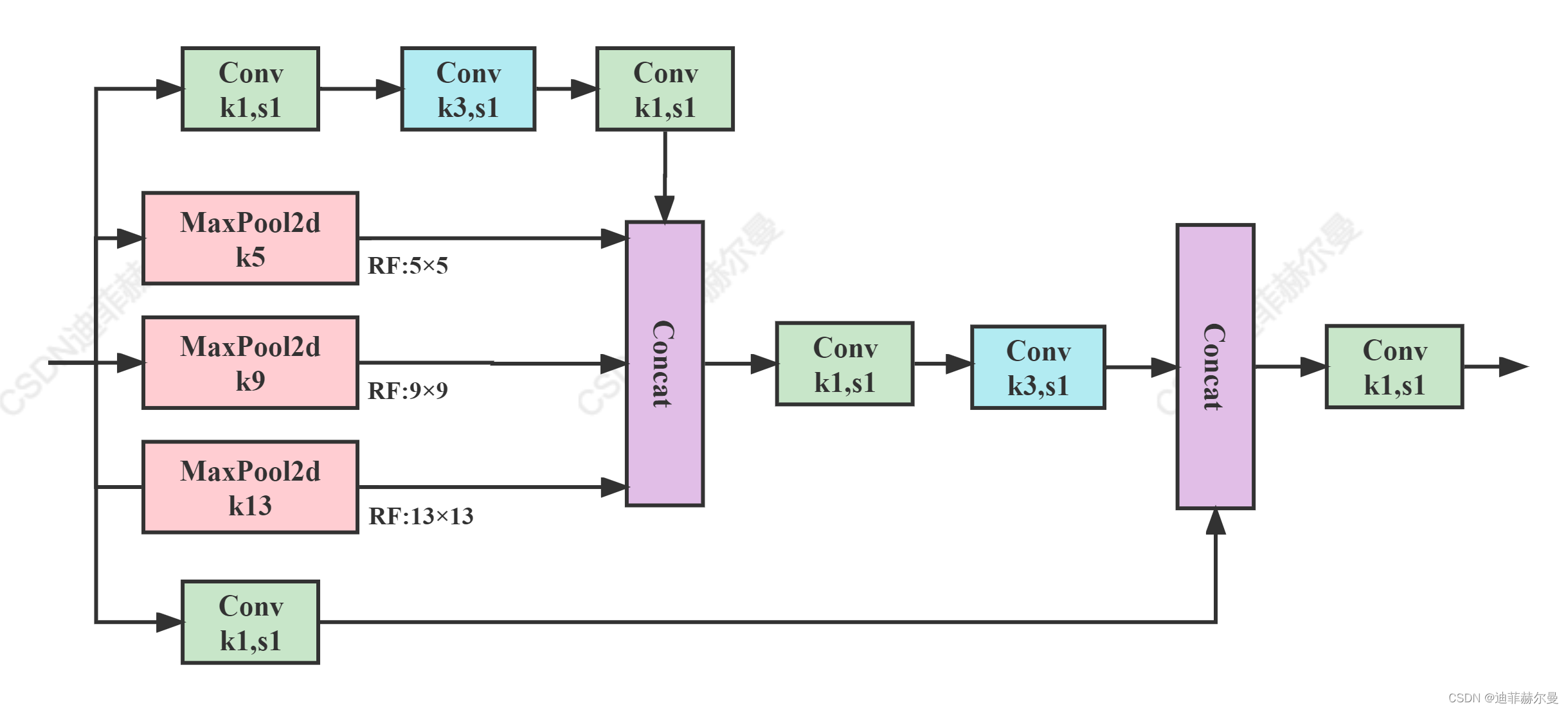
class SPPCSPC(nn.Module): # CSP https://github.com/WongKinYiu/CrossStagePartialNetworks def __init__(self, c1, c2, n=1, shortcut=False, g=1, e=0.5, k=(5, 9, 13)): super(SPPCSPC, self).__init__() c_ = int(2 * c2 * e) # hidden channels self.cv1 = Conv(c1, c_, 1, 1) self.cv2 = Conv(c1, c_, 1, 1) self.cv3 = Conv(c_, c_, 3, 1) self.cv4 = Conv(c_, c_, 1, 1) self.m = nn.ModuleList([nn.MaxPool2d(kernel_size=x, stride=1, padding=x // 2) for x in k]) self.cv5 = Conv(4 * c_, c_, 1, 1) self.cv6 = Conv(c_, c_, 3, 1) self.cv7 = Conv(2 * c_, c2, 1, 1) def forward(self, x): x1 = self.cv4(self.cv3(self.cv1(x))) y1 = self.cv6(self.cv5(torch.cat([x1] + [m(x1) for m in self.m], 1))) y2 = self.cv2(x) return self.cv7(torch.cat((y1, y2), dim=1))- 1
- 2
- 3
- 4
- 5
- 6
- 7
- 8
- 9
- 10
- 11
- 12
- 13
- 14
- 15
- 16
- 17
- 18
- 19
#分组SPPCSPC 分组后参数量和计算量与原本差距不大,不知道效果怎么样 class SPPCSPC_group(nn.Module): def __init__(self, c1, c2, n=1, shortcut=False, g=1, e=0.5, k=(5, 9, 13)): super(SPPCSPC_group, self).__init__() c_ = int(2 * c2 * e) # hidden channels self.cv1 = Conv(c1, c_, 1, 1, g=4) self.cv2 = Conv(c1, c_, 1, 1, g=4) self.cv3 = Conv(c_, c_, 3, 1, g=4) self.cv4 = Conv(c_, c_, 1, 1, g=4) self.m = nn.ModuleList([nn.MaxPool2d(kernel_size=x, stride=1, padding=x // 2) for x in k]) self.cv5 = Conv(4 * c_, c_, 1, 1, g=4) self.cv6 = Conv(c_, c_, 3, 1, g=4) self.cv7 = Conv(2 * c_, c2, 1, 1, g=4) def forward(self, x): x1 = self.cv4(self.cv3(self.cv1(x))) y1 = self.cv6(self.cv5(torch.cat([x1] + [m(x1) for m in self.m], 1))) y2 = self.cv2(x) return self.cv7(torch.cat((y1, y2), dim=1))- 1
- 2
- 3
- 4
- 5
- 6
- 7
- 8
- 9
- 10
- 11
- 12
- 13
- 14
- 15
- 16
- 17
- 18
- 19
2 参数量对比
这里我在
yolov5s.yaml中使用各个模型替换SPP模块模型 参数量(parameters) 计算量(GFLOPs) SPP 7225885 16.5 SPPF 7235389 16.5 ASPP 15485725 23.1 BasicRFB 7895421 17.1 SPPCSPC 13663549 21.7 分组SPPCSPC 8355133 17.4
3 改进方式
第一步;各个代码放入
common.py中
第二步;yolo.py中加入类名
第三步;修改配置文件
yolov5配置文件如下:# YOLOv5 🚀 by Ultralytics, GPL-3.0 license # YOLOv5 v6.0 backbone backbone: # [from, number, module, args] [[-1, 1, Conv, [64, 6, 2, 2]], # 0-P1/2 [-1, 1, Conv, [128, 3, 2]], # 1-P2/4 [-1, 3, C3, [128]], [-1, 1, Conv, [256, 3, 2]], # 3-P3/8 [-1, 6, C3, [256]], [-1, 1, Conv, [512, 3, 2]], # 5-P4/16 [-1, 9, C3, [512]], [-1, 1, Conv, [1024, 3, 2]], # 7-P5/32 [-1, 3, C3, [1024]], [-1, 1, SPPF, [1024, 5]], # 9 #[-1, 1, ASPP, [1024]], # 9 #[-1, 1, SPP, [1024]], #[-1, 1, BasicRFB, [1024]], #[-1, 1, SPPCSPC, [1024]], ]- 1
- 2
- 3
- 4
- 5
- 6
- 7
- 8
- 9
- 10
- 11
- 12
- 13
- 14
- 15
- 16
- 17
- 18
- 19
- 20
- 21
更多内容导航
1.手把手带你调参Yolo v5 (v6.1)(一)🌟强烈推荐
4.手把手带你Yolov5 (v6.1)添加注意力机制(一)(并附上30多种顶会Attention原理图)🌟
5.手把手带你Yolov5 (v6.1)添加注意力机制(二)(在C3模块中加入注意力机制)
8.Yolov5更换上采样方式( 最近邻 / 双线性 / 双立方 / 三线性 / 转置卷积)
9.Yolov5如何更换EIOU / alpha IOU / SIoU?
10.Yolov5更换主干网络之《旷视轻量化卷积神经网络ShuffleNetv2》🍀
12.空间金字塔池化改进 SPP / SPPF / ASPP / RFB / SPPCSPC🍀
13.持续更新中
-
相关阅读:
活动功能->状态模式的使用
【华为联机对战服务】SDK初始化方法,返回1001错误码
NPOI组件下载、引用、基本使用
【面试经典150 | 栈】有效的括号
Linux 和 分区
ZMQ/ZeroMQ的三种消息模式
PHY驱动开发算法详解
java---IO流:特殊操作流
【李宏毅机器学习】Explainable AI
某攻防演练心得之随笔记
- 原文地址:https://blog.csdn.net/weixin_43694096/article/details/126354660
