-
【数据结构】链表OJ题(建议收藏!!!)
注意OJ题,传过来的一般是指向头结点的头指针,而非带哨兵卫的头结点。
一.移除链表元素

解题思路1:不建立哨兵卫
(1)着重利用到两个指针,cur(即当前位置,去寻找值为val的重要指针),prev(指向cur前面的一个结点),利用这两个指针移除链表中的特定元素。
(2)刚开始cur指向头结点,而prev被初始化为NULL(不然就会沦为野指针),cur会在每次循环后,遍历移向下一个结点,所以当cur为NULL时,跳出循环,如果cur指向的结点值不为val,则cur跳过此结点,指向下一个结点,在这步指向之前,要把cur的位置先赋给prev。
(3)当cur指向的结点值为val,则要删除当前结点。在这里分为两种情况,要删除的是头结点,和不是头结点。如果是头结点,第一步替换头结点,head=head->next;第二步:释放头结点,free(cur),第三步:重置cur,cur=head。如果不是头结点,第一步断开连接,让prev->next=cur->next,第二步释放次结点,free(cur),第三步cur指向此节点的下一个结点,即cur=prev->next;
>图解:

代码实现:
struct ListNode* removeElements(struct ListNode* head, int val) { struct ListNode* cur=head,*prev=NULL; while(cur) { if(cur->val==val) { //1.头删 if(cur==head) { head=head->next; free(cur); cur=head; } //2.非头删 else { prev->next=cur->next; free(cur); cur=prev->next; } } else { prev=cur; cur=cur->next; } } return head; }- 1
- 2
- 3
- 4
- 5
- 6
- 7
- 8
- 9
- 10
- 11
- 12
- 13
- 14
- 15
- 16
- 17
- 18
- 19
- 20
- 21
- 22
- 23
- 24
- 25
- 26
- 27
- 28
- 29
- 30
解题思路2:建立新链表
解题思路:

struct ListNode* removeElements(struct ListNode* head, int val) { struct ListNode* cur=head; struct ListNode* newhead=NULL,*tail=NULL; while(cur) { if(cur->val!=val) { if(tail==NULL) { newhead=tail=cur; } else { tail->next=cur; tail=tail->next; } cur=cur->next; } else { struct ListNode* del=cur; cur=cur->next; free(del); } } //最后一个结点为val时,注意将最后一个结点的指针域指向空 if(tail) { tail->next=NULL; } return newhead; }- 1
- 2
- 3
- 4
- 5
- 6
- 7
- 8
- 9
- 10
- 11
- 12
- 13
- 14
- 15
- 16
- 17
- 18
- 19
- 20
- 21
- 22
- 23
- 24
- 25
- 26
- 27
- 28
- 29
- 30
- 31
- 32
- 33
- 34
解题思路3:建立哨兵卫
带哨兵卫后(头结点,但只有指针域),代码变得更加简洁,建立新链表时,不需要判断tail是否为NULL,让tail=guard后,即可连接符合条件的结点。一定要记住,若最后一个结点为val,要记住把tail->next==NULL。
*注意我们建立的新节点最后也需要释放。并且最开始要把guard->next置为空,不然它将会是一个野指针,当传过来的是空链表,那么程序就会报错。

struct ListNode* removeElements(struct ListNode* head, int val) { struct ListNode* cur=head;//cur勇于遍历原链表 struct ListNode* guard=(struct ListNode*)malloc(sizeof(struct ListNode)); guard->next=NULL;//若原链表为NULL struct ListNode* tail=guard;//tail指向头结点 while(cur) { if(cur->val!=val) { tail->next=cur;//连接符合条件的结点 tail=tail->next;//更新tail cur=cur->next;//更新cur } else { struct ListNode* del=cur;//保存val的位置 cur=cur->next; free(del); } } //最后结点为val if(tail) { tail->next=NULL; } head=guard->next; free(guard); return head; }- 1
- 2
- 3
- 4
- 5
- 6
- 7
- 8
- 9
- 10
- 11
- 12
- 13
- 14
- 15
- 16
- 17
- 18
- 19
- 20
- 21
- 22
- 23
- 24
- 25
- 26
- 27
- 28
- 29
- 30
- 31
二.合并两个有序链表

解题思路:创建新的链表
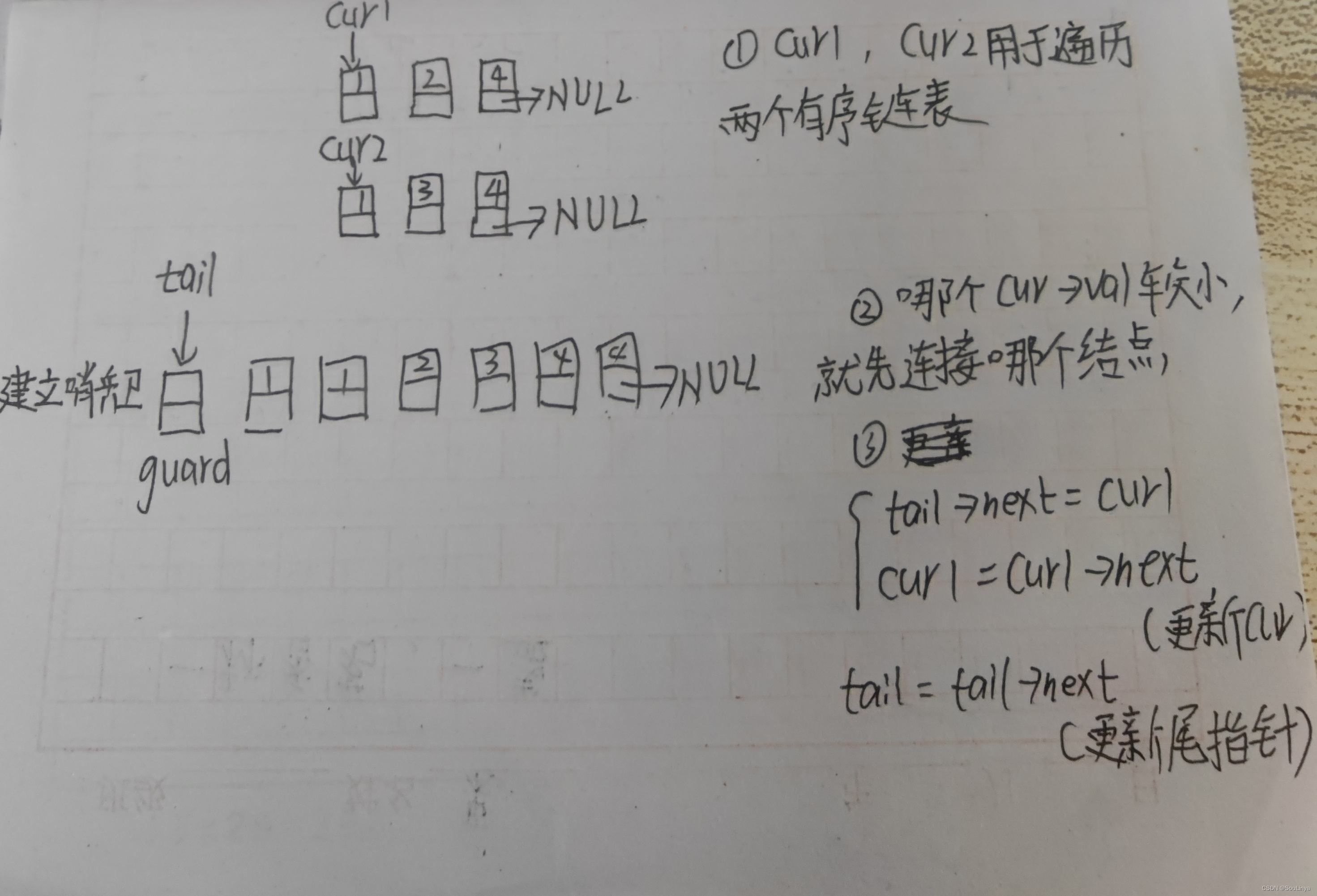
(1)两个指针分别遍历两个链表
(2)建立哨兵卫,tail尾指针,cur->val较小值进行连接,注意指针指向的更新。
(3)注意有一个有序链表会先连接完成,那么会退出循环,注意我们还需要将剩下一个链表的其余结点连接上去
(4)注意释放哨兵卫的头结点
(5)若传过来的是空链表,那么刚开始我们要把guard->next置为空,不然它将沦为野指针。
(6)这里因为原链表最后已置为空,不像上道题目一样,可能会把最后一个结点删除,所以我们不用考虑这层。
代码实现struct ListNode* mergeTwoLists(struct ListNode* list1, struct ListNode* list2) { struct ListNode* guard=(struct ListNode* )malloc(sizeof(struct ListNode)); guard->next=NULL; struct ListNode* cur1=list1,* cur2=list2; struct ListNode* tail=guard; while(cur1&&cur2) { if(cur1->val<cur2->val) { tail->next=cur1; cur1=cur1->next; } else { tail->next=cur2; cur2=cur2->next; } tail=tail->next; } if(cur1) { tail->next=cur1; } if(cur2) { tail->next=cur2; } struct ListNode* head=guard->next; free(guard); return head; }- 1
- 2
- 3
- 4
- 5
- 6
- 7
- 8
- 9
- 10
- 11
- 12
- 13
- 14
- 15
- 16
- 17
- 18
- 19
- 20
- 21
- 22
- 23
- 24
- 25
- 26
- 27
- 28
- 29
- 30
- 31
- 32
- 33
- 34
- 35
三.翻转链表

解题思路1:头插
(1)定义一个新的指针newnode,进行头插,注意更新头指针。
(2)两个指针cur,next,用于前后遍历原链表,next指针用于保存cur下一个结点的位置,cur是要进行头插的结点。注意每次循环都要更新这两个指针的位置。

struct ListNode* reverseList(struct ListNode* head) { struct ListNode* cur=head; struct ListNode* newnode = NULL; while(cur) { struct ListNode* next=cur->next;//保留cur下一个结点的地址 cur->next=newnode; newnode=cur; cur=next; } return newnode; }- 1
- 2
- 3
- 4
- 5
- 6
- 7
- 8
- 9
- 10
- 11
- 12
- 13
- 14
- 15
解题思路2:翻转
(1)需要3个辅助指针,当n2指向NULL时跳出循环;
(2)三个指针进行迭代
(3)注意传过来的若为空指针,n3不能直接置成,n3=n2->next,这是错误的示范。所以要先判断n2是否为NULL。

struct ListNode* reverseList(struct ListNode* head) { struct ListNode* n1,*n2,*n3; n1=NULL; n2=head; n3=NULL; while(n2) { n3=n2->next; n2->next=n1; //迭代 n1=n2; n2=n3; } return n1; }- 1
- 2
- 3
- 4
- 5
- 6
- 7
- 8
- 9
- 10
- 11
- 12
- 13
- 14
- 15
- 16
- 17
- 18
四.链表的中间结点

解题思路1:遍历
因为这道题目没有时间复杂度的要求,所以要解决这道题,我们只需要先遍历一遍链表,统计链表的结点个数,然后再遍历一遍链表,寻找中间结点即可。此方法的时间复杂度为o(n^2)。struct ListNode* middleNode(struct ListNode* head) { struct ListNode* cur=head; int count=0; while(cur)//遍历链表 { count++; cur=cur->next; } int mid=count/2; struct ListNode* midnode=head; while(mid--) { midnode=midnode->next; } return midnode; }- 1
- 2
- 3
- 4
- 5
- 6
- 7
- 8
- 9
- 10
- 11
- 12
- 13
- 14
- 15
- 16
- 17
- 18
解题思路2:快慢指针
我们也可以只遍历一遍链表,就找到中间结点,这样时间复杂度就为O(n).
利用的方法是快慢指针。那么什么是快慢指针呢?
快指针一次走两步,慢指针一次走一步,那么当快指针走到空时,慢指针走到一半,之后返回慢指针指向的地址即可。


struct ListNode* middleNode(struct ListNode* head) { struct ListNode* fast,*slow; fast=slow=head; while(fast&&fast->next) { slow=slow->next;//慢指针走一步 fast=fast->next->next;//快指针走两步 } return slow; }- 1
- 2
- 3
- 4
- 5
- 6
- 7
- 8
- 9
- 10
- 11
- 12
五.链表中倒数第k个结点

要求只遍历一遍,即时间复杂度为O(n).
方法:利用快慢指针
fast先走k步

struct ListNode* FindKthToTail(struct ListNode* pListHead, int k ) { struct ListNode* fast,*slow; fast=slow=pListHead; //while(--k)// k-1步 while(k--)//k步 { //1.传过来的是空链表 //2.k>=结点数 if(fast==NULL) { return NULL; } fast=fast->next; } while(fast) { slow=slow->next; fast=fast->next; } return slow; }- 1
- 2
- 3
- 4
- 5
- 6
- 7
- 8
- 9
- 10
- 11
- 12
- 13
- 14
- 15
- 16
- 17
- 18
- 19
- 20
- 21
- 22
六.链表分割
测试用例:

(1)普通情况

(2)当最后一个小于x时,会造成环状,最后返回的是val4这个结点,所以val7的结点一定要置为空

(3)当传过来的为空指针,我们的输出也为{}空,所以防止 lessTail->next=greaterGuard->next;出错,我们一开始得把新建的两个哨兵卫结点的next置NULL
class Partition { public: ListNode* partition(ListNode* pHead, int x) { struct ListNode* lessGuard,*lessTail,*greaterGuard,*greaterTail; lessGuard=lessTail=(struct ListNode*)malloc(sizeof(struct ListNode)); greaterGuard=greaterTail=(struct ListNode*)malloc(sizeof(struct ListNode)); //注意置空 lessGuard->next=NULL; greaterGuard->next=NULL; //cur遍历原链表 struct ListNode* cur=pHead; while(cur) { if(cur->val<x) { lessTail->next=cur;//连接符合条件的cur lessTail=lessTail->next;//更新指针 } else { greaterTail->next=cur; greaterTail=greaterTail->next; } cur=cur->next; } //连接俩链表 lessTail->next=greaterGuard->next; greaterTail->next=NULL; pHead=lessGuard->next; free(greaterGuard); free(lessGuard); return pHead; } };- 1
- 2
- 3
- 4
- 5
- 6
- 7
- 8
- 9
- 10
- 11
- 12
- 13
- 14
- 15
- 16
- 17
- 18
- 19
- 20
- 21
- 22
- 23
- 24
- 25
- 26
- 27
- 28
- 29
- 30
- 31
- 32
- 33
- 34
- 35
- 36
- 37
- 38
- 39
七.链表的回文结构
测试用例:

class PalindromeList { public: struct ListNode* middleNode(struct ListNode* head) { struct ListNode* slow,*fast; slow=fast=head; while(fast&&fast->next) { slow=slow->next;//走一步 fast=fast->next->next; } return slow; } struct ListNode* reverseList(struct ListNode* head) { struct ListNode* n1,*n2,*n3; n1=NULL; n2=head; n3=NULL; while(n2) { n3=n2->next; n2->next=n1; //迭代 n1=n2; n2=n3; } return n1; } bool chkPalindrome(ListNode* head) { //1.找中间结点 struct ListNode* mid=middleNode(head); //2.逆序包括中间结点在内之后的结点 struct ListNode* rmid=reverseList(mid); while(head&&rmid) { //判断回文 if(head->val!=rmid->val) { return false; } head=head->next; rmid=rmid->next; } return true; } };- 1
- 2
- 3
- 4
- 5
- 6
- 7
- 8
- 9
- 10
- 11
- 12
- 13
- 14
- 15
- 16
- 17
- 18
- 19
- 20
- 21
- 22
- 23
- 24
- 25
- 26
- 27
- 28
- 29
- 30
- 31
- 32
- 33
- 34
- 35
- 36
- 37
- 38
- 39
- 40
- 41
- 42
- 43
- 44
- 45
- 46
- 47
- 48
- 49
- 50
- 51
- 52
八.相交链表

1.思路:想找到俩链表相交的结点,即需要俩链表的最后一个结点的next指针域指向的结点地址相同;(注意而非val相同)
2.要求:时间复杂度为O(n+m),空间复杂度为O(1);
3.方法:(1)是否相交->俩链表的尾结点是否相等;
(2)求出俩链表的长度lenA,lenB
(3)较长的链表先走 差距步 ,然后再俩链表同时走,第一个结点地址相等,那就是链表交点。
(4)注意空链表无结点struct ListNode *getIntersectionNode(struct ListNode *headA, struct ListNode *headB) { struct ListNode* curA=headA; struct ListNode* curB=headB; int lenA=1; int lenB=1; //计算链表长度,找到尾结点 while(curA) { curA=curA->next; lenA++; } while(curB) { curB=curB->next; lenB++; } //如果俩链表遍历到最后的结点地址不相同 //则两链表不相交 if(curA!=curB) { return NULL; } struct ListNode* shorttail=headA; struct ListNode*longtail=headB; if(lenA>lenB) { shorttail=headB; longtail=headA; } //先走差距步 int gap=abs(lenA-lenB); while(gap--) { longtail=longtail->next; } while(longtail&&shorttail)//俩链表一起走的时候,保证不为空 { if(longtail==shorttail)//相等时返回结点 { return shorttail; } else { longtail=longtail->next; shorttail=shorttail->next; } } return NULL; }- 1
- 2
- 3
- 4
- 5
- 6
- 7
- 8
- 9
- 10
- 11
- 12
- 13
- 14
- 15
- 16
- 17
- 18
- 19
- 20
- 21
- 22
- 23
- 24
- 25
- 26
- 27
- 28
- 29
- 30
- 31
- 32
- 33
- 34
- 35
- 36
- 37
- 38
- 39
- 40
- 41
- 42
- 43
- 44
- 45
- 46
- 47
- 48
- 49
- 50
- 51
九.环形链表I
注意环形链表不能遍历

测试用例:

解题思路1:
方法:快慢指针
fast指针一次走两步,slow指针一次走一步


代码实现:
bool hasCycle(struct ListNode *head) { struct ListNode* fast,*slow; //1.快慢指针指向头结点 fast=slow=head; //2.追赶 //因为fast走的比slow快 //若有环则循环 //若无环fast会先指向NULL,跳出循环 while(fast&&fast->next) { slow=slow->next; fast=fast->next->next; //慢指针一次走一步 //快指针一次走两步 //走一次,差距缩小一步 //直到相遇 if(slow==fast) { return true; } } return false; }- 1
- 2
- 3
- 4
- 5
- 6
- 7
- 8
- 9
- 10
- 11
- 12
- 13
- 14
- 15
- 16
- 17
- 18
- 19
- 20
- 21
- 22
- 23
- 24
思考问题1:
(1)请问,slow一次走一步,fast一次走三步,是否可以?
假设slow进环后,fast和slow之间差距N,那么追赶的距离就是N;
这种情况下,每追赶一次,他们之间的距离就缩小2步。·如果追赶的距离N是偶数,就追得上;
若N是奇数,意味着fast与slow,在第一次中,不会刚好相遇,会出现以下这种情况,于是他们之间的距离就变成了C-1(C是环的长度),并进入新一轮的追赶,在这种情况下,若C-1是偶数,则这一轮追得上,若C-1是奇数,则永远追不上。

(2)请问,slow一次走一步,fast一次走X步,是否可以?
(3)请问,slow一次走Y步,fast一次走X步(X>Y),是否可以?
与上面的情况同理,能否追赶上取决于,每追赶一次,slow和fast指针的距离是缩小偶数倍,还是奇数倍,并且取决于环的长度。十.环形链表II

这道题与上道题大近相同,这道题要判断链表是否有环,还需要返回链表开始入环的第一个结点(即L的位置),如果链表无环,则返回NULL。解题思路1:公式推导
由上述环状链表可得,fast快指针一次走两步,slow一次走一步,所以得出公式:fast走的距离=2*slow走的距离。
(1)假设进环前的长度是L,环的长度是C,入口点到相遇点距离是X
(2)则slow走的距离是:L+X;fast走的距离是:L+N*C+X;(假设slow进环,fast在环里面已经转了N圈,N>=1)
(3)推导公式:
2(L+X)=L+NC+X
L+X=NC
L=NC-X
L=(N-1)C+C-X
可以这么说:一个指针A从头开始走,一个指针B从相遇点开始走,他们会在入口点相遇

struct ListNode *detectCycle(struct ListNode *head) { struct ListNode* slow, *fast; slow=fast=head; while(fast&&fast->next)//若为空,则无环 { slow=slow->next; fast=fast->next->next; //直到相遇 if(slow==fast) { struct ListNode* meet=slow; //一个指针从头开始走,一个指针从相遇点开始走 //他们会在入口点相遇 while(meet!=head) { meet=meet->next; head=head->next; } return head;//or meet } } return NULL; }- 1
- 2
- 3
- 4
- 5
- 6
- 7
- 8
- 9
- 10
- 11
- 12
- 13
- 14
- 15
- 16
- 17
- 18
- 19
- 20
- 21
- 22
- 23
- 24
- 25
解题思路2:转换成相交问题
1.找到交点(slow==fast);
2.保留链表交点下一个结点的地址
3.断开链表
4.找链表交点
5.恢复链表struct ListNode *getIntersectionNode(struct ListNode *headA, struct ListNode *headB) { struct ListNode* curA=headA; struct ListNode* curB=headB; int lenA=1; int lenB=1; //计算链表长度,找到尾结点 while(curA) { curA=curA->next; lenA++; } while(curB) { curB=curB->next; lenB++; } //如果俩链表遍历到最后的结点地址不相同 //则两链表不相交 if(curA!=curB) { return NULL; } struct ListNode* shorttail=headA; struct ListNode*longtail=headB; if(lenA>lenB) { shorttail=headB; longtail=headA; } //先走差距步 int gap=abs(lenA-lenB); while(gap--) { longtail=longtail->next; } while(longtail&&shorttail)//俩链表一起走的时候,保证不为空 { if(longtail==shorttail)//相等时返回结点 { return shorttail; } else { longtail=longtail->next; shorttail=shorttail->next; } } return NULL; } struct ListNode *detectCycle(struct ListNode *head) { struct ListNode* fast, *slow; fast=slow=head; while(fast&&fast->next) { slow=slow->next; fast=fast->next->next; if(fast==slow) { //相遇点 struct ListNode* meet=slow; //保存相遇点的下一个结点 struct ListNode* next=meet->next; //断开环 meet->next=NULL; //恢复环 struct ListNode* entryNode=getIntersectionNode(next,head);//找交点 meet->next=next; return entryNode; } } return NULL; }- 1
- 2
- 3
- 4
- 5
- 6
- 7
- 8
- 9
- 10
- 11
- 12
- 13
- 14
- 15
- 16
- 17
- 18
- 19
- 20
- 21
- 22
- 23
- 24
- 25
- 26
- 27
- 28
- 29
- 30
- 31
- 32
- 33
- 34
- 35
- 36
- 37
- 38
- 39
- 40
- 41
- 42
- 43
- 44
- 45
- 46
- 47
- 48
- 49
- 50
- 51
- 52
- 53
- 54
- 55
- 56
- 57
- 58
- 59
- 60
- 61
- 62
- 63
- 64
- 65
- 66
- 67
- 68
- 69
- 70
- 71
- 72
- 73
- 74
- 75
- 76
- 77
- 78
-
相关阅读:
C语言字符函数
【进程概念③】:进程环境变量/进程切换
【Maven学习】3.9 实验九:继承
YOLO算法创新改进系列(项目汇总)
大厂偏爱的Agent技术究竟是个啥
php基于BS模式的物业管理系统设计与实现毕业设计源码290918
SpringAOP入门案例
基于springboot停车位管理系统【附源码】开源项目
数据库数据恢复-SQL SERVER数据库分区被格式化的数据恢复方案
零数科技受邀参加中国投资峰会
- 原文地址:https://blog.csdn.net/weixin_63449996/article/details/126154554
