-
Tomcat线程池与Fork/Join使用
1 Tomcat线程池
1 简介
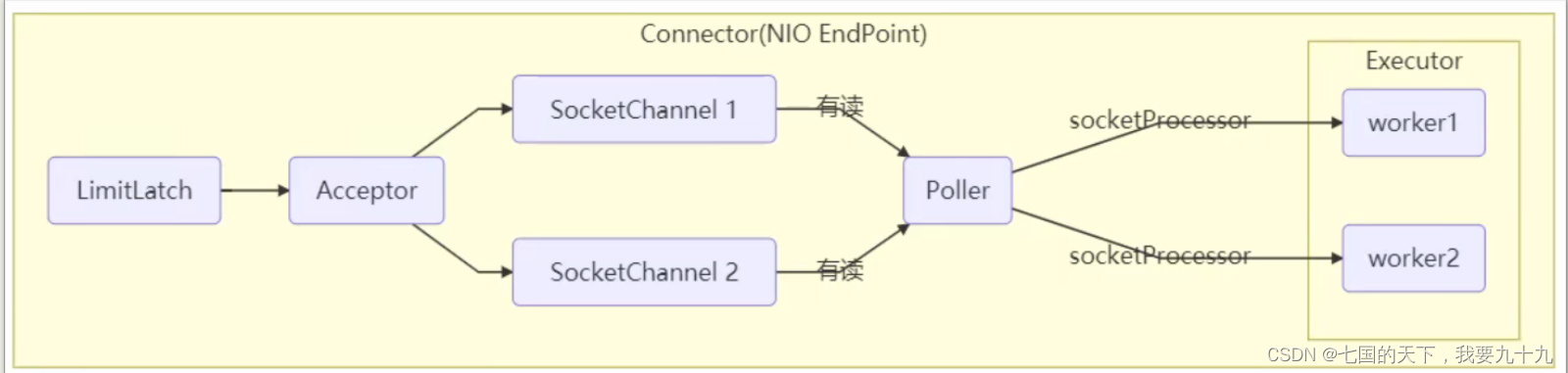
Tomcat使用线程池:
- LimitLatch 用来限流,可以控制最大连接个数
- Acceptor 只负责 接收新的 socket 连接
- Poller 只负责监听 socket channel 是否有 可读的 I/O 事件
- 一旦可读,封装一个任务对象(socketProcessor),提交给 Executor 线程池处理
- Executor 线程池中的工作线程最终负责进行处理请求
Tomcat 线程池扩展了 ThreadPoolExecutor, 但是总线程数达到 maximumPoolSize, 此时不会立即抛出 RejectedExecutionException 异常, 而是再次尝试将任务放入队列,如果再次失败, 才抛出RejectedExecutionException 异常.
部分源码
public void execute(Runnable command, long timeout, TimeUnit unit) { submittedCount.incrementAndGet(); try { super.execute(command); } catch (RejectedExecutionException rx) { if (super.getQueue() instanceof TaskQueue) { final TaskQueue queue = (TaskQueue)super.getQueue(); try { if (!queue.force(command, timeout, unit)) { submittedCount.decrementAndGet(); throw new RejectedExecutionException("Queue capacity is full."); } } catch (InterruptedException x) { submittedCount.decrementAndGet(); Thread.interrupted(); throw new RejectedExecutionException(x); } } else { submittedCount.decrementAndGet(); throw rx; } } }- 1
- 2
- 3
- 4
- 5
- 6
- 7
- 8
- 9
- 10
- 11
- 12
- 13
- 14
- 15
- 16
- 17
- 18
- 19
- 20
- 21
- 22
- 23
任务队列
public boolean force(Runnable o, long timeout, TimeUnit unit) throws InterruptedException { if ( parent.isShutdown() ) throw new RejectedExecutionException( "Executor not running, can't force a command into the queue" ); //forces the item onto the queue, to be used if the task is rejected return super.offer(o,timeout,unit); }- 1
- 2
- 3
- 4
- 5
- 6
- 7
- 8
2 Connector 配置
配置项 默认值 说明 acceptorThreadCount 1 acceptor 线程数量 pollerThreadCount 1 poller 线程数量 minSpareThreads 10 核心线程数,即 corePoolSize maxThreads 200 最大线程数,即 maximumPoolSize executor 最大线程数,即 maximumPoolSize 3 Executor 线程配置
配置项 默认值 说明 threadPriority 5 线程优先级 daemon true 是否守护线程 minSpareThreads 25 核心线程数,即 corePoolSize maxThreads 200 最大线程数,即 maximumPoolSize maxIdleTime 60000 线程生存时间,单位是毫秒,默认值即 1 分钟 maxQueueSize Integer.MAX_VALUE 队列长度 prestartminSpareThreads false 核心线程是否在服务器启动时启动 任务执行流程图:

2 Fork/Join
1 说明
Fork/Join 是 JDK 1.7 加入的新的线程池实现,它体现的是一种分治思想,适用于能够进行任务拆分的 cpu 密集型运算.
任务拆分,是将一个大任务拆分为算法上相同的小任务,直至不能拆分可以直接求解。跟递归相关的一些计 算,如归并排序、斐波那契数列、都可以用分治思想进行求解.
Fork/Join 在分治的基础上加入了多线程,可以把每个任务的分解和合并交给不同的线程来完成,可提升了运算效率, 默认会创建与 cpu 核心数大小相同的线程池.
2 案例
提交给 Fork/Join 线程池的任务需要继承 RecursiveTask(有返回值)或 RecursiveAction(没有返回值)
创建了一个对 1~n 之间的整数求和的任务.
@Slf4j(topic = "c.AddTask") class AddTask1 extends RecursiveTask<Integer> { int n; public AddTask1(int n) { this.n = n; } @Override public String toString() { return "{" + n + '}'; } @Override protected Integer compute() { // 如果 n 已经为 1,可以求得结果了 if (n == 1) { log.debug("join() {}", n); return n; } // 将任务进行拆分(fork) AddTask1 t1 = new AddTask1(n - 1); t1.fork(); log.debug("fork() {} + {}", n, t1); // 合并(join)结果 int result = n + t1.join(); log.debug("join() {} + {} = {}", n, t1, result); return result; } }- 1
- 2
- 3
- 4
- 5
- 6
- 7
- 8
- 9
- 10
- 11
- 12
- 13
- 14
- 15
- 16
- 17
- 18
- 19
- 20
- 21
- 22
- 23
- 24
- 25
- 26
- 27
- 28
- 29
- 30
- 31
测试
public static void main(String[] args) { ForkJoinPool pool = new ForkJoinPool(4); System.out.println(pool.invoke(new AddTask1(5))); }- 1
- 2
- 3
- 4
运行结果
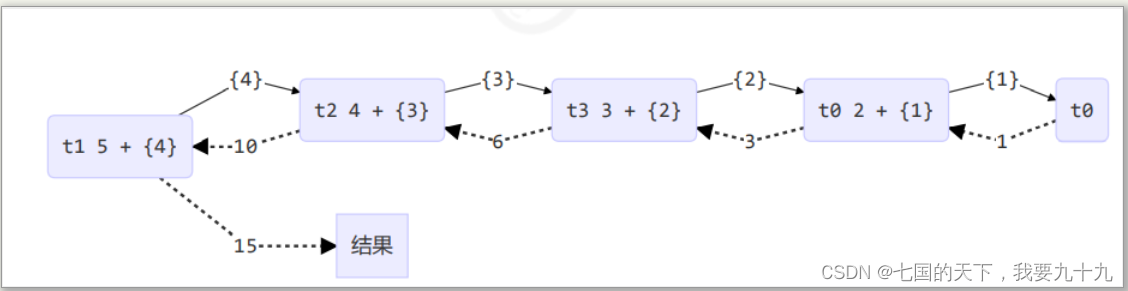
[ForkJoinPool-1-worker-0] - fork() 2 + {1} [ForkJoinPool-1-worker-1] - fork() 5 + {4} [ForkJoinPool-1-worker-0] - join() 1 [ForkJoinPool-1-worker-0] - join() 2 + {1} = 3 [ForkJoinPool-1-worker-2] - fork() 4 + {3} [ForkJoinPool-1-worker-3] - fork() 3 + {2} [ForkJoinPool-1-worker-3] - join() 3 + {2} = 6 [ForkJoinPool-1-worker-2] - join() 4 + {3} = 10 [ForkJoinPool-1-worker-1] - join() 5 + {4} = 15 15- 1
- 2
- 3
- 4
- 5
- 6
- 7
- 8
- 9
- 10
执行流程图:
方案优化
class AddTask3 extends RecursiveTask<Integer> { int begin; int end; public AddTask3(int begin, int end) { this.begin = begin; this.end = end; } @Override public String toString() { return "{" + begin + "," + end + '}'; } @Override protected Integer compute() { // 5, 5 if (begin == end) { log.debug("join() {}", begin); return begin; } // 4, 5 if (end - begin == 1) { log.debug("join() {} + {} = {}", begin, end, end + begin); return end + begin; } // 目标 1 5 // 3 int mid = (end + begin) / 2; // 1,3 AddTask3 t1 = new AddTask3(begin, mid); t1.fork(); // 4,5 AddTask3 t2 = new AddTask3(mid + 1, end); t2.fork(); log.debug("fork() {} + {} = ?", t1, t2); int result = t1.join() + t2.join(); log.debug("join() {} + {} = {}", t1, t2, result); return result; } }- 1
- 2
- 3
- 4
- 5
- 6
- 7
- 8
- 9
- 10
- 11
- 12
- 13
- 14
- 15
- 16
- 17
- 18
- 19
- 20
- 21
- 22
- 23
- 24
- 25
- 26
- 27
- 28
- 29
- 30
- 31
- 32
- 33
- 34
- 35
- 36
- 37
- 38
- 39
- 40
- 41
- 42
- 43
测试
public static void main(String[] args) { ForkJoinPool pool = new ForkJoinPool(4); System.out.println(pool.invoke(new AddTask3(1, 10))); }- 1
- 2
- 3
- 4
运行结果
[ForkJoinPool-1-worker-0] - join() 1 + 2 = 3 [ForkJoinPool-1-worker-3] - join() 4 + 5 = 9 [ForkJoinPool-1-worker-0] - join() 3 [ForkJoinPool-1-worker-1] - fork() {1,3} + {4,5} = ? [ForkJoinPool-1-worker-2] - fork() {1,2} + {3,3} = ? [ForkJoinPool-1-worker-2] - join() {1,2} + {3,3} = 6 [ForkJoinPool-1-worker-1] - join() {1,3} + {4,5} = 15 15- 1
- 2
- 3
- 4
- 5
- 6
- 7
- 8
流程执行图:

-
相关阅读:
飞行动力学 - 第31节-荷兰滚模态机理 之 基础点摘要
从 Hackathon 战队到创业公司,和开发者们聊聊真实世界 AI Apps 的基础设施丨活动预告
C++ 编译运行opencv4代码踩坑及解决
shell脚本中的运算符和条件判断
电脑基础知识—————— 删除文件
Kotlin基础学习 16
C++ 模拟实现 STL 中 unordered 系列的容器
zookeeper+kafka群集
学习Hutool工具类库
有没有免费的视频剪辑软件?快来看看这些视频裁剪软件
- 原文地址:https://blog.csdn.net/ABestRookie/article/details/126331578
