-
数据结构与算法------二叉树
二叉树的递归遍历(前-中-后序)
- // 前序遍历·递归·LC144_二叉树的前序遍历
- class Solution {
- public List
preorderTraversal(TreeNode root) { - List
result = new ArrayList (); - preorder(root, result);
- return result;
- }
- public void preorder(TreeNode root, List
result) { - if (root == null) {
- return;
- }
- result.add(root.val);
- preorder(root.left, result);
- preorder(root.right, result);
- }
- }
- // 中序遍历·递归·LC94_二叉树的中序遍历
- class Solution {
- public List
inorderTraversal(TreeNode root) { - List
res = new ArrayList<>(); - inorder(root, res);
- return res;
- }
- void inorder(TreeNode root, List
list) { - if (root == null) {
- return;
- }
- inorder(root.left, list);
- list.add(root.val); // 注意这一句
- inorder(root.right, list);
- }
- }
- // 后序遍历·递归·LC145_二叉树的后序遍历
- class Solution {
- public List
postorderTraversal(TreeNode root) { - List
res = new ArrayList<>(); - postorder(root, res);
- return res;
- }
- void postorder(TreeNode root, List
list) { - if (root == null) {
- return;
- }
- postorder(root.left, list);
- postorder(root.right, list);
- list.add(root.val); // 注意这一句
- }
- }
二叉树的层次遍历( BFS--迭代方式--借助队列)
- //BFS--迭代方式--借助队列
- class Solution {
- public List
- public List
- checkFun(root);
- return resList;
- }
- //BFS--迭代方式--借助队列
- public void checkFun(TreeNode node) {
- if (node == null) return;
- Queue
que = new LinkedList (); - que.offer(node);
- while (!que.isEmpty()) {
- List
itemList = new ArrayList (); - int len = que.size();
- while (len > 0) {
- TreeNode tmpNode = que.poll();
- itemList.add(tmpNode.val);
- if (tmpNode.left != null) que.offer(tmpNode.left);
- if (tmpNode.right != null) que.offer(tmpNode.right);
- len--;
- }
- resList.add(itemList);
- }
- }
- }
给你一棵二叉树的根节点
root,翻转这棵二叉树,并返回其根节点。示例 1:

输入:root = [4,2,7,1,3,6,9]
输出:[4,7,2,9,6,3,1]
示例 2:

输入:root = [2,1,3]
输出:[2,3,1]
示例 3:
输入:root = []
输出:[]
- //DFS--递归
- class Solution {
- public TreeNode invertTree(TreeNode root) {
- if(root==null) return root;
- TreeNode left=invertTree(root.left);
- TreeNode right=invertTree(root.right);
- swap(root);
- return root;
- }
- //交换
- public void swap(TreeNode root){
- TreeNode temp=root.left;
- root.left=root.right;
- root.right=temp;
- }
- }
- //BFS--层次遍历
- class Solution {
- public TreeNode invertTree(TreeNode root) {
- if(root==null) return null;
- Queue
queue=new LinkedList<>(); - queue.offer(root);
- while(!queue.isEmpty()){
- int size=queue.size();
- while(size-->0){
- TreeNode node = queue.poll();
- swap(node);
- if(node.left!=null) queue.offer(node.left);
- if(node.right!=null) queue.offer(node.right);
- }
- }
- return root;
- }
- public void swap(TreeNode root){
- TreeNode temp=root.left;
- root.left=root.right;
- root.right=temp;
- }
- }
给你一个二叉树的根节点
root, 检查它是否轴对称。示例 1:

输入:root = [1,2,2,3,4,4,3]
输出:true
示例 2:

输入:root = [1,2,2,null,3,null,3]
输出:false
- //DFS--递归
- class Solution {
- public boolean isSymmetric(TreeNode root) {
- return compare(root.left,root.right);
- }
- public boolean compare(TreeNode left,TreeNode right){
- if(left==null&&right!=null) return false;
- if(right==null&&left!=null) return false;
- if(left==null&&right==null) return true;
- if(left.val!=right.val) return false;
- return compare(left.left,right.right)&&compare(left.right,right.left);
- }
- }
- //BFS--层次 队列
- class Solution {
- public boolean isSymmetric(TreeNode root) {
- if(root==null) return true;
- Queue
queue=new LinkedList<>(); - queue.offer(root.left);
- queue.offer(root.right);
- while(!queue.isEmpty()){
- int size=queue.size();
- while(size-->0){
- TreeNode left=queue.poll();
- TreeNode right=queue.poll();
- if(left==null&&right!=null) return false;
- if(left!=null&&right==null) return false;
- if(left==null&&right==null) continue;
- if(left.val!=right.val) return false;
- queue.offer(left.left);
- queue.offer(right.right);
- queue.offer(left.right);
- queue.offer(right.left);
- }
- }
- return true;
- }
- }
给定一个二叉树,找出其最小深度。
最小深度是从根节点到最近叶子节点的最短路径上的节点数量。
说明:叶子节点是指没有子节点的节点。
示例 1:

输入:root = [3,9,20,null,null,15,7]
输出:2
示例 2:
输入:root = [2,null,3,null,4,null,5,null,6]
输出:5
- //递归
- class Solution {
- public int minDepth(TreeNode root) {
- if(root==null) return 0;
- int res=0;
- int leftDepth=minDepth(root.left);
- int rightDepth=minDepth(root.right);
- if(root.left==null&&root.right!=null){
- return rightDepth+1;
- }
- if(root.left!=null&&root.right==null){
- return leftDepth+1;
- }
- res=Math.min(leftDepth,rightDepth)+1;
- return res;
- }
- }
- //BFS 队列
- class Solution {
- public int minDepth(TreeNode root) {
- if(root==null) return 0;
- Queue
queue=new LinkedList<>(); - queue.offer(root);
- int depth=0;
- while(!queue.isEmpty()){
- int size=queue.size();
- depth++;
- while(size-->0){
- TreeNode node=queue.poll();
- if(node.left!=null) queue.offer(node.left);
- if(node.right!=null) queue.offer(node.right);
- if(node.left==null&&node.right==null) return depth;
- }
- }
- return depth;
- }
- }
给你一棵 完全二叉树 的根节点 root ,求出该树的节点个数。
完全二叉树 的定义如下:在完全二叉树中,除了最底层节点可能没填满外,其余每层节点数都达到最大值,并且最下面一层的节点都集中在该层最左边的若干位置。若最底层为第 h 层,则该层包含 1~ 2h 个节点。
- //递归
- class Solution {
- public int countNodes(TreeNode root) {
- if(root==null) return 0;
- int res=0;
- if(root.left!=null){
- res+=countNodes(root.left);
- }
- if(root.right!=null){
- res+=countNodes(root.right);
- }
- return res+1;
- }
- }
- //BFS
- class Solution {
- public int countNodes(TreeNode root) {
- if(root==null) return 0;
- Queue
queue=new LinkedList<>(); - queue.offer(root);
- int res=0;
- while(!queue.isEmpty()){
- int size=queue.size();
- while(size-->0){
- TreeNode node=queue.poll();
- res++;
- if(node.left!=null) queue.offer(node.left);
- if(node.right!=null) queue.offer(node.right);
- }
- }
- return res;
- }
- }
示例 1:
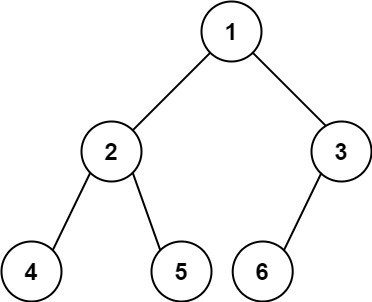
输入:root = [1,2,3,4,5,6]
输出:6
示例 2:
输入:root = []
输出:0
示例 3:
输入:root = [1]
输出:1
给定一个二叉树,判断它是否是高度平衡的二叉树。
本题中,一棵高度平衡二叉树定义为:
一个二叉树每个节点 的左右两个子树的高度差的绝对值不超过 1 。
示例 1:

输入:root = [3,9,20,null,null,15,7]
输出:true
示例 2:
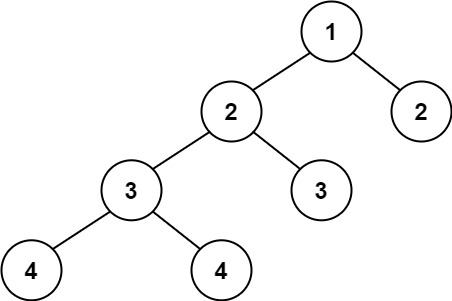
输入:root = [1,2,2,3,3,null,null,4,4]
输出:false
示例 3:
输入:root = []
输出:true
- //递归
- class Solution {
- public boolean isBalanced(TreeNode root) {
- if(root==null) return true;
- int left=hight(root.left);
- int right=hight(root.right);
- if(Math.abs(right-left)>1){
- return false;
- }
- return isBalanced(root.left)&&isBalanced(root.right);
- }
- //递归求高度
- public int hight(TreeNode root){
- if(root==null) return 0;
- return Math.max(hight(root.left),hight(root.right))+1;
- }
- }
- //BFS求高度
- public int hight(TreeNode root){
- if(root==null) return 0;
- Queue
node = new LinkedList<>(); - queue.offer(root);
- int res=0;
- while(!queue.isEmpty()){
- int size=queue.size();
- res++;
- while(size-->0){
- TreeNode node=queue.poll();
- if(node.left!=null) queue.offer(node.left);
- if(node.right!=null) queue.offer(node.right);
- }
- }
- return res;
- }
给你一个二叉树的根节点
root,按 任意顺序 ,返回所有从根节点到叶子节点的路径。叶子节点 是指没有子节点的节点。
示例 1:
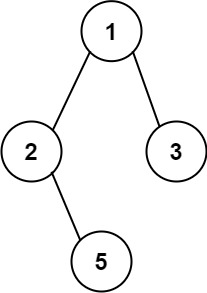
输入:root = [1,2,3,null,5]
输出:["1->2->5","1->3"]
示例 2:
输入:root = [1]
输出:["1"]
- class Solution {
- public List
binaryTreePaths(TreeNode root) { - List
res=new LinkedList<>(); - List
path=new LinkedList<>(); - getPath(root,res,path);
- return res;
- }
- public void getPath(TreeNode root,List
res,List {path) - if(root==null) return;
- path.add(root.val);
- if(root.left==null&&root.right==null){//叶子节点
- StringBuilder sb=new StringBuilder();
- for(int i=0;i
- sb.append(path.get(i)).append("->");
- }
- sb.append(path.get(path.size()-1));//处理最后一个节点
- res.add(sb.toString());
- }
- if(root.left!=null){
- getPath(root.left,res,path);
- path.remove(path.size()-1);
- }
- if(root.right!=null){
- getPath(root.right,res,path);
- path.remove(path.size()-1);
- }
- }
- }
给定二叉树的根节点
root,返回所有左叶子之和。示例 1:

转存失败重新上传取消
输入: root = [3,9,20,null,null,15,7]
输出: 24
解释: 在这个二叉树中,有两个左叶子,分别是 9 和 15,所以返回 24示例 2:
输入: root = [1]
输出: 0
- //DFS 递归
- class Solution {
- public int sumOfLeftLeaves(TreeNode root) {
- if(root==null) return 0;
- int left=sumOfLeftLeaves(root.left);
- int right=sumOfLeftLeaves(root.right);
- int value=0;
- if(root.left!=null&&root.left.left==null&&root.left.right==null){
- value+=root.left.val;
- }
- int res=left+right+value;
- return res;
- }
- }
- //BFS 层次 队列
- class Solution {
- public int sumOfLeftLeaves(TreeNode root) {
- if(root==null || root.left==null&&root.right==null) return 0;
- Queue
queue=new LinkedList<>(); - queue.offer(root);
- int sum=0;
- while(!queue.isEmpty()){
- int size=queue.size();
- while(size-->0){
- TreeNode node=queue.poll();
- if(node.left!=null) {
- if(node.left.left==null&&node.left.right==null){
- sum+=node.left.val;
- }
- queue.offer(node.left);
- }
- if(node.right!=null){
- queue.offer(node.right);
- }
- }
- }
- return sum;
- }
- }
这题在层次遍历中出错,直接在node.left!=null里面判断是左叶子就行
这题关键点是:1.找左叶子 2.左叶子的判断是root.left!=null&&root.left.left==null&&root.left.right==null
给定一个二叉树的 根节点
root,请找出该二叉树的 最底层 最左边 节点的值。假设二叉树中至少有一个节点。
示例 1:

输入: root = [2,1,3]
输出: 1
示例 2:

输入: [1,2,3,4,null,5,6,null,null,7]
输出: 7
- // 递归法
- class Solution {
- private int Deep = -1;
- private int value = 0;
- public int findBottomLeftValue(TreeNode root) {
- value = root.val;
- findLeftValue(root,0);
- return value;
- }
- private void findLeftValue (TreeNode root,int deep) {
- if (root == null) return;
- if (root.left == null && root.right == null) {//到叶子节点
- if (deep > Deep) {
- value = root.val;
- Deep = deep;//到最大深度
- }
- }
- findLeftValue(root.left,deep + 1);
- findLeftValue(root.right,deep + 1);
- }
- }
- //BFS 层次
- class Solution {
- public int findBottomLeftValue(TreeNode root) {
- if(root==null) return 0;
- if(root.left==null&&root.right==null) return root.val;
- Queue
queue=new LinkedList<>(); - queue.offer(root);
- int res=0;
- while(!queue.isEmpty()){
- int size=queue.size();
- while(size-->0){
- TreeNode node=queue.poll();
- if(size==0) res=node.val;
- if(node.right!=null) {
- queue.offer(node.right);
- }
- if(node.left!=null) {
- queue.offer(node.left);
- }
- }
- }
- return res;
- }
- }
本题递归需要注意的是:1 先找叶子节点 2 找最大深度 层次遍历只需要每次更新size=0即最左边的节点的值
给你二叉树的根节点 root 和一个表示目标和的整数 targetSum 。判断该树中是否存在 根节点到叶子节点 的路径,这条路径上所有节点值相加等于目标和 targetSum 。如果存在,返回 true ;否则,返回 false 。
叶子节点 是指没有子节点的节点。
示例 1:

输入:root = [5,4,8,11,null,13,4,7,2,null,null,null,1], targetSum = 22
输出:true
解释:等于目标和的根节点到叶节点路径如上图所示。示例 2:
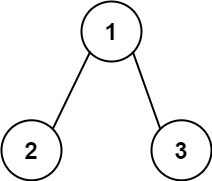
输入:root = [1,2,3], targetSum = 5
输出:false
解释:树中存在两条根节点到叶子节点的路径:
(1 --> 2): 和为 3
(1 --> 3): 和为 4
不存在 sum = 5 的根节点到叶子节点的路径。
示例 3:输入:root = [], targetSum = 0
输出:false
解释:由于树是空的,所以不存在根节点到叶子节点的路径。- class Solution {
- public boolean hasPathSum(TreeNode root, int targetSum) {
- if(root==null) return false;
- targetSum-=root.val;
- if(root.left==null&&root.right==null&&targetSum==0) return true;
- if(root.left!=null) {
- if(hasPathSum(root.left,targetSum))
- return true;
- }
- if(root.right!=null){
- if(hasPathSum(root.right,targetSum))
- return true;
- }
- return false;
- }
- }
- class Solution {
- public TreeNode buildTree(int[] inorder, int[] postorder) {
- if(inorder.length==0 || postorder.length==0) return null;
- return build(inorder,0,inorder.length,postorder,0,postorder.length);
- }
- public TreeNode build(int[] inorder,int inorderLeft,int inorderRight,int[] postorder,int posLeft,int posRight){
- int rootValue=postorder[postRight-1];//找到后序节点的尾节点 该节点为原树的头节点
- TreeNode root=new TreeNode(rootValue);//构造头节点
- int rootIndex=0;
- for(int i=inorderLeft;i
- if(rootValue==inorder[i]){
- rootIndex=i;
- break;
- }
- }
- //递归
- root.left=build(inorder,inorderLeft,rootInex,postorder,posLeft,posLeft+(rootIndex-inorderLeft));
- root.right=build(inorder,rootIndex+1,inorderRight,postorder,posLeft+(rootIndex-1),posRight);
- }
- }
给定一个不重复的整数数组 nums 。 最大二叉树 可以用下面的算法从 nums 递归地构建:
创建一个根节点,其值为 nums 中的最大值。
递归地在最大值 左边 的 子数组前缀上 构建左子树。
递归地在最大值 右边 的 子数组后缀上 构建右子树。
返回 nums 构建的 最大二叉树 。示例 1:

输入:nums = [3,2,1,6,0,5]
输出:[6,3,5,null,2,0,null,null,1]
解释:递归调用如下所示:
- [3,2,1,6,0,5] 中的最大值是 6 ,左边部分是 [3,2,1] ,右边部分是 [0,5] 。
- [3,2,1] 中的最大值是 3 ,左边部分是 [] ,右边部分是 [2,1] 。
- 空数组,无子节点。
- [2,1] 中的最大值是 2 ,左边部分是 [] ,右边部分是 [1] 。
- 空数组,无子节点。
- 只有一个元素,所以子节点是一个值为 1 的节点。
- [0,5] 中的最大值是 5 ,左边部分是 [0] ,右边部分是 [] 。
- 只有一个元素,所以子节点是一个值为 0 的节点。
- 空数组,无子节点。示例 2:

输入:nums = [3,2,1]
输出:[3,null,2,null,1]
- class Solution {
- public TreeNode constructMaximumBinaryTree(int[] nums) {
- if(nums.length==0) return null;
- return build(nums,0,nums.length);
- }
- public TreeNode build(int[] nums,int left,int right){
- if(right-left<1) return null;
- if(right-left==1) return new TreeNode(nums[left]);
- int rootValue=0;
- int rootIndex=0;
- for(int i=0;iif(nums[i]>rootValue){rootValue=nums[i];rootIndex=i;}}TreeNode root=new TreeNode(rootValue);root.left=build(nums,left,rootIndex);root.right=build(nums,rootIndex+1,right);return root;}}
给你两棵二叉树: root1 和 root2 。
想象一下,当你将其中一棵覆盖到另一棵之上时,两棵树上的一些节点将会重叠(而另一些不会)。你需要将这两棵树合并成一棵新二叉树。合并的规则是:如果两个节点重叠,那么将这两个节点的值相加作为合并后节点的新值;否则,不为 null 的节点将直接作为新二叉树的节点。
返回合并后的二叉树。
示例 1:

输入:root1 = [1,3,2,5], root2 = [2,1,3,null,4,null,7]
输出:[3,4,5,5,4,null,7]
示例 2:输入:root1 = [1], root2 = [1,2]
输出:[2,2]- class Solution {
- public TreeNode mergeTrees(TreeNode root1, TreeNode root2) {
- if(root1==null&&root2==null) return null;
- if(root1==null&&root2!=null) return root2;//root2不为空 返回root2
- if(root1!=null&&root2==null) return root1;//root1不为空 返回root2
- TreeNode root=new TreeNode(root1.val+root2.val);//创建新的节点
- root.left=mergeTrees(root1.left,root2.left);//合并左节点
- root.right=mergeTrees(root1.right,root2.right);//合并右节点
- return root;
- }
- }
给定二叉搜索树(BST)的根节点 root 和一个整数值 val。
你需要在 BST 中找到节点值等于 val 的节点。 返回以该节点为根的子树。 如果节点不存在,则返回 null 。
示例 1:

输入:root = [4,2,7,1,3], val = 2 输出:[2,1,3]
示例 2:

输入:root = [4,2,7,1,3], val = 5 输出:[]
- //利用二叉搜索树的性质
- class Solution {
- public TreeNode searchBST(TreeNode root, int val) {
- if(root==null) return null;
- if(root.val==val) return root;
- if(valreturn searchBST(root.left,val);}else if(val>root.val){return searchBST(root.right,val);}return root;}}
给你一个二叉树的根节点 root ,判断其是否是一个有效的二叉搜索树。
有效 二叉搜索树定义如下:
节点的左子树只包含 小于 当前节点的数。
节点的右子树只包含 大于 当前节点的数。
所有左子树和右子树自身必须也是二叉搜索树。示例 1:
输入:root = [2,1,3] 输出:true
- class Solution {
- public boolean isValidBST(TreeNode root) {
- return isBST(root,null,null);
- }
- public boolean isBST(TreeNode root,TreeNode min,TreeNode max){
- if(root==null) return true;
- if(min!=null&&root.val<=min.val) return false;
- if(max!=null&&root.val>=max.val) return false;
- return isBST(root.left,min,root)&&isBST(root.right,root,max);
- }
- }
给你一个二叉搜索树的根节点
root,返回 树中任意两不同节点值之间的最小差值 。差值是一个正数,其数值等于两值之差的绝对值。
示例 1:
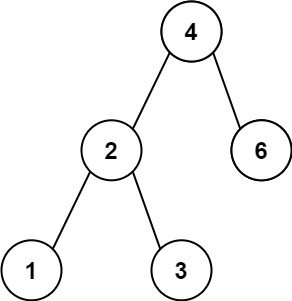
输入:root = [4,2,6,1,3] 输出:1
示例 2:
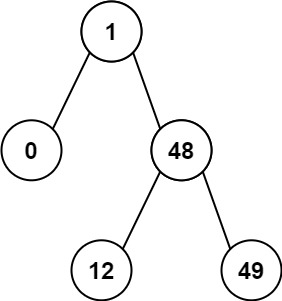
输入:root = [1,0,48,null,null,12,49] 输出:1
注意:如果出现二叉搜索树求最值,差值之类的,把它转化成有序数组,然后中序遍历
- class Solution {
- TreeNode pre;
- int res=Integer.MAX_VALUE;
- public int getMinimumDifference(TreeNode root) {
- if(root==null) return 0;
- traval(root);
- return res;
- }
- public void traval(TreeNode root){
- if(root==null) return;
- traval(root.left);
- if(pre!=null){
- res=Math.min(res,root.val-pre.val);
- }
- pre=root;
- traval(root.right);
- }
- }
给定一个二叉树, 找到该树中两个指定节点的最近公共祖先。
百度百科中最近公共祖先的定义为:“对于有根树 T 的两个节点 p、q,最近公共祖先表示为一个节点 x,满足 x 是 p、q 的祖先且 x 的深度尽可能大(一个节点也可以是它自己的祖先)。”
示例 1:
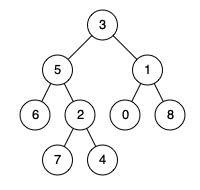
输入:root = [3,5,1,6,2,0,8,null,null,7,4], p = 5, q = 1
输出:3
解释:节点 5 和节点 1 的最近公共祖先是节点 3 。示例 2:
输入:root = [3,5,1,6,2,0,8,null,null,7,4], p = 5, q = 4
输出:5
解释:节点 5 和节点 4 的最近公共祖先是节点 5 。因为根据定义最近公共祖先节点可以为节点本身。- class Solution {
- public TreeNode lowestCommonAncestor(TreeNode root, TreeNode p, TreeNode q) {
- if(root==null || root==p || root==q) return root;
- TreeNode left=lowestCommonAncestor(root.left,p,q);
- TreeNode right=lowestCommonAncestor(root.right,p,q);
- if(left==null&&right==null) return null;
- if(left==null && right!=null) return right;
- if(left!=null && right==null) return left;
- return root;
- }
- }
给定一个二叉搜索树, 找到该树中两个指定节点的最近公共祖先。
百度百科中最近公共祖先的定义为:“对于有根树 T 的两个结点 p、q,最近公共祖先表示为一个结点 x,满足 x 是 p、q 的祖先且 x 的深度尽可能大(一个节点也可以是它自己的祖先)。”
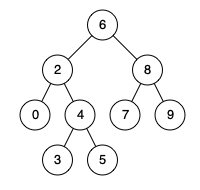
示例 1:
输入: root = [6,2,8,0,4,7,9,null,null,3,5], p = 2, q = 8
输出: 6
解释: 节点 2 和节点 8 的最近公共祖先是 6。示例 2:
输入: root = [6,2,8,0,4,7,9,null,null,3,5], p = 2, q = 4
输出: 2
解释: 节点 2 和节点 4 的最近公共祖先是 2, 因为根据定义最近公共祖先节点可以为节点本身。- class Solution {
- public TreeNode lowestCommonAncestor(TreeNode root, TreeNode p, TreeNode q) {
- if(root==null || root==p || root==q) return root;
- TreeNode left=lowestCommonAncestor(root.left,p,q);
- TreeNode right=lowestCommonAncestor(root.right,p,q);
- if(root.val
- if(root.val>p.val&&root.val>q.val) return right;
- return root;
- }
- }
给定二叉搜索树(BST)的根节点 root 和要插入树中的值 value ,将值插入二叉搜索树。 返回插入后二叉搜索树的根节点。 输入数据 保证 ,新值和原始二叉搜索树中的任意节点值都不同。
注意,可能存在多种有效的插入方式,只要树在插入后仍保持为二叉搜索树即可。 你可以返回 任意有效的结果 。
示例 1:
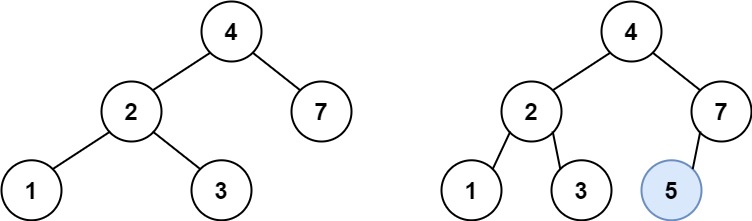
输入:root = [4,2,7,1,3], val = 5 输出:[4,2,7,1,3,5] 解释:另一个满足题目要求可以通过的树是:

示例 2:
输入:root = [40,20,60,10,30,50,70], val = 25
输出:[40,20,60,10,30,50,70,null,null,25]示例 3:
输入:root = [4,2,7,1,3,null,null,null,null,null,null], val = 5
输出:[4,2,7,1,3,5]- class Solution {
- public TreeNode insertIntoBST(TreeNode root, int val) {
- if(root==null) return new TreeNode(val);
- if(root.val>val) root.left=insertIntoBST(root.left,val);
- if(root.valreturn root;}}
给定一个二叉搜索树的根节点 root 和一个值 key,删除二叉搜索树中的 key 对应的节点,并保证二叉搜索树的性质不变。返回二叉搜索树(有可能被更新)的根节点的引用。
一般来说,删除节点可分为两个步骤:
首先找到需要删除的节点;
如果找到了,删除它。示例 1:
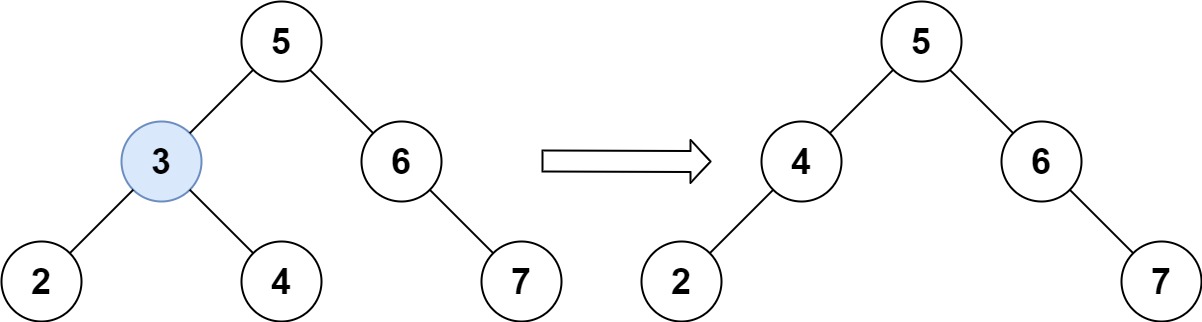
输入:root = [5,3,6,2,4,null,7], key = 3
输出:[5,4,6,2,null,null,7]
解释:给定需要删除的节点值是 3,所以我们首先找到 3 这个节点,然后删除它。
一个正确的答案是 [5,4,6,2,null,null,7], 如下图所示。
另一个正确答案是 [5,2,6,null,4,null,7]。
示例 2:
输入: root = [5,3,6,2,4,null,7], key = 0
输出: [5,3,6,2,4,null,7]
解释: 二叉树不包含值为 0 的节点
示例 3:输入: root = [], key = 0
输出: []- class Solution {
- public TreeNode deleteNode(TreeNode root, int key) {
- if(root==null) return null;
- if(root.val==key){
- if(root.left==null){
- return root.right;
- }else if(root.right==null){
- return root.left;
- }else{
- TreeNode cur=root.right;
- while(cur.left!=null){
- cur=cur.left;
- }
- cur.left=root.left;
- root=root.right;
- return root;
- }
- }
- if(root.val>key) root.left=deleteNode(root.left,key);
- if(root.valreturn root;}}
给你二叉搜索树的根节点 root ,同时给定最小边界low 和最大边界 high。通过修剪二叉搜索树,使得所有节点的值在[low, high]中。修剪树 不应该 改变保留在树中的元素的相对结构 (即,如果没有被移除,原有的父代子代关系都应当保留)。 可以证明,存在 唯一的答案 。
所以结果应当返回修剪好的二叉搜索树的新的根节点。注意,根节点可能会根据给定的边界发生改变。
示例 1:
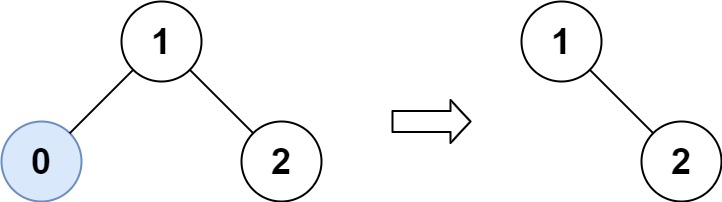
输入:root = [1,0,2], low = 1, high = 2 输出:[1,null,2]
示例 2:
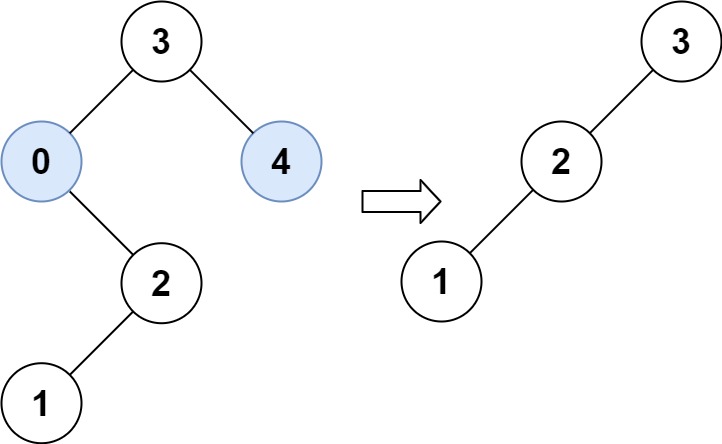
输入:root = [3,0,4,null,2,null,null,1], low = 1, high = 3 输出:[3,2,null,1]
- class Solution {
- public TreeNode trimBST(TreeNode root, int low, int high) {
- if(root==null) return null;
- if(root.val>low){
- TreeNode left=trimBST(root.left,low,high);//寻找符合区间
- return left;
- }
- if(root.valTreeNode right=trimBST(root.right,low,high);//寻找符合区间return right;}root.left=trimBST(root.left,low,high);root.right=trimBST(root.right,low,high);return root;}}
给你一个整数数组 nums ,其中元素已经按 升序 排列,请你将其转换为一棵 高度平衡 二叉搜索树。
高度平衡 二叉树是一棵满足「每个节点的左右两个子树的高度差的绝对值不超过 1 」的二叉树。
示例 1:
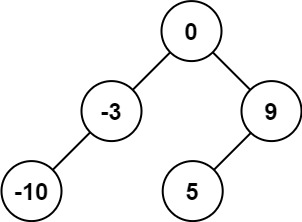
输入:nums = [-10,-3,0,5,9]
输出:[0,-3,9,-10,null,5]
解释:[0,-10,5,null,-3,null,9] 也将被视为正确答案: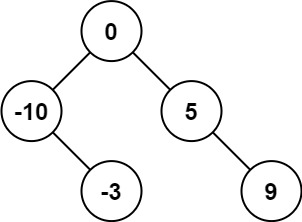
示例 2:
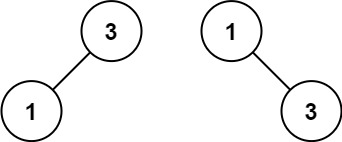
输入:nums = [1,3] 输出:[3,1] 解释:[1,null,3] 和 [3,1] 都是高度平衡二叉搜索树。
- class Solution {
- public TreeNode sortedArrayToBST(int[] nums) {
- if(nums.length==0) return null;
- return travel(nums,0,nums.length-1);
- }
- public TreeNode travel(int[] nums,int left,int right){
- if(left>right) return null;
- int mid=left+(right-left)/2;
- TreeNode root=new TreeNode(nums[mid]);//构造头节点
- root.left=travel(nums,left,mid-1);//构造左节点
- root.right=travel(nums,mid+1,right);//构造右节点
- return root;
- }
- }
给出二叉 搜索 树的根节点,该树的节点值各不相同,请你将其转换为累加树(Greater Sum Tree),使每个节点 node 的新值等于原树中大于或等于 node.val 的值之和。
示例 1:

输入:[4,1,6,0,2,5,7,null,null,null,3,null,null,null,8]
输出:[30,36,21,36,35,26,15,null,null,null,33,null,null,null,8]示例 2:
输入:root = [0,null,1]
输出:[1,null,1]
示例 3:输入:root = [1,0,2]
输出:[3,3,2]
示例 4:输入:root = [3,2,4,1]
输出:[7,9,4,10]思路:采用中序遍历的逆序,也就是右中左的顺序
- class Solution {
- int pre=0;
- public TreeNode convertBST(TreeNode root) {
- return travel(root);
- }
- public TreeNode travel(TreeNode root){
- if(root==null) null;
- travel(root.right);//右
- root.val+=pre;//中
- pre=root.val;
- travel(root.left);//左
- return root;
- }
- }
-
相关阅读:
登录认证方式汇总,例如ThreadLocal+拦截器+Redis、JWT
淘宝直播零代码弹窗生产方案总结
TCP为什么需要三次握手和四次挥手?
一个信号博弈模型的解法
【开源】基于JAVA的学生日常行为评分管理系统
C++中的泛型详细讲解
Wireshark详细使用教程
【Spring Cloud】新闻头条微服务项目:分布式文件系统MinIO实现文章页面存取
测试左移-快速玩转Debug
C++通讯录管理系统
- 原文地址:https://blog.csdn.net/weixin_46345400/article/details/125986153
