-
RTT外设驱动使用2--ADC串口添加
配置步骤
- 配置KConfig文件
- 打开menuconfig选中ADC外设
- 保存配置生成mdk工程
- 修改CubuMX
这里最不可思议的是不要管理规则通道和注入通道问题
1. 配置KConfig文件
 ## 2. 打开menuconfig选中ADC外设

3. 保存配置生成mdk工程

4. 修改CubuMX

5. 测试文件
 ```c
```c
/*- 程序清单: ADC 设备使用例程
- 例程导出了 adc_sample 命令到控制终端
- 命令调用格式:adc_sample
- 程序功能:通过 ADC 设备采样电压值并转换为数值。
-
示例代码参考电压为3.3V,转换位数为12位。- 1
*/
#include
#include#define ADC_DEV_NAME “adc1” /* ADC 设备名称 /
#define ADC_DEV_CHANNEL0 0 / ADC 通道 /
#define ADC_DEV_CHANNEL1 1 / ADC 通道 /
#define ADC_DEV_CHANNEL5 5 / ADC 通道 /
#define REFER_VOLTAGE 330 / 参考电压 3.3V,数据精度乘以100保留2位小数*/
#define CONVERT_BITS (1 << 12) /* 转换位数为12位 */static int adc_vol_sample(int argc, char *argv[])
{
rt_adc_device_t adc_dev;
rt_uint32_t value, vol0,vol1,vol5;
rt_err_t ret = RT_EOK;/* 查找设备 */ adc_dev = (rt_adc_device_t)rt_device_find(ADC_DEV_NAME); if (adc_dev == RT_NULL) { rt_kprintf("adc sample run failed! can't find %s device!\n", ADC_DEV_NAME); return RT_ERROR; } /* 使能设备 */ ret = rt_adc_enable(adc_dev, ADC_DEV_CHANNEL0); ret = rt_adc_enable(adc_dev, ADC_DEV_CHANNEL1); ret = rt_adc_enable(adc_dev, ADC_DEV_CHANNEL5); while(1) { /* 读取采样值 */ value = rt_adc_read(adc_dev, ADC_DEV_CHANNEL0); /* 转换为对应电压值 */ vol0 = value * REFER_VOLTAGE / CONVERT_BITS; //rt_kprintf("the voltage is :%d.%02d \n", vol0 / 100, vol0 % 100); /* 读取采样值 */ value = rt_adc_read(adc_dev, ADC_DEV_CHANNEL1); /* 转换为对应电压值 */ vol1 = value * REFER_VOLTAGE / CONVERT_BITS; //rt_kprintf("the voltage is :%d.%02d \n", vol1 / 100, vol1 % 100); rt_thread_delay(500); /* 读取采样值 */ value = rt_adc_read(adc_dev, ADC_DEV_CHANNEL5); /* 转换为对应电压值 */ vol5 = value * REFER_VOLTAGE / CONVERT_BITS; rt_kprintf("the voltage is :%d.%02d %d.%02d %d.%02d \n", vol0 / 100, vol0 % 100,vol1 / 100, vol1 % 100,vol5 / 100, vol5 % 100); rt_thread_delay(500); } /* 关闭通道 */ ret = rt_adc_disable(adc_dev, ADC_DEV_CHANNEL0); ret = rt_adc_disable(adc_dev, ADC_DEV_CHANNEL1); return ret;- 1
- 2
- 3
- 4
- 5
- 6
- 7
- 8
- 9
- 10
- 11
- 12
- 13
- 14
- 15
- 16
- 17
- 18
- 19
- 20
- 21
- 22
- 23
- 24
- 25
- 26
- 27
- 28
- 29
- 30
- 31
- 32
- 33
- 34
- 35
- 36
- 37
- 38
- 39
- 40
- 41
- 42
- 43
- 44
}
/* 导出到 msh 命令列表中 */
MSH_CMD_EXPORT(adc_vol_sample, adc voltage convert sample);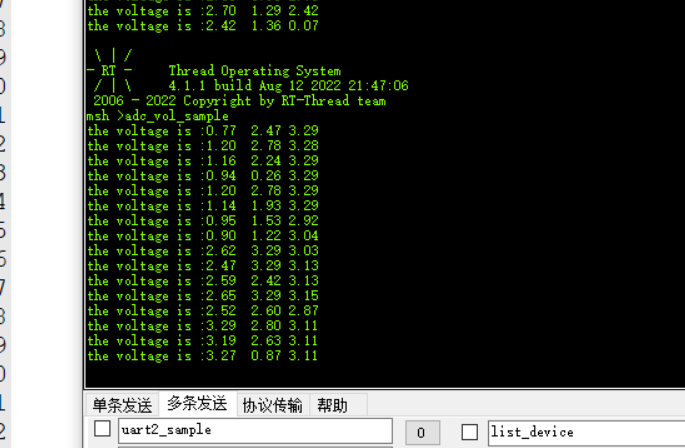- 1
- 2
- 3
- 4
-
相关阅读:
JavaSE题
三门问题-Swift测试
如何在JAVA中构建区块链?
数据库:什么是数据库,有哪些数据库,数据库用来干什么,图导,拓展
Java框架-MyBatis 详细介绍(crud+缓存+联表+缓存+日志...)
ZGC关键技术分析
本地配置启动两个tomcat,并实现简单的nginx负载平衡
ic2常用命令
Java 中使用 Elasticsearch 进行 Boot 操作和 DSL 查询文档详解
大厂面试题-MySQL为什么使用B+Tree作为索引结构
- 原文地址:https://blog.csdn.net/u010261063/article/details/126312192
