-
JAVA 面向对象(OOP)
1.什么是面向对象?

2.面向过程与面向对象的区别

3.回顾方法的定义
- break和return的区别
跳出switch,结束循环和return的区别
- 方法名: 注意规范。驼峰命名法。
- 参数列表
- 异常抛出
4.回顾方法的调用
- 静态方法
- 非静态方法
- 形参和实参
- 值传递和引用传递
- this 关键字
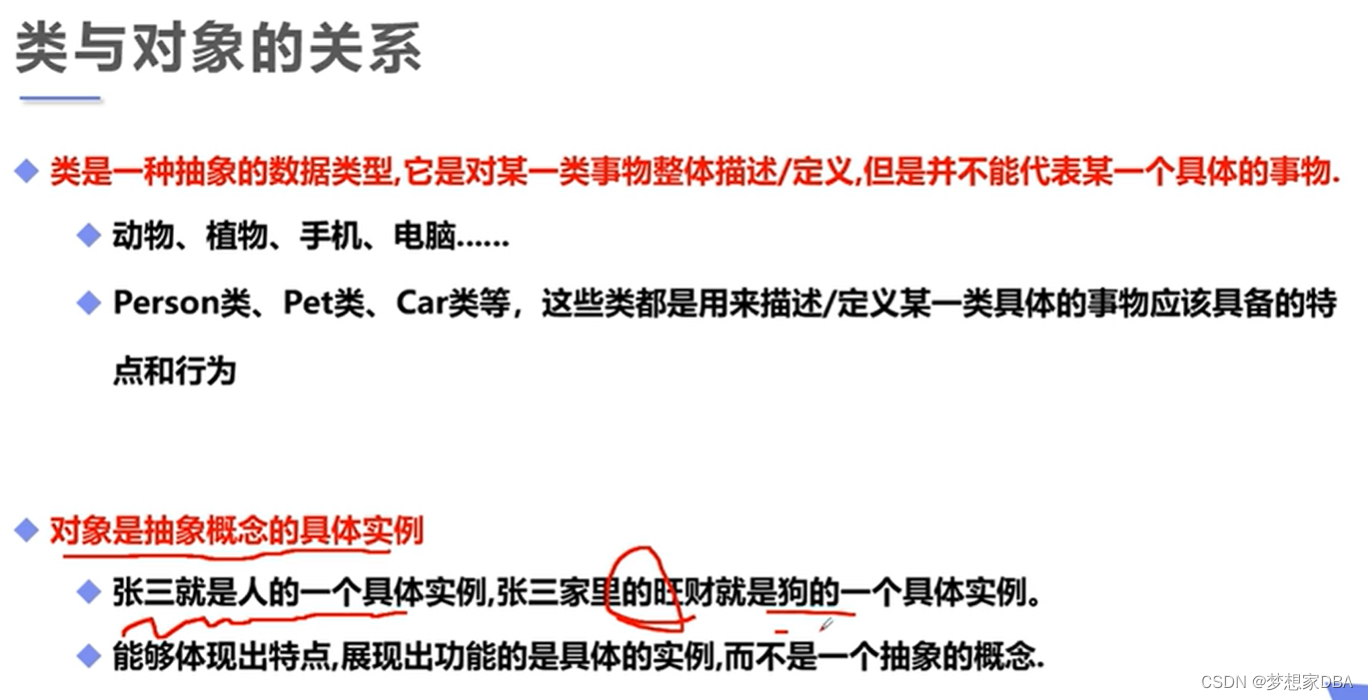
5.类与对象的创建
使用new关键字创建对象
使用new关键字创建的时候,除了分配内存空间之外,还会给创建好的对象进行默认的初始化以及对类中构造器的调用。
类中的构造器也称为构造方法,是在进行创建对象的时候必须要调用的。并且构造器有以下两个特点:
1、必须和类的名字相同
2、必须没有返回类型,也不能写void- package org.psmaxwell.oop.demo02;
- //学生类
- public class Student {
- //属性: 字段
- String name; //null
- int age; //0
- //方法
- public void study(){
- System.out.println(this.name +"在学习");
- }
- }
- /**
- * public static void main(String[] args) {
- *
- *
- * // 类: 抽象的, 实例化
- * // 类实例化后会返回一个自己的对象!
- * //student 对象就是一个Student类的具体实例!
- * Student xiaoming = new Student();
- * Student xh = new Student();
- *
- * xiaoming.name = "小明";
- * xiaoming.age = 3;
- *
- * System.out.println(xiaoming.name);
- * System.out.println(xiaoming.age);
- *
- * xh.name = "小红";
- * xh.age = 3;
- *
- * System.out.println(xh.name);
- * System.out.println(xh.age);
- *
- * }
- */
6.构造器详解
- package org.psmaxwell.oop.demo03;
- public class Pet {
- public String name;
- public int age;
- //无参构造
- public void shout(){
- System.out.println("叫了一声");
- }
- }
- /**
- *
- Pet dog = new Pet();
- dog.name = "旺财";
- dog.age = 3;
- dog.shout();
- System.out.println(dog.name);
- System.out.println(dog.age);
- */
7.简单小结类与对象
1.类是一个模板,对象是一个具体的实例。
2.方法
定义、调用!
3.对应的引用
引用类型: 基本类型
对象是通过引用来操作的,栈---》堆4.属性: 字段Field 成员变量
默认初始化
数字 : 0 0.0
char : u0000
boolean : false
引用 : null修饰符 属性类型 属性名 = 属性值!
5.对象的创建和使用
- 必须使用new 关键字创造对象,构造器 Person Maxwell = new Person();
- 对象的属性 Maxwell.name
- 对象方法 Maxwell.sleep()6.类
静态的属性 属性
动态的行为 方法封装、继承、多态
8.封装详解
该露的露,该藏的藏
我们程序设计要追求“高内聚,低耦合”。高内聚就是类的内部数据操作细节自己完成。不允许外部干涉;低耦合:仅暴露少量的方法给外部使用。封装(数据的隐藏)
通常,应禁止直接访问一个对象中数据的实际标识,而应通过操作接口来访问,这称为信息隐藏。- 记住这句话就够了:属性私有,get/set
- package org.psmaxwell.oop.Demo04;
- //类 private: 私有
- public class Student {
- //属性私有
- private String name; //名字
- private int id; //学号
- private char sex; //性别
- private int age;
- //提供一些可以操作这个属性的方法
- // 提供一些public的get、set的方法
- //get 获得这个数据
- public String getName(){
- return this.name;
- }
- // set 给这个数据设置值
- public void setName(String name){
- this.name=name;
- }
- //alt + Insert
- public int getId() {
- return id;
- }
- public void setId(int id) {
- this.id = id;
- }
- public char getSex() {
- return sex;
- }
- public void setSex(char sex) {
- this.sex = sex;
- }
- public int getAge() {
- return age;
- }
- public void setAge(int age) {
- if(age>120 || age<0) {
- this.age = 3;
- }else{
- this.age = age;
- }
- }
- }
- /**
- *
- * Student s1 = new Student();
- *
- * s1.setName("Maxwell");
- *
- * System.out.println(s1.getName());
- *
- * s1.setAge(999); //不合法
- *
- * System.out.println(s1.getAge());
- */
9.什么是继承?

10.Super详解
super注意点:
1.调用父类的构造方法,必须在构造方法的第一个
2.super必须只能出现在子类的方法或者构造方法中。
super和this不能同时调用构造方法。
Super Vs this:
代表的对象不同:
this : 本身调用者这个对象
super: 代表父类对象的应用前提:
this : 没有继承也可以使用
super: 只能在继承条件下才可以使用构造方法:
this() : 本类构造器。
super() : 父类构造器!- package org.psmaxwell.oop;
- import org.psmaxwell.oop.demo05.Person;
- import org.psmaxwell.oop.demo05.Student;
- // 一个项目应该只存在一个main方法
- public class Application {
- public static void main(String[] args) {
- Student student = new Student();
- // student.test("小山");
- // student.test1();
- }
- }
- package org.psmaxwell.oop.demo05;
- // 学生 is 人 子类 派生类
- // 子类继承了父类,就会拥有父类的全部方法
- public class Student extends Person {
- public Student() {
- //隐藏代码:调用了父类的无参构造
- super();//调用父类的构造器,必须要在子类构造器的第一行。
- System.out.println("Student无参构造执行了");
- }
- //Ctrl + H
- private String name = "xiaoshan";
- public void print(){
- System.out.println("Student");
- }
- public void test1(){
- print(); //Student
- this.print(); //Student
- super.print(); //Person
- }
- public void test2(String name){
- System.out.println(name); // 小山 main
- System.out.println(this.name); //调用子类
- System.out.println(super.name); //调用父类
- }
- }
- package org.psmaxwell.oop.demo05;
- //Person is 人 父类
- //在Java中,所有的类,都默认直接或者间接继承Object
- public class Person /*extends Object*/{
- public Person() {
- System.out.println("Person无参执行了");
- }
- protected String name = "Maxwell";
- //私有的东西无法被继承
- public void print(){
- System.out.println("Person");
- }
- }
11.方法重写
---重写
重写: 需要有继承关系,子类重写父类的方法!
1.方法名必须相同
2.参数列表必须相同
3.修饰符:范围可以扩大; public> protected>Default>private
4.抛出的异常:范围可以被缩小,但不能扩大;ClassNotFoundException ---> Exception(大)
重写,子类的方法和父类必须一致;方法体不同为什么需要重写?
1.父类的功能,子类不一定需要,或者不一定满足。
Alt + Insert :overwrite;- package org.psmaxwell.oop;
- import org.psmaxwell.oop.demo05.A;
- import org.psmaxwell.oop.demo05.B;
- //静态的方法和非静态方法区别很大!
- //非静态: 重写
- public class Application {
- public static void main(String[] args) {
- // 静态方法: //方法的调用只和左边,定义的数据类型有关
- A a = new A();
- a.test(); //A
- //父类的引用指向子类
- B b = new A(); //子类重写了父类的方法
- b.test(); //B
- }
- }
- package org.psmaxwell.oop.demo05;
- //继承
- public class A extends B{
- //重写
- @java.lang.Override //注解
- public void test() {
- System.out.println("A=>test()");
- }
- }
- package org.psmaxwell.oop.demo05;
- //重写都是方法的重写,与属性无关
- public class B {
- public void test(){
- System.out.println("B=>test()");
- }
- }
12.instanceof和类型转换
- package org.psmaxwell.oop;
- import org.psmaxwell.oop.demo06.Person;
- import org.psmaxwell.oop.demo06.Student;
- import org.psmaxwell.oop.demo06.Teacher;
- public class Application {
- public static void main(String[] args) {
- //类型之间的转换 父 子
- //高 低
- Person obj = new Student();
- //student 将这个对象转换为Student类型,我们就可以使用Student类型的方法了。
- // 子类转父类可能丢失自己的本来的一些方法!
- // Student student = (Student) obj;
- // student.go();
- ((Student) obj).go();
- /**
- * 1.父类的引用执行子类的对象
- * 2.把子类转换为父类,向上转型
- * 3.把父类转换为子类,向下转型,强制转换。
- * 4.方便方法的调用,减少重复的代码,简洁
- *
- * 封装、继承、多态、接口
- * 多实践、多测试、实践出真知。
- *
- *
- */
- }
- }
- package org.psmaxwell.oop.demo06;
- public class Person {
- public void run(){
- System.out.println("run");
- }
- }
- package org.psmaxwell.oop.demo06;
- public class Student extends Person {
- public void go(){
- System.out.println("go");
- }
- }
- /**
- *
- * public class Student extends Person {
- *
- * @java.lang.Override
- * public void run() {
- * System.out.println("son");
- * }
- *
- * public void eat(){
- * System.out.println("eating");
- * }
- * }
- *
- *
- *
- */
- /**
- *
- * // Object > String
- * // Object > Person > Teacher
- * // Object > Person > Student
- * Object object = new Student();
- *
- * //System.out.println(x instanceof y); //能不能通过
- *
- * System.out.println(object instanceof Student); //true
- * System.out.println(object instanceof Person); //true
- * System.out.println(object instanceof Object); //true
- * System.out.println(object instanceof Teacher); //false
- * System.out.println(object instanceof String); //false
- *
- * System.out.println("==========================");
- *
- * Person person = new Student();
- *
- * System.out.println(person instanceof Student); //true
- * System.out.println(person instanceof Person); //true
- * System.out.println(person instanceof Object); //true
- * System.out.println(person instanceof Teacher); //false
- * // System.out.println(person instanceof String); //编译报错
- *
- *
- * System.out.println("==========================");
- *
- * Student student = new Student();
- *
- * System.out.println(student instanceof Student); //true
- * System.out.println(student instanceof Person); //true
- * System.out.println(student instanceof Object); //true
- * //System.out.println(student instanceof Teacher); //编译报错
- * //System.out.println(student instanceof String); //编译报错
- */
13.static关键字详解
- package org.psmaxwell.oop.demo07;
- //静态导入包
- import static java.lang.Math.random;
- import static java.lang.Math.PI;
- public class Test {
- public static void main(String[] args) {
- System.out.println(Math.random());
- System.out.println(PI);
- }
- }
- package org.psmaxwell.oop;
- public class Application {
- public static void main(String[] args) {
- }
- }
- package org.psmaxwell.oop.demo07;
- //static
- public class Student {
- private static int age; //静态的变量
- private double score; //非静态变量
- public void run(){
- go();
- }
- public static void go(){
- }
- public static void main(String[] args) {
- Student.go();
- }
- }
- package org.psmaxwell.oop.demo07;
- public class Person {
- //2
- {
- //代码块(匿名代码块)
- System.out.println("匿名代码块");
- }
- // 1 只执行一次
- static {
- //静态代码块
- System.out.println("静态代码块");
- }
- //3
- public Person() {
- System.out.println("构造方法");
- }
- public static void main(String[] args) {
- Person person = new Person();
- System.out.println("==========================");
- Person person2 = new Person();
- }
- }
14.抽象类
- abstract 修饰符可以用来修饰方法也可以修饰类,如果修饰方法,那么该方法就是抽象方法,如果修饰类,那么该类就是抽象类。
- 抽象类中可以没有抽象方法,但是有抽象方法的类一定要声明为抽象类。
- 抽象类,不能使用new关键字来创建对象,它是用来让子类继承的。
- 抽象方法,只有方法的声明,没有方法的实现,它是用来让子类实现的。
- 子类继承抽象类,那么就必须要实现抽象类没有实现的抽象方法,否则该子类也要声明为抽象类。
- package org.psmaxwell.oop.demo08;
- //abstract 抽象类 类 extends: 单继承 (接口可以多继承)
- public abstract class Action {
- // 约束 有人帮我们实现-
- // abstract ,抽象方法,只有方法名字,没有方法的实现。
- //约束- 有人帮我们实现 抽象方法,只有方法的名字,没有方法的实现
- public abstract void doSomething();
- //1.不能new这个抽象类, 只能靠子类去实现它,约束。
- //2.抽象类中可以写普通的方法
- //3.抽象方法必须在抽象类中
- //抽象的抽象 : 约束
- // 思考题 new , 存在构造器吗?
- //存在的意义 抽象出来, 提高开发效率
- }
- package org.psmaxwell.oop.demo08;
- //抽象类的所有方法,都继承了它的子类,都必须要实现它的方法 除非
- public class A extends Action{
- @java.lang.Override
- public void doSomething() {
- }
- }
15.接口的定义与实现

- package org.psmaxwell.oop.demo09;
- //抽象的思维 Java
- //interface 定义的关键字, 接口都需要有实现类。
- public interface UserService {
- //常量
- public static final int AGE = 99;
- //接口中的所有定义其实都是抽象的public
- void run(String name);
- void delete(String name);
- void update(String name);
- void query(String name);
- }
- package org.psmaxwell.oop.demo09;
- //抽象类 : extends
- // 类 可以实现接口 implements 接口
- // 实现了接口的类, 就需要重写接口中的方法
- //利用接口实现多继承
- public class UserServiceImpl implements UserService,TimeService{
- @java.lang.Override
- public void run(java.lang.String name) {
- }
- @java.lang.Override
- public void delete(java.lang.String name) {
- }
- @java.lang.Override
- public void update(java.lang.String name) {
- }
- @java.lang.Override
- public void query(java.lang.String name) {
- }
- @java.lang.Override
- public void timer() {
- }
- }
- package org.psmaxwell.oop.demo09;
- public interface TimeService {
- void timer();
- }
作用:
1.约束
2.定义一些方法,让不同的人实现
3.public abstract
4.public static final
5.接口不能被实例化,接口中没有构造方法
6.implements 可以实现多个接口
7.必须要重写接口中的方法
8.总结博客16.N种内部类

- package org.psmaxwell.oop.demo10;
- public class Outer {
- private int id=10;
- public void out(){
- System.out.println("这是外部类的方法");
- }
- public class Inner{
- public void in(){
- System.out.println("这是内部类的方法");
- }
- //获得外部类的私有属性
- public void getID(){
- System.out.println(id);
- }
- }
- }
- package org.psmaxwell.oop;
- import org.psmaxwell.oop.demo10.Outer;
- public class Application {
- public static void main(String[] args) {
- // new
- Outer outer = new Outer();
- //通过这个外部类来实例化内部类
- Outer.Inner inner = outer.new Inner();
- inner.in();
- inner.getID();
- }
- }
- package org.psmaxwell.oop.demo10;
- public class Outer {
- //局部内部类
- public void method(){
- class Inner{
- public void in(){
- }
- }
- }
- }
- //一个java类中可以有多个class类,但只能有一个public class
- //class A{
- // public static void main(String[] args) {
- //
- // }
- //}
- package org.psmaxwell.oop.demo10;
- public class Outer {
- //局部内部类
- public void method(){
- class Inner{
- public void in(){
- }
- }
- }
- }
- //一个java类中可以有多个class类,但只能有一个public class
- //class A{
- // public static void main(String[] args) {
- //
- // }
- //}
- package org.psmaxwell.oop.demo10;
- public class Test {
- public static void main(String[] args) {
- //没有名字初始化类,不用讲实例保存到变量
- new Apple().eat();
- UserService userService = new UserService(){
- @java.lang.Override
- public void hello() {
- }
- };
- }
- }
- class Apple{
- public void eat(){
- System.out.println("1");
- }
- }
- interface UserService{
- void hello();
- }
-
相关阅读:
C#获取http请求的JSON数据并解析
2022前端面试题总结
区块链模块化的破局之路
android源码学习-android异常处理机制
【预测模型-SVM预测】基于粒子群算法结合支持向量机SVM实现Covid-19风险预测附matlab代码
mplfinance 一个堪称完美python量化金融可视化工具详析
官宣!Sam Altman加入微软,OpenAI临时CEO曝光,回顾董事会‘’政变‘’始末
web:[SUCTF 2019]EasySQL
平面运动机器人的传感器外参标定
springboot项目如何打包成.sh脚本形式运行|assemly插件打包自定义脚本参数
- 原文地址:https://blog.csdn.net/u011868279/article/details/126296394
