-
(pytorch进阶之路)cGAN、LSGAN
原来gan有什么问题:判别器的输入无论是真实的样本还是预测样本,输入都只有一个,x或者g(z),我们只是把照片放入判别器中

但是我们在MNIST数据集中,有10类数据分别是0~9,仅仅是输入随机的高斯变量z,没有输入任何的其他信息,不能指望生成器能够生成特定数字照片cGAN
原先的随机高斯变量随机性和不确定度很大,有帮助于预测目标照片的信息特别少,这时候我们能提供一个变量c(condition条件),也就是G不仅仅输入z,还输入c,这个c可以是个标签信息,更好的指导生成特定数字的照片
论文地址:
https://arxiv.org/pdf/1411.1784公式:y可能是每张照片的标签信息

y作为判别器和生成器的输入时,更好的去学习目标照片绿色部分就是条件信息,可以是离散或者连续的变量,常见做法像是MNIST的one-hot label转化成类似word emb,再和z拼接起来输入道网络之中
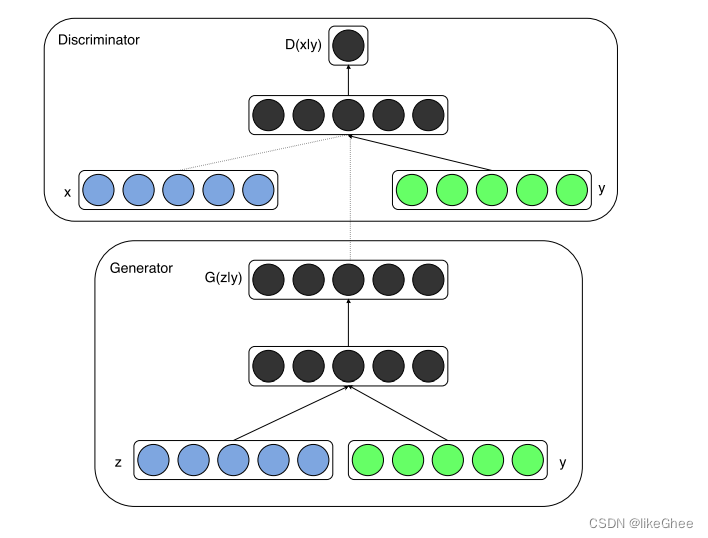
基于GAN修改代码,
对于generator,forward函数加多一个参数labels,传入nn.Embedding获取emb,再和z拼接即可,修改一下DNN网络,第一层的DNN第一个参数改成(in_dim + label_emb_dim)import torch import torch.nn as nn import torch.utils.data import numpy as np class CGenerator(nn.Module): def __init__(self, latent_dim, image_size: list, cls_num, label_emb_dim): """ image_size = [1, 28, 28] """ super().__init__() self.image_size = image_size self.embedding = nn.Embedding(cls_num, label_emb_dim) out_dim = int(np.prod(image_size)) self.model = nn.Sequential( torch.nn.utils.spectral_norm(nn.Linear(latent_dim + label_emb_dim, 64)), nn.ReLU(inplace=True), torch.nn.utils.spectral_norm(nn.Linear(64, 128)), nn.ReLU(inplace=True), torch.nn.utils.spectral_norm(nn.Linear(128, 256)), nn.ReLU(inplace=True), torch.nn.utils.spectral_norm(nn.Linear(256, 512)), nn.ReLU(inplace=True), torch.nn.utils.spectral_norm(nn.Linear(512, 1024)), nn.ReLU(inplace=True), torch.nn.utils.spectral_norm(nn.Linear(1024, out_dim)), nn.Tanh() ) def forward(self, z, labels): """ labels: 标签信息,离散的标签变量 z: noise, shape = [bs, latent_dim] return: image.shape = [bs, c, h, w] """ label_emb = self.embedding(labels) print(label_emb.shape) z = torch.cat([z, label_emb], dim=-1) output = self.model(z) images = output.reshape([z.shape[0], *self.image_size]) return images def test_main(): bs, c, h, w = 2, 1, 28, 28 image_size = [c, h, w] latent_dim = 64 inputx = torch.randn([bs, latent_dim]) cls_num = 10 label_emb_dim = 32 labels = torch.randint(0, 9, [bs, ]) res = CGenerator(latent_dim, image_size, cls_num, label_emb_dim)(inputx, labels) print(res.shape) if __name__ == '__main__': test_main()- 1
- 2
- 3
- 4
- 5
- 6
- 7
- 8
- 9
- 10
- 11
- 12
- 13
- 14
- 15
- 16
- 17
- 18
- 19
- 20
- 21
- 22
- 23
- 24
- 25
- 26
- 27
- 28
- 29
- 30
- 31
- 32
- 33
- 34
- 35
- 36
- 37
- 38
- 39
- 40
- 41
- 42
- 43
- 44
- 45
- 46
- 47
- 48
- 49
- 50
- 51
- 52
- 53
- 54
- 55
- 56
- 57
- 58
- 59
- 60
- 61
同理对于discriminator,forward函数加多一个参数labels,传入nn.Embedding获取emb,再和z拼接,同理修改DNN网络第一层DNN第一个参数输入dim大小
import torch import torch.nn as nn import numpy as np class CDiscriminator(nn.Module): def __init__(self, image_size: list, cls_num, label_emb_dim): """ image_size: list = [c, h, w] """ super().__init__() self.image_size = image_size self.embedding = nn.Embedding(cls_num, label_emb_dim) in_dim = int(np.prod(image_size)) self.model = nn.Sequential( nn.Linear(in_dim + label_emb_dim, 1024), nn.ReLU(inplace=True), nn.Linear(1024, 512), nn.ReLU(inplace=True), nn.Linear(512, 256), nn.ReLU(inplace=True), nn.Linear(256, 128), nn.ReLU(inplace=True), nn.Linear(128, 64), nn.ReLU(inplace=True), nn.Linear(64, 1), # 输出是个sigmoid概率 0~1 nn.Sigmoid() ) def forward(self, images, labels): """ images.shape = [bs, c , h , w] return: probability.shape = [bs, 1] """ labels_emb = self.embedding(labels) inputx = torch.cat([images.reshape(images.shape[0], -1), labels_emb], dim=-1) probability = self.model(inputx) return probability def test_main(): bs, c, h, w = 2, 1, 28, 28 d = CDiscriminator([c, h, w], 10, 32) labels = torch.randint(0, 9, [bs, ]) inputx = torch.randn([bs, c, h, w]) prob = d(inputx, labels) print(prob.shape) if __name__ == '__main__': test_main()- 1
- 2
- 3
- 4
- 5
- 6
- 7
- 8
- 9
- 10
- 11
- 12
- 13
- 14
- 15
- 16
- 17
- 18
- 19
- 20
- 21
- 22
- 23
- 24
- 25
- 26
- 27
- 28
- 29
- 30
- 31
- 32
- 33
- 34
- 35
- 36
- 37
- 38
- 39
- 40
- 41
- 42
- 43
- 44
- 45
- 46
- 47
- 48
- 49
- 50
- 51
- 52
- 53
- 54
- 55
LSGAN
Least Squares GAN,最小二乘GAN/最小平方GAN,目前很多GAN的论文或者代码已经不再是原始的GAN所用的二元交叉熵目标函数了,很多采用的是LSGAN的目标函数,类似做一个回归任务,而不是分类任务
原始GAN是用sigmoid的交叉熵误差函数,但是这种目标函数可能会导致梯度消失的问题,loss曲线当x大于2时loss的斜率已经接近于0,优化二元交叉熵函数相当于在优化JSD散度(Jensen–Shannon divergence)
LSGAN采用的是最小平方误差函数,最小化最小平方误差函数相当于优化一个Pearson卡方散度,LSGAN能产生更高质量的图片,在训练过程中会更加的稳定
论文地址:
https://openaccess.thecvf.com/content_ICCV_2017/papers/Mao_Least_Squares_Generative_ICCV_2017_paper.pdf假设我们使用的编码方案为
虚假标签定义为:a
真实标签定义为:b,
用c表示G想要D相信的虚假信息的值我们LSGAN的目标函数:只用一个回归的值去表示

当b-c=1,b-a=2时,2C(G) = pearson卡方散度形式
比如:a=-1,b=1,c=0

另一种方案是让G生成样本尽可能和真实样本一致,c=b=1,a=0

代码实现,原先使用的BCE loss,换成MSE loss,
loss_fn = torch.nn.MSELoss()真实标签设为1,虚假标签设为0和之前设的为一致,就不用动了
-
相关阅读:
说前端页面性能监控
UML 的概述 和 顺序图
SpringCloud原生组件之OpenFeign远程调用
Springboot全局异常和自定义异常
uniapp、小程序canvas相关
单链表OJ题——11.随机链表的复制
AXI总线基础知识学习记录1
HG/T 5367.5-2022 轨道交通车辆用防结冰涂料检测
Chat2DB下载、以及AI功能使用
Kubernetes Prometheus 监控 Nginx
- 原文地址:https://blog.csdn.net/qq_19841133/article/details/126284043
