-
(JavaSE)继承和多态
继承
继承:对共性的抽取,实现代码的复用

可以把狗和猫这两个类中姓名,年龄,吃饭这些共同部分抽取出来,组成一个新的类
子类可以继承父类的成员属性和方法
子类也叫派生类
父类也叫基类,超类子类要体现自己特有的属性
继承不要超过3层
父类成员访问
访问同名成员属性
class Base{ int a; int b; } public class Derived extends Base { int a; int c; public void method(){ a=10; b=20; c=30; System.out.println(a); System.out.println(b); System.out.println(c); } public static void main(String[] args) { Derived derived=new Derived(); derived.method(); Base base=new Base(); System.out.println(base.a); } }- 1
- 2
- 3
- 4
- 5
- 6
- 7
- 8
- 9
- 10
- 11
- 12
- 13
- 14
- 15
- 16
- 17
- 18
- 19
- 20
- 21
- 22
- 23
10//子类的a 20 30 0//父类的a- 1
- 2
- 3
- 4
当子类和父类中有同名的成员变量时,优先访问子类(就近原则)
在子类中访问子类父类同名的成员属性,如果想访问父类的
super

输出结果:null正在看家护院!
访问同名成员方法
public class Base { public void methodA(){ System.out.println("Base中的methodA()"); } } public class Derived extends Base{ public void methodA(int a) { System.out.println("Derived中的method(int)方法"); } } public void methodC(){ methodA(); // 没有传参,访问父类中的methodA() methodA(20); // 传递int参数,访问子类中的methodA(int) } }- 1
- 2
- 3
- 4
- 5
- 6
- 7
- 8
- 9
- 10
- 11
- 12
- 13
- 14
- 15
在子类方法中或通过子类对象访问方法时,当子类和父类存在同名的成员方法时,如果构成重载,则根据调用的方法的参数列表访问相对应的方法

说明重载可以发生在两个不同的类
每一个类都会生成自己的字节码文件
Java中只能继承一个类
super关键字
super.data 访问父类的普通成员变量
super.func()调用父类的普通成员方法
super()调用父类的构造方法
super只能在非静态方法中使用子类构造方法
当我们没写构造方法时,编译器会默认给一个不带参数的构造方法。
子类构造对象时,要先调用父类的构造方法


虽然调用了父类的构造方法,但是没有生成父类的对象,只是帮助子类初始化从父类继承的属性


public class Test { public static void main(String[] args) { Dog dog=new Dog("hello",5,false); System.out.println("=============================="); Cat cat=new Cat(); System.out.println("=============================="); Dog dog2=new Dog("hello",5,false); } }- 1
- 2
- 3
- 4
- 5
- 6
- 7
- 8
- 9
Animal::static{} Dog::static{} Animal::{} Animal(String , int) Dog::{} Dog(String , int ,boolean) ============================== Cat::static{} Animal::{} Animal(String , int) Cat::{} Cat() ============================== Animal::{} Animal(String , int) Dog::{} Dog(String , int ,boolean)- 1
- 2
- 3
- 4
- 5
- 6
- 7
- 8
- 9
- 10
- 11
- 12
- 13
- 14
- 15
- 16
- 17
- 18
静态代码块只会执行一次
protected关键字

package demo1; public class TestDemo { protected int a=10; public void func(){ System.out.println(a); } }- 1
- 2
- 3
- 4
- 5
- 6
- 7
- 8
- 9
package demo2; import demo1.TestDemo; public class Test extends TestDemo { public void test(){ System.out.println(super.a); } public static void main(String[] args) { Test t=new Test(); //t.test(); //10 //System.out.println(t.a); //10 } }- 1
- 2
- 3
- 4
- 5
- 6
- 7
- 8
- 9
- 10
- 11
- 12
- 13
- 14
说明不同包的子类可以访问
注:外部类的修饰符只有public或default,因为外部类的上一级是包,所以外部类的作用域是同一包和任何位置

继承与组合
继承: is a
组合: has aclass Student{ } class Teacher{ } class School{ public Student[] students; public Teacher[] teachers; }- 1
- 2
- 3
- 4
- 5
- 6
- 7
- 8
- 9
- 10
Student , Teacher这两个类的实例是School这个类的字段
多态
多态的条件:继承,向上转型,重写
重写

重写和重载的区别

静态绑定和动态绑定
静态绑定(早绑定):根据传入的参数决定调用哪个方法
编译时就确定好调用哪个方法。public static void function(){ } public static void function(int a){ } public static void function(int a,int b){ } public static void main(String[] args) { function(); function(10); function(10,20); }- 1
- 2
- 3
- 4
- 5
- 6
- 7
- 8
- 9
- 10
- 11
- 12
- 13
- 14
- 15
- 16
动态绑定(晚绑定):
运行时才确定好调用哪个方法。
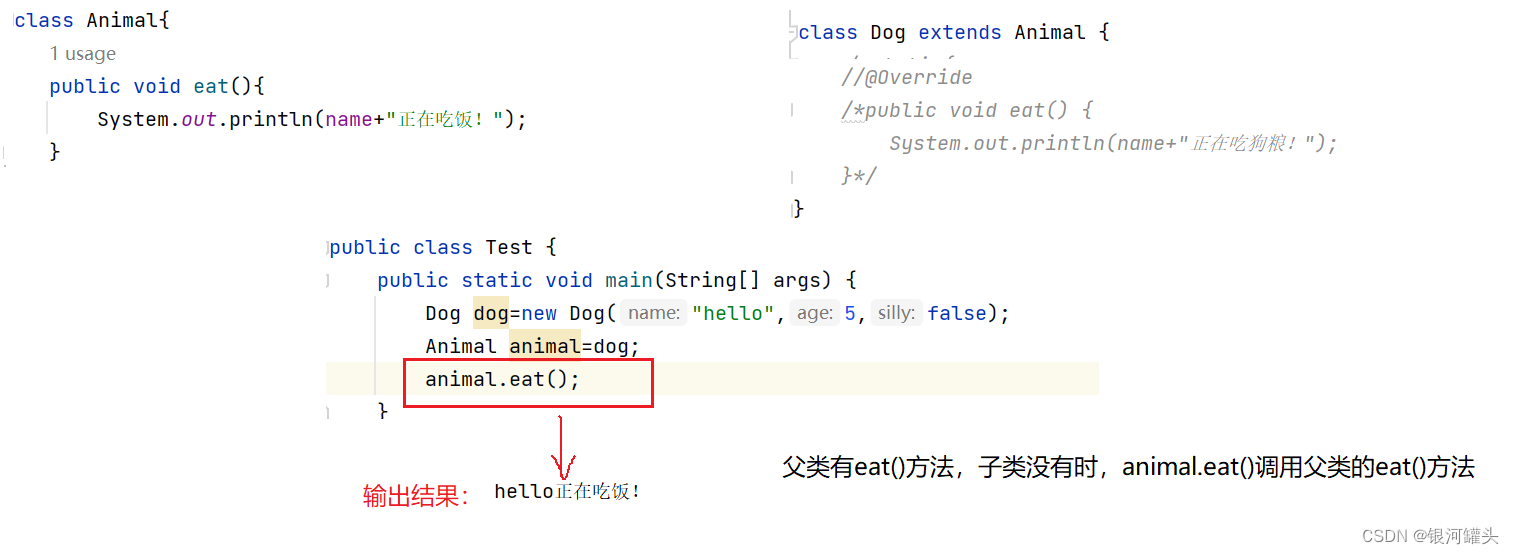
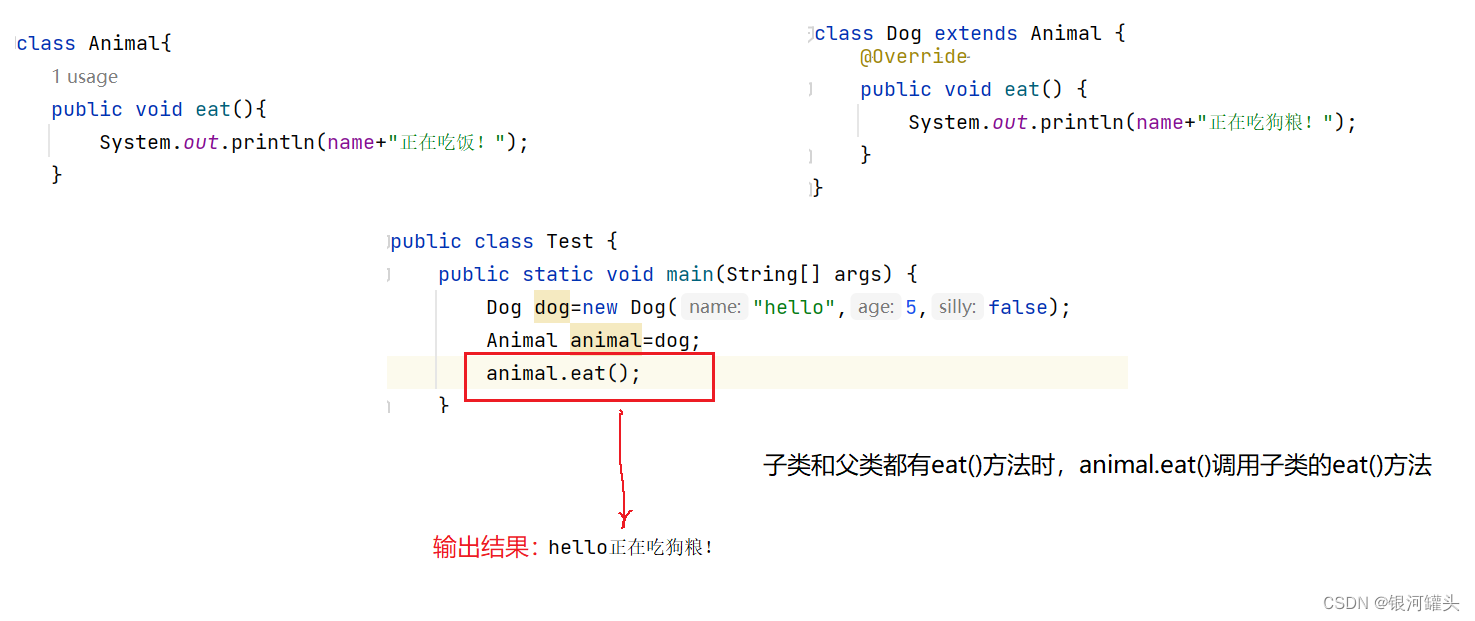

向上转型
直接赋值
public class Test { public static void main2(String[] args) { //1.直接赋值 Dog dog=new Dog("hello",5,false); Animal animal1=dog; Animal animal2=new Cat("hello",5); animal1.eat(); }- 1
- 2
- 3
- 4
- 5
- 6
- 7
- 8
方法传参

方法返回
public class Test { public static Animal function2(){ return new Cat(); } }- 1
- 2
- 3
- 4
- 5
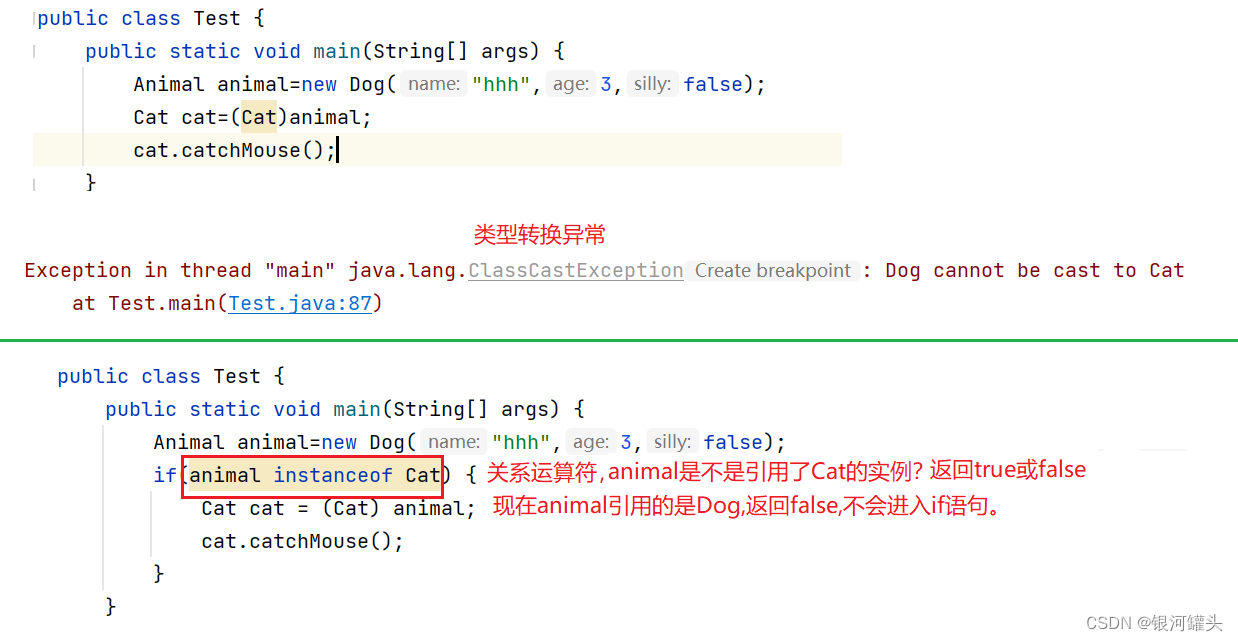
向下转型
public static void main(String[] args) { Animal animal=new Cat("hhh",3); Cat cat=(Cat)animal;//向下转型 cat.catchMouse(); }- 1
- 2
- 3
- 4
- 5
多态的优缺点
多态的好处:降低代码的"圈复杂度"。
圈复杂度:一段代码中条件语句和循环语句出现的个数class Shape{ public void draw(){ System.out.println("画图形!"); } } class Rect extends Shape{ @Override public void draw() { System.out.println("画矩形!"); } } class Cycle extends Shape{ @Override public void draw() { System.out.println("画圆!"); } } class Flower extends Shape{ @Override public void draw() { System.out.println("画❀!"); } }- 1
- 2
- 3
- 4
- 5
- 6
- 7
- 8
- 9
- 10
- 11
- 12
- 13
- 14
- 15
- 16
- 17
- 18
- 19
- 20
- 21
- 22
- 23
如果我想要实现画一个圆,一个矩形,一个圆,一个矩形,一个花
不用多态,这样实现
public static void drawShapes(){ String[] strings={"cycle","rect","cycle","rect","flower"}; for (String x: strings) { if(x.equals("cycle")){ Cycle cycle=new Cycle(); cycle.draw(); }else if(x.equals("rect")){ Rect rect=new Rect(); rect.draw(); }else { Flower flower=new Flower(); flower.draw(); } } } public static void main(String[] args) { drawShapes(); }- 1
- 2
- 3
- 4
- 5
- 6
- 7
- 8
- 9
- 10
- 11
- 12
- 13
- 14
- 15
- 16
- 17
- 18
- 19
- 20
使用多态:
public static void drawShapes(){ Shape[] shapes={new Cycle(),new Rect(),new Cycle(),new Rect(),new Flower()}; for (Shape s: shapes) { s.draw(); } } public static void main(String[] args) { drawShapes(); }- 1
- 2
- 3
- 4
- 5
- 6
- 7
- 8
- 9
- 10
⭐⭐⭐⭐⭐⭐⭐分割线⭐⭐⭐⭐⭐⭐⭐⭐
class B { public B() { func(); } public void func() { System.out.println("B.func()"); } } class D extends B { private int num = 1; @Override public void func() { System.out.println("D.func() " + num); } } public class Test { public static void main(String[] args) { D d = new D(); } }- 1
- 2
- 3
- 4
- 5
- 6
- 7
- 8
- 9
- 10
- 11
- 12
- 13
- 14
- 15
- 16
- 17
- 18
- 19
- 20
- 21
- 22
- 23
- 24
输出结果
D.func() 0- 1
分析:构造D对象,调用父类B的构造方法,而B的构造方法内调用了重写的func方法,由于动态绑定,调用重写的子类方法,此时子类D还没有开始构造,num的值未初始化是0
得出结论:构造方法内部尽量只使用final,static方法,防止重写
-
相关阅读:
Python真的是白学了
xargs 命令详解
Python 多线程、线程池、进程池
Java面试题每日问题
红队技术笔记
Synchronized 关键字
我认识Handler又多了一点点...
MySQL 常用函数
数字时代安全风险防范与保密科技创新
项目实战:修改水果库存系统特定库存记录
- 原文地址:https://blog.csdn.net/qq_63983125/article/details/126260464
