-
刷题《剑指Offer》day12
题目来源:力扣《剑指Offer》第二版
完成时间:2022/08/07
30. 包含min函数的栈

题目链接:剑指 Offer 30. 包含min函数的栈 - 力扣(LeetCode)
我的题解
我的题解和书上的一样,用一个辅助栈。出栈的时候,两个栈同时出栈。入栈的时候,判断一下,如果入栈元素小于等于辅助栈栈顶元素,则直接入栈,如果大于则辅助栈的栈顶元素再入栈一次。这样可以保持辅助栈栈顶的元素最小。
class MinStack { public: /** initialize your data structure here. */ stack<int> min_stack; stack<int> data_stack; MinStack() { } void push(int x) { if(min_stack.empty() || x < min_stack.top()){ min_stack.push(x); }else { min_stack.push(min_stack.top()); } data_stack.push(x); } void pop() { if(!data_stack.empty()){ min_stack.pop(); data_stack.pop(); } } int top() { return data_stack.top(); } int min() { return min_stack.top(); } }; /** * Your MinStack object will be instantiated and called as such: * MinStack* obj = new MinStack(); * obj->push(x); * obj->pop(); * int param_3 = obj->top(); * int param_4 = obj->min(); */- 1
- 2
- 3
- 4
- 5
- 6
- 7
- 8
- 9
- 10
- 11
- 12
- 13
- 14
- 15
- 16
- 17
- 18
- 19
- 20
- 21
- 22
- 23
- 24
- 25
- 26
- 27
- 28
- 29
- 30
- 31
- 32
- 33
- 34
- 35
- 36
- 37
- 38
- 39
- 40
- 41
- 42
31. 栈的压入、弹出序列

题目链接:剑指 Offer 31. 栈的压入、弹出序列 - 力扣(LeetCode)
我的题解1
这道题我一开始稀里糊涂的,没考虑清楚直接就写了,然后居然也过了。思路就是先匹配入栈序列,入栈序列完事后,如果出栈序列还没完事,再检查出栈序列。
class Solution { public: bool validateStackSequences(vector<int>& pushed, vector<int>& popped) { int index_push = 0, index_pop = 0; stack<int> stack1; while(index_push != pushed.size()){ if(stack1.empty()){ stack1.push(pushed[index_push]); index_push++; } if(stack1.top() == popped[index_pop]){ stack1.pop(); index_pop++; }else if(index_push != pushed.size()){ stack1.push(pushed[index_push]); index_push++; }else { return false; } } while(index_pop != popped.size()){ if(stack1.top() == popped[index_pop]){ stack1.pop(); index_pop++; }else { return false; } } return true; } };- 1
- 2
- 3
- 4
- 5
- 6
- 7
- 8
- 9
- 10
- 11
- 12
- 13
- 14
- 15
- 16
- 17
- 18
- 19
- 20
- 21
- 22
- 23
- 24
- 25
- 26
- 27
- 28
- 29
- 30
- 31
- 32
我的题解2
后来我发现如果在第一次循环中没有清空栈的话,必定是不符合要求的。精简了一下,代码如下:
class Solution { public: bool validateStackSequences(vector<int>& pushed, vector<int>& popped) { int index_push = 0, index_pop = 0; stack<int> stack1; while(true){ while(!stack1.empty() && stack1.top() == popped[index_pop]){ stack1.pop(); index_pop++; } if(index_push != pushed.size()){ stack1.push(pushed[index_push]); index_push++; }else { break; } } return stack1.empty(); } };- 1
- 2
- 3
- 4
- 5
- 6
- 7
- 8
- 9
- 10
- 11
- 12
- 13
- 14
- 15
- 16
- 17
- 18
- 19
- 20
我的题解3
好吧。。看了评论区大佬的题解,发现还可以进一步精简
class Solution { public: bool validateStackSequences(vector<int>& pushed, vector<int>& popped) { int index = 0; stack<int> stack1; for(int i = 0;i < pushed.size();i++) { stack1.push(pushed[i]); while(!stack1.empty() && stack1.top() == popped[index]){ stack1.pop(); index++; } } return stack1.empty(); } };- 1
- 2
- 3
- 4
- 5
- 6
- 7
- 8
- 9
- 10
- 11
- 12
- 13
- 14
- 15
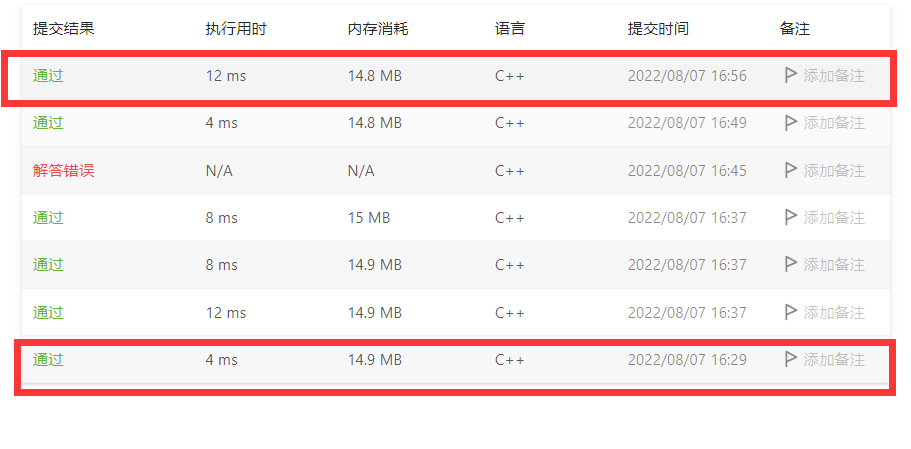
leetcode 这个提交是真的迷
32 - I. 从上到下打印二叉树

题目链接:剑指 Offer 32 - I. 从上到下打印二叉树 - 力扣(LeetCode)
我的题解
模板题,队列套就完事了
/** * Definition for a binary tree node. * struct TreeNode { * int val; * TreeNode *left; * TreeNode *right; * TreeNode(int x) : val(x), left(NULL), right(NULL) {} * }; */ class Solution { public: vector<int> levelOrder(TreeNode* root) { vector<int> result; if(root == nullptr) return result; queue<TreeNode*> que; que.push(root); while(!que.empty()) { TreeNode* tmp = que.front(); que.pop(); if(tmp->left) que.push(tmp->left); if(tmp->right) que.push(tmp->right); result.push_back(tmp->val); } return result; } };- 1
- 2
- 3
- 4
- 5
- 6
- 7
- 8
- 9
- 10
- 11
- 12
- 13
- 14
- 15
- 16
- 17
- 18
- 19
- 20
- 21
- 22
- 23
- 24
- 25
- 26
32 - II. 从上到下打印二叉树 II

题目链接:剑指 Offer 32 - II. 从上到下打印二叉树 II - 力扣(LeetCode)
我的题解
这题也非常简单,直接在上题的基础上改就行了,在每次while循环中加入对当前队列元素个数的判断,即可得出某一层的节点熟练,遍历一遍即可。
/** * Definition for a binary tree node. * struct TreeNode { * int val; * TreeNode *left; * TreeNode *right; * TreeNode(int x) : val(x), left(NULL), right(NULL) {} * }; */ class Solution { public: vector<vector<int>> levelOrder(TreeNode* root) { vector<vector<int>> result; if(root == nullptr) return result; queue<TreeNode*> que; que.push(root); while(!que.empty()) { int size = que.size(); vector<int> res; for(int i = 0;i < size;i++) { TreeNode* tmp = que.front(); que.pop(); if(tmp->left) que.push(tmp->left); if(tmp->right) que.push(tmp->right); res.push_back(tmp->val); } result.push_back(res); } return result; } };- 1
- 2
- 3
- 4
- 5
- 6
- 7
- 8
- 9
- 10
- 11
- 12
- 13
- 14
- 15
- 16
- 17
- 18
- 19
- 20
- 21
- 22
- 23
- 24
- 25
- 26
- 27
- 28
- 29
- 30
- 31
32 - III. 从上到下打印二叉树 III

题目链接:剑指 Offer 32 - III. 从上到下打印二叉树 III - 力扣(LeetCode)
我的题解
这题也比较简单,上一题基础上加个count计数,如果是偶数,就把元素插入到vector的头部。
/** * Definition for a binary tree node. * struct TreeNode { * int val; * TreeNode *left; * TreeNode *right; * TreeNode(int x) : val(x), left(NULL), right(NULL) {} * }; */ class Solution { public: vector<vector<int>> levelOrder(TreeNode* root) { vector<vector<int>> result; if(root == nullptr) return result; int count = 1; queue<TreeNode*> que; que.push(root); while(!que.empty()) { int size = que.size(); vector<int> res; for(int i = 0;i < size;i++) { TreeNode* tmp = que.front(); que.pop(); if(tmp->left) que.push(tmp->left); if(tmp->right) que.push(tmp->right); if(count % 2 == 1) { //res.push_front(tmp->val); res.push_back(tmp->val); }else { res.insert(res.begin(),tmp->val); } } result.push_back(res); count++; } return result; } };- 1
- 2
- 3
- 4
- 5
- 6
- 7
- 8
- 9
- 10
- 11
- 12
- 13
- 14
- 15
- 16
- 17
- 18
- 19
- 20
- 21
- 22
- 23
- 24
- 25
- 26
- 27
- 28
- 29
- 30
- 31
- 32
- 33
- 34
- 35
- 36
- 37
- 38
//res.push_front(tmp->val); res.push_back(tmp->val); }else { res.insert(res.begin(),tmp->val); } } result.push_back(res); count++; } return result; }- 1
- 2
- 3
- 4
- 5
- 6
- 7
- 8
- 9
- 10
- 11
};
- 1
-
相关阅读:
零基础上手unity VR开发【配置PC端项目的实时调试】
TCP网络编程
【云原生之Docker实战】使用docker部署PicUploader图床工具
js 构造函数 return 非空对象,其实例化的对象在原型上的差异
指定牛导|肿瘤专业医生芝加哥大学博士后实现夙愿
红外线热像仪的热成像质量介绍
Java面试题及答案(2021年Java面试题大全带答案)
关注短视频的“时间”,找准用户活跃时间,高流量也不是梦
spring boot + sql server大数据量批量新增
Python学习日记-第三十八天-生成器
- 原文地址:https://blog.csdn.net/m0_46369272/article/details/126215991
