-
Java 基础 --- String, StringBuilder, StringBuffer
String
String的声明方式
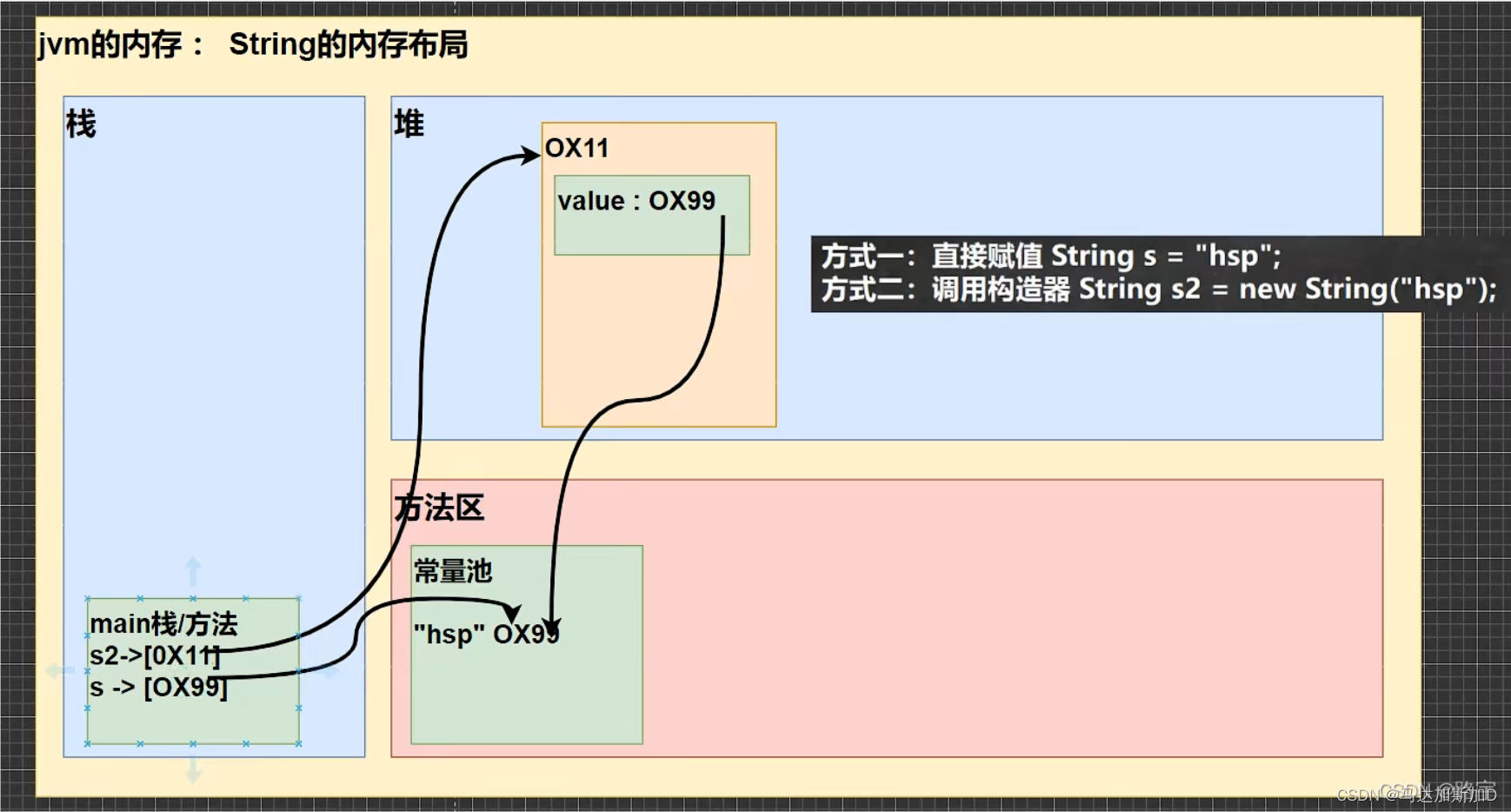
- 直接赋值: String s = “hello world” — 储存在常量池
- 调用构造器 String s = new String(“hello world”) ---- 储存在堆中的地址
- JVM为了提高性能和减少内存开销,在实例化字符串常量的时候进行了一些优化, 为字符串开辟一个字符串常量池,类似于缓存区
- 直接赋值时,首先坚持字符串常量池是否存在该字符串. 所以如果再次创建一个 String ss = "“hello world”. 将会和 s 指向同样的字符串常量
String的不可变性
- String类声明为final, 所以不能被继承
- String类实际储存字符串数据的是类内部的成员变量
final char [] value
- 因为value被final修饰, 所以value不能指向新的地址也就是不能再引用其他String变量
- String 内部没有改变 value 数组的方法,也就是不能更改String中任何一个char 元素, 因此可以保证 String 不可变。
String不可变性的体现: 只要对string做出修改, 就会开辟新的内存空间
- 1.当对字符串重新赋值时,会重新开辟新的内存空间储存新的字符串
//常量池中会同时储存 "hello world" 和 "hello" , 而不是 "hello world" 被覆盖掉 String s = "hello world" s = "hello"- 1
- 2
- 3
public static void main(String args[]) { String s = "hello"; String temp = s; s = "world"; String ss = "hello"; if (ss == temp) { //注意这里对比的是地址, 说明ss和temp指向同样的地址 //也就是 "hello" 没有被world覆盖掉 System.out.println("same"); } } output: "same"- 1
- 2
- 3
- 4
- 5
- 6
- 7
- 8
- 9
- 10
- 11
- 12
- 13
- 14
- 2.当对现有的字符串进行连接操作时,会重新开辟新的内存空间储存拼接后的字符串
- 3.当调用String的
replace().或者substring()等方法修改指定字符或字符串时,也会重新开辟新的内存空间储存修改后的字符串
public static void main(String args[]) { String s = "hello"; String temp1 = s; s = s + "world" ; String temp2 = s; if (temp1 != temp2) { System.out.println("not same"); } } output: "not same"- 1
- 2
- 3
- 4
- 5
- 6
- 7
- 8
- 9
- 10
- 11
- 12
- 13
对比两个String
- 使用 == 对比两字符串时实际对比的是地址, 而不是实际内容
- 所以一律使用
s1.equals(s2)或者s1.compareTo(s2)对比string
public static void main(String args[]) { String s = "hello"; String ss = "hello"; String sss = new String("hello"); System.out.println(s == ss); System.out.println(s == sss); System.out.println(ss == sss); } output: true // 因为 直接赋值创建String时, JVM会首先在常量池中寻找是否已经有同样的字符串. 所以s和ss指向同样的地址 false //使用构造器创建String时, 地址会指向堆内存, 然后堆内存中的地址指向常量池, 所以不一样 false //同上- 1
- 2
- 3
- 4
- 5
- 6
- 7
- 8
- 9
- 10
- 11
- 12
- 13
- 14
- 15
Another example:
public class Solution { static public String fun1(String s1) { return s1; } public static void main(String args[]) { String s = "hello"; String ss = fun1(s); System.out.println(s == ss); } } ouput: true //但是如果在fun1中对s1进行任何修改, 如拼接等, 就会开辟新的内存空间, 则 s != ss- 1
- 2
- 3
- 4
- 5
- 6
- 7
- 8
- 9
- 10
- 11
- 12
- 13
- 14
- 15
StringBuilder
- 如果代码中需要对string进行大量修改, 则推荐使用 StringBuilder类
- StringBuilder 类的对象能够被多次的修改,并且不产生新的未使用对象
Example:
public void pathToStartValue(TreeNode node, int startValue, String pathStart) { if (node == null) { return; } if (node.val == startValue) { pathTostartValue = pathStart; return; } //这里pathStart + "U" 会生成新的String, 最后导致内存超限 //所以需要改用StringBuilder pathToStartValue(node.left, startValue, pathStart + "U"); pathToStartValue(node.right, startValue, pathStart + "U"); return; }- 1
- 2
- 3
- 4
- 5
- 6
- 7
- 8
- 9
- 10
- 11
- 12
- 13
- 14
- 15
- 16
- 17
- StringBuilder提供对String的增删改查, 包括:
append:

insert

setCharAtvoid setCharAt(int index, char ch) //The character at the specified index is set to ch.- 1
- 2
delete
StringBuilder delete(int start, int end) //Removes the characters in a substring of this sequence. StringBuilder deleteCharAt(int index) //Removes the char at the specified position in this sequence.- 1
- 2
- 3
- 4
replace
StringBuilder replace(int start, int end, String str) //Replaces the characters in a substring of this sequence with characters in the specified String.- 1
- 2
substring
String substring(int start) //Returns a new String that contains a subsequence of characters currently contained in this character sequence. String substring(int start, int end) //Returns a new String that contains a subsequence of characters currently contained in this sequence.- 1
- 2
- 3
- 4
StringBuilder 和 StringBuffer 的区别
- StringBuilder 类在 Java 5 中被提出,它和 StringBuffer 之间的最大不同在于 StringBuilder 的方法不是线程安全的(不能同步访问)。
- 由于 StringBuilder 相较于 StringBuffer 有速度优势,所以多数情况下建议使用 StringBuilder 类。
-
相关阅读:
Ubuntu LabelMe AI 识别
2022年最火的十大测试工具,你掌握了几个
Ubuntu 23.10 支持基于 TPM 的全磁盘加密
23种设计模式(二十二)状态模式(阁瑞钛伦特软件-九耶实训)
解密Prompt系列18. LLM Agent之只有智能体的世界
Android Camera App启动流程解析
数据结构与算法——线性表的顺序存储
spark-RDD的两大方法
二维平面扭曲的python实现及思路
OpenStack新版UI管理skyline
- 原文地址:https://blog.csdn.net/weixin_38803409/article/details/126175948


