-
Linux ALSA驱动之PCM创建流程源码分析
1、基本概念及逻辑关系

如上图,通过上一节声卡的学习我们已经知道PCM是声卡的一个子设备,或者表示一个PCM实例。
每个声卡最多可以包含4个pcm的实例,每个pcm实例对应一个pcm设备文件。pcm实例数量的这种限制源于linux设备号所占用的位大小,如果以后使用64位的设备号,我们将可以创建更多的pcm实例。不过大多数情况下,在嵌入式设备中,一个pcm实例已经足够了。
一个pcm实例由一个playback stream和一个capture stream组成,这两个stream又分别有一个或多个substreams组成。可以用如下图来表示他们直接的逻辑关系:

当一个子流已经存在,并且已经被打开,当再次被打开的时候,会被阻塞。
在实际的应用中,通常不会如上图这么复杂,大多数情况下是一个声卡有一个PCM实例,PCM下面有一个playback和capture,而playback和capture各自有一个substream。
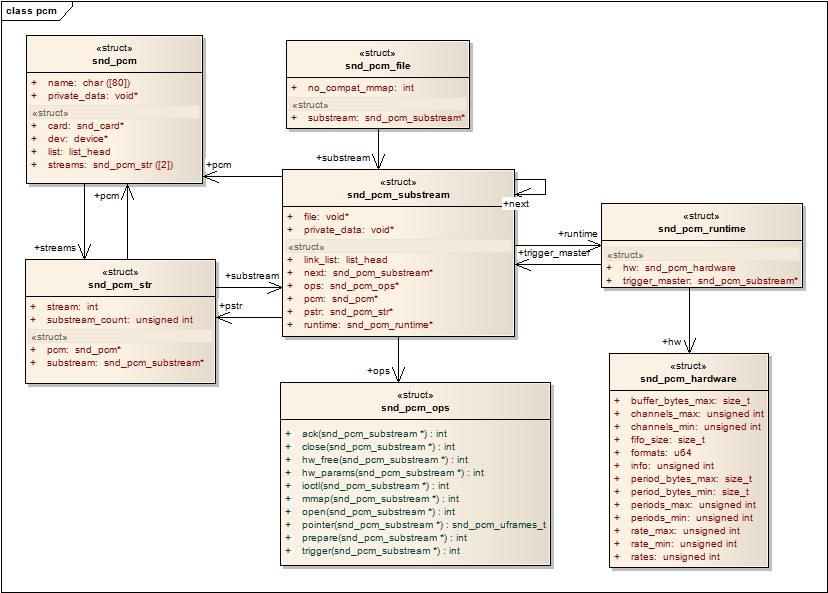
PCM层有几个很重要的结构体,我们通过如下的UML图来梳理他们直接的关系。

图片地址:http://hi.csdn.net/attachment/201104/2/0_1301728746sAUd.gif
1、snd_pcm:挂在snd_card下面的一个snd_device。
2、snd_pcm中的字段:streams[2]:该数组中的两个元素指向两个snd_pcm_str结构,分别代表playback stream和capture stream。
3、snd_pcm_str中的substream字段:指向snd_pcm_substream结构。
4、snd_pcm_substream是pcm中间层的核心,绝大部分任务都是在substream中处理,尤其是他的ops(snd_pcm_ops)字段,许多user空间的应用程序通过alsa-lib对驱动程序的请求都是由该结构中的函数处理。它的runtime字段则指向snd_pcm_runtime结构,snd_pcm_runtime记录这substream的一些重要的软件和硬件运行环境和参数。
2、PCM创建流程
PCM的整个创建流程请参考如下时序图进行理解:

alsa-driver的中间层已经提供新建PCM的API:
2.1、创建PCM实例
- int snd_pcm_new(struct snd_card *card, const char *id, int device,
- int playback_count, int capture_count, struct snd_pcm **rpcm)
card:表示所属的声卡。
ID:PCM实例的ID(名字)。
device:表示目前创建的是该声卡下的第几个PCM,第一个PCM设备从0开始计数。
playback_count:表示该PCM播放流中将会有几个substream。
capture_count :表示该PCM录音流中将会有几个substream。
rpcm:返回的PCM实例。
该函数的主要作用是创建PCM逻辑设备,创建回放子流和录制子流实例,并初始化回放子流和录制子流的PCM操作函数(数据搬运时,需要调用这些函数来驱动 codec、codec_dai、cpu_dai、dma 设备工作)。
2.2、设置PCM设备的操作函数
- void snd_pcm_set_ops(struct snd_pcm *pcm, int direction,
- const struct snd_pcm_ops *ops)
pcm:上述snd_pcm_new 创建的PCM实例。
direction:是指SNDRV_PCM_STREAM_PLAYBACK或SNDRV_PCM_STREAM_CAPTURE,即设置为播放或者录音功能。
snd_pcm_ops:结构中的函数通常就是我们驱动要实现的函数。
2.3、定义PCM的操作函数
以AC97驱动(linux/sound/arm/pxa2xx-ac97.c)为例,在驱动中对于PCM进行了如下设置:
- static const struct snd_pcm_ops pxa2xx_ac97_pcm_ops = {
- .open = pxa2xx_ac97_pcm_open,
- .close = pxa2xx_ac97_pcm_close,
- .hw_params = pxa2xx_pcm_hw_params,
- .prepare = pxa2xx_ac97_pcm_prepare,
- .trigger = pxa2xx_pcm_trigger,
- .pointer = pxa2xx_pcm_pointer,
- };
- snd_pcm_set_ops(pcm, SNDRV_PCM_STREAM_PLAYBACK, &pxa2xx_ac97_pcm_ops);
- snd_pcm_set_ops(pcm, SNDRV_PCM_STREAM_CAPTURE, &pxa2xx_ac97_pcm_ops);
2.4、定义硬件参数
- static const struct snd_pcm_hardware pxa2xx_pcm_hardware = {
- .info = SNDRV_PCM_INFO_MMAP |
- SNDRV_PCM_INFO_MMAP_VALID |
- SNDRV_PCM_INFO_INTERLEAVED |
- SNDRV_PCM_INFO_PAUSE |
- SNDRV_PCM_INFO_RESUME,
- .formats = SNDRV_PCM_FMTBIT_S16_LE |
- SNDRV_PCM_FMTBIT_S24_LE |
- SNDRV_PCM_FMTBIT_S32_LE,
- .period_bytes_min = 32,
- .period_bytes_max = 8192 - 32,
- .periods_min = 1,
- .periods_max = 256,
- .buffer_bytes_max = 128 * 1024,
- .fifo_size = 32,
- };
- int pxa2xx_pcm_open(struct snd_pcm_substream *substream)
- {
- struct snd_soc_pcm_runtime *rtd = substream->private_data;
- struct snd_pcm_runtime *runtime = substream->runtime;
- struct snd_dmaengine_dai_dma_data *dma_params;
- int ret;
- runtime->hw = pxa2xx_pcm_hardware;
- dma_params = snd_soc_dai_get_dma_data(asoc_rtd_to_cpu(rtd, 0), substream);
- if (!dma_params)
- return 0;
- /*
- * For mysterious reasons (and despite what the manual says)
- * playback samples are lost if the DMA count is not a multiple
- * of the DMA burst size. Let's add a rule to enforce that.
- */
- ret = snd_pcm_hw_constraint_step(runtime, 0,
- SNDRV_PCM_HW_PARAM_PERIOD_BYTES, 32);
- if (ret)
- return ret;
- ret = snd_pcm_hw_constraint_step(runtime, 0,
- SNDRV_PCM_HW_PARAM_BUFFER_BYTES, 32);
- if (ret)
- return ret;
- ret = snd_pcm_hw_constraint_integer(runtime,
- SNDRV_PCM_HW_PARAM_PERIODS);
- if (ret < 0)
- return ret;
- return snd_dmaengine_pcm_open(
- substream, dma_request_slave_channel(asoc_rtd_to_cpu(rtd, 0)->dev,
- dma_params->chan_name));
- }
3、PCM相关源码分析
3.1、snd_pcm_new
- /**
- * snd_pcm_new - create a new PCM instance
- * @card: the card instance
- * @id: the id string
- * @device: the device index (zero based)
- * @playback_count: the number of substreams for playback
- * @capture_count: the number of substreams for capture
- * @rpcm: the pointer to store the new pcm instance
- *
- * Creates a new PCM instance.
- *
- * The pcm operators have to be set afterwards to the new instance
- * via snd_pcm_set_ops().
- *
- * Return: Zero if successful, or a negative error code on failure.
- */
- int snd_pcm_new(struct snd_card *card, const char *id, int device,
- int playback_count, int capture_count, struct snd_pcm **rpcm)
- {
- /* 直接调用函数_snd_pcm_new,参数internal传入false */
- return _snd_pcm_new(card, id, device, playback_count, capture_count,
- false, rpcm);
- }
- static int _snd_pcm_new(struct snd_card *card, const char *id, int device,
- int playback_count, int capture_count, bool internal,
- struct snd_pcm **rpcm)
- {
- struct snd_pcm *pcm;
- int err;
- /* 1. 逻辑设备的操作函数结构体, 主要用于注册子设备 */
- static const struct snd_device_ops ops = {
- .dev_free = snd_pcm_dev_free,
- .dev_register = snd_pcm_dev_register,
- .dev_disconnect = snd_pcm_dev_disconnect,
- };
- static const struct snd_device_ops internal_ops = {
- .dev_free = snd_pcm_dev_free,
- };
- if (snd_BUG_ON(!card))
- return -ENXIO;
- if (rpcm)
- *rpcm = NULL;
- /* 2. 为snd_pcm结构体分配空间,根据传入参数赋值 */
- pcm = kzalloc(sizeof(*pcm), GFP_KERNEL);
- if (!pcm)
- return -ENOMEM;
- pcm->card = card;
- pcm->device = device;
- pcm->internal = internal;
- mutex_init(&pcm->open_mutex);
- init_waitqueue_head(&pcm->open_wait);
- INIT_LIST_HEAD(&pcm->list);
- if (id)
- strscpy(pcm->id, id, sizeof(pcm->id));
- /* 3. 根据传入的playback和capture的个数创建PCM流 snd_pcm_str */
- err = snd_pcm_new_stream(pcm, SNDRV_PCM_STREAM_PLAYBACK,
- playback_count);
- if (err < 0)
- goto free_pcm;
- err = snd_pcm_new_stream(pcm, SNDRV_PCM_STREAM_CAPTURE, capture_count);
- if (err < 0)
- goto free_pcm;
- /* 4. 创建一个PCM逻辑设备,创建逻辑设备,并添加到逻辑设备链表 */
- err = snd_device_new(card, SNDRV_DEV_PCM, pcm,
- internal ? &internal_ops : &ops);
- if (err < 0)
- goto free_pcm;
- if (rpcm)
- *rpcm = pcm;
- return 0;
- free_pcm:
- snd_pcm_free(pcm);
- return err;
- }
3.2、snd_pcm
- struct snd_pcm {
- struct snd_card *card;
- struct list_head list;
- int device; /* device number */
- unsigned int info_flags;
- unsigned short dev_class;
- unsigned short dev_subclass;
- char id[64];
- char name[80];
- struct snd_pcm_str streams[2];
- struct mutex open_mutex;
- wait_queue_head_t open_wait;
- void *private_data;
- void (*private_free) (struct snd_pcm *pcm);
- bool internal; /* pcm is for internal use only */
- bool nonatomic; /* whole PCM operations are in non-atomic context */
- bool no_device_suspend; /* don't invoke device PM suspend */
- #if IS_ENABLED(CONFIG_SND_PCM_OSS)
- struct snd_pcm_oss oss;
- #endif
- };
这里重要的变量有两个streams与private_data。streams有两个,是因为一个指向播放设备,一个指向录音设备。private_data在很多结构里都可以看到,和面象对象里的继承有点类似,如果将snd_pcm理解为基类的话,private_data指向的就是它的继承类,也就是真正的实现者。
list,在pcm.c中有一个全局变量snd_pcm_devices,将所有的snd_pcm对象链接起来,目的是外部提供一些可供枚举所有设备的接口,看起来并不怎么被用到。
另外还有info_flags、dev_class等变量看起来是为一些特殊设备预留的,对待一些特殊操作。
- struct snd_pcm_str {
- int stream; /* stream (direction) */
- struct snd_pcm *pcm;
- /* -- substreams -- */
- unsigned int substream_count;
- unsigned int substream_opened;
- struct snd_pcm_substream *substream;
- #if IS_ENABLED(CONFIG_SND_PCM_OSS)
- /* -- OSS things -- */
- struct snd_pcm_oss_stream oss;
- #endif
- #ifdef CONFIG_SND_VERBOSE_PROCFS
- struct snd_info_entry *proc_root;
- #ifdef CONFIG_SND_PCM_XRUN_DEBUG
- unsigned int xrun_debug; /* 0 = disabled, 1 = verbose, 2 = stacktrace */
- #endif
- #endif
- struct snd_kcontrol *chmap_kctl; /* channel-mapping controls */
- struct device dev;
- };
snd_pcm_str的主要作用是指向snd_pcm_substream,而snd_pcm_substream可以有多个,这也是snd_pcm_str存在的原因,否则snd_pcm直接指向snd_pcm_substream就可以了。
这里的dev是将pcm加入到文件系统时要用到。包含的信息,在下面介绍的snd_pcm_new_stream中会看到。
3.3、snd_pcm_new_stream
- /**
- * snd_pcm_new_stream - create a new PCM stream
- * @pcm: the pcm instance
- * @stream: the stream direction, SNDRV_PCM_STREAM_XXX
- * @substream_count: the number of substreams
- *
- * Creates a new stream for the pcm.
- * The corresponding stream on the pcm must have been empty before
- * calling this, i.e. zero must be given to the argument of
- * snd_pcm_new().
- *
- * Return: Zero if successful, or a negative error code on failure.
- */
- int snd_pcm_new_stream(struct snd_pcm *pcm, int stream, int substream_count)
- {
- int idx, err;
- /* 3.1 根据传入的参数,为PCM流(snd_pcm_str)赋值:方向,所属的PCM,PCM子流的个数 */
- struct snd_pcm_str *pstr = &pcm->streams[stream];
- struct snd_pcm_substream *substream, *prev;
- #if IS_ENABLED(CONFIG_SND_PCM_OSS)
- mutex_init(&pstr->oss.setup_mutex);
- #endif
- pstr->stream = stream;
- pstr->pcm = pcm;
- pstr->substream_count = substream_count;
- if (!substream_count)
- return 0;
- snd_device_initialize(&pstr->dev, pcm->card);
- pstr->dev.groups = pcm_dev_attr_groups;
- pstr->dev.type = &pcm_dev_type;
- dev_set_name(&pstr->dev, "pcmC%iD%i%c", pcm->card->number, pcm->device,
- stream == SNDRV_PCM_STREAM_PLAYBACK ? 'p' : 'c');
- /* proc */
- if (!pcm->internal) {
- err = snd_pcm_stream_proc_init(pstr);
- if (err < 0) {
- pcm_err(pcm, "Error in snd_pcm_stream_proc_init\n");
- return err;
- }
- }
- prev = NULL;
- for (idx = 0, prev = NULL; idx < substream_count; idx++) {
- /* 为子流分配空间,赋值(pcm,pcm流,ID, 方向.....) */
- substream = kzalloc(sizeof(*substream), GFP_KERNEL);
- if (!substream)
- return -ENOMEM;
- substream->pcm = pcm;
- substream->pstr = pstr;
- substream->number = idx;
- substream->stream = stream;
- sprintf(substream->name, "subdevice #%i", idx);
- substream->buffer_bytes_max = UINT_MAX;
- /* 添加子流到子流的链表 */
- if (prev == NULL) /* 第一个子流 */
- pstr->substream = substream;
- else
- prev->next = substream; /* 非第一个子流,添加到前一个子流后部 */
- /* proc */
- if (!pcm->internal) {
- err = snd_pcm_substream_proc_init(substream);
- if (err < 0) {
- pcm_err(pcm,
- "Error in snd_pcm_stream_proc_init\n");
- if (prev == NULL)
- pstr->substream = NULL;
- else
- prev->next = NULL;
- kfree(substream);
- return err;
- }
- }
- /* 结构体初始化 */
- substream->group = &substream->self_group;
- snd_pcm_group_init(&substream->self_group);
- list_add_tail(&substream->link_list, &substream->self_group.substreams);
- atomic_set(&substream->mmap_count, 0);
- prev = substream;
- }
- return 0;
- }
函数参数中的int stream,是一个枚举类型:
- enum {
- SNDRV_PCM_STREAM_PLAYBACK = 0,
- SNDRV_PCM_STREAM_CAPTURE,
- SNDRV_PCM_STREAM_LAST = SNDRV_PCM_STREAM_CAPTURE,
- };
从snd_device_initialize(&pstr->dev, pcm->card); 开始。dev最终会被传入device_add函数中,用来构建文件系统。
- void snd_device_initialize(struct device *dev, struct snd_card *card)
- {
- device_initialize(dev);
- if (card)
- dev->parent = &card->card_dev;
- dev->class = sound_class;
- dev->release = default_release;
- }
这段函数中可以看到dev->class被设置成sound_class,这个是我们之前提到的文件放到snd目录的原因。
3.4、snd_pcm_substream
- struct snd_pcm_substream {
- struct snd_pcm *pcm;
- struct snd_pcm_str *pstr;
- void *private_data; /* copied from pcm->private_data */
- int number;
- char name[32]; /* substream name */
- int stream; /* stream (direction) */
- struct pm_qos_request latency_pm_qos_req; /* pm_qos request */
- size_t buffer_bytes_max; /* limit ring buffer size */
- struct snd_dma_buffer dma_buffer;
- size_t dma_max;
- /* -- hardware operations -- */
- const struct snd_pcm_ops *ops;
- /* -- runtime information -- */
- struct snd_pcm_runtime *runtime;
- /* -- timer section -- */
- struct snd_timer *timer; /* timer */
- unsigned timer_running: 1; /* time is running */
- long wait_time; /* time in ms for R/W to wait for avail */
- /* -- next substream -- */
- struct snd_pcm_substream *next;
- /* -- linked substreams -- */
- struct list_head link_list; /* linked list member */
- struct snd_pcm_group self_group; /* fake group for non linked substream (with substream lock inside) */
- struct snd_pcm_group *group; /* pointer to current group */
- /* -- assigned files -- */
- int ref_count;
- atomic_t mmap_count;
- unsigned int f_flags;
- void (*pcm_release)(struct snd_pcm_substream *);
- struct pid *pid;
- #if IS_ENABLED(CONFIG_SND_PCM_OSS)
- /* -- OSS things -- */
- struct snd_pcm_oss_substream oss;
- #endif
- #ifdef CONFIG_SND_VERBOSE_PROCFS
- struct snd_info_entry *proc_root;
- #endif /* CONFIG_SND_VERBOSE_PROCFS */
- /* misc flags */
- unsigned int hw_opened: 1;
- unsigned int managed_buffer_alloc:1;
- };
snd_pcm_substream的内容有些多,此处只需要重要的进行介绍。
private_data:从snd_pcm中的private_data拷贝过来的,指向实现者的结构。
const struct snd_pcm_ops *ops:这部分是框架的内容,具体的操作需要实现者的参与,留给实现者的函数指针集。这个和文件操作的设计策略是一致的。
struct snd_pcm_runtime *runtime:读写数据的时候由它来控制。到分析读写代码的时候,会重点关注它。
struct snd_pcm_substream *next:将多个snd_pcm_substream对象链接起来,它就是snd_pcm_str指向的链接。
group:在用户空间可以通过SNDRV_PCM_IOCTL_LINK将多个substream链接起来。然后就可以对这些对象进行统一的操作。我没遇到过具体的应用场景。
3.5、snd_pcm_set_ops
- /**
- * snd_pcm_set_ops - set the PCM operators
- * @pcm: the pcm instance
- * @direction: stream direction, SNDRV_PCM_STREAM_XXX
- * @ops: the operator table
- *
- * Sets the given PCM operators to the pcm instance.
- */
- void snd_pcm_set_ops(struct snd_pcm *pcm, int direction,
- const struct snd_pcm_ops *ops)
- {
- struct snd_pcm_str *stream = &pcm->streams[direction];
- struct snd_pcm_substream *substream;
- for (substream = stream->substream; substream != NULL; substream = substream->next)
- substream->ops = ops;
- }
- EXPORT_SYMBOL(snd_pcm_set_ops);
此函数是提供给调用侧使用的。设置的内容可以参考pcm文件结构简图。
3.6、snd_pcm_dev_register
在继续分析snd_pcm_dev_register函数之前需要先介绍一个结构体。struct snd_minor。
- struct snd_minor {
- int type; /* SNDRV_DEVICE_TYPE_XXX */
- int card; /* card number */
- int device; /* device number */
- const struct file_operations *f_ops; /* file operations */
- void *private_data; /* private data for f_ops->open */
- struct device *dev; /* device for sysfs */
- struct snd_card *card_ptr; /* assigned card instance */
- };
type: 设备类型,比如是pcm, control, timer等设备。
card_number: 所属的card。
device: 当前设备类型下的设备编号。
f_ops: 具体设备的文件操作集合。
private_data: open函数的私有数据。
card_ptr: 所属的card。
此结构体是用来保存当前设备的上下文信息,该card下所有逻辑设备都存在此结构。
- static int snd_pcm_dev_register(struct snd_device *device)
- {
- /* 1、添加pcm结构体到全局链表snd_pcm_devices */
- int cidx, err;
- struct snd_pcm_substream *substream;
- struct snd_pcm *pcm;
- if (snd_BUG_ON(!device || !device->device_data))
- return -ENXIO;
- /* snd_devcie保存的是snd_pcm对象 */
- pcm = device->device_data;
- mutex_lock(®ister_mutex);
- /* snd_pcm对象将被保存到全局变量snd_pcm_devices中,用于枚举设备等操作 */
- err = snd_pcm_add(pcm);
- if (err)
- goto unlock;
- for (cidx = 0; cidx < 2; cidx++) {
- /* 2、确定PCM设备节点名字 */
- int devtype = -1;
- if (pcm->streams[cidx].substream == NULL)
- continue;
- switch (cidx) {
- case SNDRV_PCM_STREAM_PLAYBACK:
- devtype = SNDRV_DEVICE_TYPE_PCM_PLAYBACK;
- break;
- case SNDRV_PCM_STREAM_CAPTURE:
- devtype = SNDRV_DEVICE_TYPE_PCM_CAPTURE;
- break;
- }
- /* register pcm */
- /* 将设备添加到文件系统,将snd_pcm_f_ops传入,将被设置给snd_minor对象 */
- err = snd_register_device(devtype, pcm->card, pcm->device,
- &snd_pcm_f_ops[cidx], pcm,
- &pcm->streams[cidx].dev);
- if (err < 0) {
- list_del_init(&pcm->list);
- goto unlock;
- }
- for (substream = pcm->streams[cidx].substream; substream; substream = substream->next)
- /* 设定CONFIG_SND_PCM_TIMER宏的时候,会去设置substream的时间 */
- snd_pcm_timer_init(substream);
- }
- pcm_call_notify(pcm, n_register);
- unlock:
- mutex_unlock(®ister_mutex);
- return err;
- }
- /**
- * snd_register_device - Register the ALSA device file for the card
- * @type: the device type, SNDRV_DEVICE_TYPE_XXX
- * @card: the card instance
- * @dev: the device index
- * @f_ops: the file operations
- * @private_data: user pointer for f_ops->open()
- * @device: the device to register
- *
- * Registers an ALSA device file for the given card.
- * The operators have to be set in reg parameter.
- *
- * Return: Zero if successful, or a negative error code on failure.
- */
- int snd_register_device(int type, struct snd_card *card, int dev,
- const struct file_operations *f_ops,
- void *private_data, struct device *device)
- {
- int minor;
- int err = 0;
- struct snd_minor *preg;
- if (snd_BUG_ON(!device))
- return -EINVAL;
- preg = kmalloc(sizeof *preg, GFP_KERNEL);
- if (preg == NULL)
- return -ENOMEM;
- /* 创建一个snd_minor,并添加到全局结构体 snd_minors */
- preg->type = type;
- preg->card = card ? card->number : -1;
- preg->device = dev;
- preg->f_ops = f_ops;
- preg->private_data = private_data;
- preg->card_ptr = card;
- mutex_lock(&sound_mutex);
- /* 4、注册一个设备节点 */
- minor = snd_find_free_minor(type, card, dev);
- if (minor < 0) {
- err = minor;
- goto error;
- }
- preg->dev = device;
- device->devt = MKDEV(major, minor);
- err = device_add(device);
- if (err < 0)
- goto error;
- snd_minors[minor] = preg;
- error:
- mutex_unlock(&sound_mutex);
- if (err < 0)
- kfree(preg);
- return err;
- }
当声卡被注册时,会注册所有的逻辑设备。主要的工作是创建PCM设备节点
具体的流程:1、添加pcm结构体到全局链表snd_pcm_devices。
2、确定PCM设备节点名字。
3、创建一个snd_minor,并添加到全局结构体 snd_minors。
4、注册一个设备节点
可以看到添加到文件系统的是播放设备和录音设备,根据snd_pcm_str指向的内容来设定的。代码中看到snd_pcm也被定义为SNDRV_DEV_PCM设备,但是文件系统中并不会保存这个类型的设备。
snd_pcm_timer_init是在CONFIG_SND_PCM_TIMER宏被定义的时候,会起作用。
通过下图可以帮助你更好的理解各结构直接的乱讲关系。

-
相关阅读:
Azure Devops(十五) 使用Azure的私有Maven仓库
ResNet论文精读,代码实现与拓展知识
LAYUI-FROM
基于java实现责任链进行参数校验
2分钟彻底搞懂JS的版本演进
恭喜磊哥喜提n+1
IT业称霸应届生薪酬榜,调查超27万毕业生后,有了这些发现
前后端分离项目验证码实现
win10自带SSH免密登录Linux
一文1800字解读性能指标与性能分析
- 原文地址:https://blog.csdn.net/code_lyb/article/details/126144107