-
ros2订阅esp32发布的电池电压数据-补充
电池电压数据能订阅但是不显示,数据QoS不匹配,需要修改。
默认:

需要使用的是外部机器人通过wifi传递的数据,设置:
- // create publisher
- RCCHECK(rclc_publisher_init_best_effort(
- &publisher,
- &node,
- ROSIDL_GET_MSG_TYPE_SUPPORT(std_msgs, msg, Float32),
- "robot_battery"));
best_effort,一般而言,ros2默认为
reliable。
修改对应ros2的订阅节点:
- #include "rclcpp/rclcpp.hpp"
- #include "std_msgs/msg/float32.hpp"
- std::shared_ptr
- void TopicCallback(const std_msgs::msg::Float32::SharedPtr msg)
- {
- RCLCPP_INFO(node->get_logger(), "Robot battery voltage : '%f'", msg->data);
- }
- int main(int argc, char *argv[])
- {
- rclcpp::init(argc, argv);
- node = std::make_shared
- auto sub = node->create_subscription
- rclcpp::spin(node);
- rclcpp::shutdown();
- return 0;
- }
其中:
auto sub = node->create_subscription
这样,一个由CoCube发布到ROS2,并实现订阅的功能就实现了。
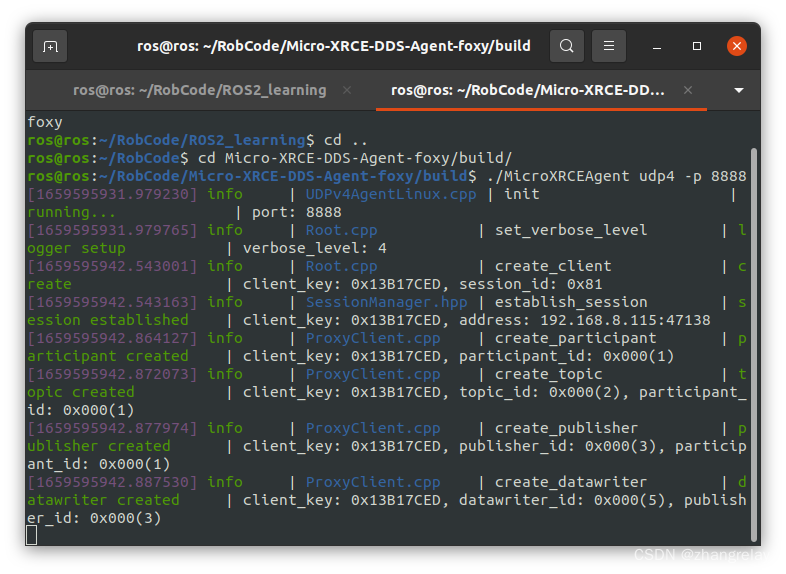
效果如下:

可以在上位机监测每一个机器人的电量状态。降低机器人程序复杂度。
rclcpp master
C++ ROS Client Library API
rclcpp Namespace Reference
This header provides the get_node_base_interface() template function. More...Namespaces
allocator
callback_group
contexts
detail
exceptions
executor
executors
experimental
function_traits
graph_listener
memory_strategies
memory_strategy
message_memory_strategy
node_interfaces
serialization_traits
strategies
subscription_traits
topic_statistics
type_support
wait_set_policies
Classes
struct AnyExecutable
class AnyServiceCallback
class AnySubscriptionCallback
class AsyncParametersClient
class CallbackGroup
class Client
class ClientBase
class Clock
class Context
Context which encapsulates shared state between nodes and other similar entities. More...
class ContextAlreadyInitialized
Thrown when init is called on an already initialized context. More...
class Duration
class Event
class Executor
Coordinate the order and timing of available communication tasks. More...
struct ExecutorOptions
Options to be passed to the executor constructor. More...
class GenericRate
class GenericTimer
Generic timer. Periodically executes a user-specified callback. More...
class GuardCondition
A condition that can be waited on in a single wait set and asynchronously triggered. More...
class InitOptions
Encapsulation of options for initializing rclcpp. More...
class JumpHandler
struct KeepAll
Use to initialize the QoS with the keep_all history setting. More...
struct KeepLast
Use to initialize the QoS with the keep_last history setting and the given depth. More...
class LoanedMessage
class Logger
class MessageInfo
Additional meta data about messages taken from subscriptions. More...
class Node
Node is the single point of entry for creating publishers and subscribers. More...
class NodeOptions
Encapsulation of options for node initialization. More...
class Parameter
Structure to store an arbitrary parameter with templated get/set methods. More...
class ParameterEventsFilter
class ParameterEventsQoS
class ParameterService
class ParametersQoS
class ParameterTypeException
Indicate the parameter type does not match the expected type. More...
class ParameterValue
Store the type and value of a parameter. More...
class Publisher
A publisher publishes messages of any type to a topic. More...
class PublisherBase
struct PublisherEventCallbacks
Contains callbacks for various types of events a Publisher can receive from the middleware. More...
struct PublisherFactory
Factory with functions used to create a MessageT specific PublisherT. More...
struct PublisherOptionsBase
Non-templated part of PublisherOptionsWithAllocator. More...
struct PublisherOptionsWithAllocator
Structure containing optional configuration for Publishers. More...
class QoS
Encapsulation of Quality of Service settings. More...
class QOSEventHandler
class QOSEventHandlerBase
struct QoSInitialization
QoS initialization values, cannot be created directly, use KeepAll or KeepLast instead. More...
class RateBase
struct ScopeExit
class SensorDataQoS
class Serialization
Default implementation to (de)serialize a message by using rmw_(de)serialize. More...
class SerializationBase
Interface to (de)serialize a message. More...
class SerializedMessage
Object oriented version of rcl_serialized_message_t with destructor to avoid memory leaks. More...
class Service
class ServiceBase
class ServicesQoS
class Subscription
Subscription implementation, templated on the type of message this subscription receives. More...
class SubscriptionBase
struct SubscriptionEventCallbacks
Contains callbacks for non-message events that a Subscription can receive from the middleware. More...
struct SubscriptionFactory
Factory containing a function used to create a Subscription. More...
struct SubscriptionOptionsBase
Non-template base class for subscription options. More...
struct SubscriptionOptionsWithAllocator
Structure containing optional configuration for Subscriptions. More...
class SubscriptionWaitSetMask
Options used to determine what parts of a subscription get added to or removed from a wait set. More...
class SyncParametersClient
class SystemDefaultsQoS
class Time
class TimerBase
class TimeSource
class TopicEndpointInfo
class UnsupportedEventTypeException
class Waitable
class WaitResult
Interface for introspecting a wait set after waiting on it. More...
class WaitSetTemplate
Encapsulates sets of waitable items which can be waited on as a group. More...
class WallTimer
Typedefs
using ParameterMap = std::unordered_map< std::string, std::vector< Parameter > >
A map of fully qualified node names to a list of parameters. More...
using PublisherOptions = PublisherOptionsWithAllocator< std::allocator< void > >
using QOSDeadlineRequestedInfo = rmw_requested_deadline_missed_status_t
using QOSDeadlineOfferedInfo = rmw_offered_deadline_missed_status_t
using QOSLivelinessChangedInfo = rmw_liveliness_changed_status_t
using QOSLivelinessLostInfo = rmw_liveliness_lost_status_t
using QOSOfferedIncompatibleQoSInfo = rmw_offered_qos_incompatible_event_status_t
using QOSRequestedIncompatibleQoSInfo = rmw_requested_qos_incompatible_event_status_t
using QOSDeadlineRequestedCallbackType = std::function< void(QOSDeadlineRequestedInfo &)>
using QOSDeadlineOfferedCallbackType = std::function< void(QOSDeadlineOfferedInfo &)>
using QOSLivelinessChangedCallbackType = std::function< void(QOSLivelinessChangedInfo &)>
using QOSLivelinessLostCallbackType = std::function< void(QOSLivelinessLostInfo &)>
using QOSOfferedIncompatibleQoSCallbackType = std::function< void(QOSOfferedIncompatibleQoSInfo &)>
using QOSRequestedIncompatibleQoSCallbackType = std::function< void(QOSRequestedIncompatibleQoSInfo &)>
using Rate = GenericRate< std::chrono::system_clock >
using WallRate = GenericRate< std::chrono::steady_clock >
using SubscriptionOptions = SubscriptionOptionsWithAllocator< std::allocator< void > >
using VoidCallbackType = std::function< void()>
using TimerCallbackType = std::function< void(TimerBase &)>
using WaitSet = rclcpp::WaitSetTemplate< rclcpp::wait_set_policies::SequentialSynchronization, rclcpp::wait_set_policies::DynamicStorage >
Most common user configuration of a WaitSet, which is dynamic but not thread-safe. More...
template
using StaticWaitSet = rclcpp::WaitSetTemplate< rclcpp::wait_set_policies::SequentialSynchronization, rclcpp::wait_set_policies::StaticStorage< NumberOfSubscriptions, NumberOfGuardCondtions, NumberOfTimers, NumberOfClients, NumberOfServices, NumberOfWaitables > >
WaitSet configuration which does not allow changes after construction. More...
using ThreadSafeWaitSet = rclcpp::WaitSetTemplate< rclcpp::wait_set_policies::ThreadSafeSynchronization, rclcpp::wait_set_policies::DynamicStorage >
Like WaitSet, this configuration is dynamic, but is also thread-safe. More...
Enumerations
enum CallbackGroupType { CallbackGroupType::MutuallyExclusive, CallbackGroupType::Reentrant }
enum FutureReturnCode { FutureReturnCode::SUCCESS, FutureReturnCode::INTERRUPTED, FutureReturnCode::TIMEOUT }
Return codes to be used with spin_until_future_complete. More...
enum IntraProcessBufferType { IntraProcessBufferType::SharedPtr, IntraProcessBufferType::UniquePtr, IntraProcessBufferType::CallbackDefault }
enum IntraProcessSetting { IntraProcessSetting::Enable, IntraProcessSetting::Disable, IntraProcessSetting::NodeDefault }
Used as argument in create_publisher and create_subscriber. More...
enum EndpointType { EndpointType::Invalid = RMW_ENDPOINT_INVALID, EndpointType::Publisher = RMW_ENDPOINT_PUBLISHER, EndpointType::Subscription = RMW_ENDPOINT_SUBSCRIPTION }
enum ParameterType : uint8_t {
PARAMETER_NOT_SET = rcl_interfaces::msg::ParameterType::PARAMETER_NOT_SET, PARAMETER_BOOL = rcl_interfaces::msg::ParameterType::PARAMETER_BOOL, PARAMETER_INTEGER = rcl_interfaces::msg::ParameterType::PARAMETER_INTEGER, PARAMETER_DOUBLE = rcl_interfaces::msg::ParameterType::PARAMETER_DOUBLE,
PARAMETER_STRING = rcl_interfaces::msg::ParameterType::PARAMETER_STRING, PARAMETER_BYTE_ARRAY = rcl_interfaces::msg::ParameterType::PARAMETER_BYTE_ARRAY, PARAMETER_BOOL_ARRAY = rcl_interfaces::msg::ParameterType::PARAMETER_BOOL_ARRAY, PARAMETER_INTEGER_ARRAY = rcl_interfaces::msg::ParameterType::PARAMETER_INTEGER_ARRAY,
PARAMETER_DOUBLE_ARRAY = rcl_interfaces::msg::ParameterType::PARAMETER_DOUBLE_ARRAY, PARAMETER_STRING_ARRAY = rcl_interfaces::msg::ParameterType::PARAMETER_STRING_ARRAY
}
enum TopicStatisticsState { TopicStatisticsState::Enable, TopicStatisticsState::Disable, TopicStatisticsState::NodeDefault }
enum WaitResultKind { Ready, Timeout, Empty }
Represents the various kinds of results from waiting on a wait set. More...
Functions
std::vector< Context::SharedPtr > get_contexts ()
Return a copy of the list of context shared pointers. More...
template
rclcpp::Client< ServiceT >::SharedPtr create_client (std::shared_ptr< node_interfaces::NodeBaseInterface > node_base, std::shared_ptr< node_interfaces::NodeGraphInterface > node_graph, std::shared_ptr< node_interfaces::NodeServicesInterface > node_services, const std::string &service_name, const rmw_qos_profile_t &qos_profile, rclcpp::CallbackGroup::SharedPtr group)
template, typename PublisherT = rclcpp::Publisher
std::shared_ptr< PublisherT > create_publisher (NodeT &node, const std::string &topic_name, const rclcpp::QoS &qos, const rclcpp::PublisherOptionsWithAllocator< AllocatorT > &options=(rclcpp::PublisherOptionsWithAllocator< AllocatorT >()))
Create and return a publisher of the given MessageT type. More...
template
rclcpp::Service< ServiceT >::SharedPtr create_service (std::shared_ptr< node_interfaces::NodeBaseInterface > node_base, std::shared_ptr< node_interfaces::NodeServicesInterface > node_services, const std::string &service_name, CallbackT &&callback, const rmw_qos_profile_t &qos_profile, rclcpp::CallbackGroup::SharedPtr group)
template, typename CallbackMessageT = typename rclcpp::subscription_traits::has_message_type ::type, typename SubscriptionT = rclcpp::Subscription
std::shared_ptr< SubscriptionT > create_subscription (NodeT &&node, const std::string &topic_name, const rclcpp::QoS &qos, CallbackT &&callback, const rclcpp::SubscriptionOptionsWithAllocator< AllocatorT > &options=(rclcpp::SubscriptionOptionsWithAllocator< AllocatorT >()), typename MessageMemoryStrategyT::SharedPtr msg_mem_strat=(MessageMemoryStrategyT::create_default()))
Create and return a subscription of the given MessageT type. More...
template
rclcpp::TimerBase::SharedPtr create_timer (std::shared_ptr< node_interfaces::NodeBaseInterface > node_base, std::shared_ptr< node_interfaces::NodeTimersInterface > node_timers, rclcpp::Clock::SharedPtr clock, rclcpp::Duration period, CallbackT &&callback, rclcpp::CallbackGroup::SharedPtr group=nullptr)
template
rclcpp::TimerBase::SharedPtr create_timer (NodeT node, rclcpp::Clock::SharedPtr clock, rclcpp::Duration period, CallbackT &&callback, rclcpp::CallbackGroup::SharedPtr group=nullptr)
Create a timer with a given clock. More...
template
rclcpp::WallTimer< CallbackT >::SharedPtr create_wall_timer (std::chrono::duration< DurationRepT, DurationT > period, CallbackT callback, rclcpp::CallbackGroup::SharedPtr group, node_interfaces::NodeBaseInterface *node_base, node_interfaces::NodeTimersInterface *node_timers)
Convenience method to create a timer with node resources. More...
void spin_some (rclcpp::node_interfaces::NodeBaseInterface::SharedPtr node_ptr)
Create a default single-threaded executor and execute any immediately available work. More...
void spin_some (rclcpp::Node::SharedPtr node_ptr)
void spin (rclcpp::node_interfaces::NodeBaseInterface::SharedPtr node_ptr)
Create a default single-threaded executor and spin the specified node. More...
void spin (rclcpp::Node::SharedPtr node_ptr)
template
rclcpp::FutureReturnCode spin_until_future_complete (rclcpp::node_interfaces::NodeBaseInterface::SharedPtr node_ptr, const std::shared_future< FutureT > &future, std::chrono::duration< TimeRepT, TimeT > timeout=std::chrono::duration< TimeRepT, TimeT >(-1))
template
rclcpp::FutureReturnCode spin_until_future_complete (std::shared_ptr< NodeT > node_ptr, const std::shared_future< FutureT > &future, std::chrono::duration< TimeRepT, TimeT > timeout=std::chrono::duration< TimeRepT, TimeT >(-1))
std::string expand_topic_or_service_name (const std::string &name, const std::string &node_name, const std::string &namespace_, bool is_service=false)
Expand a topic or service name and throw if it is not valid. More...
std::ostream & operator<< (std::ostream &os, const FutureReturnCode &future_return_code)
Stream operator for FutureReturnCode. More...
std::string to_string (const FutureReturnCode &future_return_code)
String conversion function for FutureReturnCode. More...
Logger get_logger (const std::string &name)
Return a named logger. More...
Logger get_node_logger (const rcl_node_t *node)
Return a named logger using an rcl_node_t. More...
RCLCPP_LOCAL std::string extend_name_with_sub_namespace (const std::string &name, const std::string &sub_namespace)
std::string _to_json_dict_entry (const Parameter ¶m)
Return a json encoded version of the parameter intended for a dict. More...
std::ostream & operator<< (std::ostream &os, const rclcpp::Parameter &pv)
std::ostream & operator<< (std::ostream &os, const std::vector< Parameter > ¶meters)
ParameterMap parameter_map_from (const rcl_params_t *const c_params)
ParameterValue parameter_value_from (const rcl_variant_t *const c_value)
std::string to_string (ParameterType type)
Return the name of a parameter type. More...
std::ostream & operator<< (std::ostream &os, ParameterType type)
std::string to_string (const ParameterValue &type)
Return the value of a parameter as a string. More...
template
PublisherFactory create_publisher_factory (const rclcpp::PublisherOptionsWithAllocator< AllocatorT > &options)
Return a PublisherFactory with functions setup for creating a PublisherT
std::string qos_policy_name_from_kind (rmw_qos_policy_kind_t policy_kind)
bool operator== (const QoS &left, const QoS &right)
Check if two QoS profiles are exactly equal in all policy values. More...
bool operator!= (const QoS &left, const QoS &right)
template
ScopeExit< Callable > make_scope_exit (Callable callable)
template::type, typename SubscriptionT = rclcpp::Subscription
SubscriptionFactory create_subscription_factory (CallbackT &&callback, const rclcpp::SubscriptionOptionsWithAllocator< AllocatorT > &options, typename MessageMemoryStrategyT::SharedPtr msg_mem_strat, std::shared_ptr< rclcpp::topic_statistics::SubscriptionTopicStatistics< CallbackMessageT >> subscription_topic_stats=nullptr)
Return a SubscriptionFactory setup to create a SubscriptionT
Time operator+ (const rclcpp::Duration &lhs, const rclcpp::Time &rhs)
void init (int argc, char const *const argv[], const InitOptions &init_options=InitOptions())
Initialize communications via the rmw implementation and set up a global signal handler. More...
bool install_signal_handlers ()
Install the global signal handler for rclcpp. More...
bool signal_handlers_installed ()
Return true if the signal handlers are installed, otherwise false. More...
bool uninstall_signal_handlers ()
Uninstall the global signal handler for rclcpp. More...
std::vector< std::string > init_and_remove_ros_arguments (int argc, char const *const argv[], const InitOptions &init_options=InitOptions())
Initialize communications via the rmw implementation and set up a global signal handler. More...
std::vector< std::string > remove_ros_arguments (int argc, char const *const argv[])
Remove ROS-specific arguments from argument vector. More...
bool ok (rclcpp::Context::SharedPtr context=nullptr)
Check rclcpp's status. More...
bool is_initialized (rclcpp::Context::SharedPtr context=nullptr)
Return true if init() has already been called for the given context. More...
bool shutdown (rclcpp::Context::SharedPtr context=nullptr, const std::string &reason="user called rclcpp::shutdown()")
Shutdown rclcpp context, invalidating it for derived entities. More...
void on_shutdown (std::function< void()> callback, rclcpp::Context::SharedPtr context=nullptr)
Register a function to be called when shutdown is called on the context. More...
bool sleep_for (const std::chrono::nanoseconds &nanoseconds, rclcpp::Context::SharedPtr context=nullptr)
Use the global condition variable to block for the specified amount of time. More...
template
bool add_will_overflow (const T x, const T y)
Safely check if addition will overflow. More...
template
bool add_will_underflow (const T x, const T y)
Safely check if addition will underflow. More...
template
bool sub_will_overflow (const T x, const T y)
Safely check if subtraction will overflow. More...
template
bool sub_will_underflow (const T x, const T y)
Safely check if subtraction will underflow. More...
const char * get_c_string (const char *string_in)
Return the given string. More...
const char * get_c_string (const std::string &string_in)
Return the C string from the given std::string. More...
Detailed Description
This header provides the get_node_base_interface() template function.This header provides the get_node_waitables_interface() template function.
This header provides the get_node_topics_interface() template function.
This header provides the get_node_timers_interface() template function.
This header provides the get_node_time_source_interface() template function.
This header provides the get_node_services_interface() template function.
This header provides the get_node_parameters_interface() template function.
This header provides the get_node_logging_interface() template function.
This header provides the get_node_graph_interface() template function.
This header provides the get_node_clock_interface() template function.
This function is useful for getting the NodeBaseInterface pointer from various kinds of Node-like classes.
It's able to get a std::shared_ptr to a NodeBaseInterface so long as the class has a method called get_node_base_interface() which returns one.
This function is useful for getting the NodeClockInterface pointer from various kinds of Node-like classes.
It's able to get a std::shared_ptr to a NodeClockInterface so long as the class has a method called get_node_clock_interface() which returns one.
This function is useful for getting the NodeGraphInterface pointer from various kinds of Node-like classes.
It's able to get a std::shared_ptr to a NodeGraphInterface so long as the class has a method called get_node_graph_interface() which returns one.
This function is useful for getting the NodeLoggingInterface pointer from various kinds of Node-like classes.
It's able to get a std::shared_ptr to a NodeLoggingInterface so long as the class has a method called get_node_logging_interface() which returns one.
This function is useful for getting the NodeParametersInterface pointer from various kinds of Node-like classes.
It's able to get a std::shared_ptr to a NodeParametersInterface so long as the class has a method called get_node_parameters_interface() which returns one.
This function is useful for getting the NodeServicesInterface pointer from various kinds of Node-like classes.
It's able to get a std::shared_ptr to a NodeServicesInterface so long as the class has a method called get_node_services_interface() which returns one.
This function is useful for getting the NodeTimeSourceInterface pointer from various kinds of Node-like classes.
It's able to get a std::shared_ptr to a NodeTimeSourceInterface so long as the class has a method called get_node_time_source_interface() which returns one.
This function is useful for getting the NodeTimersInterface pointer from various kinds of Node-like classes.
It's able to get a std::shared_ptr to a NodeTimersInterface so long as the class has a method called get_node_timers_interface() which returns one.
This function is useful for getting the NodeTopicsInterface pointer from various kinds of Node-like classes.
It's able to get a std::shared_ptr to a NodeTopicsInterface so long as the class has a method called get_node_topics_interface() which returns one.
This function is useful for getting the NodeWaitablesInterface pointer from various kinds of Node-like classes.
It's able to get a std::shared_ptr to a NodeWaitablesInterface so long as the class has a method called get_node_waitables_interface() which returns one.
Typedef Documentation
◆ ParameterMap
using rclcpp::ParameterMap = typedef std::unordered_map
A map of fully qualified node names to a list of parameters.◆ PublisherOptions
using rclcpp::PublisherOptions = typedef PublisherOptionsWithAllocator
◆ QOSDeadlineRequestedInfo
using rclcpp::QOSDeadlineRequestedInfo = typedef rmw_requested_deadline_missed_status_t
◆ QOSDeadlineOfferedInfo
using rclcpp::QOSDeadlineOfferedInfo = typedef rmw_offered_deadline_missed_status_t
◆ QOSLivelinessChangedInfo
using rclcpp::QOSLivelinessChangedInfo = typedef rmw_liveliness_changed_status_t
◆ QOSLivelinessLostInfo
using rclcpp::QOSLivelinessLostInfo = typedef rmw_liveliness_lost_status_t
◆ QOSOfferedIncompatibleQoSInfo
using rclcpp::QOSOfferedIncompatibleQoSInfo = typedef rmw_offered_qos_incompatible_event_status_t
◆ QOSRequestedIncompatibleQoSInfo
using rclcpp::QOSRequestedIncompatibleQoSInfo = typedef rmw_requested_qos_incompatible_event_status_t
◆ QOSDeadlineRequestedCallbackType
using rclcpp::QOSDeadlineRequestedCallbackType = typedef std::function
◆ QOSDeadlineOfferedCallbackType
using rclcpp::QOSDeadlineOfferedCallbackType = typedef std::function
◆ QOSLivelinessChangedCallbackType
using rclcpp::QOSLivelinessChangedCallbackType = typedef std::function
◆ QOSLivelinessLostCallbackType
using rclcpp::QOSLivelinessLostCallbackType = typedef std::function
◆ QOSOfferedIncompatibleQoSCallbackType
using rclcpp::QOSOfferedIncompatibleQoSCallbackType = typedef std::function
◆ QOSRequestedIncompatibleQoSCallbackType
using rclcpp::QOSRequestedIncompatibleQoSCallbackType = typedef std::function
◆ Rate
using rclcpp::Rate = typedef GenericRate
◆ WallRate
using rclcpp::WallRate = typedef GenericRate
◆ SubscriptionOptions
using rclcpp::SubscriptionOptions = typedef SubscriptionOptionsWithAllocator
◆ VoidCallbackType
using rclcpp::VoidCallbackType = typedef std::function
◆ TimerCallbackType
using rclcpp::TimerCallbackType = typedef std::function
◆ WaitSet
using rclcpp::WaitSet = typedef rclcpp::WaitSetTemplate< rclcpp::wait_set_policies::SequentialSynchronization, rclcpp::wait_set_policies::DynamicStorage >
Most common user configuration of a WaitSet, which is dynamic but not thread-safe.This wait set allows you to add and remove items dynamically, and it will automatically remove items that are let out of scope each time wait() or prune_destroyed_entities() is called.
It will not, however, provide thread-safety for adding and removing entities while waiting.
See also
rclcpp::WaitSetTemplate for API documentation
◆ StaticWaitSet
template
using rclcpp::StaticWaitSet = typedef rclcpp::WaitSetTemplate< rclcpp::wait_set_policies::SequentialSynchronization, rclcpp::wait_set_policies::StaticStorage< NumberOfSubscriptions, NumberOfGuardCondtions, NumberOfTimers, NumberOfClients, NumberOfServices, NumberOfWaitables > >
WaitSet configuration which does not allow changes after construction.This wait set requires that you specify all entities at construction, and prevents you from calling the typical add and remove functions. It also requires that you specify how many of each item there will be as a template argument.
It will share ownership of the entities until destroyed, therefore it will prevent the destruction of entities so long as the wait set exists, even if the user lets their copy of the shared pointer to the entity go out of scope.
Since the wait set cannot be mutated, it does not need to be thread-safe.
See also
rclcpp::WaitSetTemplate for API documentation
◆ ThreadSafeWaitSet
using rclcpp::ThreadSafeWaitSet = typedef rclcpp::WaitSetTemplate< rclcpp::wait_set_policies::ThreadSafeSynchronization, rclcpp::wait_set_policies::DynamicStorage >
Like WaitSet, this configuration is dynamic, but is also thread-safe.This wait set allows you to add and remove items dynamically, and it will automatically remove items that are let out of scope each time wait() or prune_destroyed_entities() is called.
It will also ensure that adding and removing items explicitly from the wait set is done in a thread-safe way, protecting against concurrent add and deletes, as well as add and deletes during a wait(). This thread-safety comes at some overhead and the use of thread synchronization primitives.
See also
rclcpp::WaitSetTemplate for API documentation
Enumeration Type Documentation
◆ CallbackGroupType
enum rclcpp::CallbackGroupType
strong
Enumerator
MutuallyExclusive
Reentrant
◆ FutureReturnCode
enum rclcpp::FutureReturnCode
strong
Return codes to be used with spin_until_future_complete.SUCCESS: The future is complete and can be accessed with "get" without blocking. This does not indicate that the operation succeeded; "get" may still throw an exception. INTERRUPTED: The future is not complete, spinning was interrupted by Ctrl-C or another error. TIMEOUT: Spinning timed out.
Enumerator
SUCCESS
INTERRUPTED
TIMEOUT
◆ IntraProcessBufferType
enum rclcpp::IntraProcessBufferType
strong
Used as argument in create_publisher and create_subscriber when intra-process communication is enabledEnumerator
SharedPtr
Set the data type used in the intra-process buffer as std::shared_ptrUniquePtr
Set the data type used in the intra-process buffer as std::unique_ptrCallbackDefault
Set the data type used in the intra-process buffer as the same used in the callback.◆ IntraProcessSetting
enum rclcpp::IntraProcessSetting
strong
Used as argument in create_publisher and create_subscriber.Enumerator
Enable
Explicitly enable intraprocess comm at publisher/subscription level.Disable
Explicitly disable intraprocess comm at publisher/subscription level.NodeDefault
Take intraprocess configuration from the node.◆ EndpointType
enum rclcpp::EndpointType
strong
Enumerator
Invalid
Publisher
Subscription
◆ ParameterType
enum rclcpp::ParameterType : uint8_t
Enumerator
PARAMETER_NOT_SET
PARAMETER_BOOL
PARAMETER_INTEGER
PARAMETER_DOUBLE
PARAMETER_STRING
PARAMETER_BYTE_ARRAY
PARAMETER_BOOL_ARRAY
PARAMETER_INTEGER_ARRAY
PARAMETER_DOUBLE_ARRAY
PARAMETER_STRING_ARRAY
◆ TopicStatisticsState
enum rclcpp::TopicStatisticsState
strong
Represent the state of topic statistics collector. Used as argument in create_subscriber.Enumerator
Enable
Explicitly enable topic statistics at subscription level.Disable
Explicitly disable topic statistics at subscription level.NodeDefault
Take topic statistics state from the node.◆ WaitResultKind
enum rclcpp::WaitResultKind
Represents the various kinds of results from waiting on a wait set.Enumerator
Ready
Timeout
Empty
Function Documentation
◆ get_contexts()
std::vector
Return a copy of the list of context shared pointers.This function is thread-safe.
◆ create_client()
template
rclcpp::Client::SharedPtr rclcpp::create_client ( std::shared_ptr< node_interfaces::NodeBaseInterface > node_base,
std::shared_ptr< node_interfaces::NodeGraphInterface > node_graph,
std::shared_ptr< node_interfaces::NodeServicesInterface > node_services,
const std::string & service_name,
const rmw_qos_profile_t & qos_profile,
rclcpp::CallbackGroup::SharedPtr group
)
Create a service client with a given type.◆ create_publisher()
template, typename PublisherT = rclcpp::Publisher
std::shared_ptrrclcpp::create_publisher ( NodeT & node,
const std::string & topic_name,
const rclcpp::QoS & qos,
const rclcpp::PublisherOptionsWithAllocator< AllocatorT > & options = ( rclcpp::PublisherOptionsWithAllocator() )
)
Create and return a publisher of the given MessageT type.The NodeT type only needs to have a method called get_node_topics_interface() which returns a shared_ptr to a NodeTopicsInterface.
◆ create_service()
template
rclcpp::Service::SharedPtr rclcpp::create_service ( std::shared_ptr< node_interfaces::NodeBaseInterface > node_base,
std::shared_ptr< node_interfaces::NodeServicesInterface > node_services,
const std::string & service_name,
CallbackT && callback,
const rmw_qos_profile_t & qos_profile,
rclcpp::CallbackGroup::SharedPtr group
)
Create a service with a given type.◆ create_subscription()
template, typename CallbackMessageT = typename rclcpp::subscription_traits::has_message_type ::type, typename SubscriptionT = rclcpp::Subscription
std::shared_ptrrclcpp::create_subscription ( NodeT && node,
const std::string & topic_name,
const rclcpp::QoS & qos,
CallbackT && callback,
const rclcpp::SubscriptionOptionsWithAllocator< AllocatorT > & options = ( rclcpp::SubscriptionOptionsWithAllocator() ),
typename MessageMemoryStrategyT::SharedPtr msg_mem_strat = ( MessageMemoryStrategyT::create_default() )
)
Create and return a subscription of the given MessageT type.The NodeT type only needs to have a method called get_node_topics_interface() which returns a shared_ptr to a NodeTopicsInterface, or be a NodeTopicsInterface pointer itself.
Template Parameters
MessageT
CallbackT
AllocatorT
CallbackMessageT
SubscriptionT
MessageMemoryStrategyT
NodeT
Parameters
node
topic_name
qos
callback
options
msg_mem_strat
Returns
the created subscription
Exceptions
std::invalid_argument if topic statistics is enabled and the publish period is less than or equal to zero.
◆ create_timer() [1/2]
template
rclcpp::TimerBase::SharedPtr rclcpp::create_timer ( std::shared_ptr< node_interfaces::NodeBaseInterface > node_base,
std::shared_ptr< node_interfaces::NodeTimersInterface > node_timers,
rclcpp::Clock::SharedPtr clock,
rclcpp::Duration period,
CallbackT && callback,
rclcpp::CallbackGroup::SharedPtr group = nullptr
)
Create a timer with a given clock◆ create_timer() [2/2]
template
rclcpp::TimerBase::SharedPtr rclcpp::create_timer ( NodeT node,
rclcpp::Clock::SharedPtr clock,
rclcpp::Duration period,
CallbackT && callback,
rclcpp::CallbackGroup::SharedPtr group = nullptr
)
Create a timer with a given clock.◆ create_wall_timer()
template
rclcpp::WallTimer::SharedPtr rclcpp::create_wall_timer ( std::chrono::duration< DurationRepT, DurationT > period,
CallbackT callback,
rclcpp::CallbackGroup::SharedPtr group,
node_interfaces::NodeBaseInterface * node_base,
node_interfaces::NodeTimersInterface * node_timers
)
Convenience method to create a timer with node resources.Template Parameters
DurationRepT
DurationT
CallbackT
Parameters
period period to exectute callback
callback callback to execute via the timer period
group
node_base
node_timers
Returns
Exceptions
std::invalid argument if either node_base or node_timers are null
◆ spin_some() [1/2]
void rclcpp::spin_some ( rclcpp::node_interfaces::NodeBaseInterface::SharedPtr node_ptr )
Create a default single-threaded executor and execute any immediately available work.Parameters
[in] node_ptr Shared pointer to the node to spin.
◆ spin_some() [2/2]
void rclcpp::spin_some ( rclcpp::Node::SharedPtr node_ptr )
◆ spin() [1/2]
void rclcpp::spin ( rclcpp::node_interfaces::NodeBaseInterface::SharedPtr node_ptr )
Create a default single-threaded executor and spin the specified node.Parameters
[in] node_ptr Shared pointer to the node to spin.
◆ spin() [2/2]
void rclcpp::spin ( rclcpp::Node::SharedPtr node_ptr )
◆ spin_until_future_complete() [1/2]
template
rclcpp::FutureReturnCode rclcpp::spin_until_future_complete ( rclcpp::node_interfaces::NodeBaseInterface::SharedPtr node_ptr,
const std::shared_future< FutureT > & future,
std::chrono::duration< TimeRepT, TimeT > timeout = std::chrono::duration
)
◆ spin_until_future_complete() [2/2]
template
rclcpp::FutureReturnCode rclcpp::spin_until_future_complete ( std::shared_ptr< NodeT > node_ptr,
const std::shared_future< FutureT > & future,
std::chrono::duration< TimeRepT, TimeT > timeout = std::chrono::duration
)
◆ expand_topic_or_service_name()
std::string rclcpp::expand_topic_or_service_name ( const std::string & name,
const std::string & node_name,
const std::string & namespace_,
bool is_service = false
)
Expand a topic or service name and throw if it is not valid.This function can be used to "just" validate a topic or service name too, since expanding the topic name is required to fully validate a name.
If the name is invalid, then InvalidTopicNameError is thrown or InvalidServiceNameError if is_service is true.
This function can take any form of a topic or service name, i.e. it does not have to be a fully qualified name. The node name and namespace are used to expand it if necessary while validating it.
Expansion is done with rcl_expand_topic_name. The validation is doen with rcl_validate_topic_name and rmw_validate_full_topic_name, so details about failures can be found in the documentation for those functions.
Parameters
name the topic or service name to be validated
node_name the name of the node associated with the name
namespace_ the namespace of the node associated with the name
is_service if true InvalidServiceNameError is thrown instead
Returns
expanded (and validated) topic name
Exceptions
InvalidTopicNameError if name is invalid and is_service is false
InvalidServiceNameError if name is invalid and is_service is true
std::bad_alloc if memory cannot be allocated
RCLError if an unexpect error occurs
std::runtime_error if the topic name is unexpectedly valid or, if the rcl name is invalid or if the rcl namespace is invalid
◆ operator<<() [1/4]
std::ostream& rclcpp::operator<< ( std::ostream & os,
const FutureReturnCode & future_return_code
)
Stream operator for FutureReturnCode.◆ to_string() [1/3]
std::string rclcpp::to_string ( const FutureReturnCode & future_return_code )
inline
String conversion function for FutureReturnCode.◆ get_logger()
Logger rclcpp::get_logger ( const std::string & name )
Return a named logger.The returned logger's name will include any naming conventions, such as a name prefix. Currently there are no such naming conventions but they may be introduced in the future.
Parameters
[in] name the name of the logger
Returns
a logger with the fully-qualified name including naming conventions, or
a dummy logger if logging is disabled.
◆ get_node_logger()
Logger rclcpp::get_node_logger ( const rcl_node_t * node )
Return a named logger using an rcl_node_t.This is a convenience function that does error checking and returns the node logger name, or "rclcpp" if it is unable to get the node name.
Parameters
[in] node the rcl node from which to get the logger name
Returns
a logger based on the node name, or "rclcpp" if there's an error
◆ extend_name_with_sub_namespace()
RCLCPP_LOCAL std::string rclcpp::extend_name_with_sub_namespace ( const std::string & name,
const std::string & sub_namespace
)
inline
◆ _to_json_dict_entry()
std::string rclcpp::_to_json_dict_entry ( const Parameter & param )
Return a json encoded version of the parameter intended for a dict.◆ operator<<() [2/4]
std::ostream& rclcpp::operator<< ( std::ostream & os,
const rclcpp::Parameter & pv
)
◆ operator<<() [3/4]
std::ostream& rclcpp::operator<< ( std::ostream & os,
const std::vector< Parameter > & parameters
)
◆ parameter_map_from()
ParameterMap rclcpp::parameter_map_from ( const rcl_params_t *const c_params )
Convert parameters from rcl_yaml_param_parser into C++ class instances.Parameters
[in] c_params C structures containing parameters for multiple nodes.
Returns
a map where the keys are fully qualified node names and values a list of parameters.
Exceptions
InvalidParametersException if the rcl_params_t is inconsistent or invalid.
◆ parameter_value_from()
ParameterValue rclcpp::parameter_value_from ( const rcl_variant_t *const c_value )
Convert parameter value from rcl_yaml_param_parser into a C++ class instance.Parameters
[in] c_value C structure containing a value of a parameter.
Returns
an instance of a parameter value
Exceptions
InvalidParameterValueException if the rcl_variant_t is inconsistent or invalid.
◆ to_string() [2/3]
std::string rclcpp::to_string ( ParameterType type )
Return the name of a parameter type.◆ operator<<() [4/4]
std::ostream& rclcpp::operator<< ( std::ostream & os,
ParameterType type
)
◆ to_string() [3/3]
std::string rclcpp::to_string ( const ParameterValue & type )
Return the value of a parameter as a string.◆ create_publisher_factory()
template
PublisherFactory rclcpp::create_publisher_factory ( const rclcpp::PublisherOptionsWithAllocator< AllocatorT > & options )
Return a PublisherFactory with functions setup for creating a PublisherT◆ qos_policy_name_from_kind()
std::string rclcpp::qos_policy_name_from_kind ( rmw_qos_policy_kind_t policy_kind )
◆ operator==()
bool rclcpp::operator== ( const QoS & left,
const QoS & right
)
Check if two QoS profiles are exactly equal in all policy values.◆ operator!=()
bool rclcpp::operator!= ( const QoS & left,
const QoS & right
)
◆ make_scope_exit()
template
ScopeExitrclcpp::make_scope_exit ( Callable callable )
◆ create_subscription_factory()
template::type, typename SubscriptionT = rclcpp::Subscription
SubscriptionFactory rclcpp::create_subscription_factory ( CallbackT && callback,
const rclcpp::SubscriptionOptionsWithAllocator< AllocatorT > & options,
typename MessageMemoryStrategyT::SharedPtr msg_mem_strat,
std::shared_ptr< rclcpp::topic_statistics::SubscriptionTopicStatistics< CallbackMessageT >> subscription_topic_stats = nullptr
)
Return a SubscriptionFactory setup to create a SubscriptionTParameters
[in] callback The user-defined callback function to receive a message
[in] options Additional options for the creation of the Subscription.
[in] msg_mem_strat The message memory strategy to use for allocating messages.
[in] subscription_topic_stats Optional stats callback for topic_statistics
◆ operator+()
Time rclcpp::operator+ ( const rclcpp::Duration & lhs,
const rclcpp::Time & rhs
)
Exceptions
std::overflow_error if addition leads to overflow
◆ init()
void rclcpp::init ( int argc,
char const *const argv[],
const InitOptions & init_options = InitOptions()
)
Initialize communications via the rmw implementation and set up a global signal handler.Initializes the global context which is accessible via the function rclcpp::contexts::get_global_default_context(). Also, installs the global signal handlers with the function rclcpp::install_signal_handlers().
See also
rclcpp::Context::init() for more details on arguments and possible exceptions
◆ install_signal_handlers()
bool rclcpp::install_signal_handlers ( )
Install the global signal handler for rclcpp.This function should only need to be run one time per process. It is implicitly run by rclcpp::init(), and therefore this function does not need to be run manually if rclcpp::init() has already been run.
The signal handler will shutdown all initialized context. It will also interrupt any blocking functions in ROS allowing them react to any changes in the state of the system (like shutdown).
This function is thread-safe.
Returns
true if signal handler was installed by this function, false if already installed.
◆ signal_handlers_installed()
bool rclcpp::signal_handlers_installed ( )
Return true if the signal handlers are installed, otherwise false.◆ uninstall_signal_handlers()
bool rclcpp::uninstall_signal_handlers ( )
Uninstall the global signal handler for rclcpp.This function does not necessarily need to be called, but can be used to undo what rclcpp::install_signal_handlers() or rclcpp::init() do with respect to signal handling. If you choose to use it, this function only needs to be run one time. It is implicitly run by rclcpp::shutdown(), and therefore this function does not need to be run manually if rclcpp::shutdown() has already been run.
This function is thread-safe.
Returns
true if signal handler was uninstalled by this function, false if was not installed.
◆ init_and_remove_ros_arguments()
std::vector
char const *const argv[],
const InitOptions & init_options = InitOptions()
)
Initialize communications via the rmw implementation and set up a global signal handler.Additionally removes ROS-specific arguments from the argument vector.
See also
rclcpp::Context::init() for more details on arguments and possible exceptions
Returns
Members of the argument vector that are not ROS arguments.
Exceptions
anything remove_ros_arguments can throw
◆ remove_ros_arguments()
std::vector
char const *const argv[]
)
Remove ROS-specific arguments from argument vector.Some arguments may not have been intended as ROS arguments. This function populates the arguments in a vector. Since the first argument is always assumed to be a process name, the vector will always contain the process name.
Parameters
[in] argc Number of arguments.
[in] argv Argument vector.
Returns
Members of the argument vector that are not ROS arguments.
Exceptions
anything throw_from_rcl_error can throw
rclcpp::exceptions::RCLError if the parsing fails
◆ ok()
bool rclcpp::ok ( rclcpp::Context::SharedPtr context = nullptr )
Check rclcpp's status.This may return false for a context which has been shutdown, or for a context that was shutdown due to SIGINT being received by the rclcpp signal handler.
If nullptr is given for the context, then the global context is used, i.e. the context initialized by rclcpp::init().
Parameters
[in] context Optional check for shutdown of this Context.
Returns
true if shutdown has been called, false otherwise
◆ is_initialized()
bool rclcpp::is_initialized ( rclcpp::Context::SharedPtr context = nullptr )
Return true if init() has already been called for the given context.If nullptr is given for the context, then the global context is used, i.e. the context initialized by rclcpp::init().
Deprecated, as it is no longer different from rcl_ok().
Parameters
[in] context Optional check for initialization of this Context.
Returns
true if the context is initialized, and false otherwise
◆ shutdown()
bool rclcpp::shutdown ( rclcpp::Context::SharedPtr context = nullptr,
const std::string & reason = "user called rclcpp::shutdown()"
)
Shutdown rclcpp context, invalidating it for derived entities.If nullptr is given for the context, then the global context is used, i.e. the context initialized by rclcpp::init().
If the global context is used, then the signal handlers are also uninstalled.
This will also cause the "on_shutdown" callbacks to be called.
See also
rclcpp::Context::shutdown()
Parameters
[in] context Optional to be shutdown
[in] reason Optional string passed to the context shutdown method
Returns
true if shutdown was successful, false if context was already shutdown
◆ on_shutdown()
void rclcpp::on_shutdown ( std::function< void()> callback,
rclcpp::Context::SharedPtr context = nullptr
)
Register a function to be called when shutdown is called on the context.If nullptr is given for the context, then the global context is used, i.e. the context initialized by rclcpp::init().
These callbacks are called when the associated Context is shutdown with the Context::shutdown() method. When shutdown by the SIGINT handler, shutdown, and therefore these callbacks, is called asynchronously from the dedicated signal handling thread, at some point after the SIGINT signal is received.
See also
rclcpp::Context::on_shutdown()
Parameters
[in] callback to be called when the given context is shutdown
[in] context with which to associate the context
◆ sleep_for()
bool rclcpp::sleep_for ( const std::chrono::nanoseconds & nanoseconds,
rclcpp::Context::SharedPtr context = nullptr
)
Use the global condition variable to block for the specified amount of time.This function can be interrupted early if the associated context becomes invalid due to shutdown() or the signal handler.
See also
rclcpp::Context::sleep_for
If nullptr is given for the context, then the global context is used, i.e. the context initialized by rclcpp::init().Parameters
[in] nanoseconds A std::chrono::duration representing how long to sleep for.
[in] context Optional which may interrupt this sleep
Returns
true if the condition variable did not timeout.
◆ add_will_overflow()
template
bool rclcpp::add_will_overflow ( const T x,
const T y
)
Safely check if addition will overflow.The type of the operands, T, should have defined std::numeric_limits
::max(), >, < and - operators. Parameters
[in] x is the first addend.
[in] y is the second addend.
Template Parameters
T is type of the operands.
Returns
True if the x + y sum is greater than T::max value.
◆ add_will_underflow()
template
bool rclcpp::add_will_underflow ( const T x,
const T y
)
Safely check if addition will underflow.The type of the operands, T, should have defined std::numeric_limits
::min(), >, < and - operators. Parameters
[in] x is the first addend.
[in] y is the second addend.
Template Parameters
T is type of the operands.
Returns
True if the x + y sum is less than T::min value.
◆ sub_will_overflow()
template
bool rclcpp::sub_will_overflow ( const T x,
const T y
)
Safely check if subtraction will overflow.The type of the operands, T, should have defined std::numeric_limits
::max(), >, < and + operators. Parameters
[in] x is the minuend.
[in] y is the subtrahend.
Template Parameters
T is type of the operands.
Returns
True if the difference x - y sum is grater than T::max value.
◆ sub_will_underflow()
template
bool rclcpp::sub_will_underflow ( const T x,
const T y
)
Safely check if subtraction will underflow.The type of the operands, T, should have defined std::numeric_limits
::min(), >, < and + operators. Parameters
[in] x is the minuend.
[in] y is the subtrahend.
Template Parameters
T is type of the operands.
Returns
True if the difference x - y sum is less than T::min value.
◆ get_c_string() [1/2]
const char* rclcpp::get_c_string ( const char * string_in )
Return the given string.This function is overloaded to transform any string to C-style string.
Parameters
[in] string_in is the string to be returned
Returns
the given string
◆ get_c_string() [2/2]
const char* rclcpp::get_c_string ( const std::string & string_in )
Return the C string from the given std::string.Parameters
[in] string_in is a std::string
Returns
the C string from the std::string
Generated by doxygen 1.8.17 -
相关阅读:
【Golang】程序如何优雅的退出?
甘特图组件DHTMLX Gantt示例 - 如何有效管理团队工作时间?(二)
CSDN、掘金、简书博客文章如何转为Markdown? (csdn文章转换为markdown格式 ,三种浏览器使用方式,2022年11月27日测试)
【HJL-E6/A数字式交流电流继电器】
分享68个ASP.NET源码总有一个是你想要的
Diagrams——制作短小精悍的流程图
SpringBoot连接redis
Java学习路线大纲
【网络爬虫】2 初探网络爬虫
(02)Cartographer源码无死角解析-(18) SensorBridge→landmark与Imu的数据处理
- 原文地址:https://blog.csdn.net/ZhangRelay/article/details/126159204
