-
MySQL如何互换表中两列的数据
一、问题
数据库表数据入库时,由于数据处理出错,导致表中数据刚好有两列的数据互相对调插入了。等到发现错误时,表中已经存在了相当一部分业务数据了,只能对表中的数据进行清洗处理。
二、解决方案
可以使用
SQL的update语句进行处理。三、解决过程记录
SQL 执行环境:
MySQL版本5.7.301. 表数据初始化
已对实际业务数据进行了简化抽象处理
create table `t_info` ( `id` int not null auto_increment, `creator` varchar(8) null, `create_date` varchar(8) null, primary key (`id`) ); insert into `t_info`(`id`, `creator`, `create_date`) values (1, '20210515', '11004747'); insert into `t_info`(`id`, `creator`, `create_date`) values (2, '20210616', '12014836'); insert into `t_info`(`id`, `creator`, `create_date`) values (3, '20210617', '12011236');- 1
- 2
- 3
- 4
- 5
- 6
- 7
- 8
- 9
- 10
如下图所示,表数据中
creator列(创建者)和create_date列(创建日期)两列数据保存错误,刚好对调了

2. 误区陷阱
一开始以为直接在
update语句里对调两列数据即可-- 错误的 sql 语句 update t_info t set t.create_date = t.creator, t.creator = t.create_date- 1
- 2
- 3
- 4
- 5
- 6
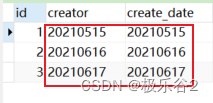
但是,如下图所示,这样做是错误的,并没有实现表中两列数据的互换。因为
creator数据先覆盖了create_date(此时原先create_date数据已丢失),然后再使用覆盖后的create_date数据(实质是creator的数据)给creator设置,其结果就是两列的数据都变为原先creator的数据。
3. 正确的处理
update t_info as a, t_info as b set a.create_date = b.creator, a.creator = b.create_date where a.id = b.id;- 1
- 2
- 3
- 4
- 5
- 6
- 7
数据处理后,查询结果如下图所示,表中两列数据互换成功。

四、拓展
如果表中的两列数据,一部分记录需要互换,另一部分记录不需要互换,这怎么办呢?上面提到的解决方案是全表数据都会影响到的。
实际开发中,对于业务数据,可能会存在存量数据有问题,需要清洗整理,而增量数据没有问题,不需要变动这种场景。这种场景下,我们需要先找出有问题的数据,然后专门针对这部分数据进行清洗整理。
-- 为了模拟对应的场景,先清掉表数据,然后再插入相应数据 delete from t_info; -- 这3条数据是有误的(模拟有问题的存量数据) insert into `t_info`(`id`, `creator`, `create_date`) values (1, '20210515', '11004747'); insert into `t_info`(`id`, `creator`, `create_date`) values (2, '20210616', '12014836'); insert into `t_info`(`id`, `creator`, `create_date`) values (3, '20210617', '12011236'); -- 这2条数据是正确的(模拟没问题的增量数据) insert into `t_info`(`id`, `creator`, `create_date`) values (4, '13011234', '20220102'); insert into `t_info`(`id`, `creator`, `create_date`) values (5, '13011235', '20220203');- 1
- 2
- 3
- 4
- 5
- 6
- 7
- 8
- 9
- 10
- 11
数据重新插入后,表数据查询结果如下图所示

附加查询条件,使得update语句只处理有问题的数据update t_info as a, t_info as b set a.create_date = b.creator, a.creator = b.create_date where a.id = b.id and a.id in (1, 2, 3); -- 附加查询条件,限定有问题的数据- 1
- 2
- 3
- 4
- 5
- 6
- 7
- 8
或者通过关联有问题的数据进行更新
-- join 与 inner join 是相同的 update t_info as a join (select * from t_info where id in (1, 2, 3)) as b on a.id = b.id set a.create_date = b.creator, a.creator = b.create_date- 1
- 2
- 3
- 4
- 5
- 6
- 7
- 8
- 9
处理后的查询结果如下图所示,数据清洗整理处理成功。

-
相关阅读:
CNPM、NPM 和 Yarn:JavaScript 包管理器的比较
C++ vector使用数组进行初始化
kalman滤波与目标跟踪1: kalman滤波理论详解
文件访问:C/C++/MFC
css 动画实现节流效果
SpringMVC概述及入门案例
画中画视频剪辑:批量制作画中画视频,让视频更具吸引力和创意
【大数据处理技术】第二篇 大数据存储与管理(持续更新)
12-Django-基础篇-HttpRequest对象
单片机学习笔记---红外遥控(外部中断)
- 原文地址:https://blog.csdn.net/u012815136/article/details/126000205