-
Spring5复习笔记
0. Spring架构
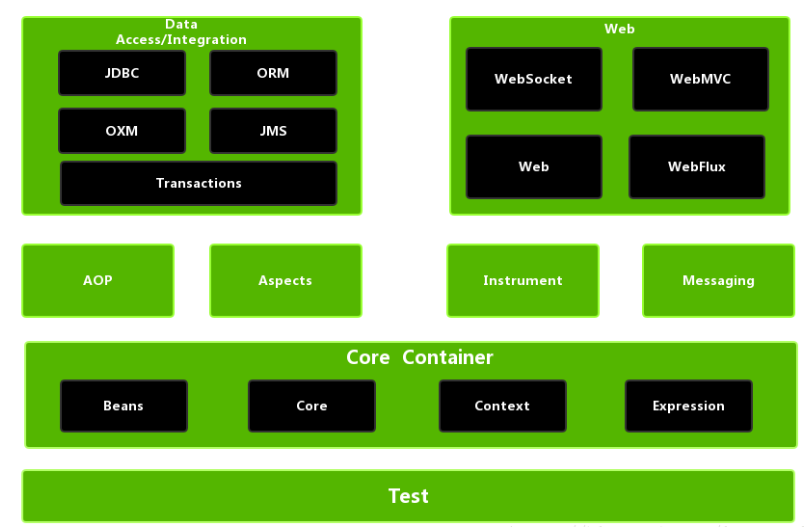
1. 内容介绍
- Spring 框架概述
- IOC容器
- IOC底层原理
- IOC接口(BeanFactory)
- IOC操作Bean管理(基于xml)
- IOC操作Bean管理(基于注解)
- AOP
- JdbcTemplete
- 事务管理(声明式事务)
- Spring5新特性
2. Spring 框架概述
- Spring是
轻量级的开源的JavaEE框架 - Spring可以解决企业开发的复杂性
- Spring有两个核心部分:IOC和AOP
IOC:控制反转,把创建对象的过程交给Spring进行管理Aop:面向切面,不修改代码进行功能增强
- Spring 特点
- 方便解耦,简化开发
- IOC控制反转解耦对象对象之间的耦合
- Aop编程支持
- 方便程序测试
- 集成的Junit,方便对程序进行单元测试
- 方便与其他框架进行整合
- 方便进行事务操作
- 简化了对声明式事务的操作
- 降低API开发难度
- 方便解耦,简化开发
3. Spring 入门案例
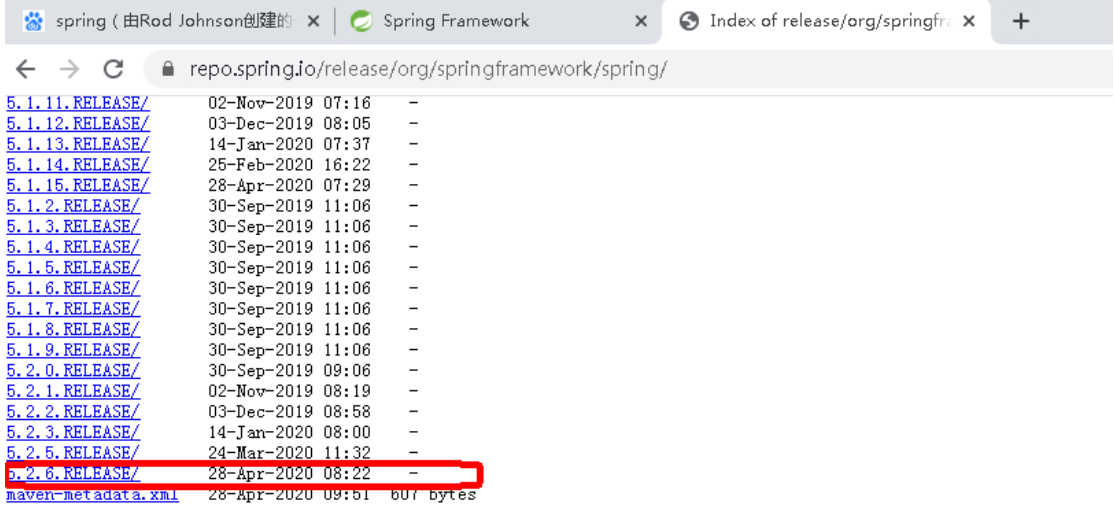
3.1 下载Spring5
- 使用Spring 最新稳定版本5.2.6


3.2 打开idea工具,创建java工程


3.3 导入Spring5相关基本jar包


3.4 创建普通类,在这个类创建普通方法
public class User { public void add() { System.out.println("add......"); } }- 1
- 2
- 3
- 4
- 5
3.5 创建Spring配置文件,在配置文件配置创建对象
- Spring 配置文件使用xml格式

bean1
<beans xmlns="http://www.springframework.org/schema/beans" xmlns:xsi="http://www.w3.org/2001/XMLSchema-instance" xmlns:p="http://www.springframework.org/schema/p" xsi:schemaLocation="http://www.springframework.org/schema/beans http://www.springframework.org/schema/beans/spring-beans.xsd"> <bean id="user" class="com.atguigu.spring5.User">bean> beans>- 1
- 2
- 3
- 4
- 5
- 6
- 7
- 8
- 9
3.6 进行测试代码编写
package com.atguigu.spring5.testdemo; import com.atguigu.spring5.Book; import com.atguigu.spring5.Orders; import com.atguigu.spring5.User; import org.junit.Test; import org.springframework.beans.factory.BeanFactory; import org.springframework.context.ApplicationContext; import org.springframework.context.support.ClassPathXmlApplicationContext; public class TestSpring5 { @Test public void testAdd() { //1 加载spring配置文件 BeanFactory context = new ClassPathXmlApplicationContext("bean1.xml"); //2 获取配置创建的对象 User user = context.getBean("user", User.class); System.out.println(user); user.add(); } }- 1
- 2
- 3
- 4
- 5
- 6
- 7
- 8
- 9
- 10
- 11
- 12
- 13
- 14
- 15
- 16
- 17
- 18
- 19
- 20
- 21
- 22
- 23
- 24
- 25
- 26
测试结果

4. IOC容器
4.1 IOC(概念和原理)
4.1.1 什么是IOC?
- 控制反转,把对象创建和对象之间的调用过程交给Spring进行管理
- 使用IOC的目的:为了降低耦合度
- 做入门案例就是IOC实现
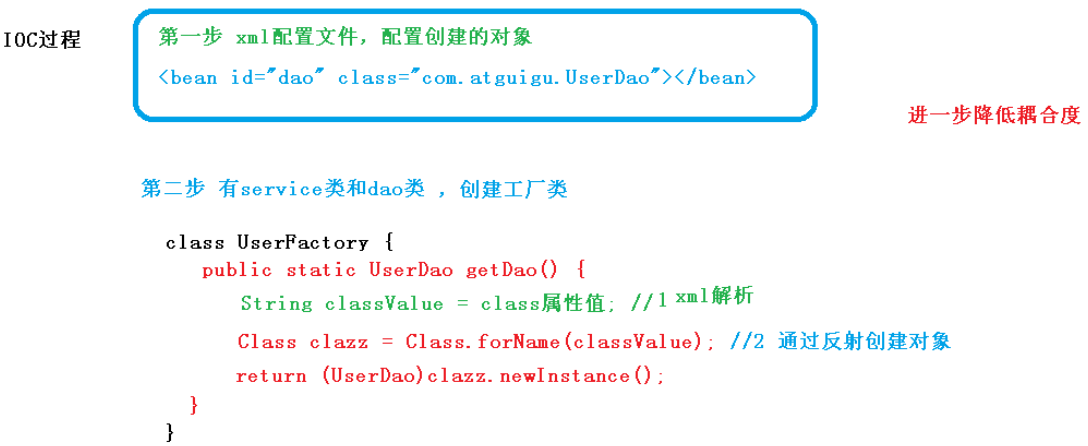
4.1.2 IOC底层原理
xml解析- 使用xml解析解析xml配置文件中的配置信息
工厂模式- 使用工厂来创建对象
反射- 工厂中实际创建对象的方式,利用反射的Class.forName()方法创建对象
4.1.3 画图讲解IOC底层原理
4.2 IOC(BeanFactory接口)
- IOC思想基于IOC容器完成,IOC容器底层就是对象工厂
- Spring提供IOC容器实现两种方式:(两个接口)
BeanFactory:IOC容器基本实现,是Spring内部的使用接口,不提供开发人员进行使用- 加载配置文件时候不会创建对象,在获取对象(使用)时才会去创建对象
ApplicationContext: BeanFactory接口的子接口,提供更多更强大的功能,一般由开发人员进行使用- 加载配置文件时就会把在配置文件对象进行创建-让对象在程序启动时创建,这样只会使程序启动时间较长,如果在获取对象(使用)时才会去创建对象,此时会使用户的等待时间变长不利于交互
- ApplicationContext接口有有实现类

4.3 IOC操作Bean管理
4.3.1 概念
4.3.1.1 什么是Bean管理?
- Bean管理值的是两个操作
- Spring创建对象
- Spring属性注入
4.3.1.2 Bean管理操作有两种方式
- 基于xml配置文件方式实现
- 基于注解方式实现
4.3.2 IOC操作Bean管理(基于xml方式)
4.3.2.1 基于xml方式创建对象
<bean id="user" class="com.atguigu.spring5.User">bean>- 1
- 2
-
在Spring配置文件中,使用bean标签,标签里面添加对应属性,就可以实现对象创建
-
在bean标签有很多,介绍常用的属性
- id属性: 唯一标识,一般使用类名首字母小写命名
- class属性: 类的全路径,该属性值用于反射时创建对象
-
创建对象时,默认也是执行无参构造方法完成对象创建
4.3.2.2 基于xml方式注入属性DI
- DI:依赖注入,也就是属性注入
4.3.2.3 注入方式一-使用set方法进行注入
-
创建类,定义属性和属性对应的set方法
package com.atguigu.spring5; /** * 演示使用set方法进行注入属性 */ public class Book { //创建属性 private String bname; private String bauthor; //创建属性对应的set方法 public void setBname(String bname) { this.bname = bname; } public void setBauthor(String bauthor) { this.bauthor = bauthor; } /打印属性-用于测试属性是否注入成功 public void testDemo() { System.out.println(bname+"::"+bauthor); } }- 1
- 2
- 3
- 4
- 5
- 6
- 7
- 8
- 9
- 10
- 11
- 12
- 13
- 14
- 15
- 16
- 17
- 18
- 19
- 20
- 21
-
在spring配置文件配置对象创建,配置属性注入
<bean id="book" class="com.atguigu.spring5.Book"> <property name="bname" value="易筋经">property> <property name="bauthor" value="达摩老祖">property> bean>- 1
- 2
- 3
- 4
- 5
- 6
- 7
- 8
- 9
-
测试代码及结果
@Test public void testBook1() { //1 加载spring配置文件 ApplicationContext context = new ClassPathXmlApplicationContext("bean1.xml"); //2 获取配置创建的对象 Book book = context.getBean("book", Book.class); System.out.println(book); book.testDemo(); }- 1
- 2
- 3
- 4
- 5
- 6
- 7
- 8
- 9
- 10
- 11
- 12

4.3.2.4 注入方式二-使用有参构造进行注入
-
创建类,定义属性,创建属性对应的有参构造方法
package com.atguigu.spring5; /** * 使用有参数构造注入 */ public class Orders { //属性 private String oname=""; private String address; //有参数构造 public Orders(String oname,String address) { this.oname = oname; this.address = address; } //打印属性-用于测试属性是否注入成功 public void ordersTest() { System.out.println(oname+"::"+address); } }- 1
- 2
- 3
- 4
- 5
- 6
- 7
- 8
- 9
- 10
- 11
- 12
- 13
- 14
- 15
- 16
- 17
- 18
- 19
- 20
-
在spring配置文件中进行配置
<bean id="orders" class="com.atguigu.spring5.Orders"> <constructor-arg name="oname" value="电脑">constructor-arg> <constructor-arg name="address" value="China">constructor-arg> bean>- 1
- 2
- 3
- 4
- 5
-
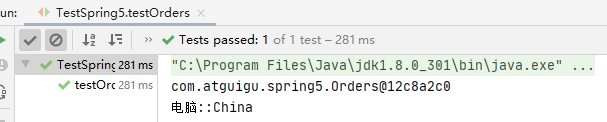
测试代码及结果
@Test public void testOrders() { //1 加载spring配置文件 ApplicationContext context = new ClassPathXmlApplicationContext("bean1.xml"); //2 获取配置创建的对象 Orders orders = context.getBean("orders", Orders.class); System.out.println(orders); orders.ordersTest(); }- 1
- 2
- 3
- 4
- 5
- 6
- 7
- 8
- 9
- 10
- 11
- 12
4.3.2.5 p名称空间注入(了解)
名称空间注入本质上还是set方法注入,只是在xml配置中简化了写法
-
使用p名称空间注入,可以简化基于xml配置方式
-
第一步: 添加p名称空间在配置文件中
<beans xmlns="http://www.springframework.org/schema/beans" xmlns:xsi="http://www.w3.org/2001/XMLSchema-instance" xmlns:p="http://www.springframework.org/schema/p" xsi:schemaLocation="http://www.springframework.org/schema/beans http://www.springframework.org/schema/beans/spring-beans.xsd">- 1
- 2
- 3
- 4
- 5
-
第二步: 进行属性注入,在bean标签里进行操作
<bean id="book" class="com.atguigu.spring5.Book" p:bname="九阳神功" p:bauthor="无名氏"> bean>- 1
- 2
- 3
-
测试代码及结果
@Test public void testBook1() { //1 加载spring配置文件 ApplicationContext context = new ClassPathXmlApplicationContext("bean1.xml"); //2 获取配置创建的对象 Book book = context.getBean("book", Book.class); System.out.println(book); book.testDemo(); }- 1
- 2
- 3
- 4
- 5
- 6
- 7
- 8
- 9
- 10
- 11
- 12

-
4.3.2.6 xml注入其他类型属性
4.3.2.6.1 字面量
4.3.2.6.1.1 null值
<property name="address"> <null/> property>- 1
- 2
- 3
- 4
4.3.2.6.1.2 属性值包含特殊符号
<property name="address"> <value>>]]>value> property>- 1
- 2
- 3
- 4
- 5
- 6
- 7
4.3.2.6.2 注入属性-外部bean
- 创建两个类service类和dao类
- 在service调用dao里面的方法
- 在spring配置文件中进行配置
UserDao
package com.atguigu.spring5.dao; public interface UserDao { public void update(); }- 1
- 2
- 3
- 4
- 5
UserDaoImpl
package com.atguigu.spring5.dao; public class UserDaoImpl implements UserDao { @Override public void update() { System.out.println("dao update..........."); } }- 1
- 2
- 3
- 4
- 5
- 6
- 7
- 8
- 9
- 10
UserService
package com.atguigu.spring5.service; import com.atguigu.spring5.dao.UserDao; import com.atguigu.spring5.dao.UserDaoImpl; public class UserService { //创建UserDao类型属性,生成set方法 private UserDao userDao; public void setUserDao(UserDao userDao) { this.userDao = userDao; } public void add() { System.out.println("service add..............."); userDao.update(); } }- 1
- 2
- 3
- 4
- 5
- 6
- 7
- 8
- 9
- 10
- 11
- 12
- 13
- 14
- 15
- 16
- 17
- 18
配置文件
<beans xmlns="http://www.springframework.org/schema/beans" xmlns:xsi="http://www.w3.org/2001/XMLSchema-instance" xmlns:p="http://www.springframework.org/schema/p" xsi:schemaLocation="http://www.springframework.org/schema/beans http://www.springframework.org/schema/beans/spring-beans.xsd"> <bean id="userService" class="com.atguigu.spring5.service.UserService"> <property name="userDao" ref="userDaoImpl">property> bean> <bean id="userDaoImpl" class="com.atguigu.spring5.dao.UserDaoImpl">bean> beans>- 1
- 2
- 3
- 4
- 5
- 6
- 7
- 8
- 9
- 10
- 11
- 12
- 13
- 14
- 15
- 16
测试类及结果
@Test public void testBean1() { //1 加载spring配置文件 ApplicationContext context = new ClassPathXmlApplicationContext("bean2.xml"); //2 获取配置创建的对象 UserService userService = context.getBean("userService", UserService.class); userService.add(); }- 1
- 2
- 3
- 4
- 5
- 6
- 7
- 8
- 9
- 10
- 11

4.3.2.6.3 注入属性-内部bean
- 一对多关系:部门和员工
- 一个部门有多个员工,一个员工属于一个部门部门是一,员工是多
- 在实体类之间表示一对多关系,员工表示所属部门,使用对象类型属性进行表示
Dept
package com.atguigu.spring5.bean; //部门类 public class Dept { private String dname; public void setDname(String dname) { this.dname = dname; } @Override public String toString() { return "Dept{" + "dname='" + dname + '\'' + '}'; } }- 1
- 2
- 3
- 4
- 5
- 6
- 7
- 8
- 9
- 10
- 11
- 12
- 13
- 14
- 15
- 16
Emp
package com.atguigu.spring5.bean; import java.util.Arrays; //员工类 public class Emp { private String ename; private String gender; //员工属于某一个部门,使用对象形式表示 private Dept dept; //生成dept的get方法 public Dept getDept() { return dept; } public void setDept(Dept dept) { this.dept = dept; } public void setEname(String ename) { this.ename = ename; } public void setGender(String gender) { this.gender = gender; } public void add() { System.out.println(ename+"::"+gender+"::"+dept); } }- 1
- 2
- 3
- 4
- 5
- 6
- 7
- 8
- 9
- 10
- 11
- 12
- 13
- 14
- 15
- 16
- 17
- 18
- 19
- 20
- 21
- 22
- 23
- 24
- 25
- 26
- 27
- 28
- 29
- 30
配置文件
<beans xmlns="http://www.springframework.org/schema/beans" xmlns:xsi="http://www.w3.org/2001/XMLSchema-instance" xmlns:p="http://www.springframework.org/schema/p" xsi:schemaLocation="http://www.springframework.org/schema/beans http://www.springframework.org/schema/beans/spring-beans.xsd"> <bean id="emp" class="com.atguigu.spring5.bean.Emp"> <property name="ename" value="lucy">property> <property name="gender" value="女">property> <property name="dept"> <bean id="dept" class="com.atguigu.spring5.bean.Dept"> <property name="dname" value="安保部">property> bean> property> bean> beans>- 1
- 2
- 3
- 4
- 5
- 6
- 7
- 8
- 9
- 10
- 11
- 12
- 13
- 14
- 15
- 16
- 17
- 18
- 19
测试类及结果
@Test public void testBean3() { //1 加载spring配置文件 ApplicationContext context = new ClassPathXmlApplicationContext("bean3.xml"); //2 获取配置创建的对象 Emp emp = context.getBean("emp", Emp.class); emp.add(); }- 1
- 2
- 3
- 4
- 5
- 6
- 7
- 8
- 9
- 10
- 11

4.3.2.6.4 注入属性-级联赋值写法一
在4.3.2.6.4中的类基础上
<beans xmlns="http://www.springframework.org/schema/beans" xmlns:xsi="http://www.w3.org/2001/XMLSchema-instance" xmlns:p="http://www.springframework.org/schema/p" xsi:schemaLocation="http://www.springframework.org/schema/beans http://www.springframework.org/schema/beans/spring-beans.xsd"> <bean id="emp" class="com.atguigu.spring5.bean.Emp"> <property name="ename" value="lucy">property> <property name="gender" value="女">property> <property name="dept" ref="dept">property> bean> <bean id="dept" class="com.atguigu.spring5.bean.Dept"> <property name="dname" value="财务部">property> bean> beans>- 1
- 2
- 3
- 4
- 5
- 6
- 7
- 8
- 9
- 10
- 11
- 12
- 13
- 14
- 15
- 16
- 17
- 18
测试类及结果
@Test public void testBean2() { //1 加载spring配置文件 ApplicationContext context = new ClassPathXmlApplicationContext("bean4.xml"); //2 获取配置创建的对象 Emp emp = context.getBean("emp", Emp.class); emp.add(); }- 1
- 2
- 3
- 4
- 5
- 6
- 7
- 8
- 9
- 10
- 11

4.3.2.6.4 注入属性-级联赋值写法二
在4.3.2.6.4中的类基础上,需要先生成dept的get方法

<beans xmlns="http://www.springframework.org/schema/beans" xmlns:xsi="http://www.w3.org/2001/XMLSchema-instance" xmlns:p="http://www.springframework.org/schema/p" xsi:schemaLocation="http://www.springframework.org/schema/beans http://www.springframework.org/schema/beans/spring-beans.xsd"> <bean id="emp" class="com.atguigu.spring5.bean.Emp"> <property name="ename" value="lucy">property> <property name="gender" value="女">property> <property name="dept.dname" value="技术部">property> bean> <bean id="dept" class="com.atguigu.spring5.bean.Dept"> <property name="dname" value="财务部">property> bean> beans>- 1
- 2
- 3
- 4
- 5
- 6
- 7
- 8
- 9
- 10
- 11
- 12
- 13
- 14
- 15
- 16
- 17
- 18
测试方法及结果(测试方法与4.3.2.6.4一致)

4.3.2.7 xml注入集合属性
4.3.2.7.1 注入数组,list,map,set类型属性
创建类,定义数组,list,map,set类型属性,生成对应set方法
package com.atguigu.spring5.collectiontype; import java.util.Arrays; import java.util.List; import java.util.Map; import java.util.Set; public class Stu { //1 数组类型属性 private String[] courses; //2 list集合类型属性 private List<String> list; //3 map集合类型属性 private Map<String,String> maps; //4 set集合类型属性 private Set<String> sets; public void setSets(Set<String> sets) { this.sets = sets; } public void setCourses(String[] courses) { this.courses = courses; } public void setList(List<String> list) { this.list = list; } public void setMaps(Map<String, String> maps) { this.maps = maps; } public void test() { System.out.println(Arrays.toString(courses)); System.out.println(list); System.out.println(maps); System.out.println(sets); System.out.println(courseList); } }- 1
- 2
- 3
- 4
- 5
- 6
- 7
- 8
- 9
- 10
- 11
- 12
- 13
- 14
- 15
- 16
- 17
- 18
- 19
- 20
- 21
- 22
- 23
- 24
- 25
- 26
- 27
- 28
- 29
- 30
- 31
- 32
- 33
- 34
- 35
- 36
- 37
- 38
在spring配置文件进行配置
<beans xmlns="http://www.springframework.org/schema/beans" xmlns:xsi="http://www.w3.org/2001/XMLSchema-instance" xmlns:p="http://www.springframework.org/schema/p" xsi:schemaLocation="http://www.springframework.org/schema/beans http://www.springframework.org/schema/beans/spring-beans.xsd"> <bean id="stu" class="com.atguigu.spring5.collectiontype.Stu"> <property name="courses"> <array> <value>java课程value> <value>数据库课程value> array> property> <property name="list"> <list> <value>张三value> <value>小三value> list> property> <property name="maps"> <map> <entry key="JAVA" value="java">entry> <entry key="PHP" value="php">entry> map> property> <property name="sets"> <set> <value>MySQLvalue> <value>Redisvalue> set> property> bean> beans>- 1
- 2
- 3
- 4
- 5
- 6
- 7
- 8
- 9
- 10
- 11
- 12
- 13
- 14
- 15
- 16
- 17
- 18
- 19
- 20
- 21
- 22
- 23
- 24
- 25
- 26
- 27
- 28
- 29
- 30
- 31
- 32
- 33
- 34
- 35
- 36
- 37
- 38
测试类及结果
@Test public void testCollection1() { ApplicationContext context = new ClassPathXmlApplicationContext("bean1.xml"); Stu stu = context.getBean("stu", Stu.class); stu.test(); }- 1
- 2
- 3
- 4
- 5
- 6
- 7
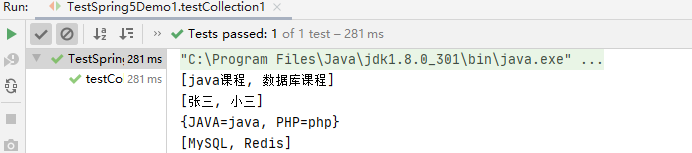
4.3.2.7.2 在集合中设置自定义对象类型值
在4.3.2.7.2的Stu类基础上加上courseList属性,并加上set方法
//学生所学多门课程 private List<Course> courseList; public void setCourseList(List<Course> courseList) { this.courseList = courseList; }- 1
- 2
- 3
- 4
- 5
Course
package com.atguigu.spring5.collectiontype; //课程类 public class Course { private String cname; //课程名称 public void setCname(String cname) { this.cname = cname; } @Override public String toString() { return "Course{" + "cname='" + cname + '\'' + '}'; } }- 1
- 2
- 3
- 4
- 5
- 6
- 7
- 8
- 9
- 10
- 11
- 12
- 13
- 14
- 15
- 16
配置文件
<beans xmlns="http://www.springframework.org/schema/beans" xmlns:xsi="http://www.w3.org/2001/XMLSchema-instance" xmlns:p="http://www.springframework.org/schema/p" xsi:schemaLocation="http://www.springframework.org/schema/beans http://www.springframework.org/schema/beans/spring-beans.xsd"> <bean id="stu" class="com.atguigu.spring5.collectiontype.Stu"> <property name="courses"> <array> <value>java课程value> <value>数据库课程value> array> property> <property name="list"> <list> <value>张三value> <value>小三value> list> property> <property name="maps"> <map> <entry key="JAVA" value="java">entry> <entry key="PHP" value="php">entry> map> property> <property name="sets"> <set> <value>MySQLvalue> <value>Redisvalue> set> property> <property name="courseList"> <list> <ref bean="course1">ref> <ref bean="course2">ref> list> property> bean> <bean id="course1" class="com.atguigu.spring5.collectiontype.Course"> <property name="cname" value="Spring5框架">property> bean> <bean id="course2" class="com.atguigu.spring5.collectiontype.Course"> <property name="cname" value="MyBatis框架">property> bean> beans>- 1
- 2
- 3
- 4
- 5
- 6
- 7
- 8
- 9
- 10
- 11
- 12
- 13
- 14
- 15
- 16
- 17
- 18
- 19
- 20
- 21
- 22
- 23
- 24
- 25
- 26
- 27
- 28
- 29
- 30
- 31
- 32
- 33
- 34
- 35
- 36
- 37
- 38
- 39
- 40
- 41
- 42
- 43
- 44
- 45
- 46
- 47
- 48
- 49
- 50
- 51
- 52
- 53
测试类与4.3.2.7.1中一致,结果

4.3.2.7.3 把集合注入部分抽取出来
提取集合的原因是,可能会有多个bean使用到相同的集合
-
在spring 配置文件中引入名称空间util

-
使用util标签完成list集合注入提取
<beans xmlns="http://www.springframework.org/schema/beans" xmlns:xsi="http://www.w3.org/2001/XMLSchema-instance" xmlns:p="http://www.springframework.org/schema/p" xmlns:util="http://www.springframework.org/schema/util" xsi:schemaLocation="http://www.springframework.org/schema/beans http://www.springframework.org/schema/beans/spring-beans.xsd http://www.springframework.org/schema/util http://www.springframework.org/schema/util/spring-util.xsd"> <util:list id="bookList"> <value>易筋经value> <value>九阴真经value> <value>九阳神功value> util:list> <bean id="book" class="com.atguigu.spring5.collectiontype.Book" scope="prototype"> <property name="list" ref="bookList">property> bean> beans>- 1
- 2
- 3
- 4
- 5
- 6
- 7
- 8
- 9
- 10
- 11
- 12
- 13
- 14
- 15
- 16
- 17
- 18
- 19
- 20
4.3.2.8 注入工厂bean(FactoryBean)
- Spring有两种类型 bean,一种普通bean,另外一种工厂bean (FactoryBean)
普通bean:在配置文件中定义bean类型就是返回类型工厂bean:在配置文件定义bean类型可以和返回类型不一样
4.3.2.8.1 创建类,让这个类作为工厂bean,实现接口FactoryBean,并实现接口里的方法,在实现的方法中定义返回的bean类型
package com.atguigu.spring5.factorybean; import com.atguigu.spring5.collectiontype.Course; import org.springframework.beans.factory.FactoryBean; public class MyBean implements FactoryBean<Course> { //定义返回bean @Override public Course getObject() throws Exception { Course course = new Course(); course.setCname("abc"); return course; } @Override public Class<?> getObjectType() { return null; } @Override public boolean isSingleton() { return false; } }- 1
- 2
- 3
- 4
- 5
- 6
- 7
- 8
- 9
- 10
- 11
- 12
- 13
- 14
- 15
- 16
- 17
- 18
- 19
- 20
- 21
- 22
- 23
- 24
- 25
4.3.2.8.2 xml方式创建工厂bean
<beans xmlns="http://www.springframework.org/schema/beans" xmlns:xsi="http://www.w3.org/2001/XMLSchema-instance" xmlns:p="http://www.springframework.org/schema/p" xmlns:util="http://www.springframework.org/schema/util" xsi:schemaLocation="http://www.springframework.org/schema/beans http://www.springframework.org/schema/beans/spring-beans.xsd http://www.springframework.org/schema/util http://www.springframework.org/schema/util/spring-util.xsd"> <bean id="myBean" class="com.atguigu.spring5.factorybean.MyBean"> bean> beans>- 1
- 2
- 3
- 4
- 5
- 6
- 7
- 8
- 9
- 10
- 11
4.3.2.8.3 测试类及结果
@Test public void test3() { ApplicationContext context = new ClassPathXmlApplicationContext("bean3.xml"); Course course = context.getBean("myBean", Course.class); System.out.println(course); }- 1
- 2
- 3
- 4
- 5
- 6
- 7

4.3.2.9 bean的作用域
4.3.2.9.1 在Spring中,默认情况下,bean是单例对象(验证)

@Test public void testCollection2() { ApplicationContext context = new ClassPathXmlApplicationContext("bean2.xml"); Book book1 = context.getBean("book", Book.class); Book book2 = context.getBean("book", Book.class); // book.test(); System.out.println(book1); System.out.println(book2); }- 1
- 2
- 3
- 4
- 5
- 6
- 7
- 8
- 9
- 10
4.3.2.9.2 Spring中如何设置对象单例还是多例
-
在spring配置文件 bean标签里面有属性(scope)用于设置单实例还是多实例
-
scope属性值
-
第一个值默认值,
singleton,表示是单实例对象 -
第二个值
prototype,表示是多实例对象
-
4.3.2.9.3 singleton和prototype的区别
- singleton单实例,prototype多实例
- 设置scope值是singleton时候,加载spring配置文件时候就会创建单实例对象
- 设置scope值是prototype时候,不是在加载spring 配置文件时候创建对象,在调用getBean方法时候创建多实例对象
4.3.2.10 bean的生命周期
生命周期:从对象创建到对象销毁的过程
- 通过构造器创建bean实例(无参数构造)
- 为bean的属性设置值和对其他bean引用(调用set方法)
- 调用bean的初始化的方法(需要进行配置初始化的方法)
- bean可以使用了(对象获取到了)
- 当容器关闭时候,调用bean的销毁的方法(需要进行配置销毁的方法)
4.3.2.10.1 演示bean生命周期
package com.atguigu.spring5.bean; public class Orders { //无参数构造 public Orders() { System.out.println("第一步 执行无参数构造创建bean实例"); } private String oname; public void setOname(String oname) { this.oname = oname; System.out.println("第二步 调用set方法设置属性值"); } //创建执行的初始化的方法 public void initMethod() { System.out.println("第三步 执行初始化的方法"); } //创建执行的销毁的方法 public void destroyMethod() { System.out.println("第五步 执行销毁的方法"); } }- 1
- 2
- 3
- 4
- 5
- 6
- 7
- 8
- 9
- 10
- 11
- 12
- 13
- 14
- 15
- 16
- 17
- 18
- 19
- 20
- 21
- 22
- 23
- 24
- 25
配置文件
init-method配置初始化方法destroy-method配置销毁方法<bean id="orders" class="com.atguigu.spring5.bean.Orders" init-method="initMethod" destroy-method="destroyMethod"> <property name="oname" value="手机">property> bean>- 1
- 2
- 3
测试类及结果
@Test public void testBean3() { // ApplicationContext context = // new ClassPathXmlApplicationContext("bean4.xml"); ClassPathXmlApplicationContext context = new ClassPathXmlApplicationContext("bean4.xml"); Orders orders = context.getBean("orders", Orders.class); System.out.println("第四步 获取创建bean实例对象"); System.out.println(orders); //手动让bean实例销毁 context.close(); }- 1
- 2
- 3
- 4
- 5
- 6
- 7
- 8
- 9
- 10
- 11
- 12
- 13

4.3.2.10.2 bean的后置处理器,bean的生命周期有七步
- 通过构造器创建bean实例(无参数构造)
- 为bean的属性设置值和对其他 bean引用(调用set方法)
- 把bean 实例传递bean后置处理器的方法postProcessBeforeInitialization
- 调用bean的初始化的方法(需要进行配置初始化的方法)
- 把bean 实例传递bean后置处理器的方法postProcessAfterInitialization
- bean可以使用了(对象获取到了)
- 当容器关闭时候,调用bean 的销毁的方法(需要进行配置销毁的方法)
bean的后置处理器:允许在调用初始化方法前后对 Bean 进行额外的处理。4.3.2.10.3 演示添加后置处理器效果
在4.3.2.10.1的基础上新增了bean的后置处理器
4.3.2.10.3.1 创建类,实现接口BeanPostProcessor,创建后置处理器
package com.atguigu.spring5.bean; import org.springframework.beans.BeansException; import org.springframework.beans.factory.config.BeanPostProcessor; import org.springframework.lang.Nullable; import org.springframework.util.SocketUtils; public class MyBeanPost implements BeanPostProcessor { @Override public Object postProcessBeforeInitialization(Object bean, String beanName) throws BeansException { System.out.println("在初始化之前执行的方法"); return bean; } @Override public Object postProcessAfterInitialization(Object bean, String beanName) throws BeansException { System.out.println("在初始化之后执行的方法"); return bean; } }- 1
- 2
- 3
- 4
- 5
- 6
- 7
- 8
- 9
- 10
- 11
- 12
- 13
- 14
- 15
- 16
- 17
- 18
- 19
4.3.2.10.3.2 配置后置处理器
<beans xmlns="http://www.springframework.org/schema/beans" xmlns:xsi="http://www.w3.org/2001/XMLSchema-instance" xmlns:p="http://www.springframework.org/schema/p" xmlns:util="http://www.springframework.org/schema/util" xsi:schemaLocation="http://www.springframework.org/schema/beans http://www.springframework.org/schema/beans/spring-beans.xsd http://www.springframework.org/schema/util http://www.springframework.org/schema/util/spring-util.xsd"> <bean id="orders" class="com.atguigu.spring5.bean.Orders" init-method="initMethod" destroy-method="destroyMethod"> <property name="oname" value="手机">property> bean> <bean id="myBeanPost" class="com.atguigu.spring5.bean.MyBeanPost">bean> beans>- 1
- 2
- 3
- 4
- 5
- 6
- 7
- 8
- 9
- 10
- 11
- 12
- 13
- 14
- 15
- 16
4.3.2.10.3.3 测试类及结果
测试类与4.3.2.10.1中的一致

4.3.2.11 xml自动装配
4.3.2.11.1 什么是自动装配?
根据指定装配规则(属性名称或者属性类型),Spring自动将匹配的属性值进行注入
个人理解自动装配:在属性中依赖于其他bean时,就会自动根据类中定义的属性类型或者属性名称来寻找容器中的bean从而将其注入

4.3.2.11.2 演示自动装配过程
实现自动装配:
- bean标签属性autowire,配置自动装配
- autowire属性常用两个值:
- byName根据属性名称注入 ,注入值bean的id值和类属性名称一样
- byType根据属性类型注入
- autowire属性常用两个值:
Dept
package com.atguigu.spring5.autowire; public class Dept { @Override public String toString() { return "Dept{}"; } }- 1
- 2
- 3
- 4
- 5
- 6
- 7
- 8
Emp
package com.atguigu.spring5.autowire; public class Emp { private Dept dept; public void setDept(Dept dept) { this.dept = dept; } @Override public String toString() { return "Emp{" + "dept=" + dept + '}'; } public void test() { System.out.println(dept); } }- 1
- 2
- 3
- 4
- 5
- 6
- 7
- 8
- 9
- 10
- 11
- 12
- 13
- 14
- 15
- 16
- 17
- 18
- 19
4.3.2.11.3.1 根据属性类型自动注入
xml配置
<beans xmlns="http://www.springframework.org/schema/beans" xmlns:xsi="http://www.w3.org/2001/XMLSchema-instance" xmlns:p="http://www.springframework.org/schema/p" xmlns:util="http://www.springframework.org/schema/util" xsi:schemaLocation="http://www.springframework.org/schema/beans http://www.springframework.org/schema/beans/spring-beans.xsd http://www.springframework.org/schema/util http://www.springframework.org/schema/util/spring-util.xsd"> <bean id="emp" class="com.atguigu.spring5.autowire.Emp" autowire="byType"> bean> <bean id="dept" class="com.atguigu.spring5.autowire.Dept">bean> beans>- 1
- 2
- 3
- 4
- 5
- 6
- 7
- 8
- 9
- 10
- 11
- 12
- 13
- 14
- 15
- 16
- 17
- 18
- 19
- 20
测试类及结果
@Test public void test4() { ApplicationContext context = new ClassPathXmlApplicationContext("bean5.xml"); Emp emp = context.getBean("emp", Emp.class); System.out.println(emp); }- 1
- 2
- 3
- 4
- 5
- 6
- 7

4.3.2.11.3.2 根据属性名称自动注入
xml配置
<beans xmlns="http://www.springframework.org/schema/beans" xmlns:xsi="http://www.w3.org/2001/XMLSchema-instance" xmlns:p="http://www.springframework.org/schema/p" xmlns:util="http://www.springframework.org/schema/util" xsi:schemaLocation="http://www.springframework.org/schema/beans http://www.springframework.org/schema/beans/spring-beans.xsd http://www.springframework.org/schema/util http://www.springframework.org/schema/util/spring-util.xsd"> <bean id="emp" class="com.atguigu.spring5.autowire.Emp" autowire="byName"> bean> <bean id="dept" class="com.atguigu.spring5.autowire.Dept">bean> beans>- 1
- 2
- 3
- 4
- 5
- 6
- 7
- 8
- 9
- 10
- 11
- 12
- 13
- 14
- 15
- 16
- 17
- 18
- 19
- 20
测试类与4.3.2.11.3.1中一致及结果

使用名称注入注意事项,注入的属性中的名称必须与bean的id一致不然会注入null
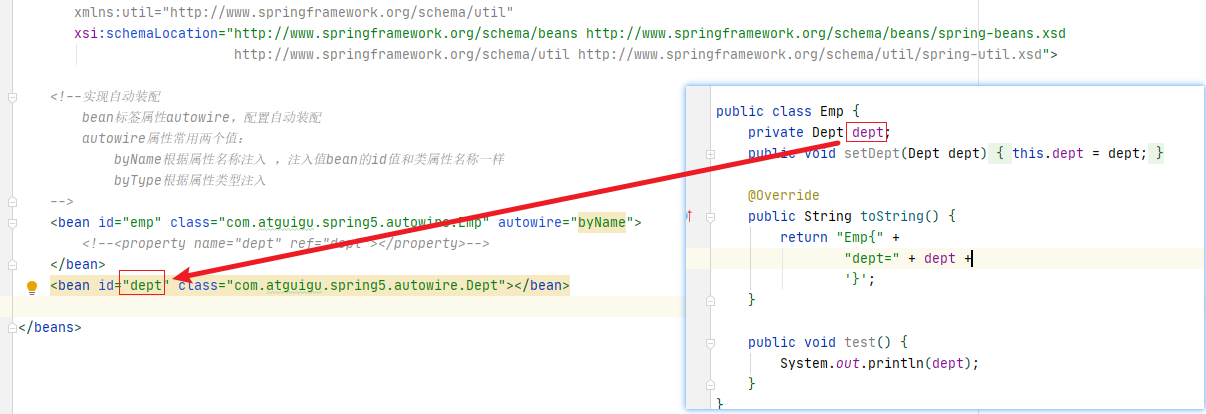
错误示例:


4.3.2.12 外部属性文件(以将数据库相关配置抽取至外部文件为例)
4.3.2.12.1 直接配置数据库信息
引入德鲁伊连接池依赖jar包

直接配置连接池
<beans xmlns="http://www.springframework.org/schema/beans" xmlns:xsi="http://www.w3.org/2001/XMLSchema-instance" xmlns:p="http://www.springframework.org/schema/p" xmlns:util="http://www.springframework.org/schema/util" xmlns:context="http://www.springframework.org/schema/context" xsi:schemaLocation="http://www.springframework.org/schema/beans http://www.springframework.org/schema/beans/spring-beans.xsd http://www.springframework.org/schema/util http://www.springframework.org/schema/util/spring-util.xsd http://www.springframework.org/schema/context http://www.springframework.org/schema/context/spring-context.xsd"> <bean id="dataSource" class="com.alibaba.druid.pool.DruidDataSource"> <property name="driverClassName" value="com.mysql.jdbc.Driver">property> <property name="url" value="jdbc:mysql://localhost:3306/mysql">property> <property name="username" value="root">property> <property name="password" value="root">property> bean> beans>- 1
- 2
- 3
- 4
- 5
- 6
- 7
- 8
- 9
- 10
- 11
- 12
- 13
- 14
- 15
- 16
- 17
- 18
4.3.2.12.2 引入外部属性文件配置数据库连接池
- 第一步同样需要引入依赖
- 创建外部属性文件,properties格式文件,写数据库信息
prop.driverClass=com.mysql.jdbc.Driver prop.url=jdbc:mysql://localhost:3306/mysql prop.userName=root prop.password=root- 1
- 2
- 3
- 4
把外部properties属性文件引入到spring配置文件中
在这之前需要引入context名称空间
<beans xmlns="http://www.springframework.org/schema/beans" xmlns:xsi="http://www.w3.org/2001/XMLSchema-instance" xmlns:p="http://www.springframework.org/schema/p" xmlns:util="http://www.springframework.org/schema/util" xmlns:context="http://www.springframework.org/schema/context" xsi:schemaLocation="http://www.springframework.org/schema/beans http://www.springframework.org/schema/beans/spring-beans.xsd http://www.springframework.org/schema/util http://www.springframework.org/schema/util/spring-util.xsd http://www.springframework.org/schema/context http://www.springframework.org/schema/context/spring-context.xsd"> <context:property-placeholder location="classpath:jdbc.properties"/> <bean id="dataSource" class="com.alibaba.druid.pool.DruidDataSource"> <property name="driverClassName" value="${prop.driverClass}">property> <property name="url" value="${prop.url}">property> <property name="username" value="${prop.userName}">property> <property name="password" value="${prop.password}">property> bean> beans>- 1
- 2
- 3
- 4
- 5
- 6
- 7
- 8
- 9
- 10
- 11
- 12
- 13
- 14
- 15
- 16
- 17
- 18
- 19
- 20
- 21
- 22
- 23
- 24
- 25
- 26
- 27
- 28
- 29
4.3.3 IOC操作Bean管理(基于注解方式)
4.3.3.1 什么是注解?注解如何使用?为什么使用注解?
- 注解是代码特殊标记,格式:@注解名称(属性名称=属性值,属性名称=属性值…)
- 使用注解,注解作用在
类上面,方法上面,属性上面 - 使用注解目的:简化 xml 配置
4.3.3.2 Spring针对Bean管理中创建对象提供的注解
- @Component
- @Service
- @Controller
- @Repository
以上四个注解的功能是一样的,都可以用来创建bean实例
@Component,@Service,@Controller,@Repository这几个注解如果Value不填Value的默认值就是类名的首字母小写,如果填了就以填写的值为准
下面的三个主要用于区分不同层次的代码
4.3.3.3 基于注解方式实现对象创建
4.3.3.3.1 引入依赖
需要先引入AOP依赖

4.3.3.3.2 开启组件扫描
<beans xmlns="http://www.springframework.org/schema/beans" xmlns:xsi="http://www.w3.org/2001/XMLSchema-instance" xmlns:p="http://www.springframework.org/schema/p" xmlns:util="http://www.springframework.org/schema/util" xmlns:context="http://www.springframework.org/schema/context" xsi:schemaLocation="http://www.springframework.org/schema/beans http://www.springframework.org/schema/beans/spring-beans.xsd http://www.springframework.org/schema/util http://www.springframework.org/schema/util/spring-util.xsd http://www.springframework.org/schema/context http://www.springframework.org/schema/context/spring-context.xsd"> <context:component-scan base-package="com.atguigu">context:component-scan> beans>- 1
- 2
- 3
- 4
- 5
- 6
- 7
- 8
- 9
- 10
- 11
- 12
- 13
- 14
- 15
- 16
4.3.3.3.3 创建类,在类上面创建对象注解
UserService
package com.atguigu.spring5.service; import com.atguigu.spring5.dao.UserDao; import org.springframework.beans.factory.annotation.Autowired; import org.springframework.beans.factory.annotation.Qualifier; import org.springframework.beans.factory.annotation.Value; import org.springframework.stereotype.Component; import org.springframework.stereotype.Controller; import org.springframework.stereotype.Repository; import org.springframework.stereotype.Service; import javax.annotation.Resource; //在注解里面value属性值可以省略不写, //默认值是类名称,首字母小写 //UserService -- userService @Component(value = "userService") //public class UserService { public void add() { System.out.println("service add......."); userDao.add(); } } - 1
- 2
- 3
- 4
- 5
- 6
- 7
- 8
- 9
- 10
- 11
- 12
- 13
- 14
- 15
- 16
- 17
- 18
- 19
- 20
- 21
- 22
- 23
UserDao及UserDaoImpl

4.3.3.3.4 开启组件扫描细节配置
<beans xmlns="http://www.springframework.org/schema/beans" xmlns:xsi="http://www.w3.org/2001/XMLSchema-instance" xmlns:p="http://www.springframework.org/schema/p" xmlns:util="http://www.springframework.org/schema/util" xmlns:context="http://www.springframework.org/schema/context" xsi:schemaLocation="http://www.springframework.org/schema/beans http://www.springframework.org/schema/beans/spring-beans.xsd http://www.springframework.org/schema/util http://www.springframework.org/schema/util/spring-util.xsd http://www.springframework.org/schema/context http://www.springframework.org/schema/context/spring-context.xsd"> <context:component-scan base-package="com.atguigu" use-default-filters="false"> <context:include-filter type="annotation" expression="org.springframework.stereotype.Controller"/> <context:exclude-filter type="annotation" expression="org.springframework.stereotype.Controller"/> context:component-scan> beans>- 1
- 2
- 3
- 4
- 5
- 6
- 7
- 8
- 9
- 10
- 11
- 12
- 13
- 14
- 15
- 16
- 17
- 18
- 19
- 20
- 21
- 22
- 23
4.3.3.4 基于注解方式实现属性注入
4.3.3.4.1 @Autowired:根据属性类型自动进行装配
第一步把service和dao对象创建,在service和 dao类添加创建对象注解
第二步在service注入dao对象,在service类添加dao类型属性,在属性上面使用注解package com.atguigu.spring5.service; import com.atguigu.spring5.dao.UserDao; import org.springframework.beans.factory.annotation.Autowired; import org.springframework.beans.factory.annotation.Qualifier; import org.springframework.beans.factory.annotation.Value; import org.springframework.stereotype.Component; import org.springframework.stereotype.Controller; import org.springframework.stereotype.Repository; import org.springframework.stereotype.Service; import javax.annotation.Resource; //在注解里面value属性值可以省略不写, //默认值是类名称,首字母小写 //UserService -- userService @Component(value = "userService") //public class UserService { //定义dao类型属性 //不需要添加set方法 //添加注入属性注解 @Autowired //根据类型进行注入 private UserDao userDao; public void add() { System.out.println("service add......."); userDao.add(); } } - 1
- 2
- 3
- 4
- 5
- 6
- 7
- 8
- 9
- 10
- 11
- 12
- 13
- 14
- 15
- 16
- 17
- 18
- 19
- 20
- 21
- 22
- 23
- 24
- 25
- 26
- 27
- 28
- 29
- 30
- 31
测试类及结果
@Test public void testService1() { ApplicationContext context = new ClassPathXmlApplicationContext("bean1.xml"); UserService userService = context.getBean("userService", UserService.class); System.out.println(userService); userService.add(); }- 1
- 2
- 3
- 4
- 5
- 6
- 7
- 8

4.3.3.4.2 @Qualifier:根据名称进行注入
这个@Qualifier注解需要与@Autowired一起使用
package com.atguigu.spring5.service; import com.atguigu.spring5.dao.UserDao; import org.springframework.beans.factory.annotation.Autowired; import org.springframework.beans.factory.annotation.Qualifier; import org.springframework.beans.factory.annotation.Value; import org.springframework.stereotype.Component; import org.springframework.stereotype.Controller; import org.springframework.stereotype.Repository; import org.springframework.stereotype.Service; import javax.annotation.Resource; //在注解里面value属性值可以省略不写, //默认值是类名称,首字母小写 //UserService -- userService @Component(value = "userService") //public class UserService { //定义dao类型属性 //不需要添加set方法 //添加注入属性注解 @Autowired //根据类型进行注入 @Qualifier(value = "userDaoImpl") //根据名称进行注入 private UserDao userDao; public void add() { System.out.println("service add......."); userDao.add(); } } - 1
- 2
- 3
- 4
- 5
- 6
- 7
- 8
- 9
- 10
- 11
- 12
- 13
- 14
- 15
- 16
- 17
- 18
- 19
- 20
- 21
- 22
- 23
- 24
- 25
- 26
- 27
- 28
- 29
- 30
- 31
4.3.3.4.3 @Resource:可以根据类型注入,也可以根据名称注入
// @Resource //根据类型进行注入 @Resource(name = "userDaoImpl") //根据名称进行注入 private UserDao userDao;- 1
- 2
- 3
4.3.3.4.4 @Value注入普通类型属性
@Value(value = "abc") private String name;- 1
- 2
4.3.3.5 完全注解开发
4.3.3.5.1 创建配置类,替代xml配置文件
package com.atguigu.spring5.config; import org.springframework.context.annotation.ComponentScan; import org.springframework.context.annotation.Configuration; @Configuration //作为配置类,替代xml配置文件 @ComponentScan(basePackages = {"com.atguigu"})//替代配置文件中的组件扫描 public class SpringConfig { }- 1
- 2
- 3
- 4
- 5
- 6
- 7
- 8
- 9
- 10
测试类及结果
使用AnnotationConfigApplicationContext获取上下文
@Test public void testService2() { //加载配置类 ApplicationContext context = new AnnotationConfigApplicationContext(SpringConfig.class); UserService userService = context.getBean("userService", UserService.class); System.out.println(userService); userService.add(); }- 1
- 2
- 3
- 4
- 5
- 6
- 7
- 8
- 9

5. AOP
5.1 什么是AOP?
-
面向切面编程(方面),利用AOP可以对业务逻辑的各个部分进行隔离,从而使得业务逻辑各部分之间的耦合度降低,提高程序的可重用性,同时提高了开发的效率。 -
通俗描述:不通过修改源代码方式,在主干功能里面添加新功能
-
使用登录例子说明AOP

5.2 AOP底层原理(动态代理)
AOP地城使用动态代理,有两种动态代理
-
JDK动态代理:被代理的类有接口的情况,使用JDK动态代理
-
创建接口实现类代理对象,增强类的方法

-
-
CGLIB动态代理:被代理的类没有接口的情况,使用CGLIB动态代理
-
创建子类的代理对象,增强类的方法
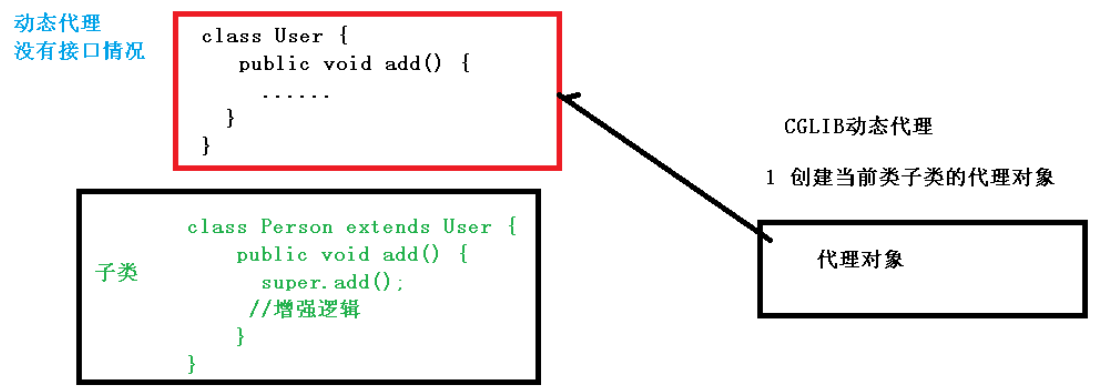
-
5.2.1 JDK动态代理
使用JDK动态代理,使用Proxy类里面的newProxyInstance方法创建代理对象


该方法有三个参数:
- 第一个参数:类加载器
- 第二个参数:增强方法所在的类,这个类实现的接口,支持多个接口
- 第三个参数:实现这个接口
InvocationHandler,创建代理对象,写增强的部分
5.2.2 编写JDK动态代理
5.2.2.1 创建接口&实现类,定义方法,
UserDao
package com.atguigu.spring5; public interface UserDao { public int add(int a,int b); public String update(String id); }- 1
- 2
- 3
- 4
- 5
- 6
UserDaoImpl
package com.atguigu.spring5; public class UserDaoImpl implements UserDao { @Override public int add(int a, int b) { System.out.println("add方法执行了....."); return a+b; } @Override public String update(String id) { System.out.println("update方法执行了....."); return id; } }- 1
- 2
- 3
- 4
- 5
- 6
- 7
- 8
- 9
- 10
- 11
- 12
- 13
- 14
- 15
5.2.2.2 使用Proxy类创建代理对象
package com.atguigu.spring5; import org.springframework.context.annotation.Configuration; import org.springframework.context.annotation.EnableAspectJAutoProxy; import java.lang.reflect.InvocationHandler; import java.lang.reflect.Method; import java.lang.reflect.Proxy; import java.util.Arrays; public class JDKProxy { public static void main(String[] args) { //创建接口实现类代理对象 Class[] interfaces = {UserDao.class}; // Proxy.newProxyInstance(JDKProxy.class.getClassLoader(), interfaces, new InvocationHandler() { // @Override // public Object invoke(Object proxy, Method method, Object[] args) throws Throwable { // return null; // } // }); UserDaoImpl userDao = new UserDaoImpl(); UserDao dao = (UserDao)Proxy.newProxyInstance(JDKProxy.class.getClassLoader(), interfaces, new UserDaoProxy(userDao)); int result = dao.add(1, 2); System.out.println("result:"+result); } } //创建代理对象代码 class UserDaoProxy implements InvocationHandler { //1 把创建的是谁的代理对象,把谁传递过来 //有参数构造传递 private Object obj; public UserDaoProxy(Object obj) { this.obj = obj; } //增强的逻辑 @Override public Object invoke(Object proxy, Method method, Object[] args) throws Throwable { //方法之前 System.out.println("方法之前执行...."+method.getName()+" :传递的参数..."+ Arrays.toString(args)); //被增强的方法执行 Object res = method.invoke(obj, args); //方法之后 System.out.println("方法之后执行...."+obj); return res; } }- 1
- 2
- 3
- 4
- 5
- 6
- 7
- 8
- 9
- 10
- 11
- 12
- 13
- 14
- 15
- 16
- 17
- 18
- 19
- 20
- 21
- 22
- 23
- 24
- 25
- 26
- 27
- 28
- 29
- 30
- 31
- 32
- 33
- 34
- 35
- 36
- 37
- 38
- 39
- 40
- 41
- 42
- 43
- 44
- 45
- 46
- 47
- 48
- 49
- 50
- 51
- 52
5.3 术语
5.3.1 连接点
类里面哪些方法可以被增强,这些方法称为连接点
5.3.2 切入点
实际被真正增强的方法,称为切入点
5.3.3 通知(增强)
实际增强的逻辑部分称为通知(增强)
5.3.3.1 通知的多种类型
- 前置通知
- 后置通知
- 环绕通知
- 异常通知
- 最终通知
5.3.4 切面
是动作,是将通知应用到切入点的过程
5.4 准备工作
Spring框架一般都是基于AspectJ实现AOP操作
AspectJ不是Spring 组成部分,独立AOP框架,一般把AspectJ和Spring框架一起使用,进行AOP操作
5.4.1 在项目中引入AOP相关依赖
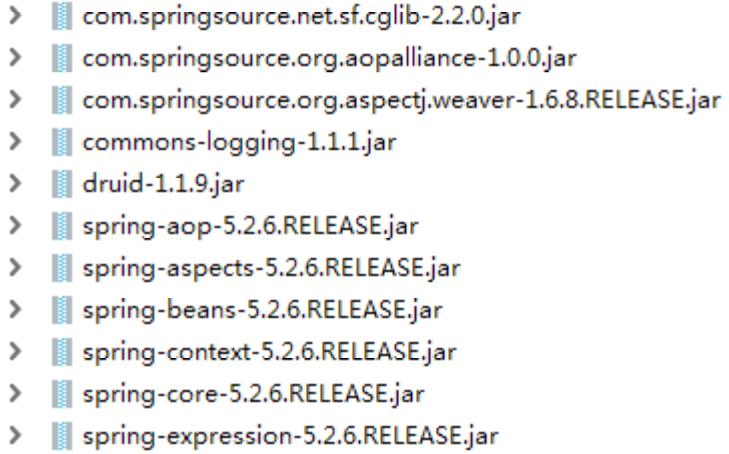
5.4.2 切入点表达式
5.4.2.1 切入点表达式作用
字段对哪个类里面的哪个方法进行增强
5.4.2.2 语法结构
execution([权限修饰符][返回类型][类全路径][方法名称]([参数列表]))
- 权限修饰符可以省略不写
- *号作为通配符
- 参数列表可以使用(…)通配
5.4.2.2.1 举例一:对com.atguigu.dao.BookDao类里面的add方法进行增强
execution(* com.atguigu.dao.BookDao.add(..))- 1
5.4.2.2.2 举例二:对com.atguigu.dao.BookDao类里面的所有方法进行增强
execution(* com.atguigu.dao.BookDao.*(..))- 1
5.4.2.2.3 举例三:对com.atguigu.dao包里面的所有类进行增强
execution(* com.atguigu.dao.*.*(..))- 1
5.4.3 基于AspectJ实现AOP操作
5.4.3.1 注解方式(推荐&重点)
5.4.3.1.1 创建类,在类中定义方法
package com.atguigu.spring5.aopanno; import org.springframework.stereotype.Component; //被增强的类 public class User { public void add() { System.out.println("add......."); } }- 1
- 2
- 3
- 4
- 5
- 6
- 7
- 8
- 9
- 10
5.4.3.1.2 创建增强类(编写增强逻辑)
在增强类里面,创建方法,让不同方法代表不同通知类型
package com.atguigu.spring5.aopanno; import org.aspectj.lang.ProceedingJoinPoint; import org.aspectj.lang.annotation.*; import org.springframework.core.annotation.Order; import org.springframework.stereotype.Component; //增强的类 public class UserProxy { //前置通知 //@Before注解表示作为前置通知 @Before(value = "execution(* com.atguigu.spring5.aopanno.User.add(..))") public void before() {//前置通知 System.out.println("before........."); } }- 1
- 2
- 3
- 4
- 5
- 6
- 7
- 8
- 9
- 10
- 11
- 12
- 13
- 14
- 15
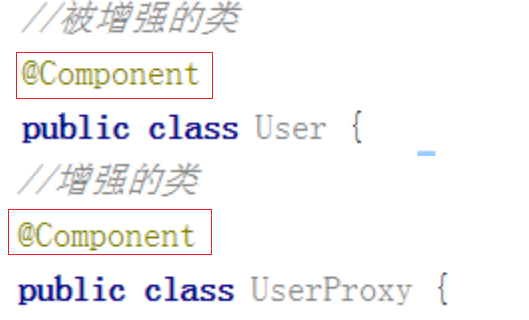
5.4.3.1.3 使用注解创建User和UserProxy对象
5.4.3.1.4 进行通知的配置
5.4.3.1.4.1 在spring配置文件中开启
注解扫描与自动代理<beans xmlns="http://www.springframework.org/schema/beans" xmlns:xsi="http://www.w3.org/2001/XMLSchema-instance" xmlns:context="http://www.springframework.org/schema/context" xmlns:aop="http://www.springframework.org/schema/aop" xsi:schemaLocation="http://www.springframework.org/schema/beans http://www.springframework.org/schema/beans/spring-beans.xsd http://www.springframework.org/schema/context http://www.springframework.org/schema/context/spring-context.xsd http://www.springframework.org/schema/aop http://www.springframework.org/schema/aop/spring-aop.xsd"> <context:component-scan base-package="com.atguigu.spring5.aopanno">context:component-scan> <aop:aspectj-autoproxy>aop:aspectj-autoproxy> beans>- 1
- 2
- 3
- 4
- 5
- 6
- 7
- 8
- 9
- 10
- 11
- 12
- 13
- 14
5.4.3.1.5 在增强类上添加注解
@Aspect
5.4.3.1.6 测试类及结果
@Test public void testAopAnno() { ApplicationContext context = new ClassPathXmlApplicationContext("bean1.xml"); User user = context.getBean("user", User.class); user.add(); }- 1
- 2
- 3
- 4
- 5
- 6
- 7

5.4.3.1.7 配置不同类型的通知
在增强类的里面,在作为通知方法上面添加通知类型注解,使用切入点表达式配置
package com.atguigu.spring5.aopanno; import org.aspectj.lang.ProceedingJoinPoint; import org.aspectj.lang.annotation.*; import org.springframework.core.annotation.Order; import org.springframework.stereotype.Component; //增强的类 @Component @Aspect //生成代理对象 public class UserProxy { //前置通知 //@Before注解表示作为前置通知 @Before(value = "execution(* com.atguigu.spring5.aopanno.User.add(..))") public void before() { System.out.println("before........."); } //后置通知(返回通知) @AfterReturning(value = "execution(* com.atguigu.spring5.aopanno.User.add(..))") public void afterReturning() { System.out.println("afterReturning........."); } //最终通知 @After(value = "execution(* com.atguigu.spring5.aopanno.User.add(..))") public void after() { System.out.println("after........."); } //异常通知 @AfterThrowing(value = "execution(* com.atguigu.spring5.aopanno.User.add(..))") public void afterThrowing() { System.out.println("afterThrowing........."); } //环绕通知 @Around(value = "execution(* com.atguigu.spring5.aopanno.User.add(..))") public void around(ProceedingJoinPoint proceedingJoinPoint) throws Throwable { System.out.println("环绕之前........."); //被增强的方法执行 proceedingJoinPoint.proceed(); System.out.println("环绕之后........."); } }- 1
- 2
- 3
- 4
- 5
- 6
- 7
- 8
- 9
- 10
- 11
- 12
- 13
- 14
- 15
- 16
- 17
- 18
- 19
- 20
- 21
- 22
- 23
- 24
- 25
- 26
- 27
- 28
- 29
- 30
- 31
- 32
- 33
- 34
- 35
- 36
- 37
- 38
- 39
- 40
- 41
- 42
- 43
- 44
- 45
- 46
- 47
- 48
- 49
测试及结果
@Test public void testAopAnno() { ApplicationContext context = new ClassPathXmlApplicationContext("bean1.xml"); User user = context.getBean("user", User.class); user.add(); }- 1
- 2
- 3
- 4
- 5
- 6
- 7
被增强类无异常结果

被增强类有异常结果


5.4.3.1.8 相同的切入点抽取
以前置通知为例
//相同切入点抽取 @Pointcut(value = "execution(* com.atguigu.spring5.aopanno.User.add(..))") public void pointdemo() { } //前置通知 //@Before注解表示作为前置通知 @Before(value = "pointdemo()") public void before() { System.out.println("before........."); }- 1
- 2
- 3
- 4
- 5
- 6
- 7
- 8
- 9
- 10
- 11
- 12
5.4.3.1.9 多个增强类对同一方法进行增强,设置增强类优先级
在增强类上面添加注解@Order(数字类型值),数字类型值越小优先级越高

5.4.3.1.10 完全使用注解开发
创建配置类,不需要xml配置文件
package com.atguigu.spring5.config; import org.springframework.context.annotation.ComponentScan; import org.springframework.context.annotation.Configuration; import org.springframework.context.annotation.EnableAspectJAutoProxy; @Configuration @ComponentScan(basePackages = {"com.atguigu"}) @EnableAspectJAutoProxy(proxyTargetClass = true) public class ConfigAop { }- 1
- 2
- 3
- 4
- 5
- 6
- 7
- 8
- 9
- 10
- 11
修改测试类,使用AnnotationConfigApplicationContext(配置类.class)获取上下文对象
@Test public void testAopAnno() { ApplicationContext context = new AnnotationConfigApplicationContext(ConfigAop.class); User user = context.getBean("user", User.class); user.add(); }- 1
- 2
- 3
- 4
- 5
- 6
- 7
- 8
5.4.3.2 xml配置文件方式
5.4.3.2.1 创建两个类,增强类与被增强类,创建方法
5.4.3.2.2 在spring配置文件中创建两个对象
<beans xmlns="http://www.springframework.org/schema/beans" xmlns:xsi="http://www.w3.org/2001/XMLSchema-instance" xmlns:context="http://www.springframework.org/schema/context" xmlns:aop="http://www.springframework.org/schema/aop" xsi:schemaLocation="http://www.springframework.org/schema/beans http://www.springframework.org/schema/beans/spring-beans.xsd http://www.springframework.org/schema/context http://www.springframework.org/schema/context/spring-context.xsd http://www.springframework.org/schema/aop http://www.springframework.org/schema/aop/spring-aop.xsd"> <bean id="book" class="com.atguigu.spring5.aopxml.Book">bean> <bean id="bookProxy" class="com.atguigu.spring5.aopxml.BookProxy">bean> <aop:config> <aop:pointcut id="p" expression="execution(* com.atguigu.spring5.aopxml.Book.buy(..))"/> <aop:aspect ref="bookProxy"> <aop:before method="before" pointcut-ref="p"/> aop:aspect> aop:config> beans>- 1
- 2
- 3
- 4
- 5
- 6
- 7
- 8
- 9
- 10
- 11
- 12
- 13
- 14
- 15
- 16
- 17
- 18
- 19
- 20
- 21
- 22
- 23
5.4.3.2.3 在spring配置文件中配置切入点
<beans xmlns="http://www.springframework.org/schema/beans" xmlns:xsi="http://www.w3.org/2001/XMLSchema-instance" xmlns:context="http://www.springframework.org/schema/context" xmlns:aop="http://www.springframework.org/schema/aop" xsi:schemaLocation="http://www.springframework.org/schema/beans http://www.springframework.org/schema/beans/spring-beans.xsd http://www.springframework.org/schema/context http://www.springframework.org/schema/context/spring-context.xsd http://www.springframework.org/schema/aop http://www.springframework.org/schema/aop/spring-aop.xsd"> <bean id="book" class="com.atguigu.spring5.aopxml.Book">bean> <bean id="bookProxy" class="com.atguigu.spring5.aopxml.BookProxy">bean> <aop:config> <aop:pointcut id="p" expression="execution(* com.atguigu.spring5.aopxml.Book.buy(..))"/> <aop:aspect ref="bookProxy"> <aop:before method="before" pointcut-ref="p"/> aop:aspect> aop:config> beans>- 1
- 2
- 3
- 4
- 5
- 6
- 7
- 8
- 9
- 10
- 11
- 12
- 13
- 14
- 15
- 16
- 17
- 18
- 19
- 20
- 21
- 22
- 23
6. JdbcTemplate(了解,后面我们都用mybatis)
6.1 什么是JdbcTemplate?
Spring框架对JDBC进行封装,使用JdbcTemplate方便实现对数据库操作
6.2 准备工作
6.2.1 引入相关jar包

6.2.2 在spring配置文件配置数据连接池
<beans xmlns="http://www.springframework.org/schema/beans" xmlns:xsi="http://www.w3.org/2001/XMLSchema-instance" xmlns:context="http://www.springframework.org/schema/context" xmlns:aop="http://www.springframework.org/schema/aop" xmlns:tx="http://www.springframework.org/schema/tx" xsi:schemaLocation="http://www.springframework.org/schema/beans http://www.springframework.org/schema/beans/spring-beans.xsd http://www.springframework.org/schema/context http://www.springframework.org/schema/context/spring-context.xsd http://www.springframework.org/schema/aop http://www.springframework.org/schema/aop/spring-aop.xsd http://www.springframework.org/schema/tx http://www.springframework.org/schema/tx/spring-tx.xsd"> <bean id="dataSource" class="com.alibaba.druid.pool.DruidDataSource" destroy-method="close"> <property name="url" value="jdbc:mysql:///user_db" /> <property name="username" value="root" /> <property name="password" value="root" /> <property name="driverClassName" value="com.mysql.jdbc.Driver" /> bean> beans>- 1
- 2
- 3
- 4
- 5
- 6
- 7
- 8
- 9
- 10
- 11
- 12
- 13
- 14
- 15
- 16
- 17
- 18
- 19
- 20
6.2.3 配置JdbcTemplate对象,注入DataSource
<bean id="jdbcTemplate" class="org.springframework.jdbc.core.JdbcTemplate"> <property name="dataSource" ref="dataSource">property> bean>- 1
- 2
- 3
- 4
- 5
6.2.4 创建Service类,创建dao类,在dao注入JdbcTemplate
<context:component-scan base-package="com.atguigu">context:component-scan>- 1
- 2
service
package com.atguigu.spring5.service; import com.atguigu.spring5.dao.UserDao; import org.springframework.beans.factory.annotation.Autowired; import org.springframework.stereotype.Service; import org.springframework.transaction.annotation.Isolation; import org.springframework.transaction.annotation.Propagation; import org.springframework.transaction.annotation.Transactional; import javax.annotation.Resource; @Service public class UserService { //注入dao @Autowired private UserDao userDao; }- 1
- 2
- 3
- 4
- 5
- 6
- 7
- 8
- 9
- 10
- 11
- 12
- 13
- 14
- 15
- 16
- 17
- 18
dao
package com.atguigu.spring5.dao; import org.springframework.beans.factory.annotation.Autowired; import org.springframework.jdbc.core.JdbcTemplate; import org.springframework.stereotype.Repository; @Repository public class UserDaoImpl implements UserDao { @Autowired private JdbcTemplate jdbcTemplate; }- 1
- 2
- 3
- 4
- 5
- 6
- 7
- 8
- 9
- 10
- 11
- 12
6.3 JdbcTemplate操作数据库
6.3.1 添加
6.3.1.1 对应数据库创建实体类

6.3.1.2 编写service和dao的新增方法

service
package com.atguigu.spring5.service; import com.atguigu.spring5.dao.UserDao; import org.springframework.beans.factory.annotation.Autowired; import org.springframework.stereotype.Service; import org.springframework.transaction.annotation.Isolation; import org.springframework.transaction.annotation.Propagation; import org.springframework.transaction.annotation.Transactional; import javax.annotation.Resource; @Service public class UserService { //注入dao @Autowired private UserDao userDao; public void add(User user){ userDao.add(user); } }- 1
- 2
- 3
- 4
- 5
- 6
- 7
- 8
- 9
- 10
- 11
- 12
- 13
- 14
- 15
- 16
- 17
- 18
- 19
- 20
- 21
dao
package com.atguigu.spring5.dao; import com.atguigu.spring5.test.User; import org.springframework.beans.factory.annotation.Autowired; import org.springframework.jdbc.core.JdbcTemplate; import org.springframework.stereotype.Repository; @Repository public class UserDaoImpl implements UserDao { @Autowired private JdbcTemplate jdbcTemplate; @Override public void add(User user) { //1 创建sql语句 String sql="insert into t_user values(?,?,?)"; //2 构造sql所需参数 Object[] args={user.getUserId(),user.getUsername(),user.getUstatus()}; //3 调用方法实现 update方法针对的是增,删,改这三种sql都可以使用 int update = jdbcTemplate.update(sql, args); System.out.println(update); } }- 1
- 2
- 3
- 4
- 5
- 6
- 7
- 8
- 9
- 10
- 11
- 12
- 13
- 14
- 15
- 16
- 17
- 18
- 19
- 20
- 21
- 22
- 23
- 24
6.3.1.3 测试类及结果
@Test public void testJdbcTemplate() { ApplicationContext context = new ClassPathXmlApplicationContext("bean1.xml"); UserService userService = context.getBean("userService",UserService.class); User user = new User("1","java","a"); userService.add(user); }- 1
- 2
- 3
- 4
- 5
- 6
- 7

6.3.2 修改与删除
修改与删除的方式与新增一致,只不过sql语句构建有些许差异

6.3.3 查询返回某个值

@Override public void selectCount() { //1 创建sql语句 String sql="select count(*) from t_user"; //3 调用方法实现 Integer count = jdbcTemplate.queryForObject(sql, Integer.class); System.out.println(count); }- 1
- 2
- 3
- 4
- 5
- 6
- 7
- 8
6.3.4 查询返回对象

@Override public User findUserInfo(String id) { //1 创建sql语句 String sql="select * from t_user where user_id=?"; //3 调用方法实现 User user = jdbcTemplate.queryForObject(sql, new BeanPropertyRowMapper<User>(User.class), id); return user; }- 1
- 2
- 3
- 4
- 5
- 6
- 7
- 8
6.3.5 查询返回集合

@Override public User findAllUser() { //1 创建sql语句 String sql="select * from t_user"; //3 调用方法实现 User user = jdbcTemplate.queryForObject(sql, new BeanPropertyRowMapper<User>(User.class)); return user; }- 1
- 2
- 3
- 4
- 5
- 6
- 7
- 8
6.3.6 批量操作(CRUD)

@Override public void batchAddUser(List<Object[]> batchArgs) { //1 创建sql语句 String sql="insert into t_user values(?,?,?)"; int[] ints = jdbcTemplate.batchUpdate(sql, batchArgs); System.out.println(Arrays.toString(ints)); }- 1
- 2
- 3
- 4
- 5
- 6
- 7
批量添加测试
@Test public void testJdbcTemplate() { ApplicationContext context = new ClassPathXmlApplicationContext("bean1.xml"); UserService userService = context.getBean("userService",UserService.class); //批量添加测试 ArrayList<Object[]> batchArgs = new ArrayList<>(); Object[] o1={"3","java","a"}; Object[] o2={"4","c++","b"}; Object[] o3={"5","mysql","c"}; batchArgs.add(o1); batchArgs.add(o2); batchArgs.add(o3); 调用批量添加方法 userService.batchAdd(batchArgs); }- 1
- 2
- 3
- 4
- 5
- 6
- 7
- 8
- 9
- 10
- 11
- 12
- 13
- 14
- 15
批量修改

批量删除

7. 事务操作
7.1 什么是事务?
事务是数据库操作的最基本单元,逻辑上的一组操作,要么都成功,如果有一个失败所有操作都失败

7.2 事务的四个特性(ACID)
-
原子性(Atomicity)
- 指事务是一个不可分割的工作单位,事务中的操作要么全部成功,要么全部失败
-
一致性(Consistency)
- 官网上事务一致性的概念是:事务必须使数据库从一个一致性状态变换到另外一个一致性状态。
- 换一种方式理解就是:事务按照预期生效,数据的状态是预期的状态。
- 举例说明:张三向李四转100元,转账前和转账后的数据是正确的状态,这就叫一致性,如果出现张三转出100元,李四账号没有增加100元这就出现了数据错误,就没有达到一致性。
个人理解就是数据库中的能量(数据)守恒
-
隔离性(Isolation)
- 一个事务不能被其他事务的操作数据所干扰,多个并发事务之间要相互隔离。
-
持久性(Durability)
- 指一个事务一旦被提交,它对数据库中数据的改变就是永久性的,接下来即使数据库发生故障也不应该对其有任何影响。
7.3 搭建事务操作环境

7.3.1 创建数据库表,添加记录

7.3.2 创建service,搭建dao,完成对象创建和注入关系
service注入dao,在dao注入JdbcTemplate,在JdbcTemplate注入DataSource
service
package com.atguigu.spring5.service; import com.atguigu.spring5.dao.UserDao; import com.atguigu.spring5.test.User; import org.springframework.beans.factory.annotation.Autowired; import org.springframework.stereotype.Service; import org.springframework.transaction.annotation.Isolation; import org.springframework.transaction.annotation.Propagation; import org.springframework.transaction.annotation.Transactional; import javax.annotation.Resource; @Service public class UserService { //注入dao @Autowired private UserDao userDao; }- 1
- 2
- 3
- 4
- 5
- 6
- 7
- 8
- 9
- 10
- 11
- 12
- 13
- 14
- 15
- 16
- 17
- 18
- 19
dao
package com.atguigu.spring5.dao; import com.atguigu.spring5.test.User; import org.springframework.beans.factory.annotation.Autowired; import org.springframework.jdbc.core.BeanPropertyRowMapper; import org.springframework.jdbc.core.JdbcTemplate; import org.springframework.stereotype.Repository; import java.util.Arrays; import java.util.List; @Repository public class UserDaoImpl implements UserDao { @Autowired private JdbcTemplate jdbcTemplate; }- 1
- 2
- 3
- 4
- 5
- 6
- 7
- 8
- 9
- 10
- 11
- 12
- 13
- 14
- 15
- 16
- 17
JdbcTemplate&DataSource&组件扫描
<beans xmlns="http://www.springframework.org/schema/beans" xmlns:xsi="http://www.w3.org/2001/XMLSchema-instance" xmlns:context="http://www.springframework.org/schema/context" xmlns:aop="http://www.springframework.org/schema/aop" xmlns:tx="http://www.springframework.org/schema/tx" xsi:schemaLocation="http://www.springframework.org/schema/beans http://www.springframework.org/schema/beans/spring-beans.xsd http://www.springframework.org/schema/context http://www.springframework.org/schema/context/spring-context.xsd http://www.springframework.org/schema/aop http://www.springframework.org/schema/aop/spring-aop.xsd http://www.springframework.org/schema/tx http://www.springframework.org/schema/tx/spring-tx.xsd"> <context:component-scan base-package="com.atguigu">context:component-scan> <bean id="dataSource" class="com.alibaba.druid.pool.DruidDataSource" destroy-method="close"> <property name="url" value="jdbc:mysql:///world"/> <property name="username" value="root" /> <property name="password" value="root" /> <property name="driverClassName" value="com.mysql.jdbc.Driver" /> bean> <bean id="jdbcTemplate" class="org.springframework.jdbc.core.JdbcTemplate"> <property name="dataSource" ref="dataSource">property> bean> beans>- 1
- 2
- 3
- 4
- 5
- 6
- 7
- 8
- 9
- 10
- 11
- 12
- 13
- 14
- 15
- 16
- 17
- 18
- 19
- 20
- 21
- 22
- 23
- 24
- 25
- 26
- 27
- 28
- 29
7.3.3 在dao创建两个方法:多钱与少钱方法,在service创建转账方法
dao
package com.atguigu.spring5.dao; import com.atguigu.spring5.test.User; import org.springframework.beans.factory.annotation.Autowired; import org.springframework.jdbc.core.BeanPropertyRowMapper; import org.springframework.jdbc.core.JdbcTemplate; import org.springframework.stereotype.Repository; import java.util.Arrays; import java.util.List; @Repository public class UserDaoImpl implements UserDao { @Autowired private JdbcTemplate jdbcTemplate; //lucy转账100给mary //少钱 @Override public void reduceMoney() { String sql = "update t_account set money=money-? where username=?"; jdbcTemplate.update(sql,100,"lucy"); } //多钱 @Override public void addMoney() { String sql = "update t_account set money=money+? where username=?"; jdbcTemplate.update(sql,100,"mary"); } }- 1
- 2
- 3
- 4
- 5
- 6
- 7
- 8
- 9
- 10
- 11
- 12
- 13
- 14
- 15
- 16
- 17
- 18
- 19
- 20
- 21
- 22
- 23
- 24
- 25
- 26
- 27
- 28
- 29
- 30
- 31
- 32
service
package com.atguigu.spring5.service; import com.atguigu.spring5.dao.UserDao; import com.atguigu.spring5.test.User; import org.springframework.beans.factory.annotation.Autowired; import org.springframework.stereotype.Service; import org.springframework.transaction.annotation.Isolation; import org.springframework.transaction.annotation.Propagation; import org.springframework.transaction.annotation.Transactional; import javax.annotation.Resource; @Service @Transactional(readOnly = false,timeout = -1,propagation = Propagation.REQUIRED,isolation = Isolation.REPEATABLE_READ) public class UserService { //注入dao @Autowired private UserDao userDao; //转账的方法 public void accountMoney() { //lucy少100 userDao.reduceMoney(); //mary多100 userDao.addMoney(); } }- 1
- 2
- 3
- 4
- 5
- 6
- 7
- 8
- 9
- 10
- 11
- 12
- 13
- 14
- 15
- 16
- 17
- 18
- 19
- 20
- 21
- 22
- 23
- 24
- 25
- 26
- 27
- 28
测试执行userService.accountMoney发现一切正常

7.3.4 模拟在转账accountMoney方法执行中出现异常
为了查看方便,每次转账演示后我都会将money置为1000
模拟accountMoney方法执行中出现异常
package com.atguigu.spring5.service; import com.atguigu.spring5.dao.UserDao; import com.atguigu.spring5.test.User; import org.springframework.beans.factory.annotation.Autowired; import org.springframework.stereotype.Service; import org.springframework.transaction.annotation.Isolation; import org.springframework.transaction.annotation.Propagation; import org.springframework.transaction.annotation.Transactional; import javax.annotation.Resource; @Service @Transactional(readOnly = false,timeout = -1,propagation = Propagation.REQUIRED,isolation = Isolation.REPEATABLE_READ) public class UserService { //注入dao @Autowired private UserDao userDao; //转账的方法 public void accountMoney() { //lucy少100 userDao.reduceMoney(); //模拟异常 int i = 10/0; //mary多100 userDao.addMoney(); } }- 1
- 2
- 3
- 4
- 5
- 6
- 7
- 8
- 9
- 10
- 11
- 12
- 13
- 14
- 15
- 16
- 17
- 18
- 19
- 20
- 21
- 22
- 23
- 24
- 25
- 26
- 27
- 28
- 29
- 30
再次启动测试
发现数据没有一致性了


7.3.5 使用事务解决转账accountMoney方法执行中出现异常

7.4 Spring事务管理
7.4.1 Spring事务管理介绍
-
事务添加到JavaEE三层结构里的Service层(业务逻辑层)
-
在Spring进行声明式事务管理,底层使用的是AOP原理
-
在Spring进行事务管理的两种方式
编程式事务管理- 通过代码来管理事务
声明式事务管理(使用)- 采用声明的方式来处理事务
- 使用方法
- 基于注解方式(使用)
- 基于xml配置文件方式
-
Spring事务管理API
-
提供一个接口,代表事务管理器,这个接口针对不同的框架提供不同的实现类

-
7.4.2 声明式事务管理
7.4.2.1 注解方式声明式事务管理(使用)
7.4.2.1.1 在spring配置文件引入名称空间tx
<beans xmlns="http://www.springframework.org/schema/beans" xmlns:xsi="http://www.w3.org/2001/XMLSchema-instance" xmlns:context="http://www.springframework.org/schema/context" xmlns:aop="http://www.springframework.org/schema/aop" xmlns:tx="http://www.springframework.org/schema/tx" xsi:schemaLocation="http://www.springframework.org/schema/beans http://www.springframework.org/schema/beans/spring-beans.xsd http://www.springframework.org/schema/context http://www.springframework.org/schema/context/spring-context.xsd http://www.springframework.org/schema/aop http://www.springframework.org/schema/aop/spring-aop.xsd http://www.springframework.org/schema/tx http://www.springframework.org/schema/tx/spring-tx.xsd"> beans>- 1
- 2
- 3
- 4
- 5
- 6
- 7
- 8
- 9
- 10
- 11
- 12
7.4.2.1.2 在spring配置文件配置事务管理器
<bean id="transactionManager" class="org.springframework.jdbc.datasource.DataSourceTransactionManager"> <property name="dataSource" ref="dataSource">property> bean>- 1
- 2
- 3
- 4
- 5
7.4.2.1.3 开启事务注解
<tx:annotation-driven transaction-manager="transactionManager">tx:annotation-driven>- 1
- 2
7.4.2.1.4 在service类上面(或者service类方法上面)添加事务注解
@Transactional,这个注解可以添加到类上面,也可以添加到方法上- 如果把这个注解添加到类上,这个类里的所有方法都会添加事务
- 如果把这个注解添加到方法上,为这个方法服务

7.4.2.1.5 声明式事务管理参数配置
在service类上面添加注解@Transactional,这个注解里面可以配置事务相关参数
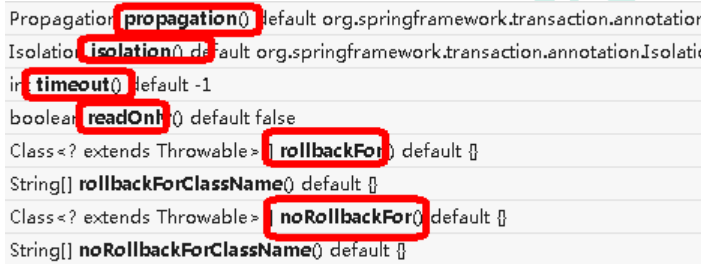
7.4.2.1.6 事务的传播行为(propagation)
多事务方法直接进行调用,这个过程中事务是如何进行管理的,
默认REQUIRED
常用的两种

7.4.2.1.6.1 使用@Transactional配置事务的传播行为

7.4.2.1.7 事务的隔离级别(ioslation)
7.4.2.1.7.1 没有设置事务隔离级别所存在的读问题
-
事务有特性为为隔离性,多事务操作之间不会产生影响,不考虑隔离性会产生很多问题
-
有三个读问题:
-
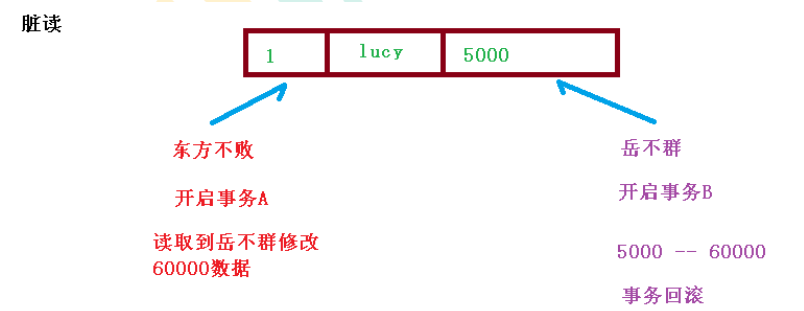
脏读-
一个未提交事务读取到另一个未提交事务的数据
-
-
不可重复读-
一个未提交事务读取到另一个提交事务修改数据

-
-
虚读(幻读)- 一个未提交事务读取到另一个提交事务添加数据
上面的三个读问题只有脏读是最严重的,会影响数据的一致性,剩余的不可重复读与幻读不会影响数据一致性,只是看起来数据来回变化
-
7.4.2.1.7.2 设置事务隔离级别,解决读问题
脏读 不可重复读 幻读 READ UNCOMMITTED(读未提交) 有 有 有 READ COMMITTED(读已提交) 无 有 有 REPEATABLE READ(可重复读) 无 无 有 SERIALIZABLE(串行化) 无 无 无 -
平常开发中尽量不要使用SERIALIZABLE,串行化会使数据库的吞吐性能大幅度下降
-
spring中的默认数据隔离级别为DEFAULT,代表使用数据库默认的事务隔离级别,而mysql默认的事务隔离级别为REPEATABLE READ

7.4.2.1.7.3 使用@Transactional配置事务的隔离级别

7.4.2.1.8 @Transactional中其他参数配置
7.4.2.1.8.1 timeout :超时时间
- 事务需要在一定时间内进行提交,如果不提交则进行回滚
- 默认值为-1代表没有超时时间,设置时间以秒为单位进行计算
7.4.2.1.8.2 readOnly:是否只读
- 读:查询操作;写:添加修改删除操作
- readOnly默认为false,代表可读可写
- 设置readOnly为true后,只能进行读操作
7.4.2.1.8.3 rollbackFor:什么异常回滚
- 设置出现哪些异常进行事务回滚
7.4.2.1.8.3 noRollbackFor:什么异常不回滚
- 设置出现哪些异常不进行事务回滚
7.4.2.2 xml方式 声明式事务管理
前两步与7.4.2.1.1,7.4.2.1.2步骤一致
7.4.2.2.1 配置通知
<tx:advice id="txadvice"> <tx:attributes> <tx:method name="accountMoney" propagation="REQUIRED"/> tx:attributes> tx:advice>- 1
- 2
- 3
- 4
- 5
- 6
- 7
- 8
- 9
可以在配置通知时配置其他参数

7.4.2.2.2 配置切入点与切面
<aop:config> <aop:pointcut id="pt" expression="execution(* com.atguigu.spring5.service.UserService.*(..))"/> <aop:advisor advice-ref="txadvice" pointcut-ref="pt"/> aop:config>- 1
- 2
- 3
- 4
- 5
- 6
- 7
7.4.2.3 完全注解声明式事务管理
7.4.2.3.1 创建配置类,使用配置类代替xml
其中
@EnableTransactionManagement等价于配置文件中的标签<tx:annotation-driven transaction-manager="transactionManager">tx:annotation-driven>- 1
- 2
package com.atguigu.spring5.config; import com.alibaba.druid.pool.DruidDataSource; import org.springframework.context.annotation.Bean; import org.springframework.context.annotation.ComponentScan; import org.springframework.context.annotation.Configuration; import org.springframework.jdbc.core.JdbcTemplate; import org.springframework.jdbc.datasource.DataSourceTransactionManager; import org.springframework.transaction.annotation.EnableTransactionManagement; import javax.sql.DataSource; @Configuration //配置类 @ComponentScan(basePackages = "com.atguigu") //组件扫描 @EnableTransactionManagement //开启事务 public class TxConfig { //创建数据库连接池 @Bean public DruidDataSource getDruidDataSource() { DruidDataSource dataSource = new DruidDataSource(); dataSource.setDriverClassName("com.mysql.jdbc.Driver"); dataSource.setUrl("jdbc:mysql:///user_db"); dataSource.setUsername("root"); dataSource.setPassword("root"); return dataSource; } //创建JdbcTemplate对象 @Bean public JdbcTemplate getJdbcTemplate(DataSource dataSource) { //到ioc容器中根据类型找到dataSource JdbcTemplate jdbcTemplate = new JdbcTemplate(); //注入dataSource jdbcTemplate.setDataSource(dataSource); return jdbcTemplate; } //创建事务管理器 @Bean public DataSourceTransactionManager getDataSourceTransactionManager(DataSource dataSource) { DataSourceTransactionManager transactionManager = new DataSourceTransactionManager(); transactionManager.setDataSource(dataSource); return transactionManager; } }- 1
- 2
- 3
- 4
- 5
- 6
- 7
- 8
- 9
- 10
- 11
- 12
- 13
- 14
- 15
- 16
- 17
- 18
- 19
- 20
- 21
- 22
- 23
- 24
- 25
- 26
- 27
- 28
- 29
- 30
- 31
- 32
- 33
- 34
- 35
- 36
- 37
- 38
- 39
- 40
- 41
- 42
- 43
- 44
- 45
- 46
8. spring5 框架新功能
整个spring5框架代码基于jdk8,运行时兼容jdk9,需对不建议使用的类和方法在代码库中删除
8.1 日志封装
spring5 框架自带了通用的日志封装
- spring5 已经移除看Log4jConfigListener,官方建议使用Log4j2
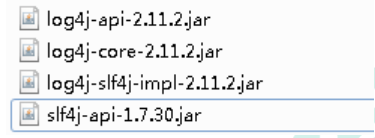
- spring5 框架整合Log4j2
8.1.1 引入依赖
8.1.2 创建log4j2.xml配置文件
调整日志级别以打出不同程度的日志信息
<configuration status="INFO"> <appenders> <console name="Console" target="SYSTEM_OUT"> <PatternLayout pattern="%d{yyyy-MM-dd HH:mm:ss.SSS} [%t] %-5level %logger{36} - %msg%n"/> console> appenders> <loggers> <root level="info"> <appender-ref ref="Console"/> root> loggers> configuration>- 1
- 2
- 3
- 4
- 5
- 6
- 7
- 8
- 9
- 10
- 11
- 12
- 13
- 14
- 15
- 16
- 17
- 18
- 19
- 20

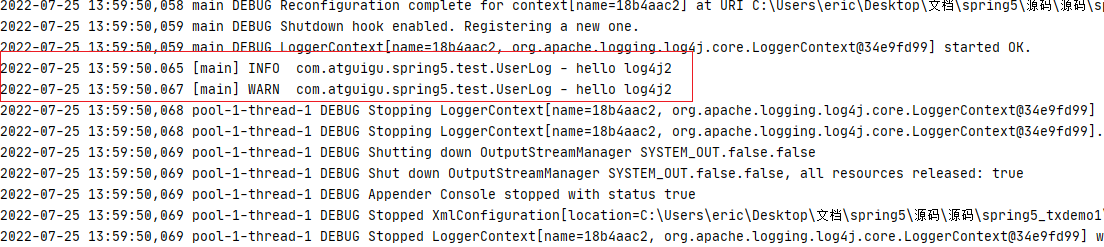
8.1.3 输入用户自定义日志
package com.atguigu.spring5.test; import org.slf4j.Logger; import org.slf4j.LoggerFactory; public class UserLog { private static final Logger log = LoggerFactory.getLogger(UserLog.class); public static void main(String[] args) { log.info("hello log4j2"); log.warn("hello log4j2"); } }- 1
- 2
- 3
- 4
- 5
- 6
- 7
- 8
- 9
- 10
- 11
- 12
- 13
- 14
- 15
- 16
效果
8.2 spring5框架核心容器支持
@Nullable注解- @Nullable 注解可以使用在方法上,表示方法返回可以为空;属性上,表示属性值可以为空;方法参数上,表示参数值可以为空
8.2.1 方法上使用-返回值可以为空

8.2.2 参数上使用-参数可以为空

8.2.3 属性上使用-属性值可以为空

8.3spring5核心容器支持函数是风格GenericApplicationContext
//函数式风格创建对象,交给spring进行管理 @Test public void testGenericApplicationContext() { //1 创建GenericApplicationContext对象 GenericApplicationContext context = new GenericApplicationContext(); //2 调用context的方法对象注册 context.refresh(); context.registerBean("user1",User.class,() -> new User()); //3 获取在spring注册的对象 // User user = (User)context.getBean("com.atguigu.spring5.test.User"); User user = (User)context.getBean("user1"); System.out.println(user); }- 1
- 2
- 3
- 4
- 5
- 6
- 7
- 8
- 9
- 10
- 11
- 12
- 13
8.4 spring5支持整合JUnit5
8.4.1 整合JUnit4
8.4.1.1 引入spring相关针对测试依赖

8.4.1.2 创建测试类,使用注解方式完成
-
@RunWith -
@ContextConfiguration-
加载配置文件
-
@ContextConfiguration("classpath:bean1.xml") //加载配置文件- 1
-
-
加载配置配置类
-
@ContextConfiguration(classes = TxConfig.class) //加载配置类- 1
-
-
package com.atguigu.spring5.test; import com.atguigu.spring5.config.TxConfig; import com.atguigu.spring5.service.UserService; import org.junit.Test; import org.junit.runner.RunWith; import org.springframework.beans.factory.annotation.Autowired; import org.springframework.test.context.ContextConfiguration; import org.springframework.test.context.junit4.SpringJUnit4ClassRunner; @RunWith(SpringJUnit4ClassRunner.class) //单元测试框架 @ContextConfiguration("classpath:bean1.xml") //加载配置文件 //@ContextConfiguration(classes = TxConfig.class) //加载配置类 public class JTest4 { @Autowired private UserService userService; @Test public void test1() { userService.accountMoney(); } }- 1
- 2
- 3
- 4
- 5
- 6
- 7
- 8
- 9
- 10
- 11
- 12
- 13
- 14
- 15
- 16
- 17
- 18
- 19
- 20
- 21
- 22
- 23
- 24
8.4.2 spring5整合JUnit5
8.4.2.1 引入JUnit5依赖

8.4.2.2 创建测试类,使用注解完成
-
@ExtendWith: 替换JUnit4中的@RunWith -
@ContextConfiguration-
加载配置文件
-
@ContextConfiguration("classpath:bean1.xml") //加载配置文件- 1
-
-
加载配置配置类
-
@ContextConfiguration(classes = TxConfig.class) //加载配置类- 1
-
-
-
@SpringJUnitConfig: 使用一个复合注解代替上面两个注解完成整合
package com.atguigu.spring5.test; import com.atguigu.spring5.service.UserService; import org.junit.jupiter.api.DynamicTest; import org.junit.jupiter.api.Test; import org.junit.jupiter.api.extension.ExtendWith; import org.springframework.beans.factory.annotation.Autowired; import org.springframework.test.context.ContextConfiguration; import org.springframework.test.context.junit.jupiter.SpringExtension; import org.springframework.test.context.junit.jupiter.SpringJUnitConfig; import org.springframework.test.context.junit4.SpringJUnit4ClassRunner; @ExtendWith(SpringExtension.class) @ContextConfiguration("classpath:bean1.xml") //@SpringJUnitConfig(locations = "classpath:bean1.xml") public class JTest5 { @Autowired private UserService userService; @Test public void test1() { userService.accountMoney(); } }- 1
- 2
- 3
- 4
- 5
- 6
- 7
- 8
- 9
- 10
- 11
- 12
- 13
- 14
- 15
- 16
- 17
- 18
- 19
- 20
- 21
- 22
- 23
- 24
- 25
- 26
- 27
- 28
- 29
8.5 spring5框架新功能Webflux
8.5.0 解释什么是异步非阻塞
- 异步和同步针对调用者
- 调用者发送请求,如果等待对方回应之后才去做其他事情就是
同步;如果发送请求之后不等待对方回应就去做其他事情就是异步
- 调用者发送请求,如果等待对方回应之后才去做其他事情就是
- 阻塞和非阻塞针对被调用者
- 被调用者收到请求之后,做完请求任务才给出反馈就是
阻塞,收到请求后马上给出反馈然后再去做其他的事情就是非阻塞
- 被调用者收到请求之后,做完请求任务才给出反馈就是

8.5.1 SpringWebflux介绍
-
是Spring5添加新的模块,用于web开发的,功能与SpringMVC类似的,WebFlux使用当前一种比较流行的
响应式编程出现的框架 -
与SpringMVC对比:

- 使用传统web框架,比如SpringMVC,这些基于Servlet容器
- WebFlux 是一种
异步非阻塞的框架,异步非阻塞的框架在Servlet3.1后才支持,核心是基于Reactor的相关API实现的 - SpringMVC采用命令式编程
- Webflux采用异步响应式编程
- 相同点:两个框架都可以使用注解方式,都运行在Tomcat等容器中
-
WebFlux特点:
非阻塞式:在有限资源的情况下,提高系统吞吐量和伸缩性,以Reactor 为基础实现响应式编程函数式编程: Spring5框架基于JDK8,Webflux使用JDK8函数式编程方式实现路由请求
8.5.2 响应式编程(Java实现)
8.5.2.1 什么是响应式编程
响应式编程是一种面向数据流和变化传播的编程范式.这意味着可以在编程语言中方便地表达静态或动态的数据流,而相关的计算模型会自动将变化的值通过数据流进行传播.
解释:
电子表格程序就是响应式编程的一个例子。单元格可以包含字面值或类似"=B1+C1"的公式,而包含公式的单元格的值会依据其他单元格的值的变化而变化。
8.5.2.2 Java8及其之前版本(demo)
实现方法: 提供
观察者模式两个类Observer和Observable原理:在 Java 中可以直接依靠类 Observable 和 接口 Observer实现观察者模式的功能。
- Observable: 开启观察者模式
- Observer:添加观察者
package com.atguigu.demoreactor.reactor8; import java.util.Observable; public class ObserverDemo extends Observable { public static void main(String[] args) { ObserverDemo observer = new ObserverDemo(); //添加观察者 observer.addObserver((o,arg)->{ System.out.println("发生变化"); }); observer.addObserver((o,arg)->{ System.out.println("手动被观察者通知,准备改变"); }); observer.setChanged(); //数据变化 observer.notifyObservers(); //通知 } }- 1
- 2
- 3
- 4
- 5
- 6
- 7
- 8
- 9
- 10
- 11
- 12
- 13
- 14
- 15
- 16
- 17
- 18
- 19
总结:
-
实现的类需要继承Observable类
-
使用addObserver():方法添加观察者
-
setChanged():方法将此Observable对象标记为已更改
-
notifyObservers():如果该对象发生了变化,则通知其所有观察者
测试结果:

8.5.3 响应式编程(Reactor实现)
-
响应式编程操作中,Reactor是满足Reactive规范框架
-
Reactor 有两个核心类

Mono- Mono实现发布者,返回0个或者1个元素
Flux- Flux对象实现发布者,返回N个元素
- 这两个类实现接口Publisher,提供丰富操作符
-
Flux和Mono都是数据流的发布者,使用Flux和Mono都可以发出三种数据信号
元素值- 将返回结果传递给订阅者
完成信号- 完成信号用于告诉订阅者数据流结束了
错误信号- 错误信号终止数据流同时把错误信息传递给订阅者
终止信号- 错误信号与完成信号都代表终止信号
8.5.3.1 代码演示Flux和Mono
- 引入依赖
<dependency> <groupId>io.projectreactorgroupId> <artifactId>reactor-coreartifactId> <version>3.1.5.RELEASEversion> dependency>- 1
- 2
- 3
- 4
- 5
- 测试代码
package com.atguigu.demoreactor.reactor8; import org.springframework.web.server.WebHandler; import reactor.core.publisher.Flux; import reactor.core.publisher.Mono; import java.util.Arrays; import java.util.List; import java.util.stream.Stream; public class TestReactor { public static void main(String[] args) { //just方法直接声明 Flux.just(1,2,3,4).subscribe(System.out::print);//接收1个以上,然后逐个发射。 Mono.just(1).subscribe(System.out::print);//发射单个基础类型数组流,然后发射。 //其他的方法 Integer[] array = {1,2,3,4}; Flux.fromArray(array).subscribe(System.out::print);//接收数组类型数据流,然后发射。 List<Integer> list = Arrays.asList(array); Flux.fromIterable(list).subscribe(System.out::print);//接收迭代器类型的数据流,然后发射。 Stream<Integer> stream = list.stream(); Flux.fromStream(stream).subscribe(System.out::print);//接收流类型的数据流,然后发射。 } }- 1
- 2
- 3
- 4
- 5
- 6
- 7
- 8
- 9
- 10
- 11
- 12
- 13
- 14
- 15
- 16
- 17
- 18
- 19
- 20
- 21
- 22
- 23
- 24
- 25
- 26
- 27
- 28
- 29
- 30
- 31
测试结果

总结:
- just方法:用于装填普通数据
- fromArray方法:接收数组类型数据流,在订阅后发射。
- fromIterable方法:接收迭代器类型的数据流,在订阅后发射。
- fromStream方法: 接收流类型的数据流,在订阅后发射。
- subscribe方法用于接收发射数据
8.5.3.2 三种信号特点
- 错误信号与完成信号都是终止信号,不能共存
- 如果没有发射任何元素值,而是自己发射错误信号或者完成信号,表示空数据流
- 如果没有错误信号,也没有完成信号,表示是无限数据流
8.5.3.3 注意事项
调用just,fromArray或者其他方法只是声明数据流,数据流并没有发出,只有进行订阅之后才会触发数据流,不订阅什么都不会发生
8.5.3.4 操作符
对流数据进行一道道操作,成为操作,比如工厂流水线
8.5.3.4.1 map (元素映射为新元素)
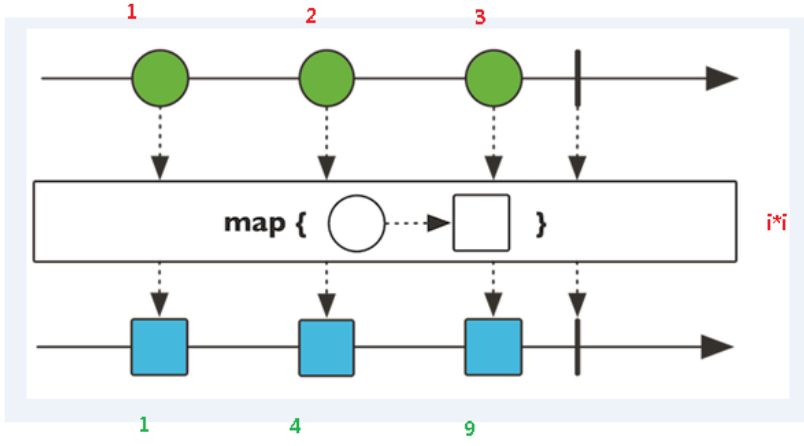
8.5.3.4.2 flatMap (元素映射为流)
把每个元素转换刘,把转换之后多个刘合并大的流

8.5.4 SpringWebFlux执行流程和核心API
SpringWebFlux基于Reactor,默认使用容器时Netty,Netty是高性能NIO框架,异步非阻塞的框架
8.5.4.1 Netty
8.5.4.1.1 BIO 同步阻塞IO

8.5.4.1.2 NIO 同步非阻塞IO 基于Reactor模型来实现

8.5.4.1.3 AIO 异步非阻塞IO,基于Proactor模型实现
8.5.4.2 SpringWebflux执行过程
SpringWebflux执行过程与SpringMVC相似
8.5.4.2.1 WebHandler
SpringWebflux核心控制器DispatchHandler,实现接口WebHandler

DispatchHandler中实现的方法

8.5.4.2.2 DispatchHandler 负责请求的处理
HandlerMapping: 请求查询到处理的方法HandlerAdaptec: 真正负责请求处理HandlerResultHandler: 响应结果处理
8.5.4.2.3 SpringWebflux 实现函数式编程两个接口
基于函数式编程模型实现SpringWebflux会使用到
RouterFunctionHandlerFunction
8.5.5 SpringWebflux (基于注解编程模型)
SpringWebflux实现方式有两种:
注解编程模型和函数式编程模型使用注解编程模型方式和之前SpringMVC使用相似的,只需要把相关依赖配置到项目中SpringBoot自动配置相关运行容器,默认情况下使用Netty服务器
8.5.5.1 创建SpringBoot工程,引入Webflux依赖,并配置启动端口号
创建SpringBoot工程

引入依赖
<dependency> <groupId>org.springframework.bootgroupId> <artifactId>spring-boot-starter-webfluxartifactId> dependency>- 1
- 2
- 3
- 4
配置启动端口号

8.5.5.2 创建包和相关类
结构

实体类User
package com.atguigu.webfluxdemo1.entity; //实体类 public class User { private String name; private String gender; private Integer age; public User(String name, String gender, Integer age) { this.name = name; this.gender = gender; this.age = age; } public void setName(String name) { this.name = name; } public void setGender(String gender) { this.gender = gender; } public void setAge(Integer age) { this.age = age; } public String getName() { return name; } public String getGender() { return gender; } public Integer getAge() { return age; } }- 1
- 2
- 3
- 4
- 5
- 6
- 7
- 8
- 9
- 10
- 11
- 12
- 13
- 14
- 15
- 16
- 17
- 18
- 19
- 20
- 21
- 22
- 23
- 24
- 25
- 26
- 27
- 28
- 29
- 30
- 31
- 32
- 33
- 34
- 35
- 36
- 37
- 38
- 39
创建接口定义操作的方法 UserService
package com.atguigu.webfluxdemo1.service; import com.atguigu.webfluxdemo1.entity.User; import reactor.core.publisher.Flux; import reactor.core.publisher.Mono; //用户操作接口 public interface UserService { //根据id查询用户 Mono<User> getUserById(int id); //查询所有用户 Flux<User> getAllUser(); //添加用户 Mono<Void> saveUserInfo(Mono<User> user); }- 1
- 2
- 3
- 4
- 5
- 6
- 7
- 8
- 9
- 10
- 11
- 12
- 13
- 14
- 15
- 16
- 17
接口实现类 UserServiceImpl
package com.atguigu.webfluxdemo1.service.impl; import com.atguigu.webfluxdemo1.entity.User; import com.atguigu.webfluxdemo1.service.UserService; import org.springframework.stereotype.Repository; import org.springframework.web.bind.annotation.ResponseBody; import reactor.core.publisher.Flux; import reactor.core.publisher.Mono; import java.util.HashMap; import java.util.Map; @Repository public class UserServiceImpl implements UserService { //创建map集合存储数据 private final Map<Integer,User> users = new HashMap<>(); public UserServiceImpl() { this.users.put(1,new User("lucy","nan",20)); this.users.put(2,new User("mary","nv",30)); this.users.put(3,new User("jack","nv",50)); } //根据id查询 @Override public Mono<User> getUserById(int id) { return Mono.justOrEmpty(this.users.get(id)); } //查询多个用户 @Override public Flux<User> getAllUser() { return Flux.fromIterable(this.users.values()); } //添加用户 @Override public Mono<Void> saveUserInfo(Mono<User> userMono) { return userMono.doOnNext(person -> { //向map集合里面放值 int id = users.size()+1; users.put(id,person); }).thenEmpty(Mono.empty()); } }- 1
- 2
- 3
- 4
- 5
- 6
- 7
- 8
- 9
- 10
- 11
- 12
- 13
- 14
- 15
- 16
- 17
- 18
- 19
- 20
- 21
- 22
- 23
- 24
- 25
- 26
- 27
- 28
- 29
- 30
- 31
- 32
- 33
- 34
- 35
- 36
- 37
- 38
- 39
- 40
- 41
- 42
- 43
- 44
- 45
- 46
创建controller UserController
package com.atguigu.webfluxdemo1.controller; import com.atguigu.webfluxdemo1.entity.User; import com.atguigu.webfluxdemo1.service.UserService; import org.springframework.beans.factory.annotation.Autowired; import org.springframework.web.bind.annotation.*; import reactor.core.publisher.Flux; import reactor.core.publisher.Mono; @RestController public class UserController { //注入service @Autowired private UserService userService; //id查询 @GetMapping("/user/{id}") public Mono<User> geetUserId(@PathVariable int id) { return userService.getUserById(id); } //查询所有 @GetMapping("/user") public Flux<User> getUsers() { return userService.getAllUser(); } //添加 @PostMapping("/saveuser") public Mono<Void> saveUser(@RequestBody User user) { Mono<User> userMono = Mono.just(user); return userService.saveUserInfo(userMono); } }- 1
- 2
- 3
- 4
- 5
- 6
- 7
- 8
- 9
- 10
- 11
- 12
- 13
- 14
- 15
- 16
- 17
- 18
- 19
- 20
- 21
- 22
- 23
- 24
- 25
- 26
- 27
- 28
- 29
- 30
- 31
- 32
- 33
- 34
- 35
8.5.5.3 接口测试
-

-

-
http://localhost:8081/saveuser
应为浏览器只能发生get请求,所有我们使用postman测试
{"name":"lucy","gender":"nan","age":20}- 1
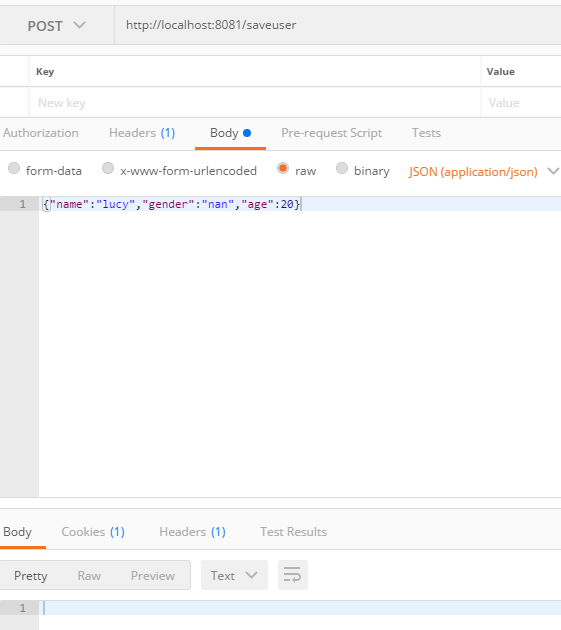
再次查询所有,发现有两个lucy了
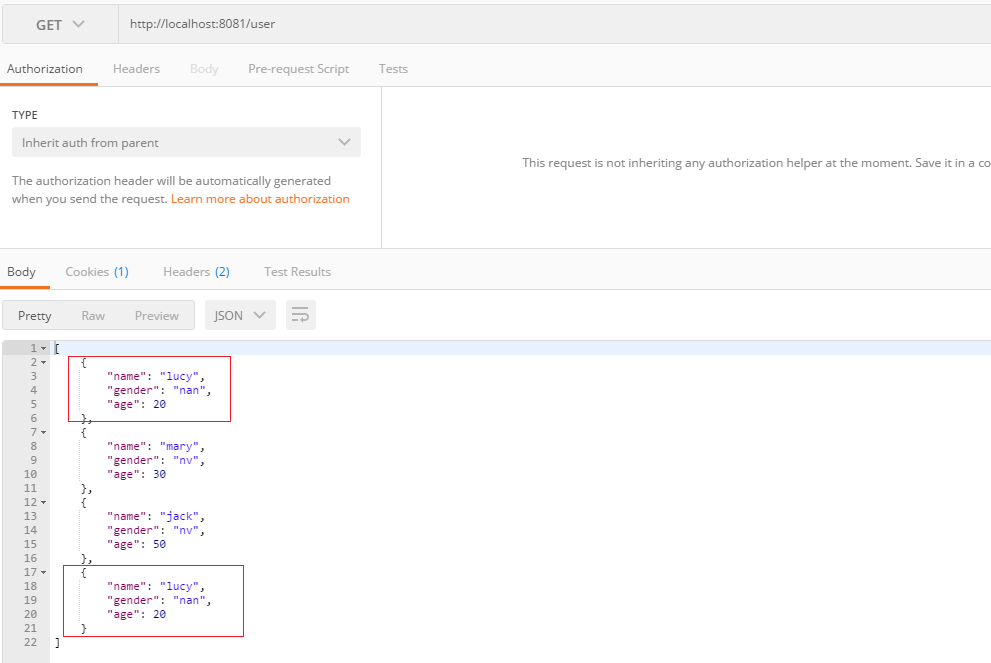
8.5.5.4 SpringMVC与SpringWebflux 说明(不同)
- SpringMVC方式实现,同步阻塞的方式,基于SpringMVC+Servlet+Tomcat
- SpringWebflux方式实现,异步非阻塞方式,基于SpringWebflux+Reactor+Netty
8.5.6 SpringWebflux (基于函数式编程模型)
注意:
- 在使用函数式编程模型操作时候,需要自己初始化服务器
- 基于函数式编程模型时候,有两个核心接口:核心任务定义两个函数式接口的实现并且启动需要的服务器。
RouterFunction(实现路由功能,请求转发给对应的 handler)HandlerFunction(处理请求生成响应的函数)。
- SpringWebflux请求和响应不再是 ServletRequest 和 ServletResponse,而是ServerRequest和 ServerResponse
8.5.6.1 构建工程
复制8.5.5中的项目新建项目,干掉controller,如果没有做8.5.5参照如下结构
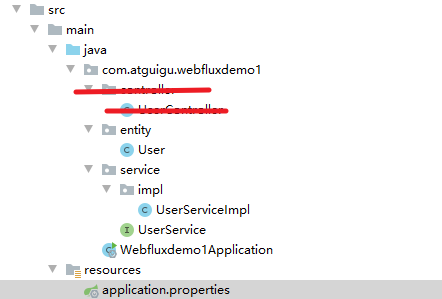
完整结构

8.5.6.2 创建Handler(具体实现方法)
package com.atguigu.webfluxdemo1.handler; import com.atguigu.webfluxdemo1.entity.User; import com.atguigu.webfluxdemo1.service.UserService; import org.springframework.http.MediaType; import org.springframework.web.reactive.function.server.ServerRequest; import org.springframework.web.reactive.function.server.ServerResponse; import reactor.core.publisher.Flux; import reactor.core.publisher.Mono; import static org.springframework.web.reactive.function.BodyInserters.fromObject; public class UserHandler { private final UserService userService; public UserHandler(UserService userService) { this.userService = userService; } //根据id查询 public Mono<ServerResponse> getUserById(ServerRequest request) { //获取id值 int userId = Integer.valueOf(request.pathVariable("id")); //空值处理 Mono<ServerResponse> notFound = ServerResponse.notFound().build(); //调用service方法得到数据 Mono<User> userMono = this.userService.getUserById(userId); //把userMono进行转换返回 //使用Reactor操作符flatMap return userMono .flatMap(person -> ServerResponse.ok().contentType(MediaType.APPLICATION_JSON) .body(fromObject(person))) .switchIfEmpty(notFound); } //查询所有 public Mono<ServerResponse> getAllUsers(ServerRequest request) { //调用service得到结果 Flux<User> users = this.userService.getAllUser(); return ServerResponse.ok().contentType(MediaType.APPLICATION_JSON).body(users,User.class); } //添加 public Mono<ServerResponse> saveUser(ServerRequest request) { //得到user对象 Mono<User> userMono = request.bodyToMono(User.class); return ServerResponse.ok().build(this.userService.saveUserInfo(userMono)); } }- 1
- 2
- 3
- 4
- 5
- 6
- 7
- 8
- 9
- 10
- 11
- 12
- 13
- 14
- 15
- 16
- 17
- 18
- 19
- 20
- 21
- 22
- 23
- 24
- 25
- 26
- 27
- 28
- 29
- 30
- 31
- 32
- 33
- 34
- 35
- 36
- 37
- 38
- 39
- 40
- 41
- 42
- 43
- 44
- 45
- 46
- 47
- 48
- 49
- 50
- 51
- 52
8.5.6.3 初始化服务器,编写Router
server
package com.atguigu.webfluxdemo1; import com.atguigu.webfluxdemo1.handler.UserHandler; import com.atguigu.webfluxdemo1.service.UserService; import com.atguigu.webfluxdemo1.service.impl.UserServiceImpl; import org.springframework.http.server.reactive.HttpHandler; import org.springframework.http.server.reactive.ReactorHttpHandlerAdapter; import org.springframework.web.reactive.function.server.RouterFunction; import org.springframework.web.reactive.function.server.RouterFunctionDsl; import org.springframework.web.reactive.function.server.RouterFunctions; import org.springframework.web.reactive.function.server.ServerResponse; import reactor.netty.http.server.HttpServer; import static org.springframework.http.MediaType.APPLICATION_JSON; import static org.springframework.web.reactive.function.server.RequestPredicates.GET; import static org.springframework.web.reactive.function.server.RequestPredicates.accept; import static org.springframework.web.reactive.function.server.RouterFunctions.toHttpHandler; public class Server { //3 最终调用 public static void main(String[] args) throws Exception{ Server server = new Server(); server.createReactorServer(); System.out.println("enter to exit"); System.in.read(); } //1 创建Router路由 public RouterFunction<ServerResponse> routingFunction() { //创建hanler对象 UserService userService = new UserServiceImpl(); UserHandler handler = new UserHandler(userService); //设置路由 return RouterFunctions.route( GET("/users/{id}").and(accept(APPLICATION_JSON)),handler::getUserById) .andRoute(GET("/users").and(accept(APPLICATION_JSON)),handler::getAllUsers); } //2 创建服务器完成适配 public void createReactorServer() { //路由和handler适配 RouterFunction<ServerResponse> route = routingFunction(); HttpHandler httpHandler = toHttpHandler(route); ReactorHttpHandlerAdapter adapter = new ReactorHttpHandlerAdapter(httpHandler); //创建服务器 HttpServer httpServer = HttpServer.create(); httpServer.handle(adapter).bindNow(); } }- 1
- 2
- 3
- 4
- 5
- 6
- 7
- 8
- 9
- 10
- 11
- 12
- 13
- 14
- 15
- 16
- 17
- 18
- 19
- 20
- 21
- 22
- 23
- 24
- 25
- 26
- 27
- 28
- 29
- 30
- 31
- 32
- 33
- 34
- 35
- 36
- 37
- 38
- 39
- 40
- 41
- 42
- 43
- 44
- 45
- 46
- 47
- 48
- 49
8.5.6.4 调用测试
启动项目查看端口28778
注意:每次启动端口都会不一样

访问http://localhost:28778/users

访问http://localhost:28778/users/1

8.5.6.5 使用客户端调用测试
client
注意:
- 需要先启动server,在启动client
- client中的调用服务器地址中端口需要与server启动后的端口一致
package com.atguigu.webfluxdemo1; import com.atguigu.webfluxdemo1.entity.User; import org.springframework.http.MediaType; import org.springframework.web.reactive.function.client.WebClient; import reactor.core.publisher.Flux; public class Client { public static void main(String[] args) { //调用服务器地址 WebClient webClient = WebClient.create("http://127.0.0.1:28778"); //根据id查询 String id = "1"; User userresult = webClient.get().uri("/users/{id}", id) .accept(MediaType.APPLICATION_JSON).retrieve().bodyToMono(User.class) .block(); System.out.println(userresult.getName()); //查询所有 Flux<User> results = webClient.get().uri("/users") .accept(MediaType.APPLICATION_JSON).retrieve().bodyToFlux(User.class); results.map(stu -> stu.getName()) .buffer().doOnNext(System.out::println).blockFirst(); } }- 1
- 2
- 3
- 4
- 5
- 6
- 7
- 8
- 9
- 10
- 11
- 12
- 13
- 14
- 15
- 16
- 17
- 18
- 19
- 20
- 21
- 22
- 23
- 24
- 25
- 26
- 27
- 28
测试结果

9. 总结
9.1 Spring框架概述
- 轻量级开源JavaEE框架,为了解决企业复杂性,两个核心组成:IOC 和AOP
- Spring5.2.6版本
9.2 IOC容器
- IOC底层原理(xml解析、工厂、反射等)
- IOC接口((BeanFactory)
- IOC操作 Bean管理(基于xml)
- IOC操作Bean管理(基于注解)
9.3 AOP
- AOP底层原理:动态代理,有接口(JDK动态代理),没有接口(CGLIB动态代理)
- 术语:切入点、增强(通知)、切面
- 基于Aspect]实现AOP操作
9.4 JdbcTemplate
- 使用JdbcTemplate实现数据库curd操作
- 使用JdbcTemplate实现数据库批量操作
9.5 事务管理
- 事务概念
- 重要概念(传播行为和隔离级别)
- 基于注解实现声明式事务管理
- 完全注解方式实现声明式事务管理
9.6 Spring5新功能
- 整合日志框架
- @Nullable注解
- 函数式注册对象
- 整合JUnit5单元测试框架
- SpringWebflux使用
-
相关阅读:
树莓派(七)文件系统及其目录结构、虚拟文件系统
ESP32-S3上手开发
【校招VIP】前端项目表达之正则表达
Java异常try{}catch{}中的return机制
ubuntu下ftp搭建
信息安全:网络物理隔离技术原理与应用.
【云原生之kubernetes实战】在k8s集群下部署portainer-k8s平台
unity 遮挡剔除的实现
支付宝小程序唤起签约并支付(周期扣款)
exe文件运行一半消失
- 原文地址:https://blog.csdn.net/qq_31745863/article/details/125991950